


You know the feeling. You need to scale your tech or operations team, local recruiting has become a dead end, and your project deadlines are creeping up fast. Nearshoring seems like the perfect escape route, promising great talent in your exact timezone without the standard offshore headaches.
But then reality hits. Your internal screening drags on, scheduling across teams becomes a nightmare, and that "fast" hiring pipeline starts to feel like a slow crawl. You aren't alone in this frustration. According to a 2025 global recruitment report by LinkedIn, the average professional time to hire has stretched to roughly 36 days, leaving many growing businesses stuck in a costly holding pattern.
When top-tier candidates are only on the market for a fraction of that time, a bloated pipeline means you are actively losing the best talent to quicker competitors.
This guide is your blueprint to fix that. We are going to break down your current nearshore recruitment timeline, expose the silent bottlenecks killing your speed, and give you actionable tactics to cut your time to hire straight in half. Let’s get your pipeline moving.
Deconstructing the Standard Nearshore Hiring Timeline
Defining the Typical Nearshore Time-to-Hire Baseline:
When building a cross-border team, you need a realistic understanding of how long it actually takes to get a person in a seat. Many business leaders jump into the regional market expecting a lightning-fast turnaround simply because the geographic distance is small. In reality, the baseline across popular engineering hubs requires a deliberate, multi-week progression.
According to a 2026 domestic versus nearshore talent report by Nearshore Business Solutions, traditional unassisted hiring pipelines for specialized talent across Latin America average 16 to 28 days to fully complete. This window stretches from the initial sourcing phase to the finalized offer acceptance. Knowing this number helps you avoid setting unrealistic project deadlines with your internal stakeholders.
The Costly Hidden Bottlenecks in Traditional Latin American Sourcing:
If your current talent pipeline feels slow, the delay is usually caused by invisible structural friction inside your internal review process. Sifting through hundreds of incoming applications manually creates an immediate drag on your scheduling momentum.
According to a 2025 global recruitment analysis by LinkedIn, the average professional time to hire across general market sectors has bloated to roughly 36 days. When you combine this general market slowness with the complexities of verifying language fluency and localized tech stacks across different countries, a standard internal HR team can easily find themselves stuck in a multi-week administrative backlog.
The biggest bottleneck occurs when resumes sit waiting for hiring manager reviews, followed closely by multi-stage scheduling conflicts across separate time zones.
Why Timezone Alignment Shouldn't Mean a Slower Vetting Process:
The primary reason you pursue a regional strategy is real-time collaboration. Having team members operate within zero to three hours of your home timezone transforms your daily sprint velocity. However, too many companies treat this geographic proximity as an excuse to stretch out their interview stages. They assume that because a candidate is close, scheduling a third or fourth conversation will be effortless.
According to technical workplace data published by McKinsey & Company, organizations maintaining a minimum of six hours of daily operational overlap with their remote teams complete projects up to 23% faster on average. You should use this operational timezone advantage to accelerate your communication during the interview loop, rather than letting it lull your screening process into a relaxed, slow-moving cadence. Mirroring the speed of your future daily workflows right during the vetting process keeps high-caliber candidates engaged from day one.
Audit Your Pipeline to Reduce Time to Hire
Identifying Internal Friction Points in Your Current Screening Process:
You cannot fix a slow nearshore hiring timeline without looking at your own internal data first. Friction usually hides in places you least expect, like an overly complex applicant tracking system or a mandatory take-home test that candidates silently drop out of. Tracking your pass-through rates between interview stages reveals exactly where your pipeline stalls.
According to global workplace data collected by the Society for Human Resource Management (SHRM), companies that actively conduct recruitment pipeline audits reduce their overall time to hire by an average of 18%. Look closely at the gap between your first resume review and the initial screening call. If that step takes longer than 48 hours, you are losing momentum before the candidate even enters your system.
Streamlining Stakeholder Alignment to Prevent Candidate Drop-Off:
When too many people have a say in a hiring decision, timelines explode. A common mistake is requiring unanimous agreement from a massive panel of internal stakeholders before making an offer. This creates scheduling nightmares across calendars and drags out the decision-making process for weeks.
According to a 2025 talent acquisition benchmark study by the Josh Bersin Company, every additional interview stage beyond three rounds reduces the likelihood of a candidate accepting an offer by roughly 20%. To keep top talent interested, you need to establish clear, upfront scorecards. Define exactly who owns the final decision, what specific technical skills matter most, and what cultural elements are non-negotiable before you ever review a single resume.
Accelerating Early-Stage Candidate Engagement:
Top nearshore professionals do not stay unemployed or open to new roles for very long. If your internal review steps move like molasses, competing teams will scoop up the best talent right from under you. You need a fast, responsive communication loop from the very first touchpoint to show candidates you value their time.
According to a 2025 global recruitment report by LinkedIn, the average professional time to hire sits at 36 days, which creates an incredibly high risk of losing elite candidates to faster companies if your early-stage responses take days instead of hours. Sending a quick, automated text update or a personalized calendar link for interview self-scheduling instantly differentiates your company from slow-moving competitors.
Action Plan To Reduce Your Nearshore Hiring Timeline
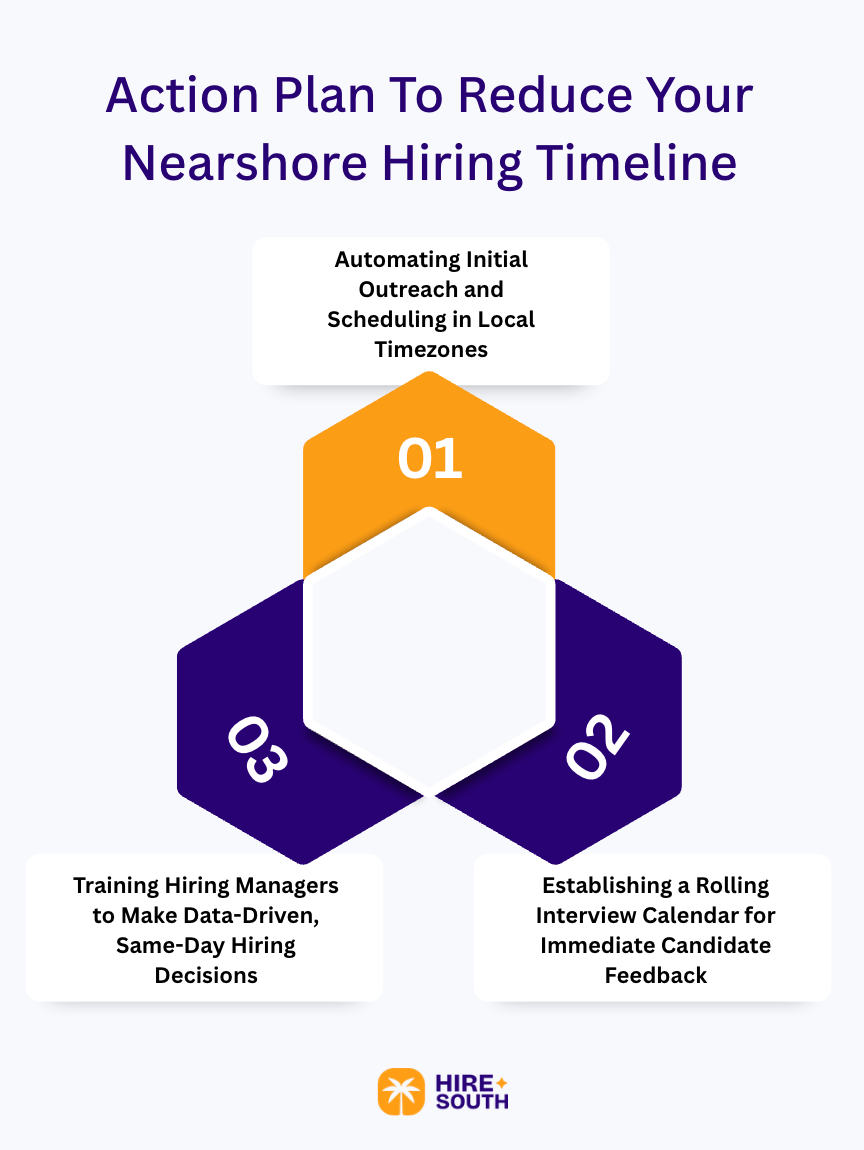
1. Automating Initial Outreach and Scheduling in Local Timezones
You can no longer rely on manual back-and-forth emails to lock in interview slots with talent in Latin America or Europe. The moment a qualified nearshore candidate submits an application, the clock starts ticking. If your team takes days to coordinate a basic introductory chat, the candidate will likely lose interest.
According to recruitment automation data published by the Society for Human Resource Management (SHRM), companies leveraging automated sourcing workflows and real-time scheduling tools cut their overall time to hire by up to 50%.
To achieve this speed, you should integrate calendar syncing software directly into your initial touchpoints. When a candidate meets your baseline criteria, the system should instantly text or email them a self-scheduling link tailored to their specific local timezone. This small adjustment removes days of administrative drag and keeps your pipeline moving over weekends and evenings without human intervention.
2. Establishing a Rolling Interview Calendar for Immediate Candidate Feedback
Leaving candidates in a state of limbo while you complete a two-week interview cycle with other applicants is a guaranteed way to spike your drop-off rates. Elite nearshore professionals often navigate multiple active offers simultaneously. To keep them engaged, you need to compress your internal feedback windows and structure your interview loops sequentially rather than in isolation.
According to global talent acquisition data from a 2025 LinkedIn report, candidate drop-off risks increase drastically when communication stalls, making structured transparency around your timeline a core competitive advantage for modern businesses.
Instead of ad-hoc scheduling, you should require your engineering or operations teams to block out dedicated, recurring weekly windows on their calendars specifically for nearshore interviews. This rolling framework ensures that a candidate can move from an initial screen to a technical deep dive within 48 hours, with feedback delivered on a strict, same-day basis.
3. Training Hiring Managers to Make Data-Driven, Same-Day Hiring Decisions
The final hurdle in any nearshore recruitment timeline is the ultimate decision-making process. Bottlenecks frequently occur when hiring managers hesitate, waiting to see "just a few more candidates" before extending an official offer. This hesitation stems from a lack of objective evaluation criteria, forcing leaders to rely on gut feelings rather than concrete metrics.
According to insights from the Josh Bersin Company, over 60% of job seekers abandon application processes solely due to slow, clunky corporate hiring portals and delayed feedback mechanisms.
To fix this, you must arm your hiring managers with standardized skills scorecards before the interview process even begins. By grading candidates on specific, pre-determined technical competencies and behavioral markers rather than subjective impressions, your team can confidently make data-backed, same-day decisions. Eliminating post-interview debate allows you to deliver a formal offer within hours of the final evaluation, successfully closing top talent before your competitors can even schedule a follow-up.
Ready to Hire LATAM Talent?
Accelerating your nearshore recruitment timeline isn't just about filling open seats faster, it is about capturing a measurable competitive advantage before your market rivals do. When top-tier international professionals stay on the market for only a matter of days, every single administrative delay or extended feedback loop directly costs your business elite talent.
At Hire South, we engineer our entire staffing process to eliminate these costly operational bottlenecks from day one. Our extensive, pre-vetted network of bilingual professionals across Latin America allows us to bypass the slow, manual sourcing stages that typically drag your pipeline down. Instead of waiting weeks to find the right cultural and technical fit, we deliver a curated shortlist of top-tier candidates directly to your team within the first two weeks.
We actively manage all localized compliance, payroll, and benefits administration, allowing you to seamlessly integrate dedicated team members into your exact timezone while cutting traditional staffing costs by up to 40%. Ready to cut your time to hire in half without sacrificing quality? Contact us today to schedule your discovery call and accelerate your team's growth.