
.jpg)

Looking to add remote team members in Argentina? You’re tapping into one of Latin America’s fastest-growing pools of professionals. In fact, a recent report ranked Argentina as the third most attractive country globally for remote talent, putting it ahead of Brazil and Colombia, according to Bloomberg Brasil.
This guide walks you through everything you need to know, from understanding Argentina’s talent landscape and typical roles in demand, to navigating legal and cost considerations, to sourcing, interviewing, onboarding, and retaining remote staff. You’ll see which skills are abundant, what to expect in terms of compensation, and how to structure contracts or use third-party services when needed.
Whether you’re hiring engineers, marketers, support staff, or creative professionals, you’ll get a clear roadmap for building an efficient, compliant, and scalable remote team in Argentina. Let’s get started.
Why Hire Remote Talent in Argentina
1. Argentina Offers a Deep Pool of Skilled Professionals
Argentina has one of the most educated workforces in Latin America. The country’s National Institute of Statistics reports that over 36 percent of adults hold a postsecondary degree, a rate significantly higher than many neighboring markets. You get access to engineers, designers, finance talent, analysts, and marketers who have strong academic foundations and hands-on experience in global teams.
This depth becomes especially valuable when you need consistent performance without long training cycles. Many Argentine professionals already operate in distributed environments, which reduces friction during onboarding and early delivery.
2. English Proficiency Supports Smooth Collaboration
Argentina consistently ranks as one of the strongest English-speaking countries in the region. EF’s English Proficiency Index placed Argentina in the top 30 worldwide and number one in Latin America. That means you can run meetings, delegate tasks, and share documentation without losing time to translation or communication gaps.
Clear communication also reduces operational risk when you scale cross-border teams. You avoid misunderstandings that often lead to rework or quality issues.
3. Time Zone Alignment Improves Productivity
Argentina’s time zone overlaps almost completely with the US East Coast and remains workable for Pacific teams. This alignment allows real-time collaboration, faster feedback loops, and easier handoffs. You can run standups, check-ins, and client-facing meetings without the delays common with offshore teams.
For agile environments, this makes a measurable difference. Teams stay synchronized, and you avoid the overnight bottlenecks that slow product cycles.
4. Competitive Compensation Lowers Hiring Costs Without Sacrificing Quality
Hiring remote talent in Argentina often costs significantly less than hiring US-based employees. According to the World Bank and regional salary benchmarks, skilled roles in Argentina typically average 40 to 60 percent lower than equivalent positions in the United States.
Lower costs don’t mean lower skill levels. Because Argentina has a strong education system and a large freelance and remote workforce, you often get high-caliber professionals at a sustainable long-term rate.
5. A Mature Remote Work Culture Reduces Ramp-Up Time
Argentina was an early adopter of remote work. The National Directorate of Public Employment reported that nearly 27 percent of the country’s workforce engaged in remote or hybrid work arrangements by 2023. This makes remote operations familiar rather than disruptive.
Professionals in Argentina typically have experience with productivity tools, asynchronous workflows, and virtual communication norms. You spend less time teaching processes and more time focusing on delivery.
6. Strong Cultural Compatibility With US and European Companies
Argentina’s business culture blends formality with flexibility, making it easy to integrate teams across borders. You benefit from shared values around accountability, direct communication, and team-oriented work.
This alignment helps reduce friction during projects and makes it easier to maintain long-term working relationships. Teams ramp faster, collaborate more naturally, and typically show higher engagement in cross-border environments.
Argentina’s Talent Landscape
Broad Educational Base with Rising Higher-Ed Attainment.
Argentina has a sizable pool of educated professionals entering the workforce each year. According to the OECD, about 19 percent of Argentines aged 25 to 34 hold a tertiary qualification. This signals a steady supply of young professionals equipped for modern remote roles across business, technical, and creative fields.
Higher education also delivers strong economic returns. Full-time workers with tertiary degrees earn 63 percent more than those with only upper-secondary education, according to the OECD. That premium often reflects stronger analytical skills, language proficiency, and professional training in globally relevant areas.
Diverse Skill Sets Across STEM, Business, and Creative Fields.
Argentina produces a broad mix of graduates, which expands your options when recruiting remotely. According to the OECD, 16 percent of bachelor-level graduates come from STEM fields, 20 percent from business, administration, or law, and 23 percent from social sciences, arts, journalism, and related disciplines.
This diversified talent output supports a wide range of roles you may be hiring for, from engineering and analytics to marketing, operations, design, and content. The variety also helps when building multi-functional remote teams that need both specialists and adaptable generalists.
High Labor-Force Participation Among Educated Workers.
Argentina’s educated population tends to stay active in the workforce, which increases the availability of talent for remote roles. According to IndexMundi labor-force participation data, more than 80 percent of working-age males with advanced education are actively engaged in the labor market.
Strong labor-force engagement among educated workers suggests that many candidates are not only qualified but also accustomed to modern work structures and eager for global opportunities.
A Workforce Already Familiar With Remote and Digital Workflows.
Argentina’s remote-work adoption has grown steadily. Before remote work became mainstream globally, studies already identified strong remote-work potential in sectors like IT, communications, trade, and professional services. According to a research review published on PMC, these fields showed some of the highest adaptability to remote environments across the country.
This early exposure to distributed workflows means a large share of Argentine professionals already understand virtual communication norms, project-management tools, and cross-border collaboration. As a result, you reduce ramp-up time compared with regions where remote work is still emerging.
Strong Talent Concentration in Urban Hubs With Solid Infrastructure.
Major cities such as Buenos Aires, Córdoba, Rosario, and Mendoza serve as the country’s primary talent clusters. According to regional workforce analyses, these hubs concentrate universities, tech ecosystems, and reliable connectivity, making them ideal locations for sourcing remote-ready professionals.
Buenos Aires in particular stands out for its density of tech companies, coworking spaces, and bilingual professionals. Talent from these urban centers typically has experience working with international teams and can transition to remote roles with minimal friction.
Established Mid- to Senior-Level Talent for Specialized Roles.
Argentina’s talent pipeline includes a significant number of experienced professionals in fields like software development, UX/UI design, digital marketing, finance, and data science. According to multiple labor-market studies, senior specialists remain a notable strength in the Argentine workforce thanks to decades of investment in public universities and technical training institutions.
This availability of mid-career professionals is especially useful when you need people who can operate with autonomy, manage complex tasks, or lead small distributed teams without heavy supervision.
Main Options To Hire Remote Talent in Argentina
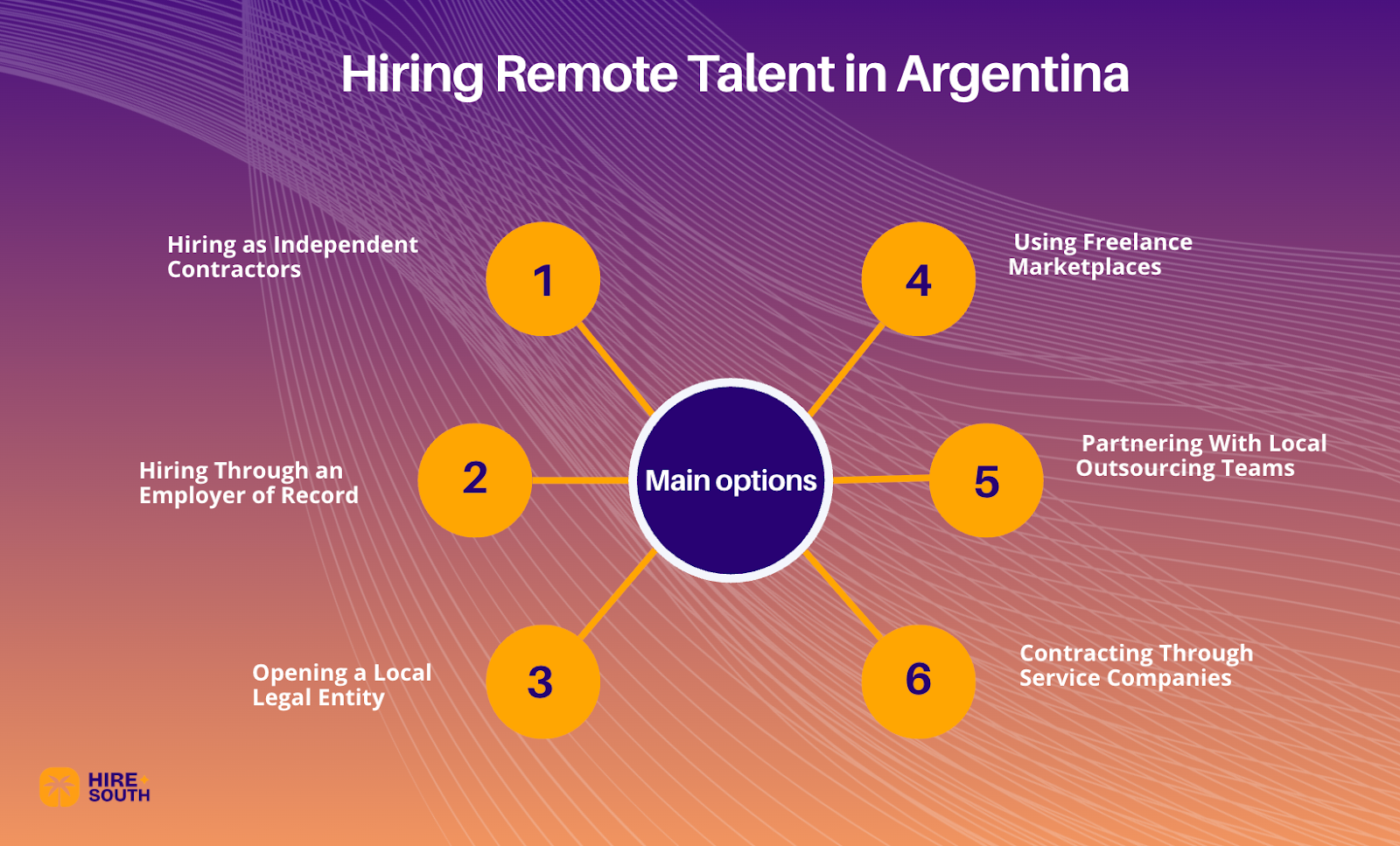
1. Hiring as Independent Contractors
One of the most common ways to work with professionals in Argentina is through independent contractor agreements. This setup is flexible and simple to manage if you only need project-based work or part-time support. Argentina has a large freelancer population, and according to the Ministry of Labor, more than 22 percent of service-sector workers engage in some form of independent or freelance work.
You only need a contract defining scope, deliverables, payment terms, and intellectual property. However, you should avoid exerting employer-like control. Misclassification risks exist in every country, and Argentina is no exception, so it helps to structure the arrangement around autonomy and project-based outputs.
2. Hiring Through an Employer of Record (EOR)
An Employer of Record (EOR) legally employs the worker in Argentina on your behalf while you manage day-to-day tasks. This option helps you avoid creating a local legal entity while maintaining full compliance with Argentine labor laws. It’s widely used for remote expansion because local employment regulations include mandatory benefits, severance rules, and social-security contributions. According to Argentina’s Ministry of Labor, mandatory employer contributions can reach 26 to 28 percent of an employee’s salary depending on the category.
With an EOR, you outsource those administrative obligations while keeping operational control. This structure works well when you need long-term, full-time team members inside the regulatory framework.
3. Opening a Local Legal Entity
You can also establish your own company in Argentina to hire employees directly. This option gives you maximum control but requires upfront legal, accounting, and compliance work. Creating a local entity means managing labor contracts, payroll taxes, social-security contributions, and terminations within Argentina’s regulatory system.
It’s most appropriate when you plan to build a larger presence or hire multiple people long-term. According to the World Bank’s enterprise data, the process of registering a company in Argentina typically takes around 11 days, which is faster than the regional average. Even so, running the entity requires ongoing oversight and local expertise.
4. Using Freelance Marketplaces
Freelance platforms offer quick access to Argentine talent across tech, design, marketing, and customer support. Argentina consistently ranks among the top Latin American talent sources on major global platforms due to its English proficiency and strong professional training.
Marketplaces work best for short-term tasks, trial projects, or small workloads. They are not ideal for full-time talent because they lack employment protections, structured onboarding, and long-term stability.
5. Partnering With Local Outsourcing Teams
Some companies hire remote talent through Argentine outsourcing firms that provide dedicated professionals. These providers legally employ the worker and manage local compliance while assigning talent to your projects. It’s similar to staff augmentation but rooted entirely within Argentina’s regulatory framework.
This model makes sense when you want a managed team, specialized skills, or multi-person support without juggling multiple local contracts. You maintain flexibility but still operate within the country’s legal employment structures.
6. Contracting Through Service Companies
Many Argentine professionals operate as registered service providers through the Monotributo tax system. This framework simplifies tax obligations for self-employed individuals and micro-entrepreneurs. Because Monotributo covers both taxes and social security in a single monthly payment, it’s popular among remote professionals. According to Argentina’s Federal Administration of Public Revenue, millions of workers are registered under this regime, making it one of the country’s largest tax categories.
For you, contracting a Monotributo provider is clean and straightforward. You sign a service agreement, pay invoices, and ensure the contractor remains fully independent.
How To Hire Remote Talent in Argentina Step By Step-by-Step
1. Define the Role, Scope, and Workload
Start by shaping a clear role profile. Identify the responsibilities, required skills, expected outcomes, and the time commitment. Argentina offers strong capabilities across tech, operations, design, marketing, finance, and customer support, so a well-defined role helps you filter quickly.
You also reduce the risk of misalignment later. A simple scope document outlining deliverables, tools, and reporting structure will make the rest of the hiring process much smoother.
2. Choose the Right Hiring Model
Before posting the job, decide how you want to engage talent. Argentina supports hiring through contractors, Employer of Record (EOR) arrangements, local entities, and service-provider models such as Monotributo.
Each model comes with different compliance and cost considerations. For example, mandatory employer contributions can reach 26 to 28 percent of salary, according to Argentina’s Ministry of Labor. Knowing this upfront helps you budget accurately.
3. Prepare Compensation Benchmarks
Build a salary or rate range before reviewing applicants. Argentina’s compensation levels are significantly lower than US averages, often 40 to 60 percent below equivalent US roles, according to regional wage analyses.
Factor in skill scarcity, seniority, bilingual requirements, and the hiring model. Transparent compensation bands also speed up negotiations and reduce dropped candidates.
4. Publish the Job in the Right Channels
Argentina’s talent market is active across global remote-work platforms, local job boards, and professional networks. Target experienced candidates by focusing on platforms used heavily in Argentina’s tech and service sectors.
Clear, localized job descriptions perform better. Highlight the role, growth opportunities, working hours, and tools used. Keep the language simple and avoid jargon that may confuse multilingual applicants.
5. Screen Applications and Shortlist Candidates
Review portfolios, work samples, and experience with distributed teams. Argentina has strong English proficiency, ranked first in Latin America, according to EF’s English Proficiency Index, so evaluate communication skills early.
Shortlisting typically involves assessing technical competence, remote-work readiness, and the ability to operate with autonomy. Prior experience in international teams is often a strong predictor of success.
6. Run Structured Interviews
Use structured interviews to compare candidates objectively. Combine technical assessments with behavioral questions to understand how someone solves problems, communicates, and handles deadlines.
Argentina’s workforce is known for strong analytical and interpersonal skills, so give candidates space to walk through their decision-making process. Simulated tasks or paid trial assignments also work well for remote roles.
7. Verify References and Work History
Conduct reference checks to confirm reliability, technical accuracy, and communication style. Remote work requires self-management, so prioritize feedback about independence and consistency.
Be factual and straightforward when contacting references. A short list of questions about performance, collaboration, and punctuality usually gives you enough clarity.
8. Select the Hiring Structure and Draft Agreements
Once you choose your candidate, finalize the legal engagement method. Contractor agreements, EOR employment contracts, or service-provider agreements all require well-crafted terms.
Include deliverables, confidentiality requirements, intellectual-property ownership, payment frequency, and termination rules. Clarity protects both sides and ensures compliance with Argentine labor standards.
9. Set Up Payment and Payroll Workflows
Argentina uses a mix of international payment platforms, local bank transfers, and invoicing systems. If hiring employees through an EOR or local entity, payroll must include mandatory contributions, vacation pay, and paid leave.
For contractors, ensure you have a consistent invoice review and payment schedule. Delayed payments can hurt engagement, especially in talent markets with strong remote-work demand.
10. Onboard With Clear Processes and Tools
Provide access to tools, communication channels, and documentation from day one. Argentina’s remote workforce is already familiar with digital collaboration platforms, which reduces onboarding friction.
Use a 30-day onboarding plan covering product knowledge, workflow expectations, and communication norms. Early clarity accelerates productivity and reduces misalignment.
11. Set Performance Expectations and Tracking
Define measurable goals, reporting structures, and review cycles. Remote roles work best when metrics and deliverables are transparent.
Regular one-on-one meetings help maintain alignment across time zones. Argentina’s time zone aligns closely with US Eastern Time, making real-time check-ins easy to maintain.
12. Create Long-Term Retention Practices
Retention improves when workers feel recognized, supported, and integrated into decision-making. Compensation adjustments, learning opportunities, and project visibility also matter.
Argentina’s workforce values stability and professional growth. Consistent communication, feedback loops, and clear development paths create stronger loyalty and longer retention cycles.
Best Practices When Hiring Remote Talent In Argentina
Set Clear Role Expectations Early:
Hiring remote talent in Argentina works best when expectations are defined from day one. Outline the exact responsibilities, required availability, collaboration tools, and performance indicators. This reduces misunderstandings and accelerates onboarding. According to McKinsey, employees with clear role expectations are 30% more likely to report high productivity.
Keep your role descriptions practical and specific. Mention how decisions are made, who approves what, and which KPIs matter most. This level of clarity helps candidates self-qualify, saving you time during hiring.
Prioritize English Proficiency Based on the Role:
Argentina has one of the highest English-proficiency levels in Latin America, ranking 28th globally according to EF English Proficiency Index. Still, proficiency varies widely across regions and industries.
Define the English level needed before interviewing. For client-facing or technical documentation roles, test candidates using structured assessments. For internal roles, evaluate comprehension through real-time conversations. You’ll get a more accurate picture than relying on resumes alone.
Use Skills-Based Assessments:
Competency testing is essential when hiring remotely. Instead of relying on credentials, use skills-based evaluations, live coding tests, task simulations, writing samples, or case-study exercises.
This approach reduces mis-hires and helps you identify talent that can perform under real conditions. According to LinkedIn’s Workplace Learning Report, skills-based hiring increases retention by 12%, making it especially useful for distributed teams.
Confirm Connectivity and Work Setup:
Reliable connectivity is key in a remote-first environment. Argentina’s average fixed broadband speed sits around 110 Mbps according to Speedtest Global Index, but inconsistency can occur depending on the province.
Ask candidates to share:
- Their internet provider and backup options
- Current hardware setup
- Power stability in their area
A quick connectivity test during an interview can save you from issues later.
Align on Time Zone and Collaboration Windows:
Argentina’s time zone (GMT-3) aligns well with U.S. EST and CST business hours. Still, it’s important to define specific collaboration windows to ensure smooth communication.
Set mandatory overlap hours, especially for roles involving product teams, customer success, or engineering. Doing this early prevents scheduling friction and keeps projects moving.
Check Familiarity With Remote Work Tools:
Argentina’s workforce has rapidly shifted toward remote work, with adoption doubling since 2019 according to the ILO. Make sure candidates are comfortable using essential tools such as Slack, Google Workspace, Notion, and Zoom.
A quick workflow test, like completing a small task in your project management tool, can reveal whether a candidate is ready for a modern distributed environment.
Conduct Cultural Fit and Communication Screening:
Argentina has a collaborative work culture that blends direct communication with a high degree of adaptability. Use structured behavioral questions to assess how candidates handle feedback, deadlines, and teamwork in remote settings.
Pay attention to response clarity, tone, and proactivity. Strong remote workers are typically concise communicators with a transparent mindset.
Validate Experience With Similar Markets:
Remote professionals in Argentina often work with U.S. and European clients, but experience varies. Prioritize candidates who:
- Understand global work standards
- Have delivered cross-border projects
- Can navigate different work cultures
This reduces onboarding friction and boosts project velocity.
Establish Transparent Compensation Benchmarks:
Compensation norms vary across cities like Buenos Aires, Córdoba, and Rosario. Use local salary data to set competitive and fair ranges. According to the Argentine Chamber of Software and IT Services (CESSI), tech salaries increased 180% year-over-year in 2024 due to inflationary pressures.
Being transparent about pay and adjustments reinforces trust and simplifies negotiations.
Run Comprehensive Reference Checks:
Reference checks are critical when hiring remotely. Focus on verifying work ethic, communication reliability, deadline management, and long-term performance, not just technical ability.
Ask for references from recent managers or project leads. You’ll likely get more actionable insight than from HR contacts alone.
Ready to Hire Talent in Argentina?
Hiring remote talent in Argentina gives companies access to a highly skilled workforce, strong English proficiency, and time zone alignment that supports real-time collaboration. It’s a strategic move backed by data, not guesswork. Argentina’s tech sector alone grew more than 15% year-over-year according to CESSI, reinforcing the country’s role as a reliable talent hub for global teams.
At Hire South, we support companies that want to hire confidently and operate efficiently across Latin America. Our team handles sourcing, vetting, compliance, payroll, and long-term talent management so you can scale without friction. With years of experience recruiting top professionals across Latin America's most competitive industries, we help you build teams that are both high-performing and sustainable. Contact us for a free consultation!