


Scaling outbound sales without blowing past your budget is a constant tightrope walk. You need hungry, articulate talent that can generate qualified pipeline, but domestic hiring costs keep climbing out of reach.
That is where a nearshore strategy changes the equation. Latin America has rapidly emerged as a powerhouse for B2B sales development. In fact, companies can cut operational overhead by up to 60% while maintaining real-time collaboration across US time zones, according to Nearshore Americas.
This guide breaks down the complete process to build, train, and launch your team in just one month. You will get a step-by-step roadmap covering everything from sourcing top-tier talent in major LATAM hubs to mastering tech integration and driving immediate ROI. Here is your 30-day blueprint to building a high-performing nearshore SDR team!
Why Building a Nearshore SDR Team in LATAM is the Ultimate Growth Strategy
Direct Cost Savings Without Sacrificing Talent Quality.
Domestic sales hiring has become brutally expensive. Between base salaries, health insurance, taxes, and software seats, a single US-based SDR can easily cost over $100,000 annually.
Nearshoring to Latin America fundamentally resets that expense structure. Companies cut operational and labor overhead by 40% to 60% compared to domestic hires, according to industry benchmarks from Fast Dolphin.
These savings do not come at the expense of skill. The regional sales talent pool is packed with educated professionals who hold university degrees and possess extensive experience executing outbound campaigns for global B2B brands. You get senior-level output at an entry-level domestic price point.
Real-Time Collaboration Through Time Zone Alignment.
Traditional offshore hubs like India or the Philippines present massive friction due to a 9.5 to 12.5-hour time difference. That gap forces your sales leadership into asynchronous communication, midnight syncs, and delayed feedback loops.
LATAM operates in direct alignment with US time zones. Major tech and talent hubs in Mexico, Colombia, and Argentina share Central, Eastern, or Mountain time zones.
- Live Sales Coaching: Review call recordings and refine pitches alongside your team during standard business hours.
- Instant Pipeline Handoffs: Nearshore SDRs can book discovery calls directly onto domestic Account Executive calendars in real time.
- Agile Campaign Pivots: Adjust messaging or target account lists during morning standups and see execution by afternoon.
High English Proficiency and Cultural Alignment.
Cold calling and personalized email outreach require nuanced communication. Misunderstandings, strong accents, or unfamiliarity with Western business norms will quickly ruin your outbound response rates.
Latin America consistently leads emerging markets in professional English capability. Argentina ranks 1st in Latin America for English proficiency, according to the EF English Proficiency Index. Across major urban tech hubs, professionals regularly achieve C1 and C2 fluency scores.
Beyond language, LATAM talent shares deep cultural affinity with North America. Nearshore reps naturally consume Western media, understand professional etiquette, and grasp subtle conversational cues. That natural rapport translates to higher call conversion rates, smoother objection handling, and better buyer experiences.
The LATAM Blueprint: Step-by-Step Overview of Your 30-Day Launch
Week-by-Week Architecture of the 30-Day Hiring and Ramp Cycle:
Executing a nearshore launch requires a tightly sequenced timeline to avoid operational drag. Traditional US SDR searches require 2 to 4 months, whereas nearshore talent acquisition in LATAM typically compresses the time-to-hire down to 14 to 21 days, according to Nearshore Business Solutions.
A 30-day blueprint creates momentum, minimizes vacant seat costs, and establishes operational rhythm. You divide the month into distinct operational blocks, moving from talent discovery to live outreach without skipping essential compliance or tech enablement steps.
- Days 1–10: Role profiling, sourcing, and initial screening.
- Days 11–15: Mock call auditions, structured interviews, and offer extensions.
- Days 16–22: System provisioning, product training, and ICP alignment.
- Days 23–30: Scripting refinement, sandbox cold calls, and live sequence launches.
Sourcing and Screening Timeline in Days 1 Through 10:
Your first ten days focus on establishing talent pipelines across proven regional hubs. You map compensation packages against local markets while broadcasting job criteria tailored for B2B phone and email outreach.
Standard SaaS SDR ramp time averages 3.2 months to hit baseline meeting quotas, according to research from The Bridge Group. Accelerating that curve starts by filtering for candidates who already possess experience using modern sales engagement platforms.
You screen applicants immediately for conversational English fluency, remote work discipline, and coachability. Pre-recorded audio prompts or video submissions help you filter out low-fit candidates prior to live interviews, saving dozens of hours for hiring managers.
Intensive Vetting and Selection Phase from Days 11 to 15:
Phase two moves candidate evaluation beyond resumes into practical execution. You schedule live interviews that test real-time critical thinking, rapid objection handling, and tone control under pressure.
Simulated roleplay forms the backbone of this vetting stage. You provide candidates with a basic product snippet 24 hours before the interview, then evaluate how well they handle unexpected cold call pushback.
Once you identify top performers, you extend competitive offers alongside local statutory compliance agreements. Securing talent quickly prevents top candidates from accepting rival offers in fast-moving LATAM talent markets.
Structured Onboarding and Tech Integration from Days 16 to 30:
The second half of your blueprint transitions new hires from recruits into productive sales development representatives. Companies implementing structured 30, 60, and 90-day onboarding plans help reps reach quota productivity 25% faster than those relying on informal training, according to research from Salesforce.
Days 16 through 22 center on core messaging, ideal customer profiles, and product education. Your reps learn buyer personas, value propositions, and key industry pain points before touching outreach tools.
Days 23 through 30 lock in technology setup and warm-up activities. You configure CRM seats, deliver dedicated email domains, and train reps on cold calling software. Your team finishes day 30 by launching initial outbound sequences to live prospect lists.
What Are The Results After 30 Days?
1. Immediate Activity Benchmarks and Early Pipeline Signals
Completing your 30-day onboarding blueprint yields clear performance metrics rather than vague promises. By the end of month one, your LATAM reps transition from sandbox practice to active outbound execution.
A fully onboarded outbound SDR averages 80 to 100 multi-channel touchpoints per day, according to benchmarks from The Bridge Group. During days 23 through 30, your nearshore reps should achieve baseline activity metrics:
- Daily Call Volume: 35 to 50 targeted dials per rep.
- Email Outreach: 30 to 40 personalized emails sent per rep.
- Social Touches: 10 to 15 LinkedIn interactions daily.
Because month one focuses on setup, scripting, and domain warm-up, initial metrics center on connect rates and initial response rates. Expect a 3% to 5% cold call connect rate and a 3% to 8% positive email reply rate as sequences begin running.
2. Accelerated Ramp Times and Early Meeting Generation
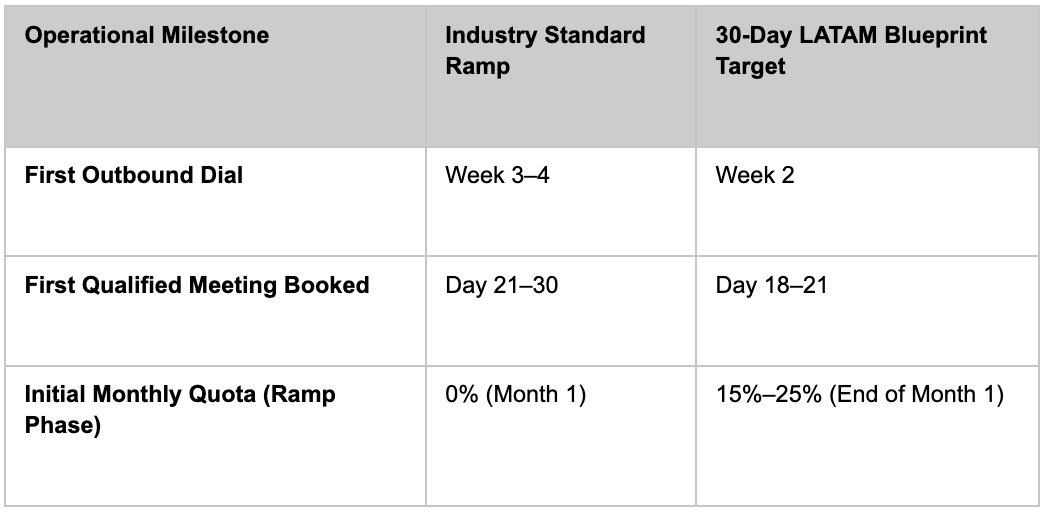
Standard US SDR ramp time averages 3.1 to 3.2 months before reps reach full quota, according to more research from The Bridge Group. A structured 30-day nearshore launch significantly compresses this schedule.
Structured onboarding programs help sales reps reach initial productivity milestones up to 37% faster, according to research compiled by SalesHive. By day 30, a nearshore SDR team should secure its first live qualified meetings.
3. Financial Payback and Cost-Per-Opportunity Reductions
The financial impact of a nearshore SDR launch becomes visible immediately on your operational expense statement. Because Latin American SDR compensation runs 40% to 60% lower than US equivalents, your cost-per-opportunity drops dramatically.
The median fully loaded cost of a US-based SDR ranges from $8,000 to $10,000 per month, accounting for base pay, benefits, taxes, and tech stack licenses. Nearshore LATAM SDRs cost between $3,000 and $4,500 per month fully loaded.
By day 30, you have established a predictable cost structure. Even with a conservative output of 2 to 4 qualified meetings per rep during the final week of month one, your cost-per-scheduled-meeting drops by over 50% compared to domestic acquisition channels.
4. Operational Readiness and Team Cohesion Metrics
Beyond quantitative metrics, day 30 delivers qualitative operational stability. Your nearshore reps operate as a fully integrated extension of your domestic sales force rather than an isolated vendor unit.
- CRM Hygiene: 100% of prospect activities, call notes, and disposition tags log accurately in your CRM.
- Feedback Loops: Weekly syncs between nearshore SDRs and domestic Account Executives happen during standard business hours without time-zone delay.
- Objection Mastery: Reps execute standardized objection-handling scripts for common pushbacks like "send me an email" or "no budget."
Ready to Build a Nearshore SDR Team in 30 Days?
When you hire LATAM talent, you can build an outbound engine in Latin America that gives revenue teams a distinct operational edge. This makes nearshoring the best way to trim overhead costs by up to 60% compared to domestic hires, while keeping full US time zone alignment. Executing this process with precision ensures your sales reps hit the ground running with the exact training, tools, and prospecting framework required to generate a consistent pipeline.
At Hire South, we streamline every step of your nearshore expansion. We source, vet, and place top-tier, English-fluent LATAM SDRs tailored to your ideal customer profile, matching you with pre-screened sales talent within two weeks. Our team manages candidate screening, cross-border payroll, and ongoing compliance, giving you high-performing sales representatives who integrate directly into your workflow from day one. Contact us today to build your nearshore SDR team and scale your sales pipeline!

.jpg)