


If you've worked with freelancers before, you know the gig mindset is shifting. While hiring a freelancer might fix a quick bug or fill a temporary gap, it won’t build your product's future. For growing companies, the real competitive edge in 2026 lies in moving beyond the revolving door of contractors.
Latin America has become the ultimate destination for this shift. It offers more than just proximity, it offers a deep pool of professionals who are looking for a home, not just a gig. In fact, according to a 2024 report by Deel, Latin America remains the fastest-growing region for global hiring, with a significant 11% increase in organizations seeking permanent, full-time talent there.
This guide breaks down exactly how to navigate that transition. You will discover the strategic benefits of same-day collaboration, the legal frameworks like EORs that make compliance simple, and the current salary benchmarks across hubs like Mexico and Argentina. It’s time to stop thinking about "outsourcing" and start thinking about building your core team.
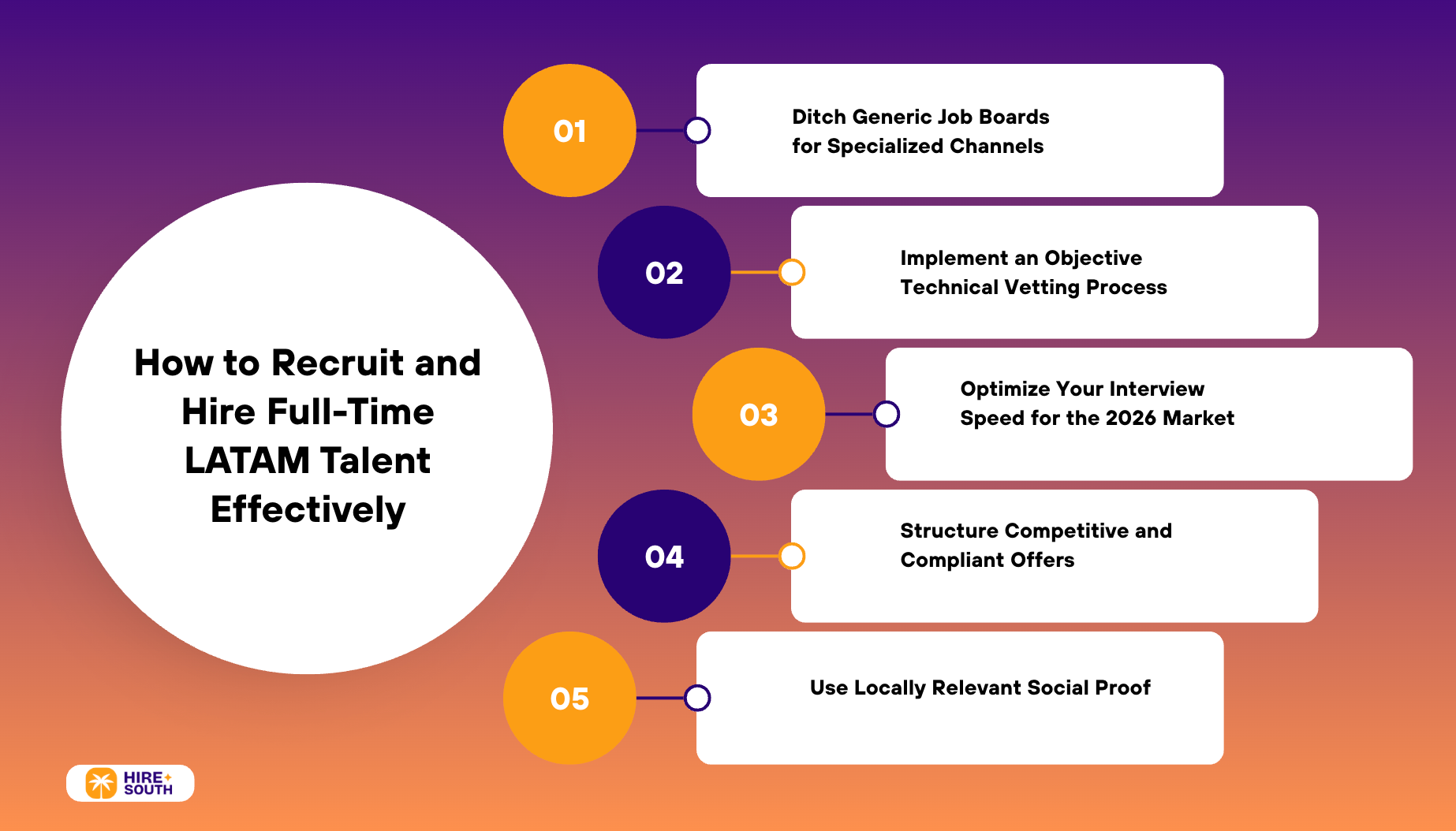
How to Recruit and Hire Full-Time LATAM Talent Effectively
Finding the right person in a sea of millions requires more than a "post and pray" strategy. To hire full-time LATAM talent who will stay for years, you need to ditch the generic job boards. The best candidates in the region often hang out in localized Slack communities, private Discord servers, or niche LinkedIn groups specific to their country.
According to a 2024 report by Statista, the English Proficiency Index in countries like Argentina and Costa Rica ranks significantly higher than in many other emerging markets. This means your recruitment process should prioritize communication skills early. If you wait until the final interview to test for language fluency, you’re wasting everyone's time.
1. Ditch Generic Job Boards for Specialized Channels
Traditional platforms are often flooded with low-quality leads. To hire long-term LATAM talent, focus your efforts where the pros live. Use platforms like Torre or regional LinkedIn filters to target specific tech hubs.
Local talent often relies on word-of-mouth. If you find one great engineer in Medellín, ask for referrals. Building a referral loop is often faster than running paid ads.
2. Implement an Objective Technical Vetting Process
Don't rely on vibes. Use a standardized scorecard to measure technical skills and cultural alignment. This levels the playing field and ensures you aren't biased toward candidates with the flashiest resumes.
According to a study by Robert Half, nearly 44% of new hires fail within the first 18 months due to poor cultural fit, not a lack of skills. In Latin America, "culture" often means a strong emphasis on collaboration and loyalty. Test for these traits through behavioral interviewing.
3. Optimize Your Interview Speed for the 2026 Market
The market for top-tier talent is aggressive. If your hiring process takes six weeks, you’ve already lost. High-performers in Brazil and Mexico often have three or four competing offers.
- Initial Screen: 15–20 minutes to check for English and basic fit.
- Technical Assessment: A short, time-boxed task (no more than 4 hours).
- Final Interview: Meet the team and discuss long-term goals.
Aim to move from first contact to an offer in 10 business days or less.
4. Structure Competitive and Compliant Offers
When you hire full-time talent in Latin America, your offer needs to look like a career move, not a temporary contract. This means including local benefits that matter.
According to 2024 data from Deel, companies that provide "equity-like" bonuses or stipends for home office setups see a 20% higher acceptance rate in the LATAM region. You should also be prepared to discuss whether the salary is "net" (after tax) or "gross," as this is a common point of confusion in South American negotiations.
5. Use Locally Relevant Social Proof
Top candidates will Google you. They want to see that you have a history of treating remote workers as equals. Show them photos of your team retreats or testimonials from other LATAM employees. Transparency about your company’s financial health and growth roadmap builds the trust necessary for a long-term commitment.
Strategies For Hiring Talent for the Long Term
Hiring for the long term isn't about filling a seat; it’s about investing in a partnership. In the LATAM market, talent isn't just looking for a paycheck, they are looking for stability and professional evolution. If you want to hire long-term LATAM talent that actually sticks around, your strategy must pivot from transactional to relational.
According to a 2026 Gallup report, Latin America and the Caribbean boast some of the highest employee thriving rates globally, with 56% of employees reporting they are thriving in their lives. This baseline of high engagement means you aren't just fighting to keep people, you’re competing to provide the best environment for people who already want to do great work.
Prioritize Career Pathing Over Competitive Sign-on Bonuses:
A one-time bonus might get someone through the door, but a clear roadmap keeps them there. High-level professionals in Brazil and Mexico value growth as a primary currency. If a candidate cannot see where they will be in your organization in 2028, they will likely view your role as a stepping stone.
According to 2025 data from Qualtrics, the "intent to stay" for three or more years is highest in Brazil at 69%, compared to just 62% in the United States. You can capitalize on this natural loyalty by discussing promotion cycles and skill-building opportunities during the very first interview.
Standardize Hybrid and Remote Flexibility:
Flexibility is no longer a perk; it is a requirement for retention. According to a 2026 Survey of Working Arrangements and Attitudes, fully remote workers show a 94.2% retention rate, significantly higher than the 81.6% found in traditional office settings.
When you hire full-time talent in Latin America, you are already leaning into a remote model. Strengthening this involves respecting "digital disconnection" policies. In countries like Mexico and Argentina, labor laws are increasingly protecting an employee's right to disconnect outside of standard hours. Honoring these boundaries builds the trust necessary for a multi-year tenure.
Implement Hyper-Personalized Benefit Packages:
Standard health insurance is the bare minimum. To truly stand out, you need to tailor benefits to the local reality. This might include private health supplements to bypass public system wait times or stipends for high-speed satellite internet in more remote regions.
According to the 2025 Latin American Employee Benefits Trends Report, companies offering customizable benefits packages see 25% higher retention rates. Instead of a "one-size-fits-all" approach, give your LATAM team a budget to choose between wellness vouchers, coworking memberships, or specialized technical certifications.
Foster Cultural Integration and Mutual Ownership:
The "us vs. them" mentality is the fastest way to lose remote talent. If your LATAM team feels like an auxiliary unit rather than the core team, they will leave as soon as a better offer arrives.
- Inclusive Meetings: Rotate meeting times so one time zone isn't always stuck with late-night calls.
- Equity and Stock Options: Providing equity to LATAM hires is a powerful way to align their long-term financial success with yours.
- Annual Retreats: Budget for face-to-face time. Physical proximity, once a year, can solidify relationships that digital tools cannot.
Build Trust Through Financial Transparency:
Inflation and currency volatility are daily realities in many LATAM nations. You build immense loyalty by being transparent about how you calculate raises and how you protect their purchasing power.
According to a 2026 market analysis, companies that peg salaries to a stable currency like the USD or provide automatic cost-of-living adjustments see a significant drop in "regrettable turnover." When employees don't have to worry about their local currency devaluing, they can focus entirely on your business goals.
Tips For Creating a Long-Term Work Environment
Building a workspace where people want to stay for five years instead of five months requires intentionality. When you hire full-time talent in Latin America, you aren't just adding a head to a spreadsheet, you are integrating a professional into a culture that often prizes social connection as much as productivity. A long-term environment is built on the pillars of psychological safety, clear communication, and shared success.
According to a 2025 report by Gallup, employees in high-trust organizations report 74% less stress and 50% higher productivity compared to those in low-trust environments. In a remote LATAM context, trust is the primary currency.
1. Implement a "Documentation First" Workflow
Relying on "quick chats" to relay vital information creates a barrier for remote teams. To hire long-term LATAM talent successfully, you must ensure they never feel out of the loop. Moving your operations to a central knowledge base like Notion or Confluence prevents the "information silo" effect that often makes remote workers feel like second-class citizens.
Clear documentation reduces the anxiety of time zone gaps. If a developer in Buenos Aires starts their day while the U.S. team is still asleep, they should have everything they need to move forward without waiting for a Slack reply.
2. Normalize Asynchronous Communication Practices
Constant meetings are a productivity killer. While the time zone alignment in LATAM is a huge perk, over-relying on "face time" can lead to burnout. According to 2024 data from Atlassian, 76% of workers report that they are more productive when they have large blocks of uninterrupted time.
Use recorded video updates for non-urgent announcements. This respects the deep-work cycles of your engineers and designers. When you do have synchronous meetings, keep them focused on relationship building or complex problem-solving rather than status updates.
3. Invest in Localized Management Training
Managing a distributed team across different cultures is a specific skill set. You cannot manage a team in Mexico the same way you manage a team in New York. Cultural nuances, such as the "high-context" communication style common in many LATAM countries, mean that feedback often needs to be delivered with more relational cushioning than a direct, "low-context" U.S. approach.
According to a 2025 study by the Harvard Business Review, managers who adapt their leadership style to the cultural context of their direct reports see a 30% increase in team engagement. Training your mid-level leads on these nuances is a high-leverage move for retention.
4. Bridge the Social Gap with Digital Watercoolers
Isolation is the biggest threat to remote tenure. To hire full-time LATAM talent for the long haul, you have to replace the office banter with digital equivalents. This doesn't mean forced "fun" Zoom happy hours.
- Non-work Channels: Create Slack spaces for pets, cooking, or local travel.
- Pairing Sessions: Encourage "co-working" calls where two people stay on a video link while working silently, simulating a shared desk environment.
- Peer Recognition: Implement a system where team members can publicly thank each other.
5. Prioritize Total Wellness and Mental Health Support
The 2026 workplace demands more than a desk and a laptop. According to the World Health Organization, for every $1 put into scaled treatment for common mental disorders, there is a return of $4 in improved health and productivity. Offering subscriptions to mental health platforms or providing "recharge days" that align with local holidays shows that you value the human, not just the output. In many LATAM cultures, the family-first mentality is a core value. When you provide a work environment that respects family time, you secure a level of loyalty that a higher salary alone cannot buy.
Looking to Hire Long-Term LATAM Talent? We Can Help!
Moving from a freelance model to a permanent team is the most effective way to protect your company’s institutional knowledge and product roadmap. In a market where, according to 2025 labor statistics from the Inter-American Development Bank, the digital economy in Latin America is projected to require over 1.2 million additional software developers by 2026, securing your talent now is a vital defensive and offensive move.
At Hire South, we specialize in bridging the gap between North American ambition and Latin American expertise. We don't just find resumes; we help you navigate the complexities of local labor laws, cultural integration, and long-term retention strategies. If you are ready to hire full-time LATAM talent and build a foundation that lasts, we provide the infrastructure and regional authority to make it happen. Contact us to book a free consultation and hire nearshore today!
.jpg)