


Building a reliable outbound pipeline without burning through your capital is a tough puzzle to solve. If you are currently sourcing top-of-funnel reps domestically, you already know the grim reality of skyrocketing salary demands and sudden turnover. That is exactly why forward-thinking revenue leaders are shifting their gaze southward.
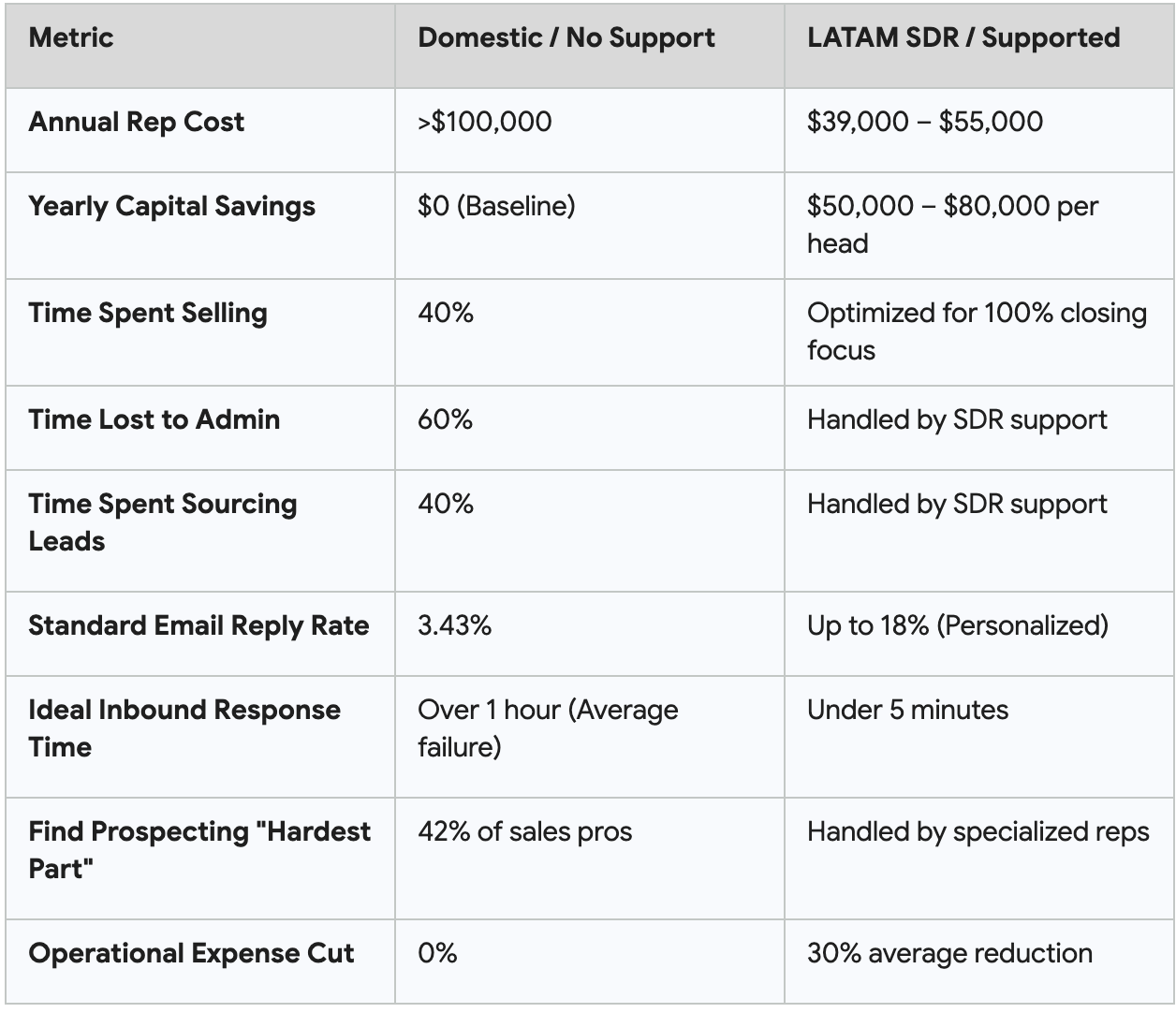
Sourcing a Sales Development Representative in LATAM offers a powerful fix. You get hungry, bilingual talent operating in your exact time zone. The economic relief is immediate. A senior nearshore outbound representative requires an all-in investment of just 39,000 dollars to 55,000 dollars, according to Howdy's 2026 salary data, which hands you a massive yearly savings of roughly 50,000 dollars to 80,000 dollars per head compared to domestic hires.
But navigating a brand-new regional talent pool takes preparation. How do you find the true gems, evaluate their phone presence, and stay compliant?
This playbook gives you the complete blueprint. You will explore a geographical breakdown of the top Latin American tech hubs, discover live objection-handling interview tactics, and unpack onboarding strategies to drastically cut ramp time. Let’s dive into how you can scale your pipeline efficiently.
How Do You Know When It’s Time To Hire Sales Support?
Recognizing the exact moment to scale your sales infrastructure prevents revenue plateaus before they damage your growth trajectory. Many organizations make the mistake of waiting until their quarterly revenue targets are missed before bringing on dedicated pipeline assistance. By mapping specific operational bottlenecks, you can identify exactly when your closers require operational relief.
1. Your Account Executives Are Drowning in Administrative Burden
When your highest-paid closing talent spends the majority of their week on manual data entry, you are misallocating core resources. Sales representatives across the industry spend just 40 percent of their time actively selling, according to Salesforce’s 2026 State of Sales report, which reveals that 60 percent of their hours vanish into administrative tasks, internal meetings, and manual content searches.
If your Account Executives are booking their own meetings, cleaning CRM data, or manually typing out follow-up notes, they lack the bandwidth to nurture active deals. This administrative tax directly shrinks your revenue potential. Hiring targeted sales support shifts the heavy lifting off their plates, allowing your top closers to focus entirely on closing.
2. Outbound Prospecting Activities Have Slumped Due to Deal Management
Pipeline generation requires absolute daily consistency, yet it is often the first activity dropped when closing reps get busy. Account Executives naturally prioritize hot opportunities over cold outreach. This creates a dangerous revenue rollercoaster where a high-revenue month is immediately followed by a dry spell because no new leads were generated.
Finding new buyers is notoriously time-consuming. In fact, sales professionals frequently spend 40 percent of their working hours simply searching for fresh prospects to contact, according to a 2026 sales productivity study by Flowlu. When you inject a dedicated sales support layer into your workflow, you guarantee that lead generation remains an uninterrupted daily engine.
3. Inbound Lead Response Times Are Breaching Critical Performance Windows
Speed to lead is a major deciding factor in modern B2B conversions. If your incoming marketing leads are sitting unaddressed for hours or days, you are actively losing market share to more agile competitors. Closing reps who are trapped in lengthy product demonstrations or contract negotiations cannot respond to new inquiries within the ideal five-minute window.
Sales development support acts as a rapid-response unit for your inbound pipeline. They triage incoming traffic, filter out unqualified accounts, and instantly book high-intent buyers into your closers' calendars. If your team is failing to contact inbound prospects within an hour, your pipeline needs immediate structural support.
4. Core Team Members Report Burnout and Struggle with Outbound Hurdles
Top-of-funnel generation is mentally taxing and requires a specific, highly resilient skill set. Forcing closing specialists to handle cold rejection daily often leads to widespread team fatigue and early turnover. Prospecting is cited as the absolute hardest part of the entire sales process by 42 percent of sales professionals, according to a 2026 sales benchmark report by Flowlu, outranking even the difficulty of closing the actual deal.
Segmenting your sales team protects your internal culture. By delegating the heavy rejection and initial outreach mechanics to specialized support reps, you maximize the efficiency of each role. Your closers remain energized, your support reps build foundational skills, and your entire organizational output scales smoothly.
What Remote Sales Talent Can Help With
Deploying distributed specialists to manage the top of your sales funnel transforms how your organization captures, processes, and closes revenue. Instead of overwhelming local closing assets with logistical tasks, utilizing remote support injects clear efficiency into your entire operation. This focus allows your closing professionals to spend their time exclusively on revenue-generating actions.
Executing Targeted Cold Email and Digital Outreach Campaigns:
Building pipeline consistency requires highly personalized, continuous digital messaging across multiple channels. Remote outreach specialists focus daily on crafting relevant messaging, building clean prospect pools, and testing copy variations. They scale your digital presence without sacrificing the quality of your brand.
Generic email templates no longer yield consistent results in competitive markets. In fact, cold email response rates across B2B platforms sit at an average of 3.43 percent, according to Martal Group’s 2026 B2B Outbound Benchmark Report, whereas campaigns using advanced personalization reach reply rates of up to 18 percent. Remote talent ensures every outbound touchpoint contains deep customization, helping your messages bypass strict spam filters and consistently land directly in target inboxes.
Conducting Focused Outbound Cold Calling and Initial Triage:
Live phone conversations remain one of the fastest ways to uncover buying intent and clear out pipeline blockers. Remote professionals serve as a rapid front-line filter, managing the massive volume of dials required to secure a single live business decision-maker. They handle initial objections, introduce your company's core value proposition, and gauge baseline fit.
This structure shields your senior closer team from the draining elements of cold phone outreach. Your remote reps navigate complex gatekeeper systems and verify initial interest. When they discover an interested, qualified buyer, they manage the scheduling logistics directly, inserting high-intent discovery calls cleanly into your closing team's calendars.
Maintaining CRM Data Accuracy and Eliminating Information Gaps:
A sales stack is only as valuable as the underlying customer data tracking inside it. When data entry falls on busy account managers or closing reps, records quickly become fragmented, incomplete, or completely out of date. Remote support talent acts as data stewards, keeping your pipeline clean and your data entries reliable.
Neglecting system hygiene introduces severe operational leaks across your organization. Around 76 percent of CRM users state that less than half of their company’s customer data is fully accurate and complete, according to Validity’s State of CRM Data Management Report, a widespread issue that leads directly to lost revenue for 37 percent of those organizations. Remote professionals systematically eliminate this risk by updating contact records, logging interaction notes, and tracking pipeline metrics in real time.
Managing Complex Multichannel Multi-Touch Follow-Up Sequences:
Securing a meeting with modern corporate buyers requires persistent, organized contact over extended periods. Most internal sales reps abandon potential opportunities far too early because they prioritize late-stage deals over long-term nurturing. Remote specialists bridge this gap by maintaining systematic multi-touch follow-up workflows across phone, email, and social media platforms.
High-performing outreach campaigns require long-term persistence. While roughly 48 percent of sales professionals never send a single follow-up message after their initial attempt goes unanswered, according to HubSpot historical performance data, a single follow-up email increases average reply rates by 22 percent. Distributed outbound reps run structured multi-day sequences, ensuring no high-value corporate target slips through the cracks due to internal bandwidth limits.
The Definitive Blueprint on How to Hire a Sales Development Representative
1. Building an Ideal Candidate Profile for Remote Outbound Roles
An effective recruitment strategy starts with a clear, objective assessment of the skills needed for your sales landscape. You must define whether your target market requires highly technical product comprehension or rapid, high-volume transactional handling. Documenting the specific tools, communication standards, and time-management traits required for the position shields your team from hiring misaligned professionals who burn out during onboarding.
The cost of a bad hire is exceptionally high for early-stage pipeline builders. The full employer cost of a domestic outbound representative routinely exceeds 100,000 dollars annually when factoring in corporate benefits, payroll taxes, tech stack provisions, and recruitment agency fees, according to a 2026 sales infrastructure cost report by Remote Growth Partners. Setting explicit, measurable standards for tech stack familiarity, phone presence, and past quota achievements before posting a single job description protects you from absorbing these heavy capital losses.
2. Identifying High-Impact Sourcing Channels and Talent Pipelines
Placing basic job ads on massive global boards usually floods your hiring dashboard with thousands of unqualified, generic résumés. To find highly capable outreach specialists, you need to engage with specialized tech communities, digital sales groups, and vetted remote work repositories. Proactively tracking down candidates who have completed formal tech sales bootcamps or specialized B2B sales academies ensures your applicant pool understands modern prospecting structures.
Targeting specialized networks allows you to access professionals who are already familiar with top-tier infrastructure. High-performing sales teams are 3.2 times more likely to utilize artificial intelligence tools and advanced sales engagement platforms than underperforming teams, according to Salesforce's 2026 State of Sales report. Sourcing directly from technical sales environments guarantees your applicants already possess functional experience with tools like HubSpot, LinkedIn Sales Navigator, and automated dialing systems.
3. Optimizing the Recruitment Workflow for Cross-Border Screening
An efficient screening sequence quickly filters out applicants who look great on paper but lack real-time conversational agility. Your recruiting pipeline should feature a distinct, multi-stage assessment structure, beginning with a short, automated video or audio pitch to check verbal communication clarity. From there, advance top candidates to structured behavioral interviews, and ultimately put them through a practical, hands-on outreach test before extending an official offer.
Strategic pipeline filtering prevents your management team from wasting hours on low-intent interviews. When running a structured, multi-tier vetting process, only 16 percent of initial applicants successfully advance to the final leadership review phase, according to historical recruitment data from Nearshore Business Solutions. This systematic elimination guarantees that your sales leaders only spend valuable face-to-face time with verified, top-tier performers who possess the precise communication skills needed to generate real revenue.
Ready to Hire a Sales Development Representative in LATAM?
Scaling your pipeline through Latin American sales development representatives optimizes your operational cost structure while injecting high-energy, bilingual talent directly into your top-of-funnel engine. However, building a predictable, compliant, and deeply vetted cross-border team requires significant time, localized legal insight, and rigorous candidate testing.
At Hire South, we systematically remove the friction from nearshore recruiting. Companies reduce their ongoing operational expenses by an average of 30 percent by nearshoring to Latin America with our framework, according to our internal placement performance data, which delivers substantial bottom-line relief without sacrificing lead generation quality. We manage the heavy lifting of regional talent acquisition, from running intensive multi-stage language and behavioral evaluations to handling cross-border payroll, local employment benefits, and ongoing HR compliance.
Whether you need a single specialized individual contributor or a full outbound team operating in your exact time zone, our custom staffing solutions and Direct Hire models align perfectly with your organizational goals. Contact us today to receive your first curated, pre-vetted candidate shortlist in under 5 days, and transform your pipeline growth.