


If you’ve spent any time on a hiring committee lately, you know the back-to-the-office debate has reached a fever pitch. But while some corporate giants are making headlines with strict mandates, the data tells a much more permanent story. In 2026, remote work isn't just a lingering pandemic habit but a structural pillar of the global economy.
According to Upwork, approximately 32.6 million Americans (about 22% of the workforce) will be working remotely by the end of this year. That is a massive pool of talent that simply isn't looking for a desk in your zip code.
This article dives into the essential shifts you need to track to keep your recruitment strategy from falling behind. We’ll explore how AI is rewriting the rules of the remote interview, why "nearshoring" in Latin America has become the secret weapon for US firms, and how top companies are ditching degrees for skills-based hiring.
Whether you’re a founder scaling a startup or an HR lead at a legacy firm, these insights will help you navigate the new reality of a borderless workforce.
Remote Staffing Industry Overview
The remote staffing market has officially graduated from a "pandemic pivot" to a multi-billion-dollar strategic pillar. As you look at the landscape in 2026, the volatility of the early 2020s has been replaced by a "Lazy W" recovery, a slow, steady stabilization where remote work settles into a permanent gear.
According to Staffing Industry Analysts, the global recruiting market is projected to reach $690.3 billion in 2026. Within this massive ecosystem, the demand for distributed talent is a primary engine. While some headlines focus on office mandates, the broader reality is that approximately 52% of the global workforce now engages in remote or hybrid work, according to Yomly. This isn't just a perk; it’s an operational necessity for companies that want to remain competitive in a tight labor market.
A Stabilized Talent Marketplace:
The "Great Resignation" has evolved into the "Great Stay." Employees are prioritizing stability and flexibility, leading to lower churn rates for companies that offer remote options. In the US, the remote work rate has found its "new normal," stabilizing between 18% and 24% of the total workforce since late 2022, according to WFH Research.
For you as a business leader, this means the pool of "active" remote seekers is more refined. You aren't just sifting through people who want to work from home; you are accessing a professional class that has built their entire career infrastructure around distributed collaboration.
The Dominance of Managed Service Providers:
Traditional agency-led hiring is facing stiff competition from Managed Service Providers (MSPs) and Recruitment Process Outsourcing (RPO) models. These services are projected to grow at a 10.05% CAGR through 2031, according to Mordor Intelligence.
Businesses are moving away from one-off hires. Instead, they are looking for partners who can handle the "heavy lifting" of remote staffing, including:
- Employer of Record (EOR) services: Managing legal and tax compliance across 100+ countries.
- Talent Authentication: Using AI to verify skills in real-time, bypassing "inflated" digital resumes.
- Zero-Trust Onboarding: Ensuring that every remote hire is integrated into a secure, encrypted digital environment from day one.
Geographic Shifts:
While North America remains the largest market for staffing revenue, the fastest growth is happening elsewhere. The Asia-Pacific (APAC) region is expanding at a rate of 8%, outpacing North America’s 7.4%, according to Technavio.
Meanwhile, Latin America is the "nearshoring" darling of 2026. With a projected 5% growth rate this year, countries like Colombia and Chile are becoming the go-to hubs for US firms seeking timezone-aligned developers and project managers without the hefty price tag of domestic talent, according to Staffing Industry Analysts.
Sector-Specific Remote Saturation:
Not all industries are created equal in the remote world. If you are in the IT or Telecom sectors, you are in the most remote-saturated market, with these fields capturing nearly 30% of the total recruiting market share, according to Mordor Intelligence.
However, Healthcare and Life Sciences are the ones to watch. This segment is forecast to expand at a 9.04% CAGR as telehealth, remote clinical research, and digital diagnostics move from "experimental" to "standard of care." In fact, even in traditionally "hands-on" industries, remote staffing is growing, roughly 73% of all departments are expected to have at least some remote workers by 2028, according to WifiTalents.
The Hiring Trends Shaping The Remote Staffing Industry
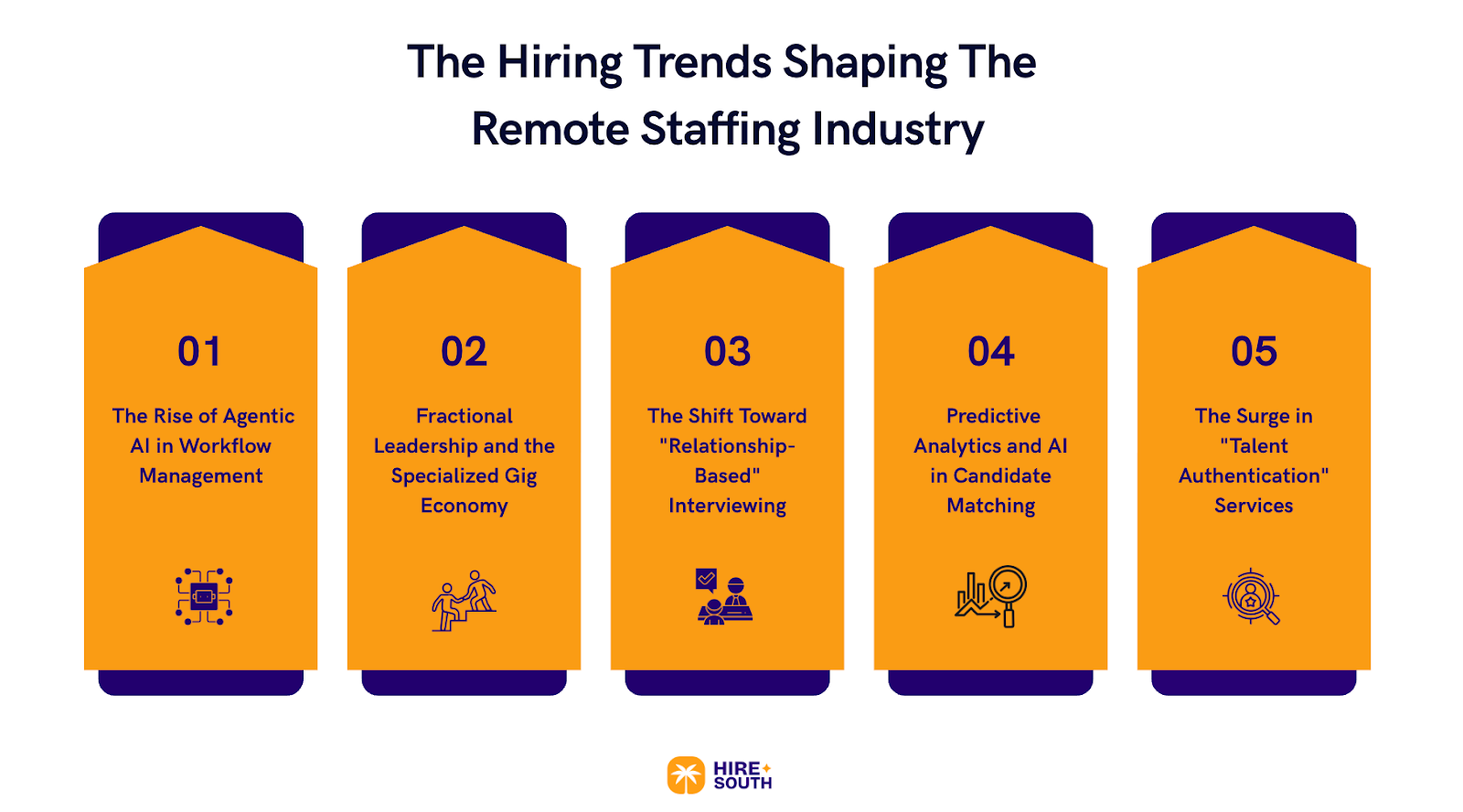
If you’re feeling like the traditional "post a job and wait" method is failing, you’re not alone. The remote staffing landscape in 2026 has moved past the experimental phase and into a high-stakes era of automation and specialized leadership. You need to understand these specific shifts to capture the 22% of the US workforce that now works remotely, according to Upwork.
1. The Rise of Agentic AI in Workflow Management
We have officially moved beyond basic chatbots that just answer FAQs. In 2026, the real trend is Agentic AI, autonomous systems that don't just "talk" but actually "do." These agents independently plan and execute multi-step recruiting workflows, from screening candidates to generating interview summaries, according to Eximius AI.
For your team, this means AI can now handle approximately 60% of a recruiter's administrative week, such as coordinating schedules and conducting initial structured screenings, according to InterviewFlow AI. This allows you to focus on the human element: relationship building and final cultural vetting.
2. Fractional Leadership and the Specialized Gig Economy
You no longer have to choose between a $250,000 full-time executive and no leadership at all. The "liquid workforce" is a dominant force in 2026, where companies increasingly hire fractional C-suite leaders and contract specialists to move at pace without the overhead of permanent payroll, according to Resource Group Holdings.
This "access over ownership" model is particularly effective for remote startups. You can bring on a fractional CFO or CTO for 10 hours a week, gaining elite expertise that was previously out of reach for mid-market firms.
3. The Shift Toward "Relationship-Based" Interviewing
With candidates now using generative AI to apply for hundreds of roles in a single click, recruiters are drowning in noise. As a result, the trend has swung back toward high-touch, relationship-driven talent attraction, according to Human Resources Online.
You’ll notice that while AI filters the initial pool, the final stages are becoming more rigorous. Leading organizations are treating hiring like a high-stakes investment, emphasizing deeper due diligence and structured interviews that test "ambiguity-confidence" and critical thinking, skills that 73% of talent leaders now rank as their top priority, according to Korn Ferry.
4. Predictive Analytics and AI in Candidate Matching
Smart screening has replaced keyword matching. Traditional applicant tracking systems (ATS) often miss great talent because a resume lacks a specific buzzword. In 2026, the best platforms use Smart Screening Questions that adapt to candidate responses to evaluate domain knowledge in real-time, according to InterviewFlow AI.
5. The Surge in "Talent Authentication" Services
Because AI can help candidates "game" the resume process, there is a massive trend toward validated assessments. Tools like Canditech now offer a library of simulations with AI-assisted scoring and robust proctoring to protect the integrity of remote evaluations.
By using these "remote-ready" assessments, you can achieve up to 87% accuracy in candidate screening compared to manual reviews, and reduce your overall time-to-hire by up to 63% in AI-automated environments.
Expected Changes in Remote Staffing for 2026
The "experimental" phase of remote work has officially ended. In 2026, you are operating in a stabilized, high-stakes environment where remote staffing has reached a tipping point of 52% of the global workforce, according to Yomly. This year isn't about deciding if you should hire remotely, but how you can navigate the tightening legal and technological guardrails that now define the industry.
The Institutionalization of Hybrid and Remote Models:
You likely noticed that the frantic "return to office" mandates of 2024 and 2025 have hit a wall of reality. By 2026, approximately 32.6 million Americans are projected to work remotely, a steady climb that now represents 22% of the national workforce, according to Upwork.
Instead of a binary "office vs. home" choice, the market has settled into a sophisticated hybrid rhythm. Around 83% of workers now favor a mix of remote and in-office days, according to Yomly. For you, this means your staffing strategy must account for "purposeful presence", hiring talent based on their ability to manage their own location-neutral productivity rather than monitoring their badge swipes.
Performance Over Presence: Outcome-Based Contracts.
One of the most significant shifts you'll face in 2026 is the move away from hourly tracking toward outcome-based performance metrics. Companies are increasingly ditching "seat policing" for results-driven evaluation.
This change is backed by hard data: remote employees have shown a 13% increase in productivity compared to their in-office counterparts, according to Virtual Latinos. Because output is easier to measure than ever, thanks to AI-integrated project management, your hiring focus is shifting toward candidates who demonstrate "high-order cognitive abilities", people who can navigate ambiguity and deliver results without constant digital supervision.
The Rise of the "Regulated" Remote Workplace:
If you thought remote staffing was a legal "Wild West," 2026 is your wake-up call. Remote work is no longer a discretionary perk; it is now a regulated feature of employment, according to HRD Connect.
The Right to Disconnect and Tribunal Scrutiny.
In 2026, the legal landscape has tightened. You must now navigate "Right to Disconnect" laws that have expanded to include small businesses, allowing employees to refuse after-hours contact unless it's a genuine emergency, according to HR Partner.
Furthermore, employment tribunals are increasingly scrutinizing "blanket" office mandates. If you require in-office attendance without a role-specific, evidence-based justification, you may face legal challenges under modern equity and discrimination laws, according to HRD Connect.
Compliance as a Competitive Edge.
Managing a distributed team across borders now requires intense oversight. Every new state or country where your employee logs in can trigger:
- Tax Nexus Exposure: Even one remote worker can create filing obligations for your entire firm, according to Workana.
- Localized Benefits: You are now often required to provide mandatory benefits, such as parental leave or health stipends, based on the worker's location, not onyour headquarters.
- Pay Transparency: In regions like Ontario and parts of the EU, you are now legally required to disclose salary ranges in job ads, according to HR Partner.
Personalization: The New Benefits Frontier:
The "one-size-fits-all" benefits package is dead. In 2026, you are competing for talent by offering modular, personalized benefits-as-a-service.
According to Pierpoint International, benefits now account for roughly 29% of total compensation, costing employers an average of $27,500 per employee annually. However, the trend has shifted toward "lifestyle stipends." Instead of a generic gym membership, you are likely offering choice-based points that employees can spend on:
- Home Office Infrastructure: 40% of workers would accept a slightly lower salary in exchange for robust remote support, according to Vena Solutions.
- Mental Health Ecosystems: Moving beyond "therapy apps" to holistic resilience coaching and digital detox policies.
- Dependent Care: With FSA limits increasing to $7,500, childcare and eldercare support have become non-negotiable for the 35–44 age group, which has the highest remote work rate at 27%, according to WEX Inc. and Vena Solutions.
Crucial Steps To Prepare Your Business for Remote Staffing
In 2026, remote staffing is no longer a "plug-and-play" scenario. You aren't just sending a laptop to a new hire; you are integrating a node into a complex, global digital network. To stay competitive, you need to audit your infrastructure before you even draft a job description.
1. Hardening Your Zero-Trust Infrastructure
Security is the biggest barrier to scaling a remote team today. In 2026, the corporate "perimeter" has effectively vanished, replaced by thousands of home Wi-Fi networks. Approximately 70% of successful data breaches now originate from endpoint devices such as laptops and phones, according to NordLayer.
You should move beyond simple VPNs. Leading firms are adopting Zero-Trust Architecture, which treats every single access request as potentially hostile regardless of where it comes from. By enforcing multi-factor authentication (MFA) and standardized encryption, you ensure your data remains secure even if your staff is working from a café in Mexico City.
2. Implementing an "Async-First" Communication Stack
If your remote culture relies on "hopping on a quick call," you’re likely bleeding productivity. Teams with strong documentation and asynchronous practices experience 67% fewer blocking delays than those relying on real-time meetings, according to GitLab and HR Oasis.
You should prioritize tools like Linear or Asana to act as your team’s "system of record." By 2026, the goal is to make work visible without needing a status meeting.
3. Mastering Global Compliance and EOR Partnerships
Hiring across state or national borders is a legal minefield in 2026. If you hire a full-time employee in a different country without a local legal entity, you risk massive tax penalties.
Most successful businesses are now bypassing this by partnering with Employer of Record (EOR) providers. These partners handle the localized payroll, taxes, and benefits compliance, allowing you to hire in 190+ countries without the administrative headache, according to Rise.
4. Salary Benchmarking and the "Flexibility Premium."
The way you pay people has changed. In 2026, you must decide if your salaries are based on where the company is located or where the employee lives.
The data suggests flexibility is a powerful bargaining chip. Roughly 40% of US workers would accept a salary that is 95% or less of their current rate in exchange for permanent remote options, according to Vena Solutions. However, you must stay transparent; salary-transparent postings attract 2.5x more applicants, according to SQ Magazine.
6. Automated Onboarding and "Talent Authentication."
With the rise of AI-inflated resumes, you should use talent authentication services to verify skills during the hiring phase. Once hired, use automated onboarding systems to cut administrative delays, these tools can reduce "admin friction" by up to 40%, according to SQ Magazine.
7. Building "Social Capital" Remotely
Don't ignore the human element. About 22% of remote workers report feeling isolated, according to Yomly. You should allocate part of your real estate savings, which average $11,000 per employee annually, according to HR Oasis, into "social stipends" or regional meetups. This investment pays off in loyalty; remote-friendly companies report 28% stronger employer branding and significantly lower turnover rates, according to SQ Magazine.
Ready to Hire Remote Talent?
As the stabilization of the global workforce continues through 2026, it is clear that remote work has moved beyond a temporary measure and into a permanent strategic advantage. With companies saving an average of $11,000 per employee annually by shifting to remote or hybrid models, according to StrongDM, the focus has now shifted from whether to hire remotely to how to do it with maximum precision and security.
At Hire South, we specialize in bridging the gap between high-growth companies and top talent in Latin America. We understand that in a competitive market, you need more than just a resume; you need a partner who can navigate the complexities of nearshore staffing. Our rigorous vetting process ensures that every professional we present is not only highly skilled but also culturally and timezone-aligned with your business.
Whether you are looking to scale your engineering team or find specialized fractional leadership, we handle the heavy lifting of global payroll, compliance, and onboarding. Let us help you turn the challenges of remote staffing into your company’s greatest growth engine. Contact us to book a free strategy call today!


.jpg)