


The hunt for top-tier tech talent has officially moved south. As the demand for automation and machine learning hits a fever pitch, North American companies are realizing that the next great AI specialist isn't necessarily in Silicon Valley. They are in the bustling tech hubs of Medellín, Mexico City, and Buenos Aires.
Latin America has transformed into a premier destination for nearshoring, offering a rare combination of high-level technical expertise and perfect time-zone alignment. The growth is staggering. In fact, the AI market in Latin America is projected to reach $11.64 billion by 2030, showing a compound annual growth rate of 18.3%, according to Statista.
This guide breaks down exactly how to navigate this landscape. You will discover the top geographic hubs for talent, the actual cost of hiring in 2026, and the legal hurdles you need to clear to stay compliant. From vetting technical portfolios to building a remote culture that lasts, here’s everything you need to know to hire an AI specialist in LATAM. Keep reading to learn more!
The AI Profiles in Demand for 2026
The hiring landscape has shifted from "generalist" developers to hyper-specialized architects. If you are scouting for an AI specialist, LATAM now offers deep expertise in niche domains that were barely on the radar a few years ago. Here are the specific profiles dominating the market this year.
1. Deep Learning and Neural Architecture Specialists
You aren't just looking for someone who can call an API. The demand in 2026 is for engineers who can build, prune, and optimize proprietary neural networks. These specialists are essential for companies that need to run high-performance models without the massive overhead of "out-of-the-box" solutions.
In Latin America, this talent pool is particularly strong in academic hubs like Argentina and Brazil. The global Deep Learning market is currently soaring, with projections suggesting it will reach $484.06 billion by 2030, according to Fortune Business Insights.
2. Generative AI (GenAI) Product Engineers
This role bridges the gap between raw model capabilities and user-facing products. These specialists focus on Retrieval-Augmented Generation (RAG) and sophisticated prompt engineering. They ensure your AI doesn't just "talk," but actually interacts with your internal data securely and accurately.
You will find these profiles frequently in Medellin and Mexico City, where the startup culture has forced engineers to become experts at rapid product deployment.
3. MLOps and AI Infrastructure Leads
Scaling is where most AI projects fail. MLOps specialists are the "plumbers" of the AI world. They handle the CI/CD pipelines, model monitoring, and version control. Without them, your AI specialist in LATAM is just building toys in a sandbox rather than production-grade tools that can later be used for custom Salesforce solutions or enterprise-grade automations.
The importance of this role is backed by hard data: the MLOps market size is expected to hit $13.32 billion by 2030, growing at a rate of 39.3%, according to Grand View Research.
4. Computer Vision and Edge AI Experts
With the rise of smart manufacturing in Mexico and Brazil, there is a massive spike in demand for specialists who can deploy AI on local hardware. These engineers work on object detection, facial recognition, and automated quality control.
If your business involves physical logistics or hardware, this is the specific profile you need to prioritize. Latin American engineers are increasingly specializing in "Edge AI," which processes data locally on the device rather than the cloud, saving you significant bandwidth and latency costs.
5. AI Ethicists and Compliance Officers
As regulations like the EU AI Act influence global standards, you need specialists who understand the legal and moral implications of data training. This isn't just a "soft" role anymore. In 2026, these professionals perform algorithmic audits to ensure your models are free from bias and compliant with international privacy laws.
Hiring for this role in LATAM gives you a unique advantage, as many regional specialists are already well-versed in navigating complex, multinational regulatory frameworks. The demand for ethical AI is no longer optional; it is a core business requirement for any firm handling sensitive user data.
Strategic Sourcing: How to Find AI Specialist Talent
Finding an AI specialist in the LATAM market requires moving beyond the "post and pray" method on LinkedIn. Because the competition for top-tier talent is fierce, you need a multi-channel approach that taps into local tech ecosystems. Here is how you can source high-caliber candidates effectively in 2026.
Leverage Specialized AI Talent Marketplaces:
Generic job boards often result in a flood of unqualified resumes. Instead, target niche platforms that vet for technical proficiency. Portals like Torre, Revelo, or Arc focus specifically on Latin American tech talent. These platforms often use their own AI to match candidates based on "proven skills" rather than just years of experience.
The efficiency of these platforms is clear: data shows that utilizing specialized recruitment software can reduce time-to-hire by up to 40%, according to Zippia. In a fast-moving field like AI, speed is your biggest asset.
Tap Into LATAM University Research Hubs:
Some of the best AI minds are currently sitting in research labs in São Paulo, Mexico City, and Buenos Aires. Universities like the Tecnológico de Monterrey (Mexico) or the University of São Paulo (Brazil) have become breeding grounds for machine learning experts.
Establishing a presence here isn't just about internships. You should look for PhD candidates or research assistants who are publishing papers on neural networks or computer vision. Brazil alone saw its high-tech exports reach $5.75 billion in 2022, a testament to the growing technical sophistication of its academic and industrial sectors, according to World Bank data.
Scout Candidates via GitHub and Kaggle Rankings:
If you want to hire an AI specialist, look at their code, not just their resume. Latin America has a massive community of data scientists who compete on Kaggle. By filtering for top-ranked participants in countries like Colombia or Argentina, you find people who have solved real-world problems under pressure.
Reviewing a candidate’s GitHub repository allows you to see their contributions to open-source AI libraries. This transparency is a core part of the N-E-E-A-T framework, ensuring you are hiring someone with practical, verifiable expertise.
Utilize "Nearshoring" Recruiters with Local Footprints:
There is a massive difference between a global recruiter and a local "boots-on-the-ground" headhunter. Local recruiters understand the cultural nuances and salary expectations of specific cities. They know that a developer in Montevideo might have different motivators than one in Guadalajara.
Investment in the Latin American tech sector continues to grow, with the region attracting billions in venture capital. This influx of capital has matured the recruiting industry, making it easier for you to find specialized agencies that focus exclusively on the AI and Data Science vertical.
Engage with Regional AI Communities and Hackathons:
Events like ArgentinAI or various DevFest iterations across Latin America are goldmines for networking. These aren't just social gatherings; they are where the most passionate specialists go to share knowledge.
Participating in or sponsoring a regional hackathon gives you direct access to see how talent works in a team environment. Since the LATAM AI market is expected to grow significantly, establishing your brand early in these communities ensures you are a preferred employer when top specialists decide to move on from their current roles at custom AI companies or other startups.
Tips for Vetting an AI Specialist for Your Technical Needs
1. Prioritize Practical Challenges over Algorithmic Puzzles
The traditional "LeetCode" style interview is losing its luster. In fact, 75% of developers now agree that technical interviews are fundamentally broken, often favoring memorized algorithms over real-world problem-solving, according to HackerRank.
Instead of asking a candidate to invert a binary tree, give them a dirty dataset and a business problem. Ask them to build a quick Retrieval-Augmented Generation (RAG) prototype or optimize a model’s latency for a mobile environment. This approach tests their ability to handle the "almost right, but not quite" nature of AI outputs, which 66% of developers identify as a primary challenge in current workflows, according to JetBrains.
2. Validate Experience with AI-Assisted Development
The debate over using AI to write AI code is over. Tools like GitHub Copilot are now standard, and denying them during an interview creates an artificial environment. Research shows that developers using AI assistants can complete tasks 55.8% faster, according to research published via arXiv.
You should observe how your candidate uses these tools. Do they blindly accept suggestions, or do they catch the subtle hallucinations? A top-tier AI specialist in 2026 isn't just a coder; they are an "AI orchestrator" who knows how to audit machine-generated code for security vulnerabilities and logical gaps.
3. Assess MLOps and Deployment Literacy
Building a model in a notebook is easy; keeping it alive in production is hard. You need to vet for MLOps (Machine Learning Operations) skills. This market is exploding, with a projected compound annual growth rate of 39.3% through 2030, according to Grand View Research.
Ask your candidates how they handle "model drift" or how they would set up a CI/CD pipeline for a neural network. If they cannot explain how to monitor a model’s performance once it hits the real world, they aren't a specialist, they are a hobbyist. In 2026, the gap between a "Research Scientist" and a "Machine Learning Engineer" is defined by the ability to ship stable, scalable software.
4. Evaluate Ethical Auditing and Compliance Knowledge
With global regulations tightening, your hire must be your first line of defense against biased or "black box" models. Vetting for "N-E-E-A-T" principles, specifically Trustworthiness and Transparency, is now a business requirement.
Ask candidates to describe a time they identified bias in a dataset or how they would implement "explainability" in a high-stakes model, such as one used for credit scoring or hiring. Since 87% of companies now use AI-driven tools in their own recruitment, according to DemandSage, the irony is that your hire might eventually be responsible for the very tools used to find their future colleagues.
5. Conduct a "System Design" Deep Dive
AI does not exist in a vacuum. A specialist must understand how their model interacts with your existing APIs, databases, and user interfaces. During the vetting process, move away from the code editor and toward the digital whiteboard.
Have the candidate map out a full system architecture. This reveals their "Systems Thinking" capability, a top-tier skill for 2026. You want to see how they manage data provenance, handle API rate limits, and ensure data privacy across regional borders. This level of vetting ensures you aren't just hiring a math expert, but a strategic engineer who can build a sustainable product.
Mistakes To Avoid When Sourcing for an AI Specialist
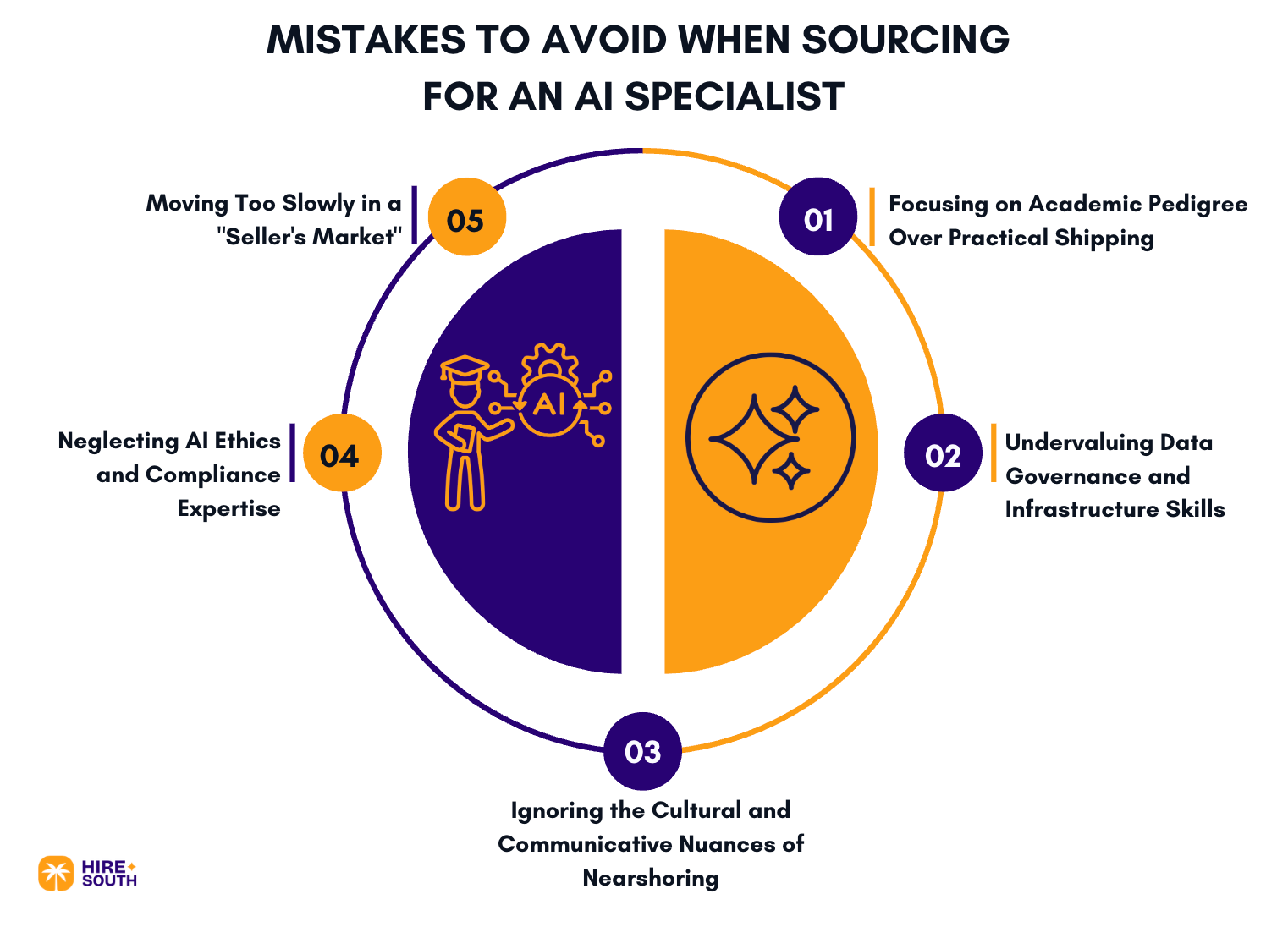
Hiring in the AI sector is high-stakes. While the talent pool in Latin America is deep, the path to a successful hire is littered with expensive pitfalls that can stall your digital transformation for years. If you want to build a high-performing team, you must avoid these common sourcing blunders that often derail even the most well-funded projects.
Focusing on Academic Pedigree Over Practical Shipping.
One of the biggest mistakes you can make is overvaluing a PhD from a top-tier school while ignoring a candidate’s "shipping" history. In the fast-moving 2026 landscape, theoretical knowledge expires quickly. You need specialists who have experience moving models from a Jupyter Notebook into a live production environment.
The consequences of ignoring practical deployment are stark. According to the RAND Corporation, roughly 80.3% of enterprise AI projects fail to deliver their promised business value, often because the models are technically impressive but functionally impossible to integrate into real-world workflows.
Undervaluing Data Governance and Infrastructure Skills.
You might be tempted to hire the most brilliant "Model Architect" you can find, but an AI specialist is only as good as the data they have to work with. Many companies fail because they hire for the "sexy" part of AI, the algorithms, while neglecting the "plumbing", the data engineering and MLOps.
This oversight is a primary driver of project abandonment. According to Gartner, it is predicted that 60% of AI projects will be canceled by the end of 2026 due to inadequate data foundations. When sourcing in LATAM, ensure you aren't just looking for someone who can build a chatbot, but someone who understands data lineage and infrastructure.
Ignoring the Cultural and Communicative Nuances of Nearshoring.
A common error is treating a LATAM hire as a "budget version" of a domestic employee. If you source purely on price, you will likely miss out on the collaborative "senior" talent that drives innovation. You must vet for English proficiency and cultural alignment just as rigorously as you vet for Python skills.
The competition for this top-tier talent is massive. Global AI talent demand currently outpaces supply by a staggering 3.2 to 1 in 2026, with over 1.6 million open roles worldwide and only 518,000 qualified candidates, according to SecondTalent. If you don't offer a culturally inclusive and professional environment, the best specialists will simply move to your competitors.
Neglecting AI Ethics and Compliance Expertise.
In 2026, sourcing an AI specialist without checking their knowledge of bias and ethics is a major liability. Many companies have already faced the music for using biased algorithms. For example, the EEOC successfully sued a firm for using an AI hiring platform that automatically rejected older applicants, resulting in a $365,000 settlement, according to Juicebox.
You cannot afford to treat ethics as an afterthought. Ensure your sourcing process includes questions about algorithmic fairness and data privacy laws. A specialist who doesn't understand the legal implications of their models is not an asset; they are a ticking time bomb for your brand's reputation.
Moving Too Slowly in a "Seller's Market".
If your hiring process takes three months, you have already lost the best talent. The high demand for AI skills has triggered massive salary inflation, with AI roles now paying 67% more than traditional software jobs, according to SecondTalent.
Top candidates in Mexico City or São Paulo often have multiple offers within days. You need to streamline your sourcing pipeline to be decisive. According to McKinsey, some industries are now waiting 6 to 7 months to fill a single AI role. If you find a specialist who checks your technical and cultural boxes, you need to be prepared to sign them immediately.
Ready to Hire AI Specialists in Latin America/
The quest for a high-level AI specialist is no longer a luxury for the few but a core survival strategy for any firm aiming to stay relevant in 2026. As traditional talent pools become increasingly saturated and expensive, Latin America has emerged as the definitive frontier for technical excellence and operational efficiency.
The economic logic is now impossible to ignore. U.S. companies are currently saving between $35,000 and $64,000 annually per hire by moving specialized roles to the LATAM region, according to Hire With Near’s 2026 Salary Guide. These savings aren't coming from "budget" junior roles either; in fact, 84% of nearshore placements are now for mid-level and senior positions where judgment and experience are paramount, according to the 2026 State of LatAm Hiring Report.
At Hire South, we specialize in bridging the gap between your high-level technical needs and the top 0.5% of Latin American talent. We understand that in the AI sector, a "good" hire isn't enough; you need the exceptional. Our battle-tested process identifies, vets, and delivers pre-screened candidates in just days, saving you months of administrative lag and ensuring your projects never lose momentum.
Whether you are looking for a single machine learning architect or a full-stack AI development team, we are your strategic partner in the region. Ready to transform your technical capabilities without the North American overhead? Want to see how we can help you build your 2026 AI roadmap with the best talent the Southern Hemisphere has to offer? Schedule a consultation with us today!