


Hiring remote talent in Latin America is becoming one of the fastest ways to scale a team without adding complexity. Strong technical skills, near-aligned time zones, and competitive compensation make the region a natural fit for companies that want speed and quality. And with internet penetration in LATAM now above 75 percent according to the World Bank, the region is more connected and work-ready than ever.
This article shows you the easy way to hire remote talent in Latin America. You’ll learn why the region has become a top nearshore hub, which roles you can fill quickly, and how to build a hiring process that removes friction. You’ll also see what to consider legally and financially, plus how to retain and scale a high-performing remote team. Finally, you’ll get practical guidance on choosing the right partner to streamline your LATAM hiring strategy.
Short, actionable, and built for busy leaders, this guide helps you make smarter decisions as you grow your remote workforce.
Common Adversities When Hiring Remote Talent
Hiring remote talent comes with its own set of challenges, and understanding them upfront helps you avoid slowdowns or costly missteps. These issues aren’t unique to Latin America, but they tend to surface more often when teams operate across borders, platforms, and legal frameworks.
Misaligned Role Expectations.
One of the biggest hurdles is defining the role clearly enough that candidates know exactly what success looks like. Vague job descriptions often lead to mismatches in skills, communication style, or seniority. A 2023 LinkedIn Global Talent Trends report found that 52 percent of failed remote hires stem from unclear expectations. When expectations shift mid-process, candidates disengage and hiring cycles stretch longer than necessary.
Inconsistent Communication Standards.
Remote work makes communication gaps more noticeable. Different comfort levels with async communication, varied writing proficiency, and platform overload can create friction. If you don’t set communication standards early, you risk delays, misunderstandings, and fragmented workflows. This is especially challenging for teams operating across multiple tools and channels.
Limited Visibility Into Work Habits.
You can’t observe work patterns in real time, so you rely heavily on candidate honesty and your evaluation process. Without structured vetting, you might miss red flags involving responsiveness, follow-through, or time management. Gartner’s 2024 Future of Work report notes that 45 percent of organizations struggle to assess remote work readiness during hiring, underscoring the need for better evaluation frameworks.
Verification and Background Checks.
Cross-border verification takes longer and often requires jurisdiction-specific checks. Education records, employment histories, and identity documents vary widely across Latin America. If your internal team isn’t familiar with regional verification systems, you may face delays or inconsistent results. This slows down hiring and increases the risk of onboarding the wrong person.
Compensation Misalignment.
Market rates fluctuate significantly by country, role, and experience level. Misjudging compensation can reduce your talent pool or extend negotiations unnecessarily. The Inter-American Development Bank reported that tech salaries in major LATAM hubs have increased between 8 and 20 percent annually, depending on the city. Without updated benchmarking, it’s easy to either overpay or underpay.
Legal and Compliance Complexities.
Each country has its own labor codes, tax requirements, and independent contractor rules. Hiring talent as contractors can be straightforward, yet misclassification risks still exist. Failing to comply with local regulations can expose your company to penalties or unexpected liabilities. Many organizations underestimate the legal preparation needed before making their first hire.
Onboarding Without Structure.
A weak onboarding experience creates early frustration for remote workers. Missing documentation, unclear workflows, and a lack of access to tools slow down productivity. Remote employees depend heavily on structured onboarding since they can’t rely on casual in-office guidance. When onboarding is rushed or incomplete, turnover risk increases in the first ninety days.
Security and Access Risks.
Providing system access across borders requires a stronger security posture. Improper credentialing, weak device policies, or unclear data handling rules increase vulnerability. Cybercrime in Latin America grew more than 30 percent year over year, according to Kaspersky’s 2024 regional report, which means your team needs consistent security protocols before onboarding new remote talent.
Cultural and Work-Style Variations.
Cultural nuances can shape communication, decision-making, and feedback styles. These differences aren’t obstacles, but they can cause friction when teams lack awareness or training. Even small gaps in work style understanding can lead to reduced collaboration or misinterpreted expectations. Successful teams acknowledge these differences early and create shared norms.
Maintaining Engagement Over Time.
Remote workers often feel disconnected when there’s limited visibility into team goals or decision-making. Without intentional engagement, motivation drops. Gallup’s 2024 State of the Global Workplace report shows that only 23 percent of remote employees globally feel “highly engaged.” Engagement isn’t automatic, you need consistent communication rhythms and structured check-ins to keep talent aligned and motivated.
What “Easy Hiring” Means in a Nearshore Context
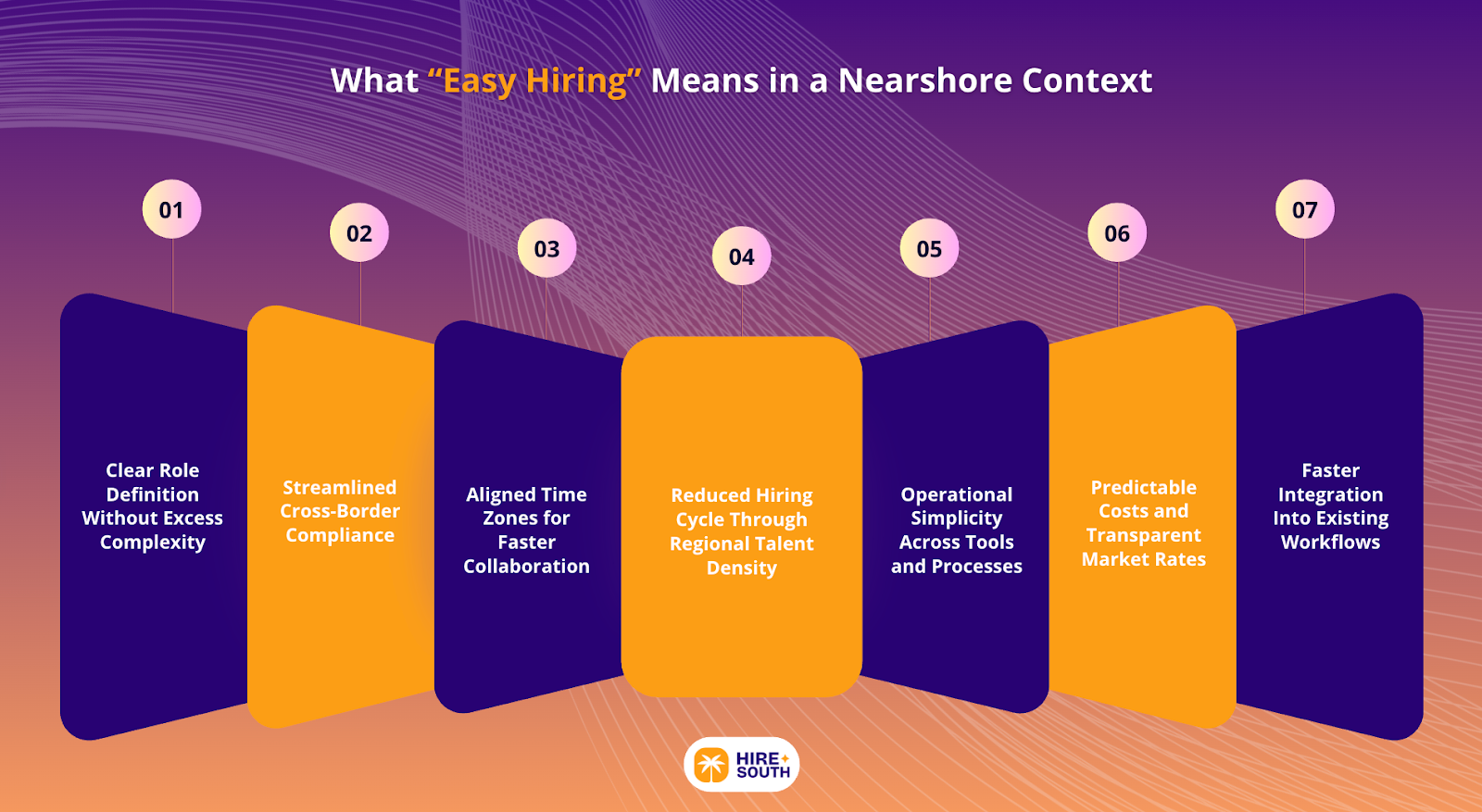
Clear Role Definition Without Excess Complexity:
Easy hiring starts with clarity. You define skills, responsibilities, and performance outcomes in a way that aligns with regional talent availability. This prevents mismatches and helps candidates self-qualify before they enter your pipeline.
Streamlined Cross-Border Compliance:
Nearshore hiring becomes “easy” when compliance steps are predictable and lightweight. You avoid navigating disparate labor codes on your own and rely on standardized processes, verified documentation, and country-specific onboarding rules that eliminate guesswork. The World Bank notes that regulatory complexity in LATAM varies sharply by country, so structuring a uniform compliance workflow reduces delays and lowers risk.
Aligned Time Zones for Faster Collaboration:
A major part of easy hiring in the nearshore model is the ability to integrate remote talent seamlessly into existing workflows. Overlapping working hours cut down response times and reduce the need for late-night or early-morning meetings. Workday’s 2024 Workforce Insights report shows that teams with aligned time zones experience 24 percent quicker project turnaround, reinforcing why nearshore hiring streamlines team performance from day one.
Reduced Hiring Cycle Through Regional Talent Density:
LATAM offers a large concentration of experienced professionals in tech, operations, and customer support. High talent density shortens hiring cycles because you spend less time searching and more time evaluating viable candidates. The Inter American Development Bank reported that the region added over one million new tech workers in five years, creating broader and more immediate access to qualified talent.
Operational Simplicity Across Tools and Processes:
Easy hiring also means minimizing tool overload and ensuring candidates progress through a simple, standardized workflow. When your sourcing, interviewing, and documentation processes are consolidated, you limit friction for both candidates and internal teams. This structure creates a smoother handoff from recruitment to onboarding and reduces drop-off rates during the hiring journey.
Predictable Costs and Transparent Market Rates:
Cost alignment is a core part of making nearshore hiring feel “easy.” You benefit from clear country-specific salary benchmarks and predictable compensation bands. With LATAM tech salaries increasing between 8 and 20 percent annually, depending on the country, according to the Inter American Development Bank, updated data ensures your offers remain competitive without overshooting budget targets.
Faster Integration Into Existing Workflows:
Nearshore hiring feels simpler when new talent can contribute quickly. Shared business hours, similar communication styles, and proximity to North American markets all support faster onboarding. This reduces the time between hire and full productivity, which is one of the main reasons companies look to nearshore regions for remote expansion.
The Fastest Paths to LATAM Talent Hiring Today
1. Sourcing Through Established Nearshore Talent Networks
One of the quickest ways to hire in LATAM is to tap into existing regional talent networks. These networks already maintain databases of pre-screened professionals across tech, operations, finance, creative, and support roles. Because candidates are validated and active in the job market, you avoid long sourcing cycles.
2. Leveraging Country-Specific Job Platforms With High Talent Density
LATAM has several job platforms that dominate in specific countries and consistently attract skilled candidates. Brazil’s Gupy, Mexico’s OCCMundial, Argentina’s Bumeran, and Colombia’s Computrabajo fill roles faster because local professionals rely on them as their primary job search channels. Using these platforms helps you reach qualified applicants quickly without running multi-week campaigns across global boards.
3. Targeting University and Bootcamp Pipelines With Proven Output
University career centers and coding bootcamps across LATAM have become reliable talent sources. Schools like Tec de Monterrey in Mexico, Universidad de los Andes in Colombia, and engineering programs in Argentina and Brazil maintain structured graduate databases. According to HolonIQ’s LATAM EdTech Market Report, technical bootcamps in the region graduate over 80,000 students each year, many with job-ready skills. These pipelines shorten the search for early-career and mid-level talent.
4. Using Referral-Based Recruiting to Speed Up Candidate Quality
Referrals remain one of the fastest ways to hire, especially in countries with strong professional networks. Referred candidates typically move through the interview process faster and require fewer evaluation loops. The 2023 Jobvite Recruiter Nation Report found that referrals lead to hires four times faster than other channels. In LATAM, where community-based networks are strong, referral recruiting consistently accelerates hiring timelines.
5. Running Specialized, Skills-Focused Screening Sprints
Skill-based screening sprints compress hiring cycles by evaluating multiple candidates in parallel. Instead of long sequential interviews, you run structured assessments tailored to local talent. This works especially well in tech and customer experience roles. Stack Overflow’s 2024 Developer Survey highlights that LATAM developers score competitively in structured tests, which increases the efficiency of skill-based evaluation workflows.
6. Building Shortlists From Regional Freelance Platforms
Freelance platforms like Workana, Freelancer LATAM, and GetNinjas provide fast access to independent professionals. While not ideal for every full-time role, they give you quick visibility into available talent with verified work histories. This approach helps you identify high-performing freelancers who may be open to long-term engagement. It also cuts down early sourcing time because candidate profiles already include portfolios, reviews, and response metrics.
7. Engaging Local Professional Communities and Industry Groups
LATAM’s tech and business communities are active across Slack groups, Discord channels, WhatsApp circles, and city-based associations. These communities often respond faster than formal job postings because members share openings directly with peers. A Digital 2024 report by DataReportal shows that WhatsApp penetration surpasses 90 percent in most LATAM countries, making it one of the most efficient channels for rapid networking and candidate outreach.
Ready to Hire Remote Talent in Latin America?
Building a reliable remote hiring strategy in Latin America comes down to clarity, consistency, and access to the right talent pools. Companies that streamline their sourcing, screening, and onboarding workflows see faster time-to-productivity and fewer failed hires, a crucial advantage as global competition for talent intensifies. With 58 percent of organizations increasing their use of global remote workers in 2024, according to Gartner, the ability to hire efficiently in LATAM is now a competitive differentiator, not just an operational choice.
At Hire South, we’ve built our processes around these exact challenges. Our team specializes in identifying high-performing LATAM talent, validating their capabilities, and aligning them with the specific needs of growing companies. By combining regional expertise, structured evaluation frameworks, and transparent hiring practices, we help organizations reduce time-to-hire and avoid missteps that slow down cross-border hiring. If you’re scaling your remote workforce and want a dependable path forward, our approach is designed to make LATAM hiring faster, clearer, and more predictable from start to finish. Whenever you are ready, contact us to start hiring faster!