


These days, finding top-tier talent shouldn’t feel like a compromise between your budget and your sleep schedule. If you’ve struggled with the high costs of domestic hiring or the lost-in-translation headaches of offshore teams, you’re likely looking for a middle ground that actually works.
That’s where nearshoring comes in. By hiring LATAM talent, you aren't just cutting costs, you're gaining partners who work in your time zone and understand your business culture. The math is hard to ignore: U.S. companies save an average of $35,000 to $64,000 annually per Latin American hire compared to equivalent domestic roles.
This article breaks down why recruiting LATAM professionals has become the go-to strategy for high-growth companies in 2026. You’ll explore the top regional tech hubs, learn how to navigate local labor laws, and discover why this model is a genuine win-win for both your bottom line and your team’s productivity.
Why Nearshoring Is Key For Hiring LATAM Talent
If you’ve ever managed a team across a 12-hour time difference, you know the "communication tax." You send a critical Slack message at 4:00 PM, only to wait until the next morning for a reply. Nearshoring eliminates this lag by aligning your talent’s workday with your own.
When you hire LATAM talent, you aren't just getting a remote worker; you’re getting real-time collaboration. This structural alignment is the primary reason that 60% of enterprise leaders now rank time zone compatibility as their "very important" factor when choosing an outsourcing partner, according to Auxis.
Unlocking Real-Time Collaboration and Velocity:
The biggest advantage of nearshoring is "synchronous communication." Because most LATAM tech hubs sit within the Eastern or Central time zones, your offshore team becomes a seamless extension of your local office. You can run daily stand-ups, jump into spontaneous huddles, and solve blockers in minutes rather than days.
This proximity has a measurable impact on your bottom line. Companies utilizing nearshore models report a 10% to 20% boost in productivity simply by removing the delays associated with traditional offshore "hand-off" models, according to Auxis. You gain an extra day of work every week by cutting out the overnight wait times.
Achieving Competitive Cost Savings Without the Quality Gap:
While hiring locally in the U.S. remains prohibitively expensive, nearshoring offers a middle ground that balances budget and skill. You can access senior-level expertise for a fraction of the domestic cost.
According to Nearshore Business Solutions, senior developers in major hubs like Bogotá or Guadalajara earn between $54,000 and $80,000 annually. When you compare that to the $200,000+ salary typically required for a senior engineer in San Francisco or New York, the math becomes a clear driver for growth. These aren't "budget" hires; they are top-tier professionals working at rational market rates.
Enhancing Talent Retention and Cultural Synergy:
High turnover is the silent killer of productivity in many offshore regions. In some Asian markets, annual turnover in the BPO and tech sectors can be destabilizing. Nearshoring to Latin America tends to offer a much more stable workforce.
Specialized nearshore staffing models currently see retention rates as high as 98% over two years, according to Howdy. This stability is often rooted in cultural affinity. LATAM professionals share a similar work ethic and business vision with U.S. standards, which reduces the friction often found in more distant outsourcing models.
Accessing a Massive and Growing Talent Reservoir:
You aren't limited to a few niche pockets of talent. The region is a powerhouse of STEM education. Argentina, for example, consistently ranks high in English proficiency, scoring 575 out of 800 in recent regional studies, according to Dev.Pro.
The scale of the workforce is also massive:
- Brazil and Mexico combined are home to more than 2.2 million software engineering professionals, according to Dev.Pro.
- The region produces over 350,000 new engineering graduates every year.
- Investment in technical education has transformed the region into a "white-collar" hub for AI, fintech, and cloud infrastructure.
The Strategic Benefits of Recruiting LATAM Professionals
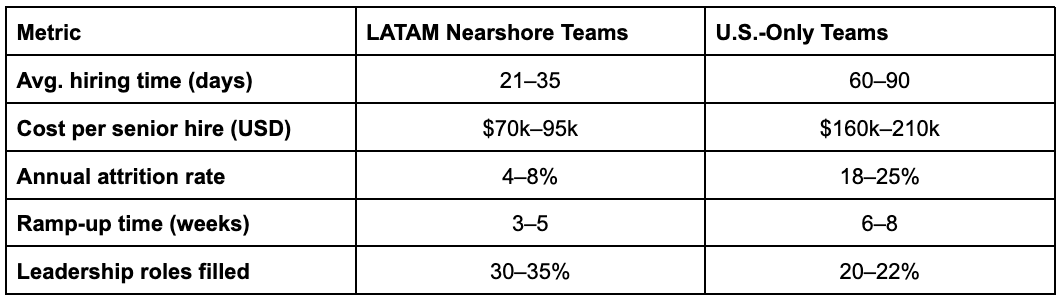
While the immediate draw of nearshoring often starts with the budget, the long-term value lies in how it fundamentally changes your team’s output. Recruiting LATAM professionals isn't just about finding a remote worker; it’s about integrating a partner who functions at your same rhythm.
In 2026, the data shows that "location-agnostic" hiring has evolved into "time-zone-synchronized" hiring. Companies are moving away from distant offshore models toward Latin America because the strategic advantages go far beyond just a lower price tag.
1. Boosting Velocity with Perfect Time Zone Overlap
The most significant strategic win is the death of the 12-hour communication lag. Unlike hiring in Eastern Europe or Asia, recruiting in LATAM allows your remote team to work the same business hours as your headquarters. This overlap facilitates synchronous collaboration, which is essential for Agile workflows and rapid-response environments.
According to Mismo, most Latin American tech hubs operate within 0 to 3 hours of U.S. time zones. A developer in Bogotá, for example, is aligned with the U.S. East Coast for most of the year. This enables real-time daily stand-ups, instant troubleshooting on Slack, and live pair programming without anyone having to wake up at 3:00 AM.
2. High English Proficiency and Communication Clarity
Language barriers are the silent killers of remote projects. Fortunately, the "nearshore" advantage includes a workforce that has invested heavily in bilingualism. In fact, Argentina consistently leads the region, ranking 28th globally and 2nd in Latin America for English proficiency, according to N-iX.
This high level of fluency ensures that complex technical requirements aren't "lost in translation." When you hire in hubs like Buenos Aires, Medellín, or Mexico City, you aren't just getting someone who can read a ticket; you're getting a professional who can contribute to high-level strategy and brainstorm solutions in real-time.
3. Tapping into a Massive, AI-Ready Talent Pipeline
If you feel the talent crunch in the U.S., it’s because the demand for specialized roles is outpacing supply. Latin America is filling that void with an aggressive focus on STEM education. The region is no longer just a "support" hub; it has become a center for AI, fintech, and cloud infrastructure.
According to Alcor, the region produces over 220,000 STEM graduates every year. In Brazil and Mexico alone, there are more than 1.5 million tech professionals ready for hire. This density allows you to fill niche roles, like AI/ML Engineers or Cloud Architects, in 2 to 6 weeks, rather than the months it might take in a hyper-competitive domestic market.
4. Drastic Reduction in Recruitment and Retention Costs
Hiring in the U.S. is expensive, but replacing a hire is even worse. Domestic turnover in tech is notoriously high. However, LATAM professionals often show much higher loyalty to international employers who provide stable, competitive compensation in USD or inflation-protected local currency.
According to Howdy, companies hiring through specialized LATAM staffing models report retention rates as high as 98% over two years. Compare that to the average U.S. tech turnover rate of roughly 23%, according to LatamCent. Over two years, maintaining a stable team can save you between $60,000 and $120,000 per team member in rehiring and lost productivity costs.
5. Cultural Alignment and Shared Business Values
Strategic fit is about more than just skills; it’s about how people work. Latin American business culture shares a strong affinity with Western norms, prioritizing transparency, direct communication, and a "can-do" entrepreneurial spirit. This shared context means less time spent on "cultural sensitivity training" and more time spent shipping code and hitting KPIs.
How Nearshoring Enhances Collaboration Between Parties

1. Eliminating the "Communication Tax" with Shared Hours
The most immediate benefit you'll notice is the removal of the 24-hour feedback loop. In many offshore models, every clarification or follow-up question adds a full day to your timeline. Nearshoring aligns your team along a North-South axis, ensuring that the majority of your workdays overlap.
According to Avila VA, this alignment allows projects to move 2 to 3 times faster compared to traditional offshore models. If a developer in Mexico City has a question at 10:00 AM, they get an answer at 10:05 AM. This isn't just a convenience; it’s a velocity multiplier that allows your team to close feedback loops in hours instead of days.
2. Fostering Agile Integration and Spontaneous Innovation
Agile methodology relies on constant, iterative communication. If you can’t have a daily stand-up without someone joining at midnight, the "Agile" part starts to break down. Nearshoring allows your LATAM professionals to participate in every ritual, sprint planning, retrospectives, and spontaneous "huddles" as if they were in the next room.
This constant contact builds a level of trust and "psychological safety" that is often missing in distant teams. According to Harvard Business School, time zone overlap significantly reduces coordination costs and makes real-time collaboration sustainable for the long term. You move from managing a "vendor" to leading a unified team.
3. Reducing Mental Fatigue and Management Overhead
Managing a team across opposite time zones is exhausting. It forces you or your leads into "split shifts," taking calls late at night or early in the morning. This leads to burnout and oversight errors. With nearshoring, the management burden drops because you aren't fighting the clock to get a status update.
According to research published by Rice Business, a one-hour increase in "temporal distance" (time zone gap) reduces synchronous communication by 11%. By keeping that gap to a minimum, you maintain the high-frequency communication necessary for complex, non-routine tasks like software architecture or creative strategy.
4. Improving Quality Through Continuous Oversight
When you work in sync, you can catch mistakes before they become expensive problems. Nearshoring facilitates "continuous supervision," where you can review code or designs as they are being produced. This real-time visibility ensures that the final output aligns perfectly with your expectations.
According to a report by McKinsey, companies that switch to nearshore strategies often see a 20% improvement in operational efficiency. This gain doesn't just come from lower wages; it comes from the reduction in "rework" and the ability to pivot project directions instantly without wasting a full work cycle.
Is Nearshore Outsourcing the Best Option for Your Company?
Choosing an outsourcing model is no longer just a binary choice between "cheap" and "local." In 2026, the decision hinges on how much collaboration your specific project requires. If your team operates in a fast-paced environment where requirements shift weekly, the nearshore model is likely your strongest bet.
However, it isn't a one-size-fits-all solution. Determining if it's the right fit requires looking at your "Total Cost of Ownership" rather than just the hourly rate. According to Ideaware, while offshore teams can offer 60% to 80% savings, nearshore teams provide a more balanced 40% to 60% reduction in costs without the "hidden" 15% to 25% rework tax often found in asynchronous offshore models.
Your Project Prioritizes Real-Time Iteration.
If you are building a product that requires constant feedback, such as a new SaaS platform or an AI-driven interface, you can’t afford to wait 12 hours for a reply. Nearshoring is the "Goldilocks" zone for Agile development.
According to Golabs Tech, projects that require frequent pivots and live collaboration perform better with nearshore developers because of the 4 to 8 hours of daily working overlap. If your internal team relies on daily stand-ups and spontaneous Slack huddles to keep projects on track, nearshoring will feel like adding a desk in the next room rather than hiring a distant vendor.
You Need to Bridge the "Seniority Gap" Without Breaking the Bank.
One of the most compelling reasons to hire LATAM professionals in 2026 is the access to experienced leadership. Domestic markets have become so competitive that hiring a senior VP of Engineering or a Lead Cloud Architect can take six months and a massive salary package.
According to data from Hire with Near, 84% of placements in Latin America for U.S. companies are now for mid-level or senior positions. In fact, one-third of all hires are for executive-level roles like Directors and VPs. If you need someone who can lead a team and architect complex systems—not just take orders, the LATAM talent pool offers the seniority you need at a fraction of the Silicon Valley price tag.
You Are Scaling a Compliance-Heavy or Regulated Operation.
If you work in fintech, healthcare, or any sector with strict data privacy laws, nearshoring offers a layer of security that traditional offshore hubs often struggle to match. Many LATAM countries have updated their legal frameworks to align with international standards like GDPR and SOC2.
According to AlterSquare, nearshore partnerships in Latin America often feature stronger Intellectual Property (IP) protections and compliance readiness than those in distant offshore locations. Because these countries share a hemisphere and frequently trade with the U.S. under agreements like the USMCA, the legal and regulatory alignment is naturally tighter.
A Quick Checklist: Is Nearshoring Right for You?
Before you sign a contract, run through these indicators. If you say "yes" to more than three, nearshoring is likely your best path forward:
- Feedback Cycles: Do you need same-day answers to unblock your engineers?
- Project Type: Are you building a core product rather than a standardized, repetitive task?
- Language: Do you need your remote team to participate in high-level strategy meetings in fluent English?
Ready to Start Nearshoring and Hire LATAM Talent?
The transition to a nearshore model is more than a cost-cutting exercise; it is a strategic upgrade to your company’s operational DNA. In an era where 84% of nearshore placements are now for mid-level to senior roles, the focus has shifted from finding "extra hands" to securing the high-level expertise required to lead complex projects. Aligning your team across the same time zones doesn't just save you money; it buys you the speed and agility necessary to outpace the competition.
At Hire South, we specialize in making this transition seamless and risk-free. By tapping into an elite network of Latin American talent, according to our internal gauntlet, we ensure you aren't just hiring, you're scaling with the region’s best. Whether you need to bridge a technical gap or build a specialized department from the ground up, our team provides the compliance, payroll, and recruitment infrastructure to get you running in just days. Make sure to schedule a FREE strategy call when you are ready to get started!