


When you need to scale a digital product, you usually face a binary choice: hire a lone-wolf freelancer or build an in-house team. However, as projects grow in complexity, the "freelancer friction" of managing scattered individuals often outweighs the initial cost savings. This is why forward-thinking companies are pivoting toward dedicated nearshore teams to bridge the gap between quality and agility.
The shift is backed by significant economic momentum. According to the Inter-American Development Bank (IDB), nearshoring could increase exports from Latin America and the Caribbean by $78 billion annually, a testament to the region's rising status as a premier hub for integrated talent. By choosing a nearshore model, you aren't just hiring people; you are adopting a synchronized engine designed to fit your time zone and your culture.
This article dives into the critical differences between a nearshore team and freelancers. We will explore why IT nearshoring vs freelancer models result in vastly different outcomes for code quality, security, and long-term scalability. If you are tired of the revolving door of gig workers, it is time to look at the stability of a nearshore team.
Why Modern Businesses Should Move Away from Freelancers
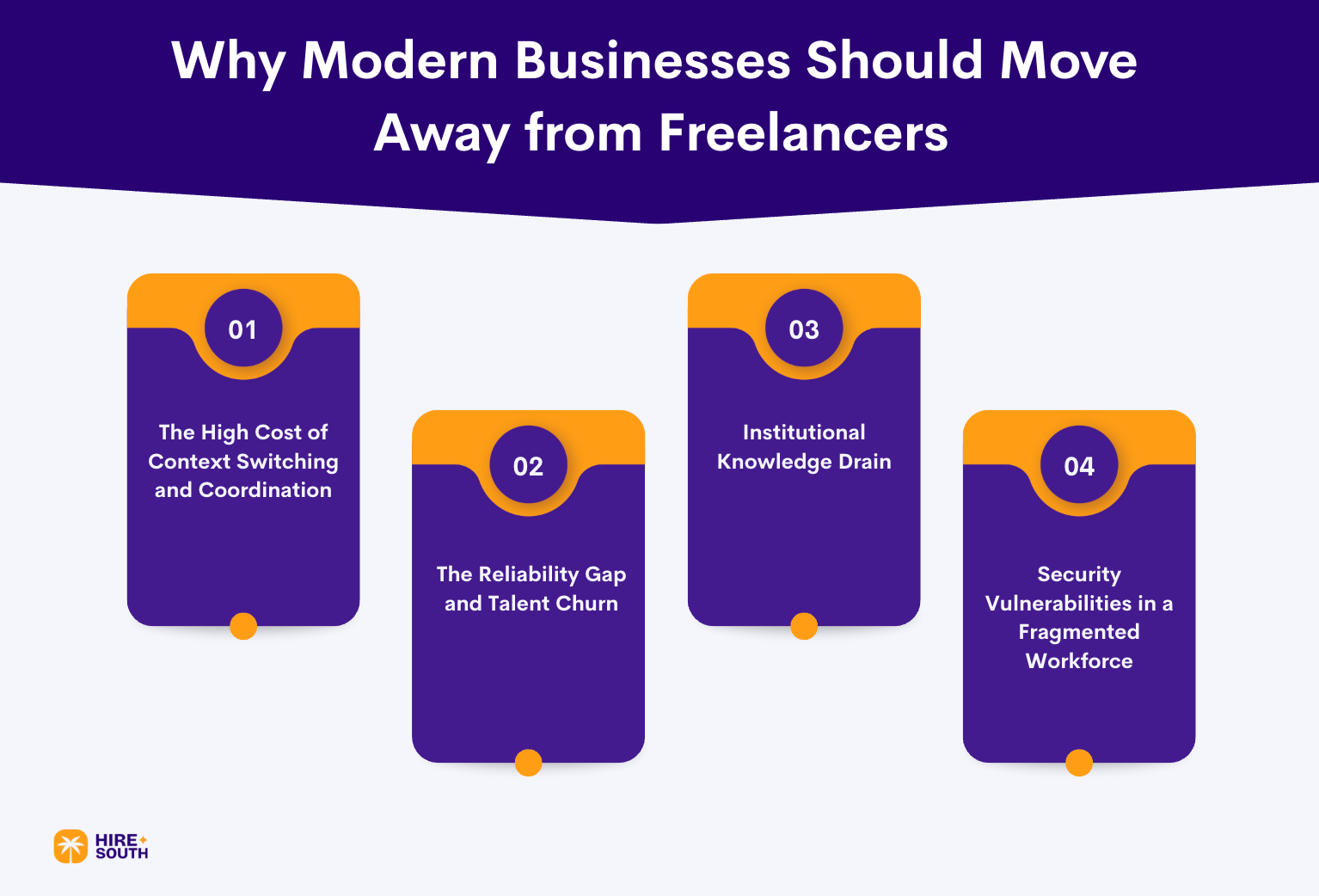
The solo freelancer model often feels like the path of least resistance when you need a quick fix. However, as your business moves from survival mode into a scaling phase, the cracks in the gig economy start to show. Relying on a fragmented network of individual contractors can quickly turn into a management nightmare that drains your most valuable resource: time.
1. The High Cost of Context Switching and Coordination
When you hire multiple freelancers, you become the de facto project manager, lead architect, and cultural glue. You have to explain your brand voice, technical debt, and business goals to five different people who likely never speak to each other. This creates a "silo effect" where information gets trapped.
According to Qatalog, workers lose an average of five hours per week just switching between different apps and trying to find information shared across disconnected team members. With freelancers, this friction is amplified. You aren't paying for a cohesive output, you are paying for individual hours that you must then stitch together yourself.
2. The Reliability Gap and Talent Churn
Freelancers are, by definition, unattached. Their primary loyalty is to their own business, not yours. If a higher-paying project comes along, your project often takes a backseat or, worse, faces a sudden "ghosting" situation.
According to Upwork’s 2024 Freelance Forward report, nearly 50% of freelancers are juggling multiple clients at any given time to maintain their financial stability. This divided attention means you aren't getting a partner, you are getting a fraction of a person. In contrast, nearshore teams operate with a "dedicated" mindset, meaning their focus remains solely on your milestones, providing a level of predictability that solo gig workers cannot guarantee.
3. Institutional Knowledge Drain
One of the biggest risks of the IT nearshoring vs freelancer debate is what happens when the work is finished. When a freelancer leaves, your institutional knowledge leaves with them. They take the "why" behind the code or the "how" behind the strategy to their next client.
Modern businesses need continuity. If a bug appears six months later, finding that same freelancer, who may now be booked for the next year, is a gamble. According to Glassdoor, it takes an average of 42 days to fill a position, but the time lost recovering lost knowledge from a departed freelancer can set a project back by months.
4. Security Vulnerabilities in a Fragmented Workforce
Managing the security protocols of several independent contractors is a logistical hurdle that leaves you exposed. Each freelancer uses their own hardware, their own unverified Wi-Fi networks, and their own storage solutions.
According to Verizon’s 2025 Data Breach Investigations Report, "human element" vulnerabilities, including insecure remote access by third parties, remain a top cause of data leaks. When you move away from freelancers toward dedicated nearshore teams, you gain the security of a centralized infrastructure. Agencies typically enforce standardized security training and hardware encryption that a solo freelancer simply doesn't have the budget or incentive to implement.
How Nearshore Teams Outperform Freelancers
While a freelancer might be a master of a single task, a nearshore team is a master of your project's ecosystem. The primary reason a nearshore team vs freelancers comparison often favors the former is the transition from "task completion" to "workflow ownership." When you hire a team, you are securing a synchronized unit that manages its own internal communication, quality checks, and deadlines.
According to ScaleupAlly, nearshore projects achieve an 80% success rate compared to just 60% for traditional offshore or fragmented models. This 20% gap represents the difference between a project that launches on time and one that languishes in endless revision loops.
Superior Speed to Market and Development Velocity.
In the tech world, speed is the ultimate currency. Because dedicated nearshore teams operate in your time zone, they eliminate the "dead time" where a project sits idle waiting for a freelancer in a different hemisphere to wake up. This real-time feedback loop allows for instant troubleshooting and rapid iteration.
According to multiple sources, nearshore teams can reduce time-to-market by 30% to 50%. This is largely due to the "same-day" resolution of blockers. When a developer encounters an issue at 10:00 AM, they can hop on a call with your product owner immediately, rather than sending an email and losing an entire business day.
Higher Accuracy and Reduced Rework.
Freelancers often lack the broader context of your business goals, leading to "feature creep" or solutions that don't scale. A nearshore team, however, integrates into your long-term roadmap. They aren't just writing code; they are building a product that must remain maintainable for years.
The accuracy gap is startling when measured over high-volume workflows. According to TRANSFORM Solution, dedicated teams maintain an accuracy rate of 96% to 99%, whereas freelancer pools often fluctuate between 78% and 89%. When you account for the cost of "rework" fixing errors made by a solo contractor, the perceived savings of a freelancer often evaporate.
Predictable SLAs and Enterprise-Grade Reliability.
One of the most significant nearshore team vs freelancers differentiators is the presence of Service Level Agreements (SLAs). Freelancers rarely commit to rigid uptime or turnaround guarantees because they lack the backup resources to cover for illness or personal emergencies.
A nearshore team provides built-in redundancy. If one developer is unavailable, the team’s lead can redistribute the load to ensure your sprint stays on track. According to Howdy, integrated nearshore platforms often report retention rates as high as 98%, ensuring that the "institutional knowledge" of your project stays within your team rather than walking out the door with a solo gig worker.
Advanced Security and Compliance Standards.
For businesses in fintech, healthcare, or any regulated industry, freelancers represent a significant security risk. Most individual contractors do not operate under rigorous frameworks like SOC2, HIPAA, or GDPR.
Nearshore agencies, conversely, build their entire business model around these standards. According to CXC Global, 2026 has seen a major shift toward nearshoring specifically because these teams provide stronger workforce governance and data protection. You get the peace of mind that your intellectual property is being handled on encrypted, company-managed hardware rather than a freelancer's personal laptop.
Transitioning From Freelancers To Nearshore Teams
Moving from a fragmented group of contractors to a unified squad is a major milestone in your company’s maturity. It signals that your projects have outgrown "quick fixes" and now require a scalable architecture. This transition is not about firing people; it is about upgrading your operational OS to handle higher complexity and faster delivery cycles.
1. Auditing Your Current Freelance Dependencies
Before you flip the switch, you need to map out where your tribal knowledge currently lives. Many businesses find themselves "hostage" to a single freelancer who holds the only key to a legacy codebase or a specific marketing automation.
According to PMI (Project Management Institute), poor communication and lack of integrated requirements are the primary causes of project failure in one-third of all business initiatives. Identifying these single points of failure allows you to prioritize which roles to migrate to a dedicated nearshore team first to ensure business continuity.
2. Standardizing Your Toolstack for Team Integration
Freelancers often bring their own preferred tools, leading to a "software soup" of Trello boards, Slack channels, and personal Dropbox folders. A successful shift to IT nearshoring requires you to centralize your environment.
You must establish a single source of truth for your documentation and code. According to Stack Overflow’s 2025 Developer Survey, teams that use centralized collaboration platforms report 24% higher productivity than those using fragmented, individual-led toolsets. By standardizing on GitHub or Notion before the team arrives, you create a plug-and-play environment for your new nearshore partners.
3. Executing a Knowledge Transfer Sprint
The transition period is the most critical phase. Instead of a hard handoff, run a two-week "Knowledge Transfer Sprint" where your outgoing freelancers document their workflows for the incoming nearshore team.
This overlap ensures that the subtle nuances of your project, the "why" behind specific decisions—aren't lost in the shuffle. According to Deloitte, organizations with high-maturity knowledge-sharing practices are 3.7 times more likely to innovate faster than their competitors. This structured handoff prevents the "restart penalty" that often occurs when changing service providers.
4. Defining New Success Metrics for Managed Teams
Your KPIs (Key Performance Indicators) must evolve when moving from a nearshore team vs freelancer model. With freelancers, you likely measure "hours worked" or "tasks completed." With a dedicated team, you should focus on "sprint velocity" and "deployment frequency."
According to DevOps Research and Assessment, high-performing teams are distinguished by their ability to deploy frequently and recover from service failures in less than one hour. A nearshore team allows you to track these enterprise-level metrics, moving your focus from micro-managing individual output to measuring the health and speed of your entire development pipeline.
Ready to Hire a Nearshore Team?
Transitioning from a fragmented freelance model to a structured, cohesive workflow is the single most effective way to eliminate technical debt and management fatigue. By moving toward dedicated nearshore teams, you secure the cultural alignment and real-time collaboration necessary to turn complex projects into predictable successes.
At Hire South, we bridge the gap between your ambitious roadmap and the high-performing talent required to execute it. We specialize in curating elite nearshore teams that integrate directly into your existing infrastructure, offering higher cost savings compared to US-based hires without the communication issues of offshore models.
Our rigorous vetting process ensures that every professional we provide is top of their field, bringing both technical mastery and a proactive, owner-centric mindset to your organization. When you are ready to stop managing individual tasks and start leading a unified workforce, we are your strategic partner for sustainable growth. Contact us to hire your next nearshore team!


.jpg)