


Hiring remote talent in Uruguay is no longer a niche strategy. It’s a competitive move. Uruguay ranks as the top country in Latin America for remote work conditions, according to the Global Remote Work Index, driven by strong digital infrastructure, high institutional stability, and a skilled workforce.
In this guide, you’ll get a clear view of Uruguay’s remote talent market and what makes it attractive for international employers. We break down key roles, hiring costs, legal and payroll considerations, and the practical steps to hire compliantly. You’ll also learn how to avoid common risks and scale remote teams in Uruguay with confidence.
Why Hire Remote Talent in Uruguay
Strong Digital Infrastructure You Can Rely On:
Uruguay offers one of the most reliable digital environments in Latin America. Internet penetration exceeds 90%, according to the International Telecommunication Union, and fixed broadband quality consistently ranks among the strongest in the region. That matters when you rely on stable connections for daily collaboration, video calls, and cloud-based work. For remote-first teams, fewer disruptions translate into higher productivity and less operational friction.
A Highly Educated, Globally Oriented Workforce:
Uruguay has a long-standing focus on education, particularly in technology and professional services. Public universities and technical institutes produce graduates with strong analytical and problem-solving skills. English proficiency is also a differentiator. Uruguay ranks among the top Latin American countries for English skills, according to EF’s English Proficiency Index, making communication with international teams smoother and more efficient.
Time Zone Alignment That Supports Real-Time Work:
Hiring remote talent in Uruguay allows you to operate in near real time with North America. The country’s GMT-3 time zone overlaps fully with US East Coast business hours and partially with Europe. That alignment reduces delays, speeds up decision-making, and simplifies team management compared to offshore regions with 8 to 12-hour gaps.
Competitive Costs Without Compromising Quality:
Remote talent hiring in Uruguay offers a balance that many companies look for. Salaries are generally lower than in the US or Western Europe, yet the quality of work remains high. According to data from the Inter-American Development Bank, labor costs in Uruguay are competitive within Latin America while maintaining strong labor standards. You get access to experienced professionals without sacrificing reliability or output.
Political and Institutional Stability for Long-Term Hiring:
Uruguay is widely recognized for its stable democratic institutions and transparent regulatory environment. It consistently ranks as one of the least corrupt countries in Latin America, according to Transparency International’s Corruption Perceptions Index. For you, this stability reduces long-term risk when building and retaining remote teams in the country.
A Remote-Ready Culture and Work Ethic:
Remote work adoption in Uruguay accelerated early and stuck. Professionals are accustomed to distributed teams, asynchronous communication, and performance-based evaluation. That cultural readiness lowers onboarding time and helps remote hires integrate quickly into international workflows, especially in tech, finance, operations, and professional services roles.
Uruguay’s Talent Landscape
1. Core Professional Profiles You’ll Find
Uruguay’s remote talent pool is strongest in technology, finance, operations, and business support roles. Software developers, QA engineers, data analysts, accountants, and bilingual customer-facing professionals are widely available. The country has also built depth in roles that require autonomy and structured thinking, which makes Uruguay's remote talent well-suited for distributed teams.
2. Education Levels and Skill Formation
Uruguay stands out for its access to higher education. Tertiary enrollment rates are among the highest in Latin America, with over 60% gross tertiary enrollment, according to the UNESCO Institute for Statistics. Public universities and technical programs play a major role, especially in engineering, IT, economics, and business administration. This results in a talent base that adapts quickly to new tools and processes.
3. English and Multilingual Capabilities
English proficiency is a practical advantage across Uruguay’s talent landscape. Professionals in tech, finance, and shared services often use English daily with international clients. Uruguay consistently ranks in the high proficiency category in Latin America, according to EF’s English Proficiency Index, which reduces communication gaps and training overhead when hiring remote talent in Uruguay.
4. Experience With International Companies
Many Uruguayan professionals have worked with US, Canadian, and European employers. This is partly driven by the country’s export-oriented services sector. ICT service exports account for a meaningful share of Uruguay’s economy, representing over 5% of GDP, according to the World Bank. That exposure shapes professionals who are comfortable with global standards, documentation, and performance metrics.
5. Geographic Concentration of Talent
Montevideo concentrates the largest share of skilled professionals, particularly in technology and corporate services. However, remote work has expanded access to talent in secondary cities such as Maldonado, Colonia, and Salto. This wider distribution increases hiring flexibility and helps you reach experienced professionals outside the most competitive urban markets.
6. Workforce Size and Availability
Uruguay’s labor force is smaller than that of larger Latin American countries, but it is highly specialized. According to Uruguay’s National Institute of Statistics, services account for more than 70% of total employment, reinforcing the country’s strength in knowledge-based and remote-friendly roles. For targeted hiring, quality often outweighs volume.
Main Options To Hire Remote Talent in Uruguay
Hiring Uruguayan Talent as Independent Contractors.
One common option is hiring remote talent in Uruguay as independent contractors. This model offers speed and flexibility, especially for short-term or project-based needs. Contractors manage their own taxes and social security, which can reduce administrative load.
That said, Uruguay has clear criteria around worker independence. According to guidance from Uruguay’s Ministry of Labor and Social Security, misclassification risks increase when contractors work under fixed schedules, use company equipment, or report to internal managers. For you, the key is limiting control and clearly defining deliverables in written agreements.
Employing Talent Through a Local Legal Entity.
If long-term growth is the goal, setting up a local entity in Uruguay allows you to hire remote employees directly. This approach provides full control over employment terms, benefits, and career development.
However, it comes with higher complexity. Employers must comply with local labor law, register with tax and social security authorities, and manage payroll contributions. According to Uruguay’s social security authority BPS, employer contributions can exceed 12% of gross salary, depending on benefits and insurance coverage. This option works best when hiring at scale.
Using an Employer of Record Model.
An Employer of Record, or EOR, is widely used for remote talent hiring in Uruguay when speed and compliance are priorities. Under this structure, the EOR legally employs the worker in Uruguay while you manage day-to-day responsibilities.
This model helps navigate local labor laws, mandatory benefits, and payroll requirements without establishing a legal entity. It’s particularly effective for companies testing the Uruguayan market or hiring small teams while maintaining compliance with Uruguay’s employment regulations.
Partnering With Local Staffing or Recruitment Firms.
Local recruitment partners focus on sourcing, vetting, and shortlisting Uruguay remote talent. This option is useful when roles require specific technical or language skills, or when hiring timelines are tight.
According to data from Uruguay XXI, the country’s investment and export promotion agency, professional services exports continue to grow year over year, increasing competition for qualified talent. Local recruiters bring market insight on salary benchmarks, candidate availability, and hiring expectations that are difficult to assess remotely.
Hybrid Hiring Models for Flexibility.
Some companies combine models. For example, starting with contractors or an EOR and transitioning to direct employment later. This phased approach reduces upfront risk while preserving long-term hiring options.
Hybrid structures are increasingly common in Uruguay’s remote talent market, especially among international companies adjusting to workforce demand, regulatory clarity, and budget planning. For you, flexibility can be as important as cost when choosing the right hiring path.
How To Hire Remote Talent in Uruguay Step By Step-by-Step
1. Define the Role and Employment Model First
Start by clarifying exactly what you need. Scope, seniority level, working hours, and expected outcomes should be explicit. This step matters more in Uruguay than many companies expect because employment classification drives compliance.
Decide early whether the role will be an employee or an independent contractor. According to Uruguay’s Ministry of Labor and Social Security, the level of control, dependency, and exclusivity are key factors used to assess worker classification. Getting this wrong can trigger reclassification risk later.
2. Set Market-Aligned Salary Expectations
Before sourcing candidates, benchmark compensation realistically. Uruguay’s salary levels vary by role and seniority, but they are generally higher than in some neighboring countries due to strong labor protections and education levels.
Data from Uruguay XXI shows that professional services and IT roles are among the country’s fastest-growing export segments, which increases competition for experienced talent. Competitive offers improve acceptance rates and reduce time to hire.
3. Source Candidates Through the Right Channels
You can access Uruguay's remote talent through local job boards, LinkedIn, referrals, and specialized recruiters. For technical and bilingual roles, LinkedIn and niche communities tend to perform best.
Because Uruguay’s talent pool is smaller and more specialized, response quality often matters more than volume. Fewer applicants, better fit, and faster decision-making usually lead to stronger hires.
4. Interview With Compliance and Culture in Mind
Remote interviews should assess both technical skills and autonomy. Many Uruguayan professionals are used to working independently, but clarity around expectations is critical.
Ask scenario-based questions that reflect real workflows. Time zone alignment, documentation habits, and communication style should be evaluated early to avoid friction once the role starts.
5. Conduct Background and Reference Checks
Reference checks are common practice in Uruguay, especially for senior or trust-based roles. Former employers are typically willing to confirm responsibilities and performance.
For regulated roles, additional verification may be required. Keeping documentation consistent supports compliance and internal governance standards.
6. Formalize Contracts According to Local Standards
Employment agreements in Uruguay must align with local labor law. Contracts typically specify salary, benefits, working hours, paid leave, and termination conditions.
According to Banco de Previsión Social (BPS), employers are responsible for registering employees for social security and making ongoing contributions. Clear, locally compliant contracts reduce disputes and support long-term retention.
7. Set Up Payroll and Mandatory Benefits
Payroll setup includes income tax withholding, social security contributions, and legally required benefits such as paid annual leave and public holidays.
Uruguay mandates a 13th salary, paid in two installments, according to national labor regulations. Factoring this into total compensation planning avoids budgeting surprises.
8. Onboard With Structure and Transparency
Effective onboarding goes beyond system access. Clear documentation, defined KPIs, and communication norms help new hires integrate quickly.
Uruguayan professionals tend to value clarity and predictability. A structured onboarding process improves engagement and shortens the ramp-up period, especially in fully remote environments.
9. Monitor Performance and Stay Compliant
Once the hire is active, ongoing compliance matters. Labor regulations evolve, and payroll accuracy must be maintained month over month.
Regular performance check-ins, paired with compliance reviews, help you retain Uruguay remote talent while minimizing legal and operational risk.
Best Practices When Hiring Remote Talent In Uruguay
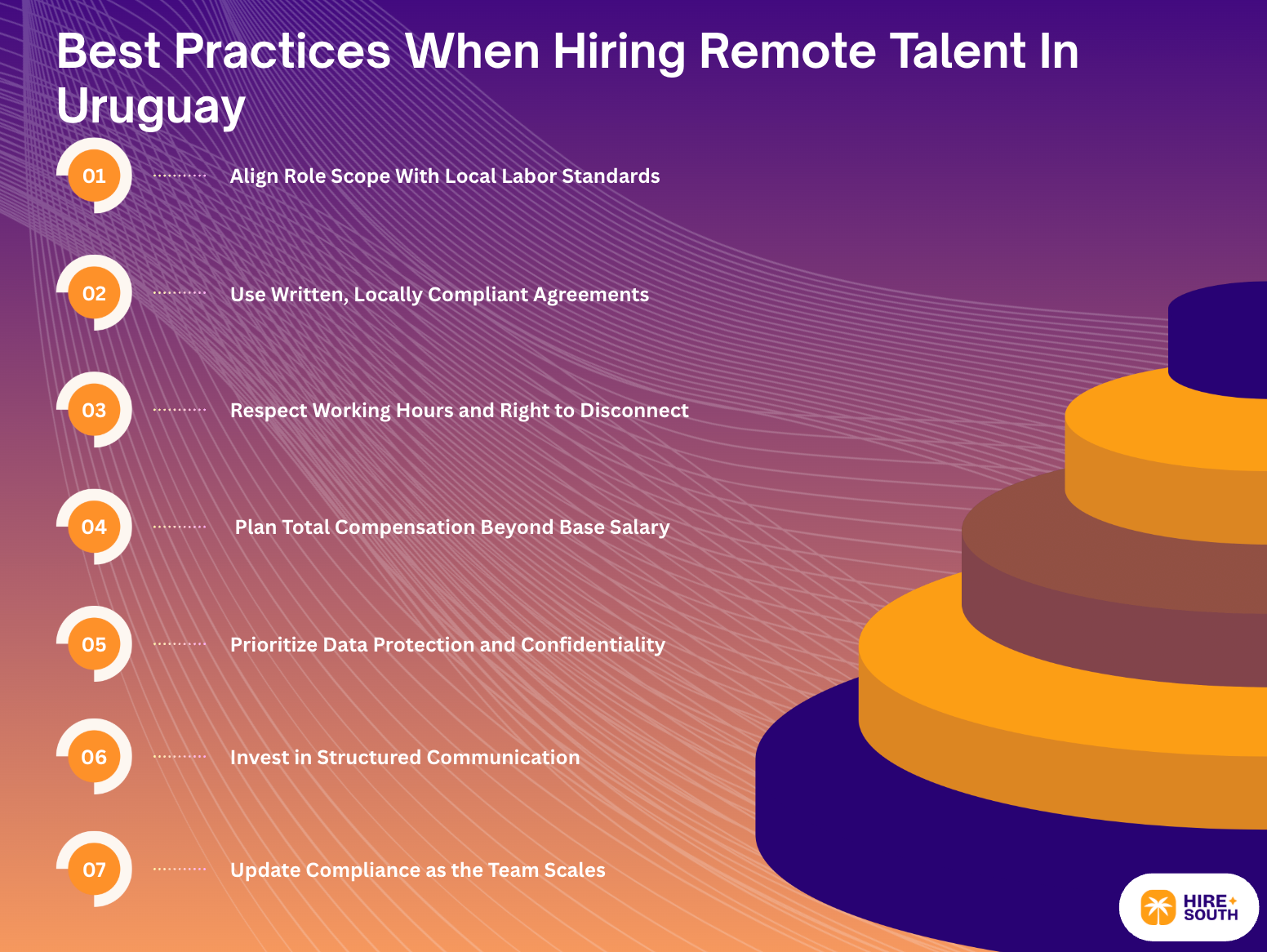
1. Align Role Scope With Local Labor Standards
Clarity upfront prevents issues later. Job descriptions should clearly define responsibilities, reporting lines, and expected outcomes. In Uruguay, ambiguity can create compliance risk, especially if the role evolves.
According to Uruguay’s Ministry of Labor and Social Security, employment relationships are assessed based on dependency and control, not just contract wording. Keeping role scope accurate and updated helps you stay aligned with local standards.
2. Use Written, Locally Compliant Agreements
Always formalize the relationship in writing. Employment contracts in Uruguay typically include salary, working hours, paid leave, benefits, and termination terms.
Uruguayan labor law requires a minimum of 20 days of paid annual leave after one year of service, according to the Ministry of Labor. Contracts that reflect statutory entitlements reduce disputes and reinforce trust with remote employees.
3. Respect Working Hours and Right to Disconnect
Uruguay has a strong employee protection framework. While flexible schedules are common in remote roles, expectations around availability should be clearly documented.
Best practice is to define core working hours while respecting personal time. This approach aligns with Uruguay’s labor culture and helps avoid burnout, which is a known risk in long-term remote arrangements.
4. Plan Total Compensation Beyond Base Salary
Base pay is only part of the picture. Uruguay mandates a 13th salary, paid in two installments each year, as established under national labor regulations and overseen by Banco de Previsión Social.
When budgeting for remote talent hiring in Uruguay, factor in social security contributions, paid leave, and statutory bonuses. Transparency around total compensation improves retention and avoids friction later.
5. Prioritize Data Protection and Confidentiality
Uruguay has one of the strongest data protection frameworks in Latin America. Law No. 18,331, enforced by the Regulatory and Control Unit for Personal Data, governs how personal and client data must be handled.
Remote employees should receive clear guidance on data security, access controls, and confidentiality obligations. This is especially important for roles handling customer data or proprietary systems.
6. Invest in Structured Communication
Uruguayan professionals value clarity and consistency. Regular check-ins, documented processes, and written feedback help remote teams perform better over time.
Clear communication is not about frequency alone. It’s about setting expectations, documenting decisions, and ensuring accountability without micromanagement.
7. Update Compliance as the Team Scales
What works for one hire may not work for ten. As your remote team in Uruguay grows, review contracts, payroll processes, and internal policies regularly.
Labor regulations, tax thresholds, and reporting requirements can change. Staying aligned with official guidance from the Ministry of Labor is a best practice that protects both your business and your remote workforce.
Ready to Hire Remote Talent in Uruguay?
Hiring remote talent in Uruguay gives you access to a highly educated, digitally connected workforce operating in a stable and transparent business environment. With services representing over 70% of total employment, the country is structurally aligned with remote and knowledge-based work.
At Hire South, we help companies hire remote talent in Uruguay and all of LATAM compliantly and efficiently, handling local employment requirements, payroll, and ongoing compliance. Our experience across Latin America allows us to support sustainable team growth while reducing legal and operational risk, so you can focus on building high-performing remote teams with confidence. Contact us for a FREE strategy session!