


Your traditional hiring model is likely hitting a ceiling. As the demand for specialized skills accelerates, the hunt for flexible, high-quality talent has moved beyond local borders. You need agility, and contingent staffing with LATAM staff is the phrase currently reshaping how modern enterprises scale without the overhead of traditional full-time roles.
This article breaks down how to master LATAM talent staffing to fuel your next growth phase. You will discover the logistical perks of nearshore alignment, the legal essentials of contingent LATAM work, and the specific tech hubs currently producing world-class engineers. We also provide a roadmap for integrating these experts into your existing team culture seamlessly.
The shift is already well underway. In fact, hiring for remote roles in Latin America saw a massive 156% increase in recent years, according to Deel’s Global Hiring Report, as companies move away from high-friction offshore models.
Ready to stop recruiting and start scaling? Let’s dive into why the future of your contingent workforce is waiting in the Southern Hemisphere.
What is the Complexity of Contingent Talent
Managing a flexible workforce isn't as simple as clicking "hire" on a platform. When you move into the realm of contingent LATAM work, you encounter a multi-layered puzzle of international compliance, tax residency, and classification risks. The "complexity" stems from the fact that every country in Latin America operates under its own distinct set of labor mandates.
You aren't just managing a task list; you are navigating a legal ecosystem. If you treat a contingent contractor like a full-time employee, providing equipment, setting strict hours, or managing them through a direct supervisor, you may inadvertently trigger "de facto" employment status. According to Baker McKenzie, misclassification in Latin American jurisdictions can result in significant back tax penalties and mandatory severance payments, even for non-resident companies.
Navigating the Statutory Benefit Trap:
One major hurdle you’ll face is the "13th and 14th-month" salary tradition prevalent in countries like Brazil and Colombia. While your contract might state a flat hourly rate, local labor courts often lean toward the worker if disputes arise. According to provisions in the Brazilian CLT (Consolidação das Leis do Trabalho), workers are entitled to specific protections that don't always align with US-style "at-will" contracting. You have to ensure your contracts are localized, not just translated.
Currency Volatility and Hyperinflation Risks:
Financial logistics add another layer of friction. Paying contingent LATAM staff means dealing with fluctuating exchange rates that can swing 5% to 10% in a single month. In Argentina, for instance, the gap between the official exchange rate and the market rate (Blue Dollar) creates a massive complexity for fair compensation. According to Reuters, inflation in Argentina surpassed 200% annually in recent cycles, forcing companies to adopt "inflation-matching" or USD-pegged payment structures to retain top talent.
Data Sovereignty and Intellectual Property:
Protecting your IP across borders is a primary concern for any tech-heavy business. While you may have a signed NDA, enforcing it in a foreign court is expensive and time-consuming. You must navigate the General Data Protection Law (LGPD) in Brazil, which is closely modeled after Europe’s GDPR. According to the IAPP (International Association of Privacy Professionals), the LGPD mandates strict data processing standards that apply to anyone handling Brazilian citizen data, regardless of where your headquarters are located.
The Operational Overhead of Timezone Fatigue:
Even with "nearshore" benefits, the complexity of synchronous work remains. While the time difference is minimal, the cultural approach to "contingent" availability varies. You aren't just buying hours; you are managing a lifestyle shift. You need to account for local holidays, like Carnival in Brazil or Independence Day, which can shut down entire talent pools for a week. Failing to bake these into your project sprint cycles leads to missed deadlines and friction between your domestic and international teams.
Why LATAM is a Safe Choice for Contingent Staffing
Choosing a region for your external workforce shouldn't feel like a gamble. While traditional offshore hubs often present "black box" risks, hidden costs, communication lag, or intellectual property concerns, the Latin American market has matured into a regulated, transparent ecosystem. You are looking for stability, and the current infrastructure in countries like Mexico, Colombia, and Uruguay is built to support high-stakes, long-term contingent LATAM work.
1. Robust Intellectual Property Protection and Legal Frameworks
Security is often the biggest hurdle when you hire outside your borders. Fortunately, many LATAM nations have modernized their legal systems to mirror Western standards. For instance, Mexico’s participation in the USMCA (United States-Mexico-Canada Agreement) provides a rigorous framework for protecting trade secrets and digital IP. According to the U.S. International Trade Administration, this agreement ensures that your proprietary code and data receive the same level of legal protection in Mexico as they do in the United States.
2. Timezone Alignment Reduces Operational Friction
Risk isn't just about legalities; it’s about "operational safety." When your team is asleep while your contractors are awake, errors go unnoticed for 12 hours. Using LATAM talent staffing eliminates this lag. Most major hubs, from Buenos Aires to Bogota, sit within one to three hours of US Eastern Time. This real-time collaboration means you can catch security vulnerabilities or deployment bugs instantly. According to Coursera's Global Skills Report, the high proficiency in "Business English" across the region further reduces the risk of expensive miscommunications that plague Eastern European or Asian outsourcing models.
3. Political and Economic Incentives for Tech Growth
You might worry about regional volatility, but many LATAM governments have spent the last decade de-risking their tech sectors to attract foreign investment. Uruguay, for example, offers significant tax exemptions for software exports, creating a highly stable environment for contingent LATAM staff. According to the Uruguayan Chamber of Information Technology, the country has become a leading software exporter per capita because of these pro-business policies. This government-backed stability means your talent pool won't vanish due to sudden regulatory shifts.
4. A Proven Track Record with Fortune 500 Companies
Safety is best measured by who else is in the pool with you. The region isn't an experimental playground; it is a proven hub for the world’s most demanding brands. Companies like Google, Amazon, and IBM have established massive operational centers in Brazil and Costa Rica. According to Procomer (Export Promotion Agency of Costa Rica), the country hosts over 300 multi-national corporations, many of which utilize contingent models to scale their engineering and support departments. When you tap into this market, you are leveraging an infrastructure that has already been vetted by the world's strictest legal and security departments.
5. Educational Continuity and Talent Pipeline Stability
A "safe" choice won't dry up in six months. The talent pipeline in Latin America is fueled by massive public and private investment in STEM. For example, Mexico graduates over 110,000 engineers every year, according to UNESCO. This steady flow of fresh, qualified professionals ensures that your contingent staffing strategy remains sustainable. You aren't fighting over a shrinking pool of aging experts; you are entering a growing market where the supply of skilled labor is actively supported by national educational mandates.
How to Build a Seamless Culture for Contingent Work
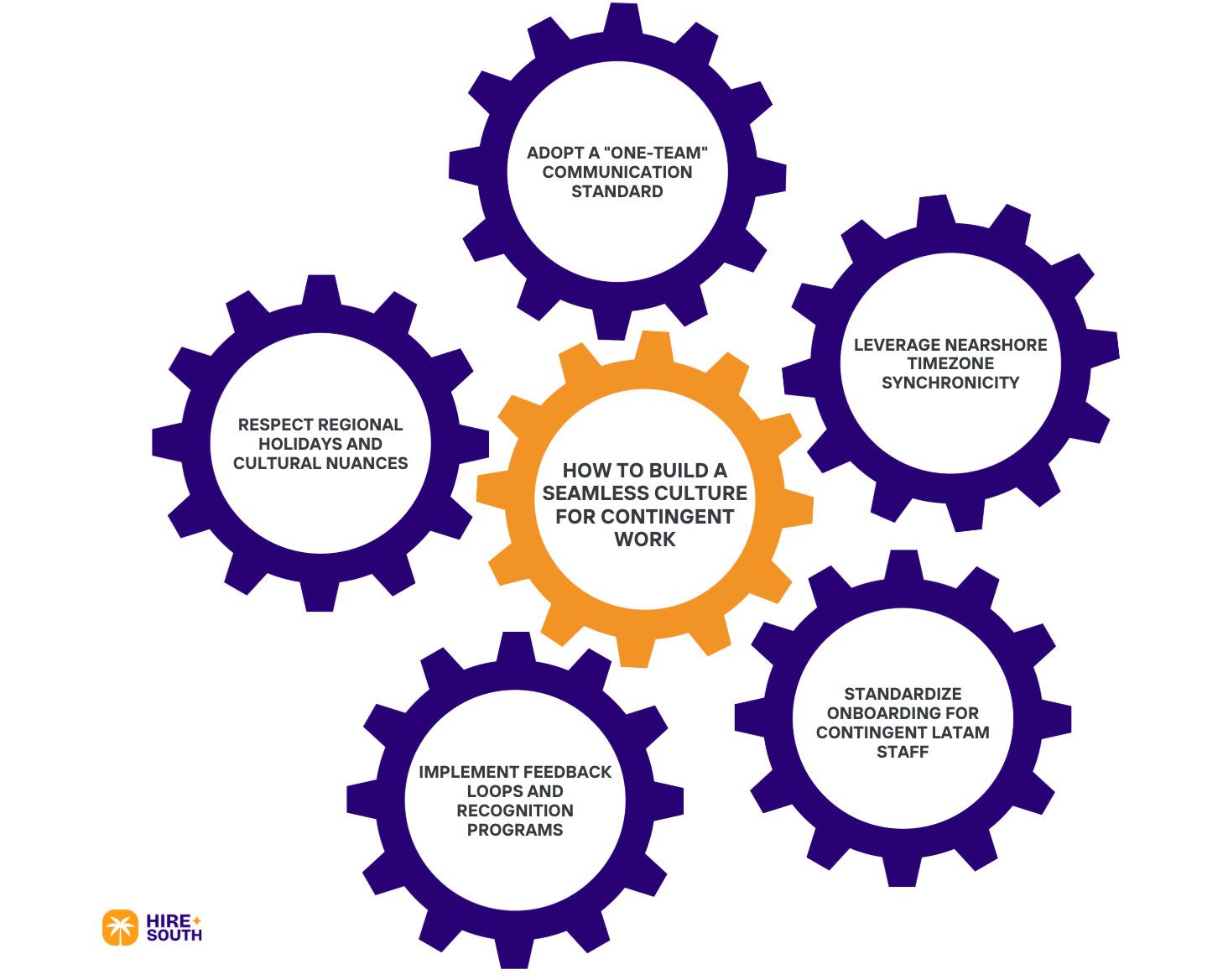
Adopt a "One-Team" Communication Standard.
Silos are the silent killers of remote productivity. You should avoid treating your LATAM talent as a "shadow team" that only receives tasks via email. Instead, treat them as first-class citizens in your digital workspace. This means including them in Slack channels, inviting them to "all-hands" meetings, and ensuring they have access to the same documentation as your local staff. According to Slack’s State of Work report, employees who feel connected to their coworkers are 58% more likely to be productive than those who feel isolated. For your contingent workforce, this connection starts with shared information.
Leverage Nearshore Timezone Synchronicity.
You have a massive cultural advantage with LATAM talent staffing: overlapping work hours. Unlike offshore models that rely on "hand-offs" while one team sleeps, you can build a culture of "live" collaboration. Use this to your advantage by scheduling core hours where everyone is online simultaneously. According to HBR (Harvard Business Review), synchronous communication is essential for complex problem-solving and psychological safety within distributed teams. It allows for spontaneous "watercooler" moments that build trust far faster than a strictly transactional relationship.
Standardize Onboarding for Contingent LATAM Staff.
Culture starts on day one, not month six. If your onboarding process is disorganized, your new contractors will feel like outsiders. You need a documented, repeatable system that grants access to tools, security protocols, and team norms immediately. According to Glassdoor, organizations with a strong onboarding process improve new hire retention by 82% and productivity by over 70%. Even for contingent roles, providing a "Welcome Guide" that outlines your company’s values and communication etiquette sets the tone for a professional, long-term partnership.
Implement Feedback Loops and Recognition Programs.
Just because someone is a contractor doesn't mean they don't value professional growth. A "seamless culture" is one where excellence is recognized regardless of payroll status. You should implement regular 1-on-1 check-ins to discuss performance and project alignment. According to Gallup, employees who receive regular recognition are four times more likely to be engaged. Applying this to your contingent LATAM work strategy ensures that your best talent stays motivated and doesn't jump to a competitor for a marginal pay increase.
Respect Regional Holidays and Cultural Nuances.
A global culture is a two-way street. You show respect by acknowledging that your team in Brazil or Argentina has a different calendar than your team in New York. While you don't need to learn every local custom, being aware of major regional holidays prevents burnout and resentment. According to SHRM, culturally inclusive workplaces experience higher loyalty and lower turnover. When you bake these considerations into your sprint planning, you signal that you value the person, not just the output.
Looking to Start Contingent Staffing With LATAM Talent?
The shift toward a flexible, borderless workforce is no longer a luxury for the few but a survival strategy for the many. When you align your operational needs with the high-caliber technical output found in Latin America, you bridge the gap between stagnant growth and true scalability.
According to Korn Ferry, the global talent crunch could result in $8.5 trillion in unrealized annual revenues by 2030, a deficit that proactive companies are already solving by tapping into the 1 million+ developers currently active in the LATAM region.
At Hire South, we specialize in removing the friction from this transition. We understand that "contingent" shouldn't mean "disconnected," which is why our services are designed to handle the heavy lifting of sourcing, vetting, and compliance for your next wave of talent. Whether you are looking to plug a specific skill gap or build a full-scale nearshore department, we provide the localized expertise and transparent infrastructure you need to succeed. Ready to get started? Book a free strategy session today!