


Finding top-tier software testers shouldn't feel like an impossible puzzle. If local tech talent shortages are stalling your product roadmap, expanding your search southward changes everything.
Latin America is no longer just an alternative sourcing destination. It is the premier hub for modern software development engineers in test.
Over 70% of North American technology leaders report that nearshore software development teams match or exceed the technical output of local hires, according to Accelerance. This guide maps out the ultimate blueprint to tap into this talent explosion.
You will discover exactly how much you can save, which countries specialize in advanced automation frameworks, and the precise compliance steps needed to protect your code. Here is how to hire QA engineers who sync perfectly with your time zone, culture, and sprint cycles.
Why Outsource QA Engineers?
Relying entirely on internal developers to check their own code creates an immediate blind spot. Software engineering teams frequently face competing priorities between building new features and debugging legacy code, which ultimately leads to a bottleneck. Outsourcing your quality assurance tasks eliminates this operational drag. It establishes an independent framework that focuses solely on breaking your application before your users do.
The global software development outsourcing market is projected to reach $618 billion, up from $564 billion, according to Geniusee. This macro shift highlights that testing is no longer treated as a minor add-on function. It is a highly specialized engineering discipline.
1. Unbiased Defect Detection Rates and Objectivity
When internal developers test their own work, confirmation bias inevitably compromises the results. They know how the software is supposed to work, so they naturally follow the golden path during manual checks. External engineering teams approach your product without these built-in assumptions.
Companies that implement outsourced QA see a 25% improvement in defect detection rates, which directly minimizes catastrophic production failures, according to Forrester Research. These external specialists focus on edge cases, unusual user journeys, and stress boundaries that internal assets frequently overlook.
2. Accelerating Product Release Cycles Through Parallel Execution
In modern development environments, speed to market determines competitive survival. If your engineering pipeline pauses every time a major build moves to staging, your velocity drops. Moving your test suites to an outsourced ecosystem allows you to run parallel execution tracks, meaning feature development and regression checking happen simultaneously.
Companies with dedicated outsourced QA teams accelerate their overall product release cycles by 30% to 50%, according to Aspire Systems. Because these testers operate without the distractions of daily internal company meetings, they provide clean, actionable bug logs directly into your Jira or GitHub queues on a predictable loop.
3. Rapid Scalability Without Long-Term Infrastructure Commitments
Product roadmaps are rarely flat. You might experience three months of intense, heavy development ahead of a major enterprise launch, followed by several months of stable maintenance. Hiring full-time, domestic QA engineers creates a rigid cost structure that leaves you paying for idle time during slow cycles.
Outsourcing gives you an elastic workforce. You can instantly spin up a team of four automated testers using tools like Playwright or Selenium, run intense stress tests for a sprint cycle, and then scale back down to a single monitor resource. You avoid the recruitment cycles, signing bonuses, and termination overhead that make internal scaling a slow, expensive operational risk.
4. Plugs Critical Internal Skill Gaps Fast
Building a comprehensive modern application requires an incredibly diverse array of testing skills. A standard manual tester cannot easily switch over to run high-scale load testing or trace API data flows.
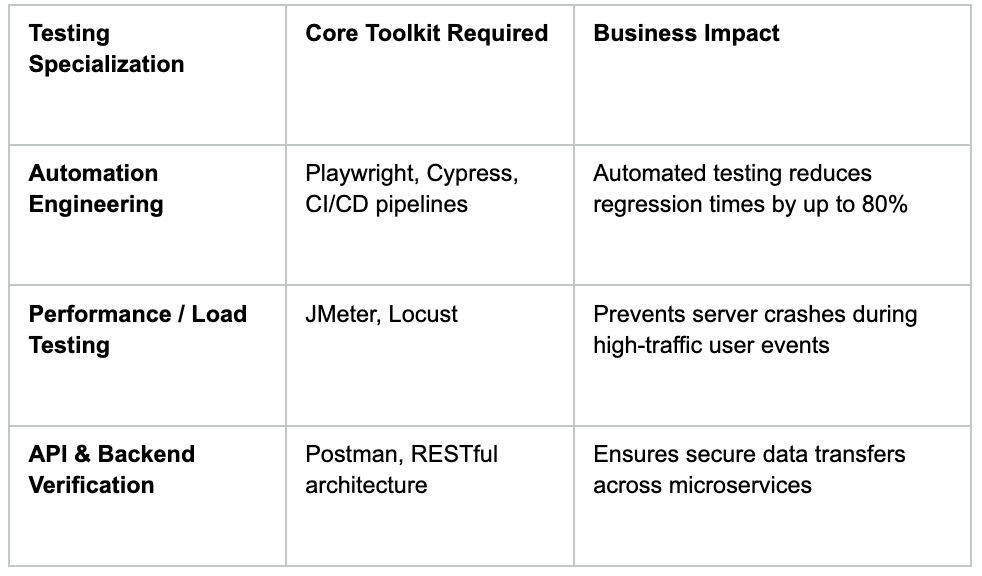
Finding local professionals who possess all three profiles is incredibly rare and expensive. Outsourcing grants you direct, immediate access to specialized agencies that house these niche experts under one roof, allowing you to deploy them precisely when your product architecture demands it.
Technical Skill Sets to Screen for in Latin America
Hiring across Latin American tech hubs requires looking far beyond standard resume bullet points. The regional talent pool has undergone a massive engineering evolution, shifting from traditional legacy frameworks to modern, developer-adjacent quality pipelines. To maximize your engineering velocity, you must structure your screening process around several core competencies.
1. Core Automation Architecture and Framework Mastery
You must prioritize candidates who demonstrate deep familiarity with contemporary, open-source automation toolkits rather than old-school commercial suites. In the current engineering landscape, JavaScript, TypeScript, and Python dominate LATAM testing pipelines.
- The Modern Trio: Ensure your technical screening evaluates hands-on experience with Playwright, Cypress, or Selenium. Playwright has become an industry favorite for modern, cross-browser testing due to its speed, automatic waiting features, and network interception capabilities, according to Panto AI.
- Language Alignment: Look for candidates whose programming language fluency directly mirrors your application’s backend or frontend stack. If your application runs on a Node.js ecosystem, your QA engineer should be writing their test scripts in TypeScript or JavaScript to align seamlessly with your internal development team.
2. Native Integration Within CI/CD Pipelines
A QA engineer who manually triggers automation scripts from their local laptop acts as a speed bottleneck. Top-tier Latin American software testers treat test code exactly like application code, ensuring it builds, executes, and reports completely inside your continuous integration and continuous deployment infrastructure.
Your screening protocol should actively verify a candidate’s ability to construct, maintain, and debug test workflows in environments such as GitHub Actions, GitLab CI, CircleCI, or Jenkins. Nearly 95% of mature engineering teams rely heavily on CI/CD test automation as their core software delivery foundation, according to Remote QA. The ideal engineer must know how to configure parallel execution rules, handle dynamic test environments, and parse automated failure logs without demanding developer intervention.
3. Backend API Verification and Data Layer Testing
Modern application bugs often hide within microservices and backend database logic rather than in the visible user interface layer. Screening for basic UI click-testing leaves your application vulnerable to critical data processing errors.4. AI-Augmented Testing and Self-Healing Maintenance
The emergence of agentic systems has changed the fundamental daily workflow of an automation engineer. Writing locators manually or spending 30% of an engineering sprint simply repairing brittle test scripts is an outdated approach to software quality.
Approximately 75% to 85% of modern quality assurance teams now actively utilize at least one AI-driven testing or self-healing tool to optimize their software delivery loops, according to Stack Overflow data trends analyzed by Remote QA. You should look for engineering candidates who know how to strategically combine standard code bases with AI-assisted utilities. Ask your candidates how they leverage self-healing scripts or predictive execution tools to minimize the maintenance tax that commonly slows down expanding codebases.
How to Hire QA Engineers Successfully: Step by Step
Transitioning your engineering operations to target a borderless workforce requires an intentional, hyper-focused recruitment methodology. Scaling a quality assurance pipeline across Latin American tech corridors cannot rely on outdated, localized hiring metrics. You must optimize your sourcing and onboarding steps to fit the unique dynamics of the remote nearshore ecosystem.
1. Designing high-impact, localized role definitions
The foundation of a successful cross-border search starts with how you present your opportunity to the regional market. Tech talent in Latin America is three times less competitive for hiring engineers and skilled workers than the majority of saturated US tech hubs, according to Terminal.io data. To capture the attention of premium candidates, you must avoid generic, copy-pasted job descriptions.
Clearly state your structural expectations right at the top of the listing. You need to explicitly define your required testing stack, whether that involves JavaScript backend testing, mobile app frameworks, or Python automation suites, while defining your required time zone overlap. Top-tier regional talent prioritizes salary transparency, role stability, and flexible scheduling over soft corporate perks or equity offerings.
2. Implementing streamlined, multi-stage screening protocols
Long, drawn-out interviewing processes will cause you to lose elite software testers to faster-moving companies. The ideal timeframe for an efficient tech interview loop from initial touchpoint to final decision should span approximately two weeks, according to tech professional surveys compiled by CodersLink.
Your technical screening must skip abstract puzzle questions and focus purely on practical execution. Use a single, live coding session where candidates write automation scripts or debug a broken CI/CD pipeline in real time.
Vetting linguistic capabilities simultaneously is equally vital. Ensure your engineering leads evaluate conversational English during these technical reviews to confirm the candidate can comfortably defend their bug logs and join live sprint planning sessions without communication bottlenecks.
3. Accelerating your timeline to hire through strategic partnerships
Attempting to build a localized recruitment pipeline from scratch in multiple foreign countries often leads to operational delays. The average timeline to source, pre-screen, and successfully hire a qualified QA engineer ranges from 21 to 30 days, according to global IT staffing benchmarks published by Huntly.
Partnering with specialized tech recruitment networks allows you to bypass the cold-sourcing phase entirely. These organizations manage pre-vetted talent pools of thousands of active automated and manual testers across various Latin American countries. This approach cuts your time-to-hire down to the minimum benchmark, ensuring you fill critical product development gaps within weeks instead of months.
4. Executing structured cross-border onboarding frameworks
Your recruitment process does not end when a candidate signs an offer letter. Integrating an international tester into an established, domestic engineering team requires deliberate operational alignment from day one.
You must establish clear documentation standards, standardized communication channels, and centralized access permissions before your new hire arrives. Provide your incoming engineer with clear ownership of specific testing suites or product modules immediately. Because Latin American engineers work in complete time zone alignment with North American teams, you can integrate them directly into your daily standups, live debugging sessions, and synchronous code reviews without experiencing the crippling communication lags common to traditional offshore models.
Ready to Hire QA Engineers in Latin America?
Maintaining top-tier software delivery speeds requires an adaptable, highly technical quality assurance team that can execute continuous testing workflows smoothly. Expanding your engineering operations into Latin America successfully bridges the gap between high domestic development costs and your daily product validation requirements. By prioritizing candidates with modern automation skills and integrating them natively into your existing development pipelines, you can accelerate your release cycles while preserving software quality.
As a specialized talent partner at Hire South, we simplify this entire cross-border expansion process for growing companies. We provide direct access to an extensive, pre-vetted network of elite Latin American professionals who are highly proficient in English and work in complete time-zone alignment with North American sprint schedules. Partnering with Hire South allows you to integrate dedicated QA specialists into your product teams smoothly, achieving up to 40% in cost savings compared to traditional domestic hiring structures while we manage the complex legal compliance, screening, and international payroll workflows on your behalf. Contact us to learn more!