


Finding elite software engineering talent in the US has become incredibly expensive. If you are trying to scale your engineering team without draining your runway, looking south is the smartest move you can make today.
Latin America is no longer just an alternative sourcing destination. It is a premier powerhouse for tech talent. According to a 2026 tech salary guide by Mismo, North American companies save up to 60% or more on base salaries by nearshoring their engineering teams to Latin America.
But saving money is only part of the equation. You also get perfect time-zone alignment and exceptional English fluency.
This guide breaks down everything you need to know to build a world-class remote team. You will discover the exact hiring steps to source elite UI/UX talent, the engineering benchmarks to watch for, and how to navigate local compliance and payroll. Let’s dive into how you can optimize your hiring process and secure top-tier frontend talent today.
Complete Guide to Frontend Developers Hiring Steps
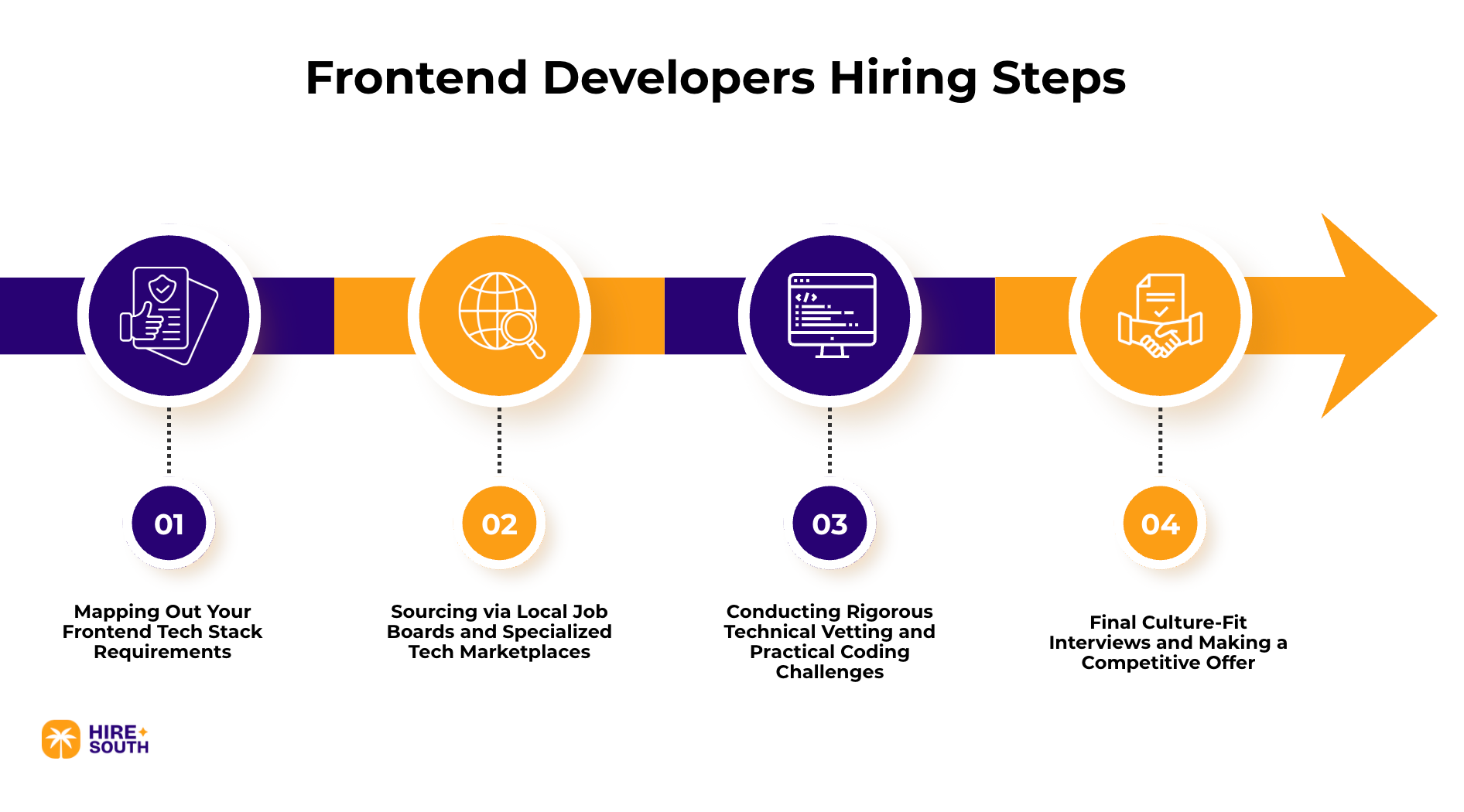
Step 1: Mapping Out Your Frontend Tech Stack Requirements
Before writing a job description, you must clearly outline the specific ecosystem requirements of your interface. Sourcing user interface talent from Latin America requires precision rather than generic text. If your web application relies on React, you need to screen for deep hooks management and architectural knowledge. If you utilize Angular, your focus shifts to TypeScript and modular architectures.
According to data published by Mismo, ubiquitous framework languages like JavaScript maintain a highly competitive regional salary baseline averaging around $37,200 annually, meaning you can afford to look for deep, specific expertise. Defining your core technology parameters early keeps your pipeline clean, blocks resume spam, and ensures your outreach targets engineers who can jump right into your existing code repos.
Step 2: Sourcing via Local Job Boards and Specialized Tech Marketplaces
Finding elite software engineers in this region requires shifting away from broad, generic career platforms. United States companies have drastically ramped up their remote hiring initiatives across Latin America, which means the competition for high-caliber engineers is fierce. According to recruitment metrics by Athyna, United States companies increased their remote hiring in Latin America by 161% between 2023 and 2026, creating a highly competitive sourcing landscape.
To capture the attention of top-tier professionals, you should skip the global job boards and lean heavily into localized tech communities. Utilizing localized networks, regional developer Slack groups, and Latin American-focused hiring platforms gives you a direct line to pre-vetted engineers who are already looking for international remote roles.
Step 3: Conducting Rigorous Technical Vetting and Practical Coding Challenges
Evaluating engineering depth requires a structured, multi-stage assessment that mirrors actual daily operations. You need to verify that a candidate can write clean, maintainable user interface code under normal development constraints. The technical challenge should focus heavily on performance optimization, responsive design, and state management.
According to technical vetting frameworks by Athyna, setting a strict 60 to 90-minute limit for junior and mid-level roles is the ideal baseline for evaluating core coding logic. For senior frontend positions, providing a 3 to 4-hour take-home assignment surfaces deep structural habits, showing you exactly how well the candidate documents their work, manages edge cases, and writes readable code.
Step 4: Final Culture-Fit Interviews and Making a Competitive Offer
The final step focuses entirely on communication dynamics, workflow alignment, and structuring an attractive compensation package. Because frontend engineers collaborate daily with product managers and UI/UX designers, your final interview must aggressively test for soft skills, active listening, and cross-border collaboration readiness.
When you extend the offer, you must balance cost savings with local market realities to prevent the candidate from signing with a competitor. According to hiring guides by Mismo, a senior developer in regional tech hubs like Argentina, Mexico, or Brazil commands an annual salary between $55,000 and $80,000, which still delivers massive cost savings compared to domestic United States engineering salaries. Presenting a clear contract that respects their local time zone and includes competitive compensation ensures you successfully close top-tier LATAM talent.
How To Optimize the Frontend Developers Hiring Process
Designing an Efficient Remote Interview Loop.
A long, drawn-out process will cause you to lose elite talent to faster competitors. Traditional United States hiring pipelines often stretch out, leaving engineering seats empty and stalling product rollouts. According to data from Ideaware, hiring a software developer through traditional corporate methods takes 4.2 months on average from posting the job to the first day of coding.
You can radically trim this down by compressing your scheduling. Avoid spreading three interviews over three weeks. Instead, group your initial screening and technical deep-dive into a tight, five-day window to keep momentum high.
Utilizing Automated AI Screening Tools for Initial Filtering.
Evaluating hundreds of international resumes manually creates an immediate administrative bottleneck. Implementing modern AI assessment platforms lets you analyze candidate profiles, parse technical portfolios, and check fundamental programming alignment within minutes. This step is crucial for identifying high-potential engineers early without wasting your internal engineering team's valuable time on live screening calls.
AI-driven tools help you look past basic resume formatting, filtering instead for actual code repository contributions and practical problem-solving logic. This automated step separates candidates who simply memorize interview answers from those who can actually ship production-ready user interfaces.
Reducing Time-to-Hire to Secure Top-Tier UI/UX Talent.
The most capable user interface engineers do not stay on the open market for long. If your internal HR processes take weeks to approve an offer, your top candidates will sign elsewhere. According to nearshore recruitment data published by Tecla, utilizing specialized talent networks can reduce your total time-to-hire to just 7 days, letting you bypass weeks of cold sourcing.
Streamlining your decision-making structure enables your development team to ramp up quickly. When you cut out unnecessary approval layers, you can secure elite talent, hit your target sprint dates, and launch critical product features ahead of schedule.
What Does It Cost to Hire Frontend Developers in LATAM and How To Retain Them?
Breaking Down Frontend Engineering Salary Benchmarks by Seniority:
Budgeting for international software engineering talent requires analyzing verified payroll data rather than guessing. Sourcing professionals from Latin America provides huge financial relief compared to expensive domestic markets, but you still must align your offers with current regional compensation standards to attract top performers.
According to a 2026 comprehensive software developer compensation report by Howdy, annual take-home salary benchmarks for Latin American tech talent break down into clear, standardized bands based on engineering experience. Junior frontend developers with zero to two years of experience typically command between $40,000 and $45,000. Mid-level developers with two to five years of experience usually earn between $50,000 and $60,000. Senior frontend developers possessing over five years of experience generally sit within the $65,000 to $75,000 range, while principal and staff engineers can command between $80,000 and $105,000.
While these figures represent premium, compliant USD compensation packages for international remote workers, they still deliver substantial savings. According to the same 2026 data by Howdy, the average base salary for a United States software engineer sits around $130,000, with fully loaded domestic costs often climbing past $160,000, meaning hiring in Latin America consistently saves your business 60% to 65% on engineering costs without sacrificing technical capabilities.
Navigating Local Labor Laws and Compliance Structures:
Building a remote engineering team across international borders introduces unique legal responsibilities. You cannot simply treat long-term, full-time remote software engineers as simple independent contractors without running into regulatory trouble. Local labor courts across Latin America protect workers aggressively, meaning misclassifying a permanent team member can result in severe retroactive financial penalties, unpaid statutory benefits, and legal disputes.
To scale your operations safely, using an Employer of Record (EOR) provides a secure, turnkey compliance model. The EOR acts as the legal employer on the ground, managing complex local payroll calculations, mandatory social security contributions, and local tax compliance. According to regional cost analysis data by Howdy, employer taxes and mandatory local benefits typically add an extra 10% to 29% on top of the engineer's base take-home salary, depending on the specific country, an overhead cost you must build directly into your long-term headcount budget.
Structuring Localized Benefits and Equity to Drive Long-Term Retention:
Securing elite software engineers is only the first step, keeping them engaged long-term requires a competitive retention strategy. Because top-tier user interface developers in Latin America receive constant recruitment offers from global tech companies, a basic salary is rarely enough to ensure loyalty. You need to build a holistic compensation framework that addresses their real-world needs and local lifestyle expectations.
Standard benefit packages for remote Latin American tech professionals should include localized private health insurance, a dedicated monthly hardware or internet stipend, and a clear annual performance review cadence. Furthermore, offering equity or stock options creates deep alignment with your business goals, giving your remote international engineers a real stake in the company’s success and drastically reducing turnover rates.
Fostering a Unified Engineering Culture Across Distributed Teams:
True employee retention is driven by culture and daily operational respect. If your remote engineers feel isolated or treated like second-class corporate citizens, they will quickly look for alternative opportunities. You must intentionally integrate your nearshore engineering team into your core business operations, giving them the same visibility and respect as your domestic staff.
Because Latin America shares convenient time zones with the United States, you can run real-time agile ceremonies, daily stand-ups, and collaborative architecture reviews without anyone working erratic hours. Involving your international frontend developers in early product strategy sessions and UI/UX design discussions builds professional ownership. When engineers understand the broader product vision and see a clear internal growth path, they stay with your company longer and build superior software.
Ready to Hire Frontend Developers in Latin America?
Optimizing your frontend recruitment strategy requires looking past local borders and building a modern, cross-border engineering pipeline. Sourcing international software developers from Latin America ensures your tech team secures exceptional technical expertise, seamless time-zone alignment, and significant capital efficiency. North American businesses typically realize up to 40% in cost savings on specialized remote talent while simultaneously expanding their operational flexibility.
At Hire South, we specialize in bridging the gap between fast-growing companies and elite Latin American technical professionals. Our comprehensive nearshore recruitment services handle the heavy lifting, managing everything from advanced technical screenings and custom interview loops to localized payroll compliance, statutory benefits, and equipment logistics. Whether you need a single senior framework specialist to round out a sprint team or a complete, managed front-end unit, we source pre-vetted engineers who are ready to integrate directly into your workflows. Contact us today to schedule a consultation and scale your development team safely, quickly, and cost-effectively.