


Finding top-tier developers feels a bit like chasing a mirage lately. You know the talent is out there, but local tech talent pools are drying up, hiring costs are skyrocketing, and traditional offshore teams often leave you dealing with painful 12-hour communication lags.
The struggle to scale your engineering capability is not just an internal headache; it is a global reality. According to a comprehensive study by Korn Ferry, the global tech industry faces a looming shortage of more than 85 million skilled workers by 2030, which could result in an astounding $8.5 trillion in unrealized annual revenues. If you continue relying solely on localized hiring or rigid staff augmentation, your product roadmap will inevitably stall.
That is exactly why progressive tech leaders are changing their playbooks. Instead of just hiring scattered remote freelancers, the move now is to build autonomous nearshore engineering pods, which are highly synchronized, self-managing teams operating in your exact time zone.
This guide breaks down exactly how to make that shift happen. You will discover the operational blueprint behind the engineering pod building process, explore the best practices to hire nearshore professionals who truly fit your culture, and learn how to scale these distributed squads without losing sleep or momentum. Ready to build an engineering ecosystem that actually runs itself? Let's dive in!
What is an Autonomous Engineering Pod?
If you are tired of micro-managing remote freelancers or waiting weeks for traditional outsourcing vendors to deliver basic updates, you need to understand the concept of an autonomous engineering pod. At its core, an engineering pod is a small, highly focused, self-contained unit of tech professionals who own a specific product feature or project from start to finish.
The magic word here is autonomous. These teams do not just write code based on a rigid ticket system. They have the internal expertise, leadership, and authority to make critical technical decisions, solve complex roadblocks, and push iterations forward without constantly pausing to ask you for permission.
A standard engineering pod is not just a random group of developers tossed into a Slack channel. It is a carefully engineered unit designed for maximum speed and minimal friction. According to a software delivery study by Grid Dynamics, these highly integrated cross-functional squads are capable of building complex software up to 40% faster than traditional siloed outsourcing teams.
They achieve this velocity because they operate like an elite startup within your larger enterprise. They run their own agile ceremonies, manage their own sprint backlogs, and take full architectural ownership of their output. Instead of passing a piece of code over a wall to a separate testing team, everything happens inside the pod ecosystem.
Cross-Functional DNA: Roles That Make Up a Balanced Pod
To maintain true autonomy, a pod must be entirely self-sufficient. This means it includes every single skill set required to take a concept from the whiteboard to the production environment. You are not just hiring a row of front-end developers, you are building a balanced ecosystem. A typical nearshore engineering pod includes:
- A Product Owner or Tech Lead: The strategic anchor who prioritizes the backlog and aligns the pod’s output with your broader business objectives.
- Full-Stack, Front-End, and Back-End Engineers: The core builders who write clean, scalable code.
- A Quality Assurance (QA) Engineer: The dedicated gatekeeper embedding automated and manual testing directly into the development cycle.
- A DevOps Specialist: The infrastructure expert ensuring continuous integration and smooth deployment pipelines.
By packing all these capabilities into a single tight-knit unit, you completely eliminate inter-departmental dependencies. The team never stalls because they are waiting on an outside designer or an external QA team to unblock them.
Why Build Engineering POD Teams Through Nearshoring
If you are trying to keep pace with rapid product roadmaps, traditional engineering recruitment can feel incredibly restrictive. Sourcing local talent takes too long, while standard offshoring often leaves you drowning in asynchronous communication delays. Building autonomous engineering pod teams through nearshoring eliminates these bottlenecks, offering a highly strategic balance of operational speed, financial efficiency, and real-time integration.
1. Unlocking Time Zone Overlap for True Synchronous Agility
The primary limitation of traditional offshore development is the massive time difference. When your internal product owners sleep while your engineering team writes code, a single simple question can stall production for an entire day. Nearshoring completely rewrites this dynamic by keeping your extended team within a zero-to-three-hour window of your home office.
According to research from McKinsey & Company, tech organizations that maintain at least six hours of direct workday overlap between their in-house and distributed teams complete projects 23% faster on average. This real-time accessibility means your nearshore pod participates actively in daily standups, live sprint planning, and spontaneous debugging sessions. Code reviews happen instantly, architectural decisions are reached during normal business hours, and blockers are resolved before they can derail a sprint timeline.
2. Capitalizing on Significant Labor Cost Savings and Reduced Overhead
Scaling an internal tech department in a competitive market requires capital that goes far beyond basic base salaries. You have to factor in recruitment agency fees, healthcare benefits, payroll taxes, physical hardware, and expensive office space footprint.
Transitioning to a nearshore pod model allows you to optimize your budget without compromising on seniority. According to a 2026 workforce analytics report by AgileEngine, software developers in major Latin American tech hubs earn roughly 43% of what equivalent United States domestic developers command in gross pay. When you factor in the total cost of employment, including benefits and operational overhead, North American businesses save between 60% and 65% by structuring their autonomous squads through nearshore partnerships. These savings free up vital capital, allowing you to fund parallel product lines or accelerate your go-to-market strategies.
3. Driving Faster Time-to-Market with Pre-Assembled Pods
Building a high-performing engineering team from scratch is historically a slow, tedious process. You have to source individuals, screen their technical capabilities, evaluate their soft skills, and then hope they mesh well together as a cohesive unit once onboarded. This fragmentation often causes severe early-stage friction and unpredictable release cycles.
Nearshore providers bypass this entire friction point by deploying pre-packaged, cross-functional engineering pods. According to data published by Startup House, specialized nearshore outsourcing agencies can assemble and deploy starter pods, consisting of an experienced tech lead, developers, and QA engineers, that ramp up to full operational productivity within just 10 business days. Because these professionals frequently have prior experience working alongside one another, they arrive with established workflows, shared coding standards, and immediate execution capabilities.
4. Enhancing Code Quality Through Shared Cultural and Professional Standards
Successful software development relies just as heavily on clear communication and shared expectations as it does on writing clean code. Nearshore professionals in regions like Latin America or Eastern Europe share deep cultural alignment with Western business practices, resulting in a collaborative style that prioritizes transparency, proactive problem-solving, and constructive feedback.
According to the 2025 EF English Proficiency Index, the younger demographic of tech professionals in Latin American hubs significantly outperforms historical regional averages, establishing a highly fluent baseline for technical documentation and daily communication. This linguistic clarity ensures that complex product requirements are interpreted the first time accurately. Instead of functioning as passive task-executors who blindly follow Jira tickets, these nearshore engineers possess the communication confidence to challenge assumptions, suggest architectural improvements, and actively protect your codebase from technical debt.
The Engineering Pod Building Process
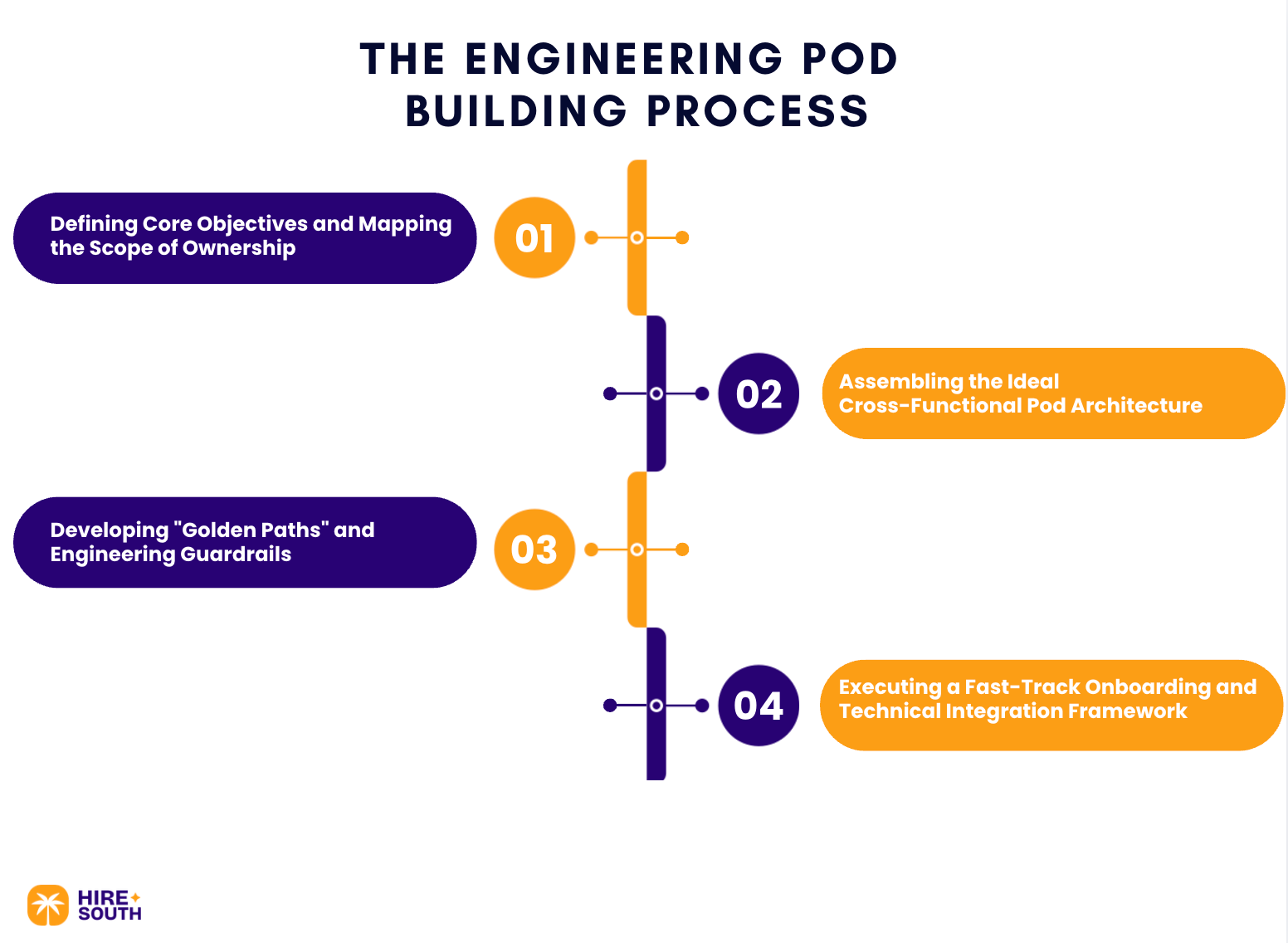
1. Defining Core Objectives and Mapping the Scope of Ownership
The initial phase of the engineering pod building process focuses entirely on establishing clear boundaries of responsibility. Trying to construct an autonomous team without defining their exact product domain guarantees alignment issues down the road.
According to a 2026 startup engineering structure guide by Everyday IT, the highest-performing engineering organizations intentionally structure their pods around specific user journeys or business outcomes, such as checkout systems or user activation tools, rather than technical layers like frontend or backend code. By dedicating a pod to an explicit, isolated problem space, you allow them to develop deep domain expertise. This clear division ensures that the team understands exactly what business metrics they are responsible for moving, eliminating overlapping efforts across your broader department.
2. Assembling the Ideal Cross-Functional Pod Architecture
Once you define the product domain, the next step involves balancing the squad with the precise roles required to eliminate external dependencies. A true autonomous pod must have all the skills needed to move a feature from a conceptual design to a live production environment without outside assistance.
According to research from Google’s Project Aristotle, engineering teams consisting of five to seven members consistently outperform larger groups in both delivery speed and code quality. This compact size minimizes communication overhead while maintaining full cross-functional capability. Your typical nearshore pod architecture should include a technical lead to govern architectural decisions, full-stack engineers to handle implementation, and a dedicated quality assurance professional to manage automated testing pipelines. This precise combination ensures the squad can run its own agile sprints seamlessly.
3. Developing "Golden Paths" and Engineering Guardrails
Before your nearshore professionals write their first line of code, you must establish the operational guardrails that allow them to make decisions safely. True autonomy does not mean letting a team operate without standards, it requires building a clear infrastructure that guides their workflow.
According to a 2026 platform engineering blueprint by Infisical, modern engineering teams rely heavily on internal developer portals and structured "golden paths," which are standardized, pre-approved software templates and automated deployment routes. By providing your nearshore pod with automated continuous integration and continuous deployment pipelines, comprehensive code style guidelines, and standardized secrets management frameworks, you eliminate deployment friction. The team can spin up environments, run regression tests, and push updates independently without needing to consult your core infrastructure team at every step.
4. Executing a Fast-Track Onboarding and Technical Integration Framework
The final step in the pod-building process is transitioning the team to full production mode. A disorganized onboarding process can cause a remote team to lose momentum, resulting in early-stage frustration and delayed release cycles.
The impact of structured technical onboarding is measurable. According to a workforce benchmark study by TechClass, technical hires in the median organization can take up to 35 days to reach basic productivity when using unstructured remote training methods. Conversely, organizations that implement a standardized 30-60-90-day onboarding framework, featuring preconfigured development environments, clear technical documentation, and early starter projects, significantly reduce that ramp-up time.
By providing immediate access to required code repositories, communication channels, and clear architectural documentation on day one, you close the early productivity gap. This systematic approach ensures your nearshore professionals feel integrated into your company culture immediately, enabling them to ship valuable code within their very first sprints.
Ready to Hire Nearshore Professionals?
Building autonomous engineering units is no longer just a trend for forward-thinking tech companies; it has become a core operational necessity for businesses that want to stay competitive. In fact, according to a global outsourcing survey by Deloitte, 64% of North American organizations actively prioritize Latin American partnerships when real-time collaboration and time-zone alignment are critical to their software delivery pipelines. Transitioning to this modern engineering model requires more than just sourcing resumes; it demands a partner who understands the fine line between standard staff augmentation and true product ownership.
At Hire South, we specialize in helping scaling organizations bridge that gap by building dedicated, high-performing nearshore engineering pods. We leverage an elite regional network of pre-vetted tech professionals to construct cross-functional teams that seamlessly integrate into your existing workflows from day one.
By pairing deep technical expertise with complete alignment in your normal working hours, we ensure your extended team operates with the speed, transparency, and high structural accountability required to protect your codebase and hit your product milestones. If you are ready to stop micro-managing external developers and start scaling with a self-governing tech engine, let our team at Hire South help you architect your next high-velocity engineering squad. Book a free discovery call to learn more!