

Finding qualified AI talent locally feels nearly impossible right now, and the fierce competition for specialized talent is pushing budgets to their limits. The search for a better way to scale artificial intelligence capabilities leads directly to nearshore talent.
Nearshoring to Latin America gives organizations instant access to a massive, highly skilled talent pool. Over 87 percent of top-earning remote professionals in LATAM already collaborate with United States clients, according to a Higlobe report. Beyond the seamless time zone overlap, this workforce brings deep technical expertise and bilingual fluency to complex artificial intelligence workflows.
This guide breaks down everything needed to recruit, evaluate, and integrate nearshore prompt engineers. Explore salary benchmarks, key regional technology hubs, essential technical skills, and structured hiring frameworks designed to help scale teams efficiently.
What Do AI Prompt Engineers Actually Do?
Architectural Context Construction and System Prompt Design:
AI prompt engineers design the instructions, framing parameters, and system rules that guide large language models toward accurate outputs. They build structured context windows, define explicit execution constraints, and establish clear operational boundaries so models behave reliably in enterprise production environments.
Advanced Prompting Techniques and Context Framing:
These professionals apply specialized methodologies like chain-of-thought, directional-stimulus, and few-shot prompting to force step-by-step logic and structured decision-making. Rather than relying on simple text inputs, they design complex inputs that teach models how to reason through ambiguous queries, parse dense unstructured data, and isolate critical variable dependencies.
Model Testing, Output Evaluation, and Safety Guardrails:
They run rigorous A/B performance tests across model updates to catch hallucination risks, off-topic outputs, and safety vulnerabilities before deployment. Enterprise adoption demands stringent safety controls; Gartner forecasts that over 80 percent of enterprises will deploy generative AI in live production settings, according to its technology adoption studies. Prompt engineers build guardrails to ensure model compliance and strict output accuracy.
RAG Integration and Contextual Data Management:
Prompt engineers build Retrieval-Augmented Generation (RAG) pipelines, bridging the gap between proprietary corporate databases and raw language models. They configure semantic search parameters, optimize data retrieval windows, and format internal enterprise knowledge so AI models produce grounded responses without leaking sensitive company information.
Building Reusable Prompt Libraries and Multi-Agent Workflows:
They systematically organize successful prompt structures into version-controlled enterprise repositories for company-wide deployment. Additionally, prompt engineers map out autonomous multi-agent workflows, establishing communication protocols between separate AI agents so they can execute complex, multi-step business operations independently.
Why Companies Should Hire AI Engineers in Latin America
1. Overcoming Local AI Talent Scarcity and Skyrocketing Costs
Domestic technology hubs face an unprecedented shortage of specialized artificial intelligence talent. Sourcing engineers locally often results in months of recruiting delay and inflated compensation demands that strain project budgets.
Turning toward nearshore markets lets enterprise tech teams instantly tap into an expansive candidate pool without competing in overheated local hiring markets.
2. Real-Time Collaboration via Geographic Time Zone Overlap
Offshore software development traditionally suffered from severe communication lag across opposing time zones. Latin American tech hubs operate within UTC-3 to UTC-6, sharing 5 to 8 business hours daily with Eastern and Pacific time zones.
This close alignment enables real-time standups, immediate code reviews, and rapid iteration loops during normal business hours.
3. Deep Upskilling and Rapid AI Adoption Rates
Latin American developers proactively embrace emerging software frameworks and generative artificial intelligence tools. Regional enrollment in generative AI training programs skyrocketed 425 percent year-over-year, according to Coursera’s 2025 Global Skills Report.
Over 74 percent of LATAM developers actively use AI-assisted coding tools like GitHub Copilot and Cursor in their daily workflows, on par with North American peers, according to Stack Overflow survey data.
4. High English Proficiency and Cultural Work Alignment
Communication friction can dismantle remote software initiatives faster than technical skill gaps. Primary technology centers across Argentina, Mexico, Colombia, and Costa Rica heavily prioritize English language training across higher education systems.
Bilingual prompt engineers from these regions bring strong English fluency along with shared business norms, agile methodology experience, and direct communication habits.
Essential Skills to Look for in Bilingual AI Prompt Engineers
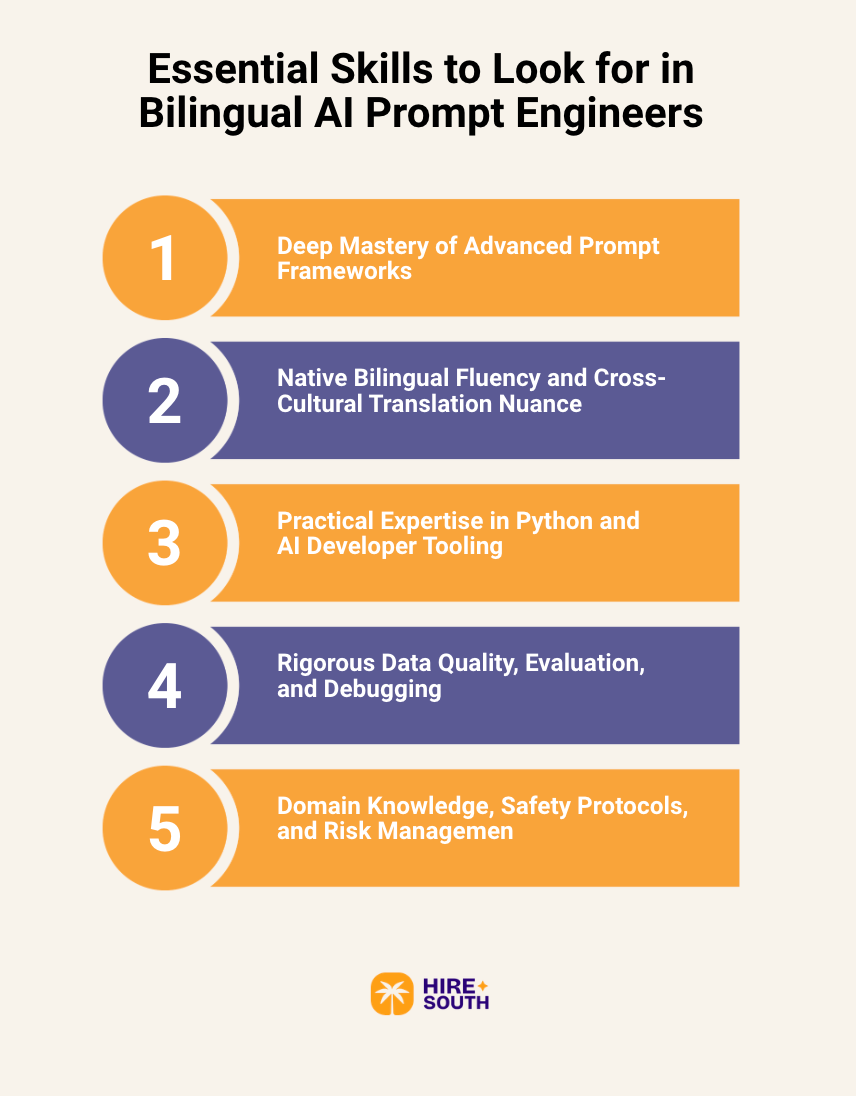
Deep Mastery of Advanced Prompt Frameworks.
Top prompt engineers go far beyond writing simple natural language requests. They possess deep experience in zero-shot, few-shot, chain-of-thought, and directional-stimulus prompting methodologies.
They understand how to structure complex execution instructions, define system parameters, and enforce strict JSON or XML output formats. This structural control ensures enterprise large language models generate reliable data that plugs directly into backend systems.
Native Bilingual Fluency and Cross-Cultural Translation Nuance.
True prompt engineering requires an intuitive grasp of linguistics and subtle vocabulary differences across languages. A native bilingual engineer understands how nuance, syntax, and idiom translations impact model reasoning across multi-language datasets.
Latin America leads global growth in online technology education, recording a 425 percent year-over-year increase in generative AI course enrollments, according to Coursera's 2025 Global Skills Report. Sourcing talent from this region yields engineers who easily bridge linguistic gaps, allowing US teams to build models that perform seamlessly across English and Spanish user bases.
Practical Expertise in Python and AI Developer Tooling.
Prompt engineering is rarely a standalone text design job. High-performing candidates hold strong foundations in software engineering, with deep proficiency in Python, API integration, vector databases, and popular orchestration frameworks like LangChain and LlamaIndex.
They must know how to inspect raw context vectors, track API token usage, optimize context window limits, and implement Retrieval-Augmented Generation (RAG) architecture directly within software pipelines.
Rigorous Data Quality, Evaluation, and Debugging.
A great prompt engineer treats prompt optimization like rigorous software testing. They set up automated evaluation frameworks to continuously benchmark accuracy, latency, and hallucination rates across model iterations.
Human validation skills are essential as AI development shifts toward automated coding and generation tools. Over 84 percent of enterprise developers actively use or plan to use AI coding tools in their daily workflows, according to GitHub research. Engineers need strong critical thinking to spot subtle logic errors, identify edge-case failures, and audit model outputs for structural compliance.
Domain Knowledge, Safety Protocols, and Risk Management.
Evaluating candidate expertise means looking for candidates who prioritize model security from day one. Qualified AI engineers implement robust guardrails to protect systems against prompt injection attacks, sensitive data leaks, and jailbreak vulnerabilities.
They understand regulatory compliance, enterprise privacy standards, and ethical AI frameworks. This guarantees that model behavior aligns with company safety guidelines before reaching end users.
How to Integrate LATAM Prompt Engineers into Your Existing Workflow
1. Aligning Communication Protocols Across Overlapping Time Zones
Integrating LATAM prompt engineers begins with structuring an operational schedule that balances live collaboration with uninterrupted focus time. Latin American hubs share 5 to 8 business hours daily with North American time zones, allowing your engineering leadership to conduct daily standups, live pair-programming sessions, and architecture reviews without requiring offset shifts.
Establish explicit "overlap windows" (typically 10:00 AM to 2:00 PM EST) dedicated strictly to synchronous meetings and real-time troubleshooting. Outside of these core hours, default to asynchronous workflows using tools like Slack, Notion, and Loom to protect deep work blocks.
Research shows that asynchronous communication protocols reduce meeting fatigue by 42 percent among distributed engineering teams while preserving focus for high-complexity tasks, according to SowFlow studies.
2. Standardizing Version Control for Enterprise Prompt Libraries
Prompt engineering code must follow the same deployment pipelines, testing standards, and version control procedures as production software. Treat system prompts, context configurations, and RAG retrieval templates as raw codebase assets rather than loose documentation.
- Store all prompt templates in dedicated Git repositories using standardized naming conventions and branch strategies.
- Implement feature flags so team members can dynamically test prompt changes without redeploying backend application infrastructure.
- Enforce automated pull request (PR) reviews where every prompt iteration requires peer approval and programmatic evaluation logs before reaching production.
3. Establishing Automated Benchmark Testing and Evaluation Logs
Your internal product team needs shared metrics to evaluate model performance objectively. Do not rely on subjective, manual human checks to judge whether a new system prompt improves outputs.
Require incoming LATAM prompt engineers to integrate open-source evaluation frameworks like Ragas, TruLens, or DeepEval into your continuous integration (CI/CD) workflow. These platforms continuously run test suites against sample datasets to score accuracy, context relevance, semantic similarity, and hallucination rates automatically.
4. Embedding Nearshore Engineers into Cross-Functional Product Sprints
Avoid isolating LATAM prompt engineers in standalone "AI research labs" or disconnected offshore silos. Treat them as core members of your cross-functional product squads alongside frontend developers, backend engineers, data architects, and product managers.
- Include prompt engineers in initial product discovery calls to assess feasibility before feature design begins.
- Pair prompt developers directly with data engineering teams to refine embedding chunk sizes and semantic search parameters.
- Provide direct access to customer support feedback loops so prompt engineers can rapidly adjust context windows based on real-world user queries.
5. Managing Compliance, Data Security, and Environment Access
Integrating distributed talent demands strict security controls to protect sensitive corporate assets and customer data. Ensure all nearshore talent operates within a zero-trust security architecture from their first day of onboarding.
Deploy enterprise password management tools, enforce multi-factor authentication (MFA) across all corporate accounts, and restrict access to live customer data. Supply nearshore engineers with secure, virtual desktop environments or encrypted hardware managed via Mobile Device Management (MDM) platforms like Jamf or InTune.
When configuring AI workspace credentials, use anonymized synthetic test datasets for local development, reserving access to production API keys through managed vault infrastructure like HashiCorp Vault.
Ready to Hire AI Developers in Latin America?
Scaling an enterprise artificial intelligence deployment demands high-caliber talent that can bridge technical execution with real-time business needs. Tapping into nearshore markets provides an efficient, sustainable solution to the domestic tech shortage, allowing organizations to integrate bilingual AI expertise without blowing past budget constraints.
At Hire South, we simplify the entire process of sourcing, vetting, and embedding top-tier Latin American tech talent directly into your existing infrastructure. We deliver a hand-picked shortlist of pre-vetted engineers, vetted for English fluency, deep technical capability, and cultural fit, enabling companies to make their first key hire in as little as 10 to 16 days while reducing overall staffing expenses by 30 to 45 percent. From initial screening to cross-border compliance and payroll, our team handles the heavy lifting so you can focus on shipping product. Reach out to Us today to discover how our nearshore hiring solutions can help scale your AI capabilities seamlessly.