


Finding reliable IT help shouldn't bankrupt your business. Yet, as software stacks grow more complex, maintaining an in-house helpdesk can feel like a financial trap. It's a massive headache for scaling companies.
You need high-quality assistance, but local salaries are skyrocketing. In fact, a striking 70% of businesses turn to external partners specifically as a cost-cutting measure, according to a global outsourcing report by Deloitte. The good news is that you don't have to compromise on quality or communication to protect your bottom line.
This guide breaks down exactly how to build an affordable, bilingual tech team without the headache. You will learn how to vet top-tier international talent, navigate cultural alignment, and leverage nearby time zones for real-time collaboration. We will also explore the exact roadmap to integrate a remote helpdesk into your daily workflow seamlessly. Here’s how to scale your technical support efficiently!
The Rising Demand for Affordable Tech Support Outsourcing
Running a business means keeping up with an explosion of new software, apps, and digital platforms. Every new tool you add to your workflow means another system that can break. When things go wrong, your customers and internal teams expect instant fixes. Managing this surge in daily technical issues can easily overwhelm a scaling company.
Building an internal IT helpdesk sounds like a solid plan until you calculate the overhead. Real estate, expensive hardware, and recurring certification training costs add up fast. Because of these rising structural expenses, the technical support outsourcing market is hitting new highs. The global technical support outsourcing market size reached $57.76 billion, according to data from Straits Research.
The pressure is shifting. Companies simply cannot justify the massive capital investments required to maintain specialized technical personnel locally. This financial strain explains why so many business leaders look beyond their immediate geographic borders for answers.
Outsourcing helps you skip the heavy infrastructure investments. You pay a predictable, subscription-based rate instead of dealing with volatile overhead costs. This setup lets you scale up your technical support capabilities during busy seasons and scale back down when things quiet down.
Passing non-core IT tasks to a dedicated external partner changes how your business operates. It shifts your focus back to growth. In fact, a major driver for this change is focus, with 65% of companies stating that outsourcing directly helps them focus on their core business activities, according to an industry benchmark report by RAAS Cloud.
You gain immediate access to an established infrastructure. You do not have to build ticketing workflows, set up phone systems, or design internal monitoring protocols from scratch. Instead, you tap into a fully functioning operation on day one, ensuring your systems stay online while your budget remains secure.
Why Smart Fast-Growing Companies Hire LATAM Tech Support
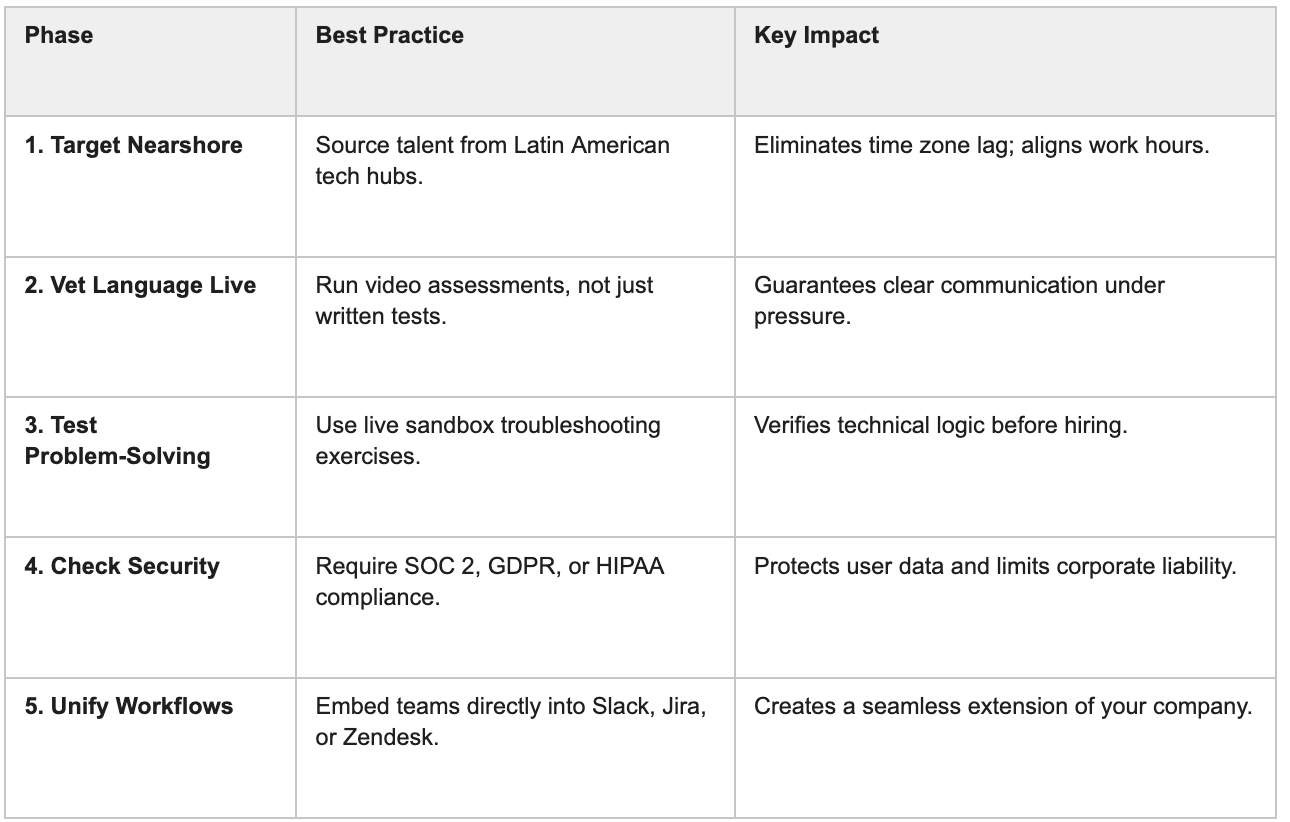
Expanding your technical operations does not have to mean managing radical time differences or dealing with frustrating communication delays. For forward-thinking organizations, looking south has become the definitive strategy for efficiently scaling helpdesk operations. Choosing to hire LATAM tech support allows you to secure elite technical talent while keeping your entire team structurally aligned.
The strategic shift toward Latin American infrastructure is backed by massive regional momentum. The Latin American information technology services market is projected to grow by $58.78 billion between 2025 and 2030, according to Technavio data. This explosive expansion highlights how rapidly the region is transforming into a dominant global hub for critical technical services and managed support workflows.
1. Real-Time Collaboration via Overlapping North American Time Zones
The most immediate operational advantage of nearshoring to Latin America is timezone alignment. Unlike traditional offshore destinations that operate on a 10 to 12-hour delay, professional support teams in Central and South America share direct daylight hours with North American markets. This eliminates the frustrating lag of waiting until the next business day for critical system fixes.
Your internal teams can collaborate in real time with support assets throughout the standard workday. Whether your headquarters runs on Eastern, Central, or Pacific time, your remote technical teams are online when your users need them most. This overlap ensures immediate incident response times, seamless communication on platforms like Slack or Microsoft Teams, and tighter operational control.
2. Sourcing Technical Talent from Top Latin American Innovation Hubs
Latin American tech centers are producing highly qualified technical professionals who are fluent in English and deeply integrated into modern developer ecosystems. Major cities across Brazil, Mexico, Colombia, and Argentina have invested heavily in technical education and infrastructure. The resulting talent pool possesses advanced capabilities in cloud architecture, network security, and complex database management.
Furthermore, these professionals are exceptionally fast adopters of cutting-edge technology. Software engineers and support experts across Latin America heavily utilize advanced artificial intelligence tooling, cloud optimization workflows, and predictive troubleshooting systems as standard parts of their operational routine, according to data from Ruzora. You are not just hiring basic ticket takers, you are integrating tech-savvy problem solvers into your business.
3. Drastically Reducing Infrastructure and Operational Overhead Costs
Protecting your company's bottom line is simple math. The cost of hiring an equivalent, highly experienced technical professional in North America can quickly choke a growing company's budget. Shifting your search to Latin American talent networks allows you to access the exact same tier of expertise at a fraction of the domestic price tag.
The financial relief of this geographical strategy is immediate. Businesses hiring senior technical professionals in Latin America save approximately 60% compared to equivalent United States hires, according to compensation data from Nexton. These significant savings give your business the financial breathing room to expand your service hours, invest in better software tooling, or scale up your product development pipelines without draining your reserves.
What Skills to Look for When You Hire a Remote Tech Support Team
Evaluating global talent requires looking past basic resumes. When building a remote helpdesk, your hiring checklist must balance deep technical competence with structural communication skills. Identifying this specific mix ensures your remote assets can diagnose complex system failures while keeping your user experience seamless.
1. Advanced Cloud Infrastructure and Ecosystem Expertise
Modern helpdesks handle far more than simple desktop troubleshooting. Your remote team must navigate distributed networks, cloud architecture, and modern deployment pipelines. Executives state that cloud computing is the most critical area of growth for their business, according to a tech skills report published by Pluralsight.
When vetting talent, prioritize hands-on experience with major cloud ecosystems, specifically Amazon Web Services (AWS) or Microsoft Azure. Your support assets should know how to manage cloud identity protocols, configure virtual networks, and interpret system performance logs. Finding teams with verified foundational credentials, such as the AWS Certified Cloud Practitioner or Google IT Support certificate, gives you immediate baseline proof of their practical capabilities.
2. Proficiency in Modern Helpdesk Tooling and Automation
An elite tech support team lives inside ticketing platforms and collaboration software. They must possess direct, everyday experience with enterprise-grade systems like ServiceNow or Freshdesk. Your remote technicians should know how to configure automated routing workflows, manage ticket escalation paths, and maintain clean documentation under pressure.
Furthermore, look for teams capable of basic automation scripting using languages like Python, Bash, or PowerShell. Tech job postings requiring Python skills grew significantly to nearly 18% of all tech listings, according to data from Indeed's Tech Talent Report. Technicians who can write simple scripts can automate repetitive diagnostic tasks, which drastically slashes your average resolution times.
3. Diagnostic Logic and Adaptive Problem Solving
Technical certifications matter, but raw analytical reasoning keeps your operations running. Remote support professionals operate without a physical colleague sitting next to them to double-check their work. They must rely entirely on structured, logical workflows to isolate variables and pinpoint the root cause of an outage.
Test your candidates using live, scenario-based troubleshooting exercises during the interview process. Observe how they approach an unfamiliar system failure. A top-tier technical specialist will ask targeted, process-oriented questions, gather data systematically, and consult internal knowledge bases before changing critical system settings.
4. Clear, Low-Friction Communication and Empathy
Excellent technical skills are useless if your support team cannot explain the solution to a frustrated end-user. Remote technical support requires sharp active listening, absolute patience, and the ability to translate complex technical jargon into clear, actionable instructions.
Your outsourced helpdesk must communicate seamlessly across multiple digital channels, including real-time chat, email workflows, and video calls. They need to write clear internal notes so that when a ticket moves from Tier 1 to Tier 3, your advanced engineers do not have to restart the discovery process from scratch. Empathy and clarity transform a stressful technical glitch into a positive customer retention experience.
Ready to Hire English-Speaking Tech Support Teams in Latin America?
Maintaining a balance between budget constraints and operational excellence is one of the toughest challenges modern business leaders face. When system downtime occurs, it costs companies an average of $5,600 per minute, according to data from Gartner. Protecting your bottom line while delivering immediate, high-quality technical assistance requires a calculated, strategic approach to nearshore staffing. You do not have to settle for long resolution times or restrictive overhead expenses just to keep your operations running smoothly.
At Hire South, we eliminate the friction of building a top-tier global helpdesk by connecting your business with the top tier of bilingual tech talent in Latin America. Our nearshore staff augmentation and dedicated support solutions match you with vetted professionals who work directly inside your time zone, speak fluent English, and seamlessly integrate into your daily operational workflows.
By partnering with us, you can cut your technical labor overhead by up to 40% without compromising on data security, technical expertise, or user satisfaction. We take care of the heavy lifting, including recruitment, rigorous vetting, payroll, and regional compliance, so your leadership team can stay focused on driving growth and pushing your product roadmap forward.