


You have a project that needs a specialist’s touch, but adding another permanent salary to your ledger feels like a heavy lift. This is exactly why the modern workforce is shifting toward agile, project-based talent. Knowing how to hire an independent contractor effectively is no longer just an HR trick, it is a competitive advantage for businesses of all sizes.
The financial perks are hard to ignore. According to ADP, companies can save significantly on labor costs because they aren't responsible for the 7.62% employer share of FICA taxes, health insurance, or paid leave. These independent contractor benefits allow you to reinvest that capital directly back into your core operations.
This guide breaks down everything you need to know. We will explore the most strategic uses of independent contractors, walk through the independent contractor hiring process, and tackle the legal nuances of worker classification. By the end, you’ll have a clear roadmap for scaling your team without the traditional overhead.
What is an Independent Contractor?
An independent contractor is a self-employed professional or entity contracted to perform work or provide services as a non-employee. Unlike a traditional staff member, a contractor maintains control over how the task is completed. You provide the goal, and they provide the methodology, tools, and expertise.
In the eyes of the IRS and Department of Labor, the distinction lies in the "Economic Reality" of the relationship. If you control only the result of the work and not the specific means and methods of accomplishing it, you are likely dealing with an independent contractor.
The Three Pillars of Contractor Status.
To ensure you are navigating independent contractor hiring correctly, regulatory bodies typically look at three specific categories of control.
Behavioral Control:
This dictates whether you have the right to direct and control how the worker does the task. If you are providing extensive instructions on when, where, and how to work, the government may view you as an employee. True contractors generally use their own methods and schedules to hit your deadlines.
Financial Control:
This covers the business aspects of the worker’s job. Independent contractors usually have a significant investment in their own equipment and unreimbursed business expenses. According to MBO Partners, 68% of full-time independent professionals provide their own health insurance and retirement funding, highlighting their financial independence from the firms that hire them.
Relationship Type:
This is defined by written contracts and the intent of the parties. If you provide benefits like a 401(k), paid vacation, or insurance, the "independent" label disappears. The relationship is typically project-based or for a specific period, rather than an indefinite, open-ended engagement.
Key Characteristics of an Independent Professional.
If you are evaluating a potential hire, look for these specific traits that define a true contractor:
- Multiple Clients: They often juggle several projects for different companies simultaneously.
- Profit or Loss Potential: They can make a profit or realize a loss depending on how efficiently they manage their business.
- Specialized Expertise: They are often brought in for high-level independent contractor uses like software architecture, legal consulting, or specialized marketing.
- Self-Equipped: You don't provide the laptop, the software licenses, or the desk space.
The Benefits of Hiring an Independent Contractor
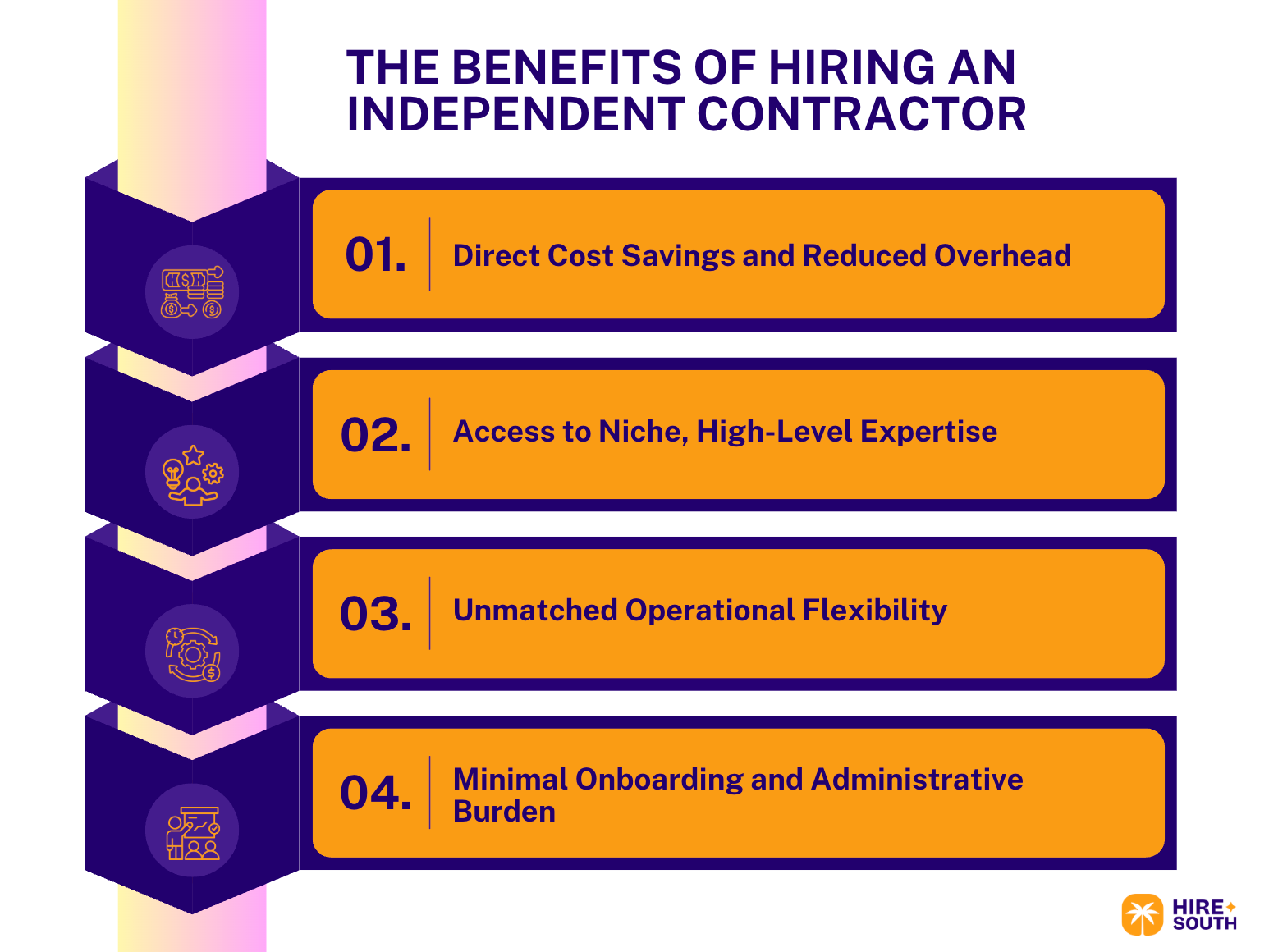
The landscape of work is shifting, and for many businesses, the traditional full-time model isn’t always the most efficient growth path. When you hire an independent contractor, you aren't just filling a seat; you are engaging a mini-business designed to deliver specific results. This relationship offers a level of agility that a standard W-2 arrangement simply cannot match.
From specialized expertise to significant bottom-line savings, the benefits of being an independent contractor are numerous. If you are looking to scale quickly or manage a complex project without the long-term weight of a permanent hire, these professionals are often the strategic answer.
1. Direct Cost Savings and Reduced Overhead
The most immediate advantage is financial. When you work with a contractor, your payment is typically limited to the agreed-upon rate for the work performed. You are not responsible for the "hidden" costs of employment that often catch business owners off guard.
According to the U.S. Bureau of Labor Statistics, as of September 2025, benefits for private industry workers averaged $13.68 per hour worked, accounting for nearly 29.7% of total employer costs. When you engage a contractor, that entire 30% premium disappears from your ledger. You are also exempt from:
- Payroll Taxes: You do not pay the employer’s share of FICA (Social Security and Medicare).
- Unemployment Insurance: Since they aren't employees, you don't contribute to state or federal unemployment funds on their behalf.
- Workers’ Compensation: Contractors generally provide their own business insurance.
2. Access to Niche, High-Level Expertise
One of the most strategic uses of independent contractors is bringing in skills your current team lacks. Instead of hiring a generalist and spending months on training, you can hire a specialist who has already mastered the specific problem you are facing.
Because contractors work with various clients across different industries, they bring a "cross-pollination" of ideas. They have seen what works elsewhere and can apply those best practices to your project immediately. According to a 2024 LinkedIn Global Hiring Trends report, organizations using skills-based platforms to find specialized talent saved an average of 30% on recruitment costs compared to traditional methods.
3. Unmatched Operational Flexibility
The ability to "flex" your workforce is a massive competitive advantage. Business needs aren't static; they ebb and flow with market demands and seasonal cycles. Independent contractors allow you to scale your team up for a big launch and scale back down once the goal is reached—without the legal and emotional hurdles of layoffs.
This "on-demand" nature means you can:
- Test New Markets: Launch a pilot program without a permanent headcount.
- Fill Gap Roles: Keep projects moving while you search for a long-term executive.
- Accelerate Speed to Market: According to Gloroots, distributed and agile teams can respond 30–40% faster to incidents and deployment needs than rigid, traditional structures.
4. Minimal Onboarding and Administrative Burden
Hiring a new employee is an intensive process that involves HR orientations, benefits enrollment, and weeks of "ramping up" before they become productive. According to Deloitte, the average cost-per-hire in the U.S. is approximately $4,700, and that doesn't include the time lost during training.
Contractors are expected to "hit the ground running." Since they are independent businesses, they come equipped with their own:
- Tools and Software: No need to buy extra licenses or hardware.
- Workspace: You save on real estate and utility overhead.
- Training: They stay updated on their industry at their own expense, not yours.
Why and When to Hire an Independent Contractor
Deciding between a permanent hire and a project-based professional isn't just about the budget; it is about the "speed of execution." In the current market, the ability to pivot is more valuable than a fixed headcount. You should look at independent contractor uses as a way to inject high-octane energy into specific initiatives without the drag of traditional employment cycles.
According to SHRM ]data for 2026, the average time-to-fill a permanent position has stabilised at around 42 to 45 days. In contrast, you can often hire an independent contractor and have them active within a week, especially when using specialised talent platforms. This speed makes them the ideal choice for high-stakes, time-sensitive shifts in your business strategy.
Timing is everything. You don't want to hire a contractor for a core, recurring business function, but they are the clear winners in several specific scenarios:
Short-Term Project Sprints:
If you have a clear beginning, middle, and end to a task, like a website migration or a seasonal marketing push, contractors are your best bet. You get the expert output you need, and when the project closes, the financial commitment ends automatically.
Accessing Rare "Unicorn" Skills:
Certain roles, especially in AI implementation or niche legal compliance, are incredibly hard to find. According to Robert Half, roles tied to productivity and AI adoption remain in high demand through 2026, often leading to bidding wars for full-time talent. Hiring a contractor allows you to bypass the long-term salary competition and pay for a specific outcome instead.
Testing New Markets or Products:
Are you thinking about expanding into a new region or launching a pilot service? Using a contractor allows you to "test the waters" without the legal complexity of setting up a new entity or committing to long-term payroll. It’s the ultimate low-risk research and development strategy.
The "Core vs. Context" Framework:
A simple way to decide is to ask: Is this task part of my "Core" business identity or just "Context" that supports it?
- Core tasks (like your lead product developer) should generally stay in-house.
- Context tasks (like a specialized auditor or a graphic designer for a one-off report) are prime for independent contractor hiring.
Signs You Should Wait Before Hiring:
While the independent contractor benefits are significant, they aren't a universal fix. You might want to skip the contractor route if:
- You need someone to manage and lead a large internal team indefinitely.
- The role requires deep, daily immersion in your sensitive company culture and long-term brand voice.
- You need to exercise total control over how the work is done every hour of the day, this would likely lead to legal misclassification.
Looking to Hire an Independent Contractor in Latin America?
Building a scalable, modern business requires a shift from static hiring to a more dynamic, result-oriented model. By leaning into the strategic independent contractor uses we’ve discussed, you can bypass the overhead of traditional employment while accessing top-tier expertise exactly when you need it. In an economy where specialized skills are the new currency, hiring an independent contractor with confidence is your fastest route to operational agility.
At Hire South, we specialize in helping you navigate this shift without the typical administrative headaches. Our team connects you with the top Latin American professionals who are not only culturally aligned and time-zone compatible but can also reduce your labor costs by more than half. We handle the heavy lifting, from rigorous vetting and English assessments to global payroll and compliance, so you can focus on making the high-level decisions that drive your company forward.
Whether you need a single specialist or a full managed team, we provide the infrastructure to scale your workforce effectively, efficiently, and affordably. Contact us to help you find your next contractor!


.jpg)