


The hunt for top-tier tech talent has officially entered the fast lane. If you have scouted for engineering talent lately, you already know that AI-driven platforms and automated algorithms are running the show. Finding software engineers is now faster than ever, but it comes with a major catch.
How do you know if the candidate on your screen is actually the one writing the code?
With synthetic resumes and AI-polished portfolios on the rise, true validation is becoming a lost art. According to Korn Ferry, the global tech talent shortage could reach over 85 million people by 2030, meaning the pressure to secure qualified developers is hitting critical levels. Businesses are flooding automated platforms to bridge this gap, yet rushing the process often leads to costly mismatches.
This guide cuts through the algorithmic noise. You will discover exactly how to navigate automated hiring solutions without sacrificing quality, run bulletproof nearshore development verification, and pick a partner that passes every validation check. It is time to outsmart the bots and build a high-performing nearshore team you can actually trust.
Understanding the Shift to an Automated Market for Tech Talent
The manual process of sorting through resumes line by line is officially a thing of the past. Today, searching for specialized software engineers means entering a landscape run almost entirely by algorithms. High-speed algorithmic platforms have completely replaced traditional, human-heavy tech recruitment, shifting the industry into a fully automated marketplace.
This evolution happened out of pure necessity. According to SelectSoftware Reviews, an astounding 99% of U.S. hiring managers state that their organizations now use AI in some capacity throughout the recruitment process. The sheer volume of global applicants makes human screening impossible to scale, forcing companies to rely on machine learning to filter, rank, and match technical talent at lightning speed.
For businesses seeking nearshore software development partners or individual engineers, this shift changes the entire playbook. You are no longer competing simply for visibility, instead, you are operating within a digital ecosystem where software agents instantly grade engineering talent before a human ever sees a portfolio. Understanding how these automated networks function is the first step to successfully navigating them.
The Evolution of Sourcing in Nearshore in Automated Markets.
Sourcing tech talent across borders used to rely on personal networks, regional agencies, and manual reference checks. Now, finding talent across nearshore tech hubs relies heavily on predictive data and automated marketplaces. Platforms use natural language processing to scan code repositories, analyze LinkedIn activity, and score candidate profiles against your exact job parameters in milliseconds.
This automated approach offers an undeniable competitive advantage in speed. According to Careertrainer.ai, AI-powered recruitment tools can reduce overall time-to-hire metrics by up to 40%. For a scaling business, cutting weeks off the hiring cycle means your product roadmaps stay on schedule, and your internal engineering teams avoid burning out.
However, moving at machine speed introduces a distinct set of operational challenges. When the entire sourcing funnel is automated, the human element is pushed to the very end of the process. If your organization relies purely on automated matching platforms without understanding their mechanics, you risk missing highly qualified developers who simply did not optimize their profiles for the platform's specific algorithm.
High-Volume Filtering and the Reality of Algorithmic Screening.
To truly master nearshore in automated markets, you have to look at what happens behind the screen. When a remote position opens up, automated market systems instantly ingest hundreds of applications, standardizing the data into clean, uniform profiles. The platform then runs algorithmic screening models to assign every candidate a match-probability score.
This process relies heavily on semantic search, looking for clusters of related skills rather than exact phrase matches. For example, if you need a backend developer, the system does not just look for the word "Python", it scans for associated frameworks like Django, Flask, cloud architecture patterns, and database management systems to infer a developer's true depth.
The reality of this high-volume filtering is that it creates a massive optimization game. While automation successfully removes the initial administrative burden from your internal team, it also establishes an environment where the best-optimized profile wins the algorithm's favor, which does not always correlate with the best actual engineer for your specific project.
Why You Need Rigorous Nearshore Development Verification Processes
Relying strictly on automated shortlists to hire software engineers is a massive gamble. While platform algorithms are great at tracking down keywords, they are fundamentally incapable of validating human integrity, actual coding compliance, or identity consistency. If you bypass a strict, manual verification layer, you risk introducing severe vulnerabilities directly into your codebase.
The threat landscape in remote tech recruitment has escalated well beyond basic resume padding. Today, sophisticated automation allows bad actors to manipulate screening systems at a scale never seen before. To protect your intellectual property and project timelines, your organization must transition from simple keyword filtering to an ironclad nearshore development verification strategy.
1. The Danger of Ghost Developers and Outsourcing Subcontracting
The most challenging threat facing modern engineering leaders is the rise of "ghost developers" and unvetted subcontracting. In this scenario, a highly skilled senior engineer aces the initial automated screening and shines during the technical interview. However, once the contract is signed and onboarding begins, that engineer vanishes.
Instead of getting the elite talent you interviewed, your tasks are quietly passed off to junior, unvetted subcontractors. This bait-and-switch strategy happens entirely behind the scenes. According to a landmark 2026 workforce study by First Advantage, an incredible 76% of hiring professionals globally have encountered falsified candidate details, while 45% have dealt directly with candidate identity misrepresentation.
When a remote worker secretly outsources their own role, your corporate data security is instantly compromised. These third-party subcontractors operate completely outside your security protocols, access your repositories without authorization, and routinely introduce buggy, unverified code into production. Without a continuous verification loop, you could easily pay premium rates for subpar, high-risk code execution.
2. Establishing a Bulletproof Nearshore Development Verification Framework
Beating the bots requires building a multi-layered verification framework that validates identity and true technical execution simultaneously. A standard background check simply is not enough anymore. Your internal talent teams must actively verify that the digital persona on paper matches the physical human writing code in real time.
According to a comprehensive 2025 survey of 3,000 corporate managers conducted by Checkr, 35% of hiring leaders reported that someone other than the listed applicant participated in their virtual technical interviews. This means identity verification must happen at every single touchpoint of your hiring pipeline.
- Multi-Factor Identity Matching: Require candidates to present valid, government-issued identification on camera right before any live technical evaluation begins.
- Hardware and IP Tracking: Ensure the engineer’s physical location matches the regional boundaries established in your nearshore contract, blocking unauthorized VPN usage.
- Git Commit Analysis: Routinely match an engineer’s live-interview coding style against their daily repository pushes to identify sudden shifts in syntax or code structure.
3. Beyond the Resume: Validating Real-Time Strategic Coding Capabilities
To secure top-tier talent in an automated market, your team has to completely reinvent the technical assessment process. Traditional, take-home coding assignments are no longer reliable. Because generative AI tools can solve standard algorithmic puzzles in seconds, a flawless code submission no longer proves a developer's actual ability.
Your technical evaluations must focus heavily on real-time, strategic problem-solving. According to data published by Metaview, 39% of job candidates actively use AI tools during the application process, with 29% using them specifically to answer technical assessment questions.
To combat this trend, shift your focus toward interactive pair-programming sessions. Ask candidates to debug a broken legacy codebase live on screen, or have them explain the architectural trade-offs of a complex system design choice. These dynamic, human-to-human technical conversations quickly reveal a developer's true depth of experience, separating senior engineers from those simply reading AI-generated prompts.
Step-by-Step Nearshore Development Company Validation
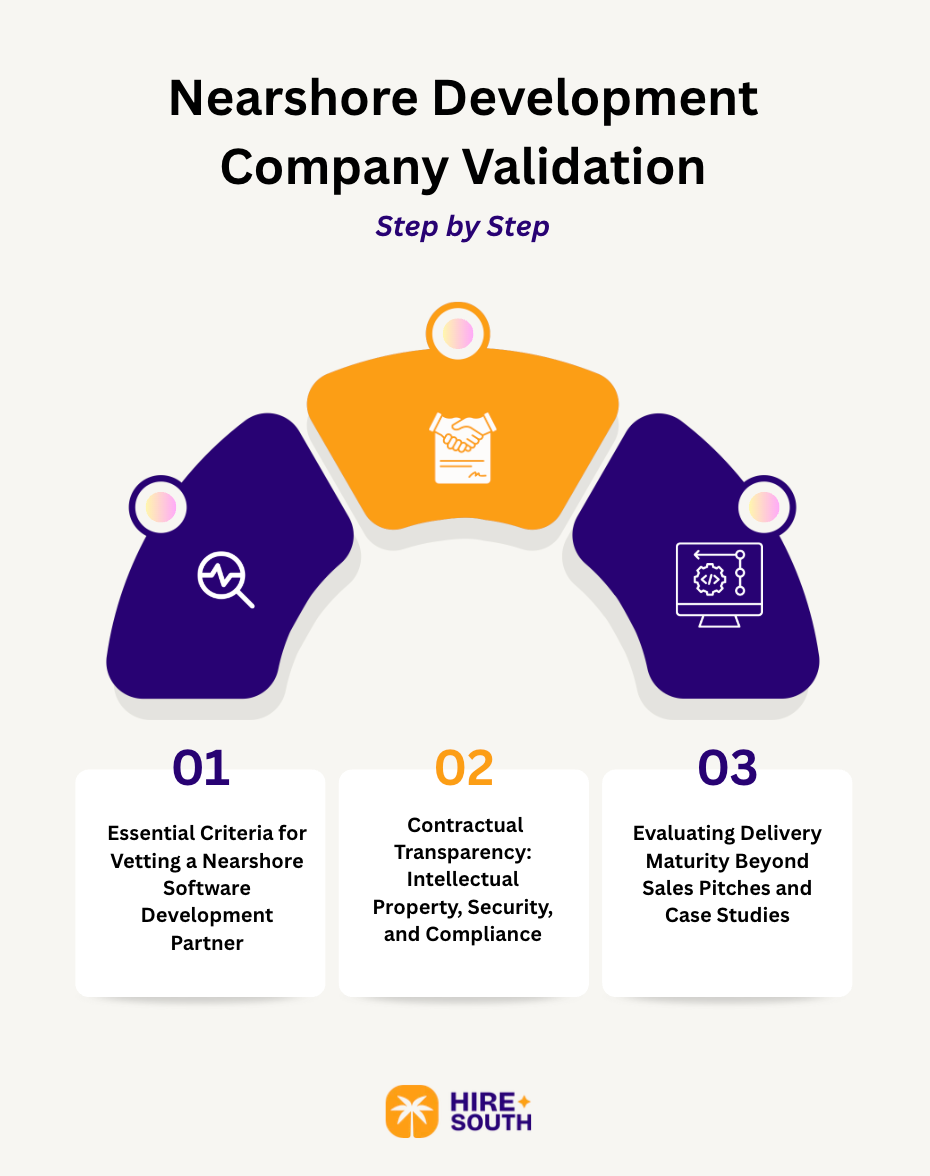
1. Essential Criteria for Vetting a Nearshore Software Development Partner
The validation process starts by looking past polished sales decks and verifying an agency's true operating capacity. Many firms in automated marketplaces act as digital brokers, winning service contracts first and scrambling to source freelancers later. To avoid this trap, you need to verify that their engineering bench actually exists.
According to a comprehensive study by ScaleUpAlly, nearshore software development initiatives achieve an 80% success rate compared to just 60% for traditional offshore models. However, capturing that 20% operational advantage depends entirely on selecting a partner with structured, permanent engineering teams.
To evaluate an active bench architecture properly, request a masked roster of the agency's full-time staff and pay close attention to their average employee tenure, since high turnover indicates an unstable operational environment. You also need to examine their sourcing maturity by asking the agency to detail their local recruitment pipeline, which verifies exactly how long it takes them to scale up a dedicated squad with specialized technical skills. Finally, investigate their financial and operational health by verifying the company's regional corporate registration, local tax compliance, and credit rating to ensure they have the financial runway to sustain long-term engineering partnerships.
2. Contractual Transparency: Intellectual Property, Security, and Compliance
When you move operations to a nearshore location, your corporate legal protections must travel with you. True nearshore development company validation means performing a rigorous review of data handling practices, security standards, and intellectual property protections.
Data security remains an immediate priority for organizations expanding their external partnerships. According to a global technology report by Deloitte, 68% of companies actively considering new external service partnerships state that data security and cross-border legal compliance are their primary operational concerns.
Ensure your nearshore partner strictly adheres to international security frameworks such as SOC 2 Type II or ISO 27001. Their regional contracts must feature enforceable intellectual property assignments that completely protect your proprietary source code, while mandating explicit compliance with your local data privacy regulations.
3. Evaluating Delivery Maturity Beyond Sales Pitches and Case Studies
The final validation step requires testing an agency's practical execution capabilities under real-world project stress. Standard corporate case studies are carefully curated marketing assets, meaning they rarely reflect the day-to-day challenges of an active engineering engagement.
To uncover an agency's true delivery maturity, you need to inspect their active software engineering processes. Request a live, guided walkthrough of their project management tools, communication channels, and internal documentation environments.
Begin with agile integration testing to evaluate how their teams handle sprint planning, backlog grooming, and retrospective meetings, ensuring their engineering workflow aligns seamlessly with your internal product management style. Next, conduct a thorough code architecture quality review by having your senior internal technical leaders inspect anonymized code samples directly from the agency's active repositories, verifying their adherence to modern design patterns, automated testing practices, and clean code documentation standards. Conclude the process with a CI/CD pipeline audit to ensure the agency uses modern, automated continuous integration and continuous deployment pipelines, guaranteeing that code security scans, unit tests, and regression testing run automatically with every single code commit.
Strategic Frameworks to Safely Hire Nearshore Professionals
Relying strictly on automated job boards to recruit engineering talent across borders is no longer a viable strategy. When you want to safely hire nearshore professionals, your business must look beyond superficial match percentages and instead implement defensive hiring frameworks.
Safeguarding your development pipelines means executing targeted validation mechanisms that measure deep communication skills, cognitive adaptability, and operational alignment. This approach allows your organization to filter out candidates who are simply optimizing their profiles for machine learning filters, ensuring you connect with genuine, high-performing experts.
Designing Multistage Live Coding Challenges that Defeat AI Assistance:
The traditional take-home technical assignment is obsolete now that advanced generative engines can churn out flawless code structures in real time. To protect your recruitment funnel, your technical assessments must move entirely into dynamic, interactive environments.
According to an engineering productivity report by Metaview, 39% of software candidates actively leverage AI tools during technical recruitment phases to assist with coding tasks. To mitigate this vulnerability, your team must structure live evaluations that prioritize real-time systemic thinking over basic syntax generation.
Instead of asking candidates to write standard algorithms from scratch, hand them an existing, complex codebase containing subtle architectural flaws and hidden bugs. Instruct them to debug, optimize, or expand the application live while explaining their engineering choices over a shared video link. This dynamic approach completely neutralizes copy-paste AI tools, quickly revealing whether a developer possesses genuine problem-solving experience or is simply reading from a secondary screen.
CEFR-Validated Fluency: Assessing Real-Time Communication Under Pressure
Technical expertise is completely wasted if an engineer cannot articulate complex architectural tradeoffs during an urgent production incident. In an automated marketplace, basic conversational English can easily be simulated through text-based filters, which makes live, standardized testing essential.
Evaluating language compatibility requires abandoning informal vibe checks in favor of structured frameworks like the Common European Framework of Reference for Languages, known globally as CEFR. According to a 2026 international remote workforce study published in the Journal of Interdisciplinary Perspectives, while 47.8% of advanced tech candidates achieve a solid B2 upper-intermediate level, there remains a persistent 11% gap in productive speaking skills when compared to passive reading comprehension.
To address this variation, your interview process must test spontaneous verbal production rather than scripted professional introductions. Task candidates with explaining a highly technical concept, such as data replication strategies or microservices orchestration, to a non-technical stakeholder over a live call. This exercise ensures that the developers you bring into your organization can participate meaningfully in fast-moving agile product discussions without encountering constant communication friction.
Cultural and Temporal Alignment: Setting Up Synchronous Agile Workflows:
The true promise of nearshore software development lies in synchronous collaboration, but maximizing this benefit requires more than just sharing a general region on a map. True operational compatibility depends on aligning your external team with your internal corporate communication styles and business practices.
Proximity provides a massive structural advantage when managed correctly. According to a comprehensive technology outsourcing analysis by HatchWorks, 80% of corporate operations leaders in North America are actively shifting toward nearshore models specifically to capitalize on close geographic proximity and overlapping work schedules.
To maximize this advantage, ensure your nearshore engineering squads maintain a minimum of five to six hours of daily synchronous working overlap with your core product teams. Use this shared window to hold active sprint planning sessions, daily standups, and collaborative pair-programming loops. By establishing these real-time connection windows, you prevent the handoff delays and isolation patterns that typically disrupt traditional, fragmented offshore development models.
Ready to Hire Nearshore Developers in Latin America?
Navigating an automated tech marketplace requires a deliberate balance between algorithmic speed and human verification. As long-term engineering success becomes increasingly dependent on strict security, data compliance, and synchronous operational alignment, cutting corners during the validation phase is no longer an option for growing enterprises.
We at Hire South can transform your technical sourcing strategy. Instead of letting your job requirements get lost in unverified databases or automated broker networks, we specialize in connecting your business directly with pre-vetted, highly skilled, dedicated software developers across Latin America. Our hands-on model guarantees absolute transparency, ensuring that the engineers joining your daily standups possess both the verified technical expertise and the real-time communication depth required to move your product roadmaps forward safely.
Building an elite cross-border engineering squad does not have to mean wrestling with synthetic profiles or compliance risks. Contact us at Hire South today to schedule a strategic consultation, and let our team help you secure trusted, long-term tech talent that integrates seamlessly into your workflow. Book a free strategy call to learn more!