


The old playbook for building a tech team is officially obsolete. You’ve likely felt the friction firsthand: job postings that stay open for months, astronomical salary demands for mid-level talent, and a local candidate pool that seems to have more AI-generated keywords than actual coding experience. The US tech hiring market isn't just in a slump; it’s structurally misaligned with the needs of 2026.
The numbers tell a stark story. Even with recent market shifts, the demand for specialized talent continues to outpace supply, with the AI talent gap alone seeing demand exceed supply by a ratio of 3.2:1, according to SecondTalent. You are competing in a hyper-crowded domestic market where the cost of a single bad hire can derail your entire roadmap.
This article breaks down why the traditional hiring model is failing your business and explores the tactical shift toward nearshoring solutions. You will learn how to leverage IT staff augmentation to bypass the "cost of vacancy" and build an elastic workforce that operates in your time zone. It’s time to stop fighting the local talent war and start winning on a global scale.
Reasons Why US Tech Hiring is Broken
You’ve posted the "perfect" job description, offered a competitive remote package, and waited. Instead of a handful of elite engineers, you’re likely staring at a mountain of 1,000+ AI-generated resumes that don't actually match your tech stack. This is the reality of the 2026 IT hiring market. The traditional pipeline is clogged with noise, making it nearly impossible to find a signal.
The math simply doesn't add up for domestic-only searches anymore. While general tech layoffs make headlines, the specific roles you actually need to fill, like Senior DevOps or AI Architects, are more scarce than ever. In fact, the demand for AI-related roles has surged so sharply that it exceeds supply by a ratio of 3.2:1, according to SecondTalent. You aren't just competing with the startup down the street; you’re competing with every Fortune 500 company panic-hiring for the same narrow slice of talent.
The Hidden Costs of the Domestic Talent War:
Hiring in the US has become an exercise in extreme overhead. Beyond the base salary, which for senior developers often clears $150,000 to $200,000, you have to factor in the "Cost of Vacancy." Every day a critical engineering seat sits empty, and your product roadmap slips. On average, it now takes 44 days to fill a tech role, according to Josh Bersin, though specialized positions can easily stretch into three or four months.
This delay creates a ripple effect. Your current team gets burnt out covering the gap, leading to "quiet quitting" or actual turnover. You aren't just losing time; you’re losing the institutional knowledge of the people who leave because they’re tired of doing two jobs.
Credential Inflation vs. Actual Capability:
There is a growing disconnect between what a resume says and what a candidate can do. Many US-based applicants have mastered the art of passing an automated screening bot but fail the first live coding challenge. This forced reliance on automated filters is backfiring.
Because everyone is using the same AI tools to "optimize" their applications, the US tech hiring process has become an arms race of bots. You end up interviewing people who are great at being candidates but mediocre at being engineers. This lack of reliable vetting infrastructure is a primary reason why tech leaders feel the system is fundamentally broken.
Geographic Salary Arbitrage and "The Great Stay":
Even with the shift toward hybrid work, salary expectations remain anchored to high-cost-of-living hubs like San Francisco or New York. You might find a great developer in a smaller US city, but they’ll still expect a "Silicon Valley" rate because they know someone else will pay it.
Meanwhile, many top-tier US developers are entering a phase of "The Great Stay." After the volatility of the past two years, high-performing talent is staying put for stability. This leaves the "active" domestic talent pool filled with either entry-level seekers or those who have been frequently displaced, according to CNBC, which reported that employee confidence in the tech sector dropped to 47.2% in early 2026. This stagnation makes finding that "unicorn" hire feel like a statistical impossibility.
How the Traditional US Tech Hiring Model is Failing
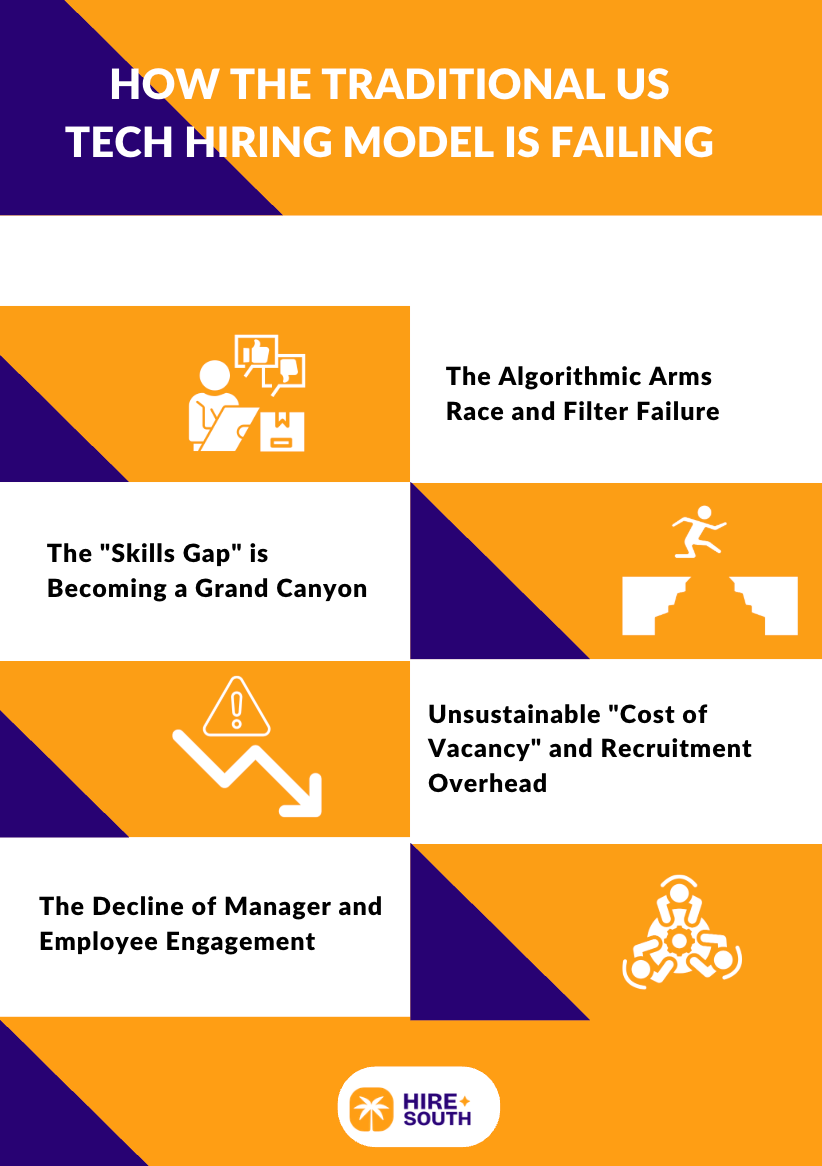
The systems you relied on five years ago to scale your engineering team are now actively working against you. In 2026, the domestic tech hiring market is suffering from a structural breakdown where the volume of noise has completely overwhelmed the capacity for quality. You are likely experiencing a "hiring fatigue" that stems from three core systemic failures.
1. The Algorithmic Arms Race and Filter Failure
The most visible sign of a broken model is the sheer volume of low-quality applications. Candidates are now using sophisticated AI agents to "reverse-engineer" job descriptions, ensuring every resume looks like a perfect match to your Applicant Tracking System (ATS).
When Southwest Airlines recently opened a posting for flight attendants, they received 15,000 applications in mere hours, forcing them to shut the listing down, according to Computerworld. In the tech sector, this same "application flooding" means your recruiters are spending 80% of their time filtering out "AI-optimized" ghosts rather than talking to real talent. The trust between the company and the candidate is breaking down because neither side believes the other is seeing their true value.
2. The "Skills Gap" is Becoming a Grand Canyon
While you see headlines about tech layoffs, those layoffs are often in non-technical or redundant roles. For the high-impact positions you actually need, like Cloud Architects or AI/ML Engineers, the scarcity has reached critical levels.
Current data shows that 69% of US employers are struggling to find skilled talent, according to ManpowerGroup. This isn't just a temporary dip; it’s a structural talent mismatch. Traditional hiring models rely on a local or national pool that is simply exhausted. By limiting your search to the US, you are fighting over a shrinking slice of the pie, while 72% of firms in the professional and technical services sector report they cannot fill their open roles.
3. Unsustainable "Cost of Vacancy" and Recruitment Overhead
The financial burden of the domestic-only model is no longer just about high salaries. You have to account for the "Cost of Vacancy", the revenue and productivity lost while a seat remains empty.
- Average Time-to-Fill: Benchmarks for technical positions now sit at 42 to 44 days, according to SHRM.
- Financial Impact: Carrying just three open roles through a standard hiring cycle can cost your business over $66,000 in vacancy losses alone before you even pay a recruiter, according to Tatvic.
- Total Compensation Inflation: A senior developer in a major US tech hub now commands a median salary of $160,000, which balloons to over $210,000 when you factor in FICA taxes, 401(k) matching, and health insurance, according to ProDevs.
4. The Decline of Manager and Employee Engagement
The traditional "hire-and-hope" model is also failing your internal culture. When you can't fill roles quickly, the burden falls on your existing team. This leads to a cycle of burnout that is hard to reverse.
Global employee engagement has dropped to 20%, its lowest level since 2020, according to Gallup. Perhaps more concerning for your leadership is that manager engagement has also plummeted. When your managers spend all their time "filling gaps" and interviewing unqualified candidates rather than mentoring their teams, your retention rates for your existing top talent begin to crater. You aren't just failing to hire; you're failing to keep the people you already have.
Strategic Nearshoring Solutions for Modern Enterprises
1. Real-Time Collaboration and Time Zone Alignment
The most significant failure of the old offshore model is the feedback loop. When you send a clarification at 5 PM and have to wait until 9 AM the next day for a response, your development velocity drops by 50% or more.
Nearshoring bridges this gap by providing near-complete time zone overlap. Teams in Mexico (CST) or Colombia (COT) operate within zero to one hour of US Central and Eastern times. This allows for real-time code reviews, immediate bug fixes, and spontaneous brainstorming sessions. According to BayOne, nearshore development can deliver 40–60% savings compared to US-based equivalents while actually accelerating delivery speed by removing the 24-hour feedback loop.
2. Accessing the Latin American Talent Surge
You may be surprised to learn that Latin America is now a global powerhouse for specialized tech talent. The region graduates over 220,000 STEM professionals annually, according to AgileEngine. This isn't just "generalist" talent, either. Mexico and Brazil now account for approximately 95% of all AI patents filed in Latin America, signaling a deep expertise in the very technologies that are currently breaking the US hiring market.
3. Cultural Synergy and Communication Fluidity
Communication friction is often a "hidden tax" on remote teams. Nearshoring minimizes this because of the deep cultural and business alignment between North and South America. You’ll find that developers in nearshore hubs often share similar educational backgrounds, project management styles, and even pop-culture references with your US team.
This cultural affinity leads to smoother integration. Younger tech professionals in Latin America are outperforming regional averages in English proficiency, according to AgileEngine. This means less time spent deciphering requirements and more time spent shipping high-quality code.
4. Operational Cost Efficiency vs. Total Value
While cost shouldn't be your only driver, the economics are undeniable. A senior software developer in hubs like Bogotá or Buenos Aires typically earns between $54,000 and $80,000 annually, compared to the $198,000 to $223,000 you might pay in San Francisco, according to AgileEngine.
That is a savings of over $120,000 per developer every single year. When you multiply that across a team of five or ten, you’re suddenly looking at millions of dollars that can be reallocated to your core R&D or marketing efforts. In an era where efficiency is the new growth, nearshoring is no longer a "budget option", it’s a strategic mandate.
How IT Staff Augmentation Solves the Crisis
1. Scaling Speed: From Months to Days
In the current IT hiring market, speed is your biggest competitive advantage. While it takes an average of 44 days to land a domestic hire, staff augmentation can reduce your "time-to-talent" to as little as 7 to 14 days, according to Technavio.
This agility allows you to respond to sudden market shifts, like a surprise competitor feature or a security patch requirement, without waiting for a recruiter to sift through a thousand LinkedIn profiles. You get an engineer who is ready to commit code on day one, not someone who needs three weeks to figure out where the digital water cooler is.
2. Eliminating the "Benefits Burden" and Hidden Costs
Hiring in the US is expensive, but the salary is only the tip of the iceberg. When you bring on a full-time dev, you’re on the hook for a "burdened cost" that includes health insurance, payroll taxes, and office equipment.
- The 1.4x Rule: On average, a full-time employee costs 1.25 to 1.4 times their base salary once benefits are included, according to the U.S. Bureau of Labor Statistics.
- Zero Overhead: With augmentation, you pay a flat hourly or monthly rate. The partner handles the taxes, the hardware, and the legal compliance.
- Capital Efficiency: This allows you to convert fixed labor costs into variable expenses. If a project wraps up early, you can scale back without the legal and emotional trauma of a RIF (Reduction in Force).
3. Access to "Unicorn" Skills on Demand
You might not need a world-class Cybersecurity Architect for three years, but you definitely need one for the next three months. Augmentation lets you rent high-level expertise that you likely couldn't afford, or find, on the permanent market.
The global IT staff augmentation market is on track to reach a valuation of $187.9 billion by 2030, growing at a CAGR of 7.5%, according to Dataintelo. This growth is fueled by companies like yours that realize it's more efficient to hire a "specialist for a season" than a "generalist for a lifetime." You gain immediate access to niche stacks, like Rust, Golang, or specialized AI modeling, without having to retrain your entire core team.
4. Maintaining Cultural Continuity and Project Control
One of the biggest fears you might have with outside help is losing "the soul" of your product. Unlike project outsourcing, where a third party builds something in a black box, staff augmentation keeps the new talent inside your ecosystem.
These developers attend your daily stand-ups, report to your CTO, and use your Jira boards. They become a temporary extension of your culture. Because they are integrated into your workflow, the risk of "knowledge silos" is virtually eliminated. You keep the IP, you keep the process, and you keep the momentum.
Ready to Hire LATAM Developers Through Nearshoring?
The era of struggling through a dysfunctional domestic talent funnel is ending as businesses transition toward more agile, borderless engineering teams. Success in the 2026 tech hiring market requires moving past the "vacancy crisis" and embracing a model where geographical proximity and technical depth finally align.
At Hire South, we specialize in bridging this gap by connecting your enterprise with the top 1% of Latin American tech talent. With the region now producing over 220,000 STEM graduates annually, according to AgileEngine, the opportunity to scale without the friction of traditional US tech hiring has never been greater.
At Hire south we provide high-impact nearshoring solutions and IT staff augmentation that integrate seamlessly into your existing workflows. Our focus is on providing you with senior-level developers who operate in your time zone, understand your business culture, and possess the specialized skills, from AI architecture to cloud security, that are increasingly scarce in the US. Let us help you reclaim your product roadmap and build the resilient, cost-effective team your company deserves. Book a call to learn more!


.jpg)