


Your team is scattered across time zones, but the work never stops. Finding the right talent shouldn't feel like a second full-time job. Whether you are a startup founder or a veteran HR director, the pressure to scale efficiently is real. Remote staffing companies have moved from a nice-to-have partner to a core business engine. On top of it, efficiency is the new currency, creating a massive demand for reliable hiring agencies.
This guide breaks down exactly what to look for in remote staffing to ensure you don't end up with a revolving door of contractors. We will explore the best remote staffing firms, compare different hiring models, and dive into the legal nuances of global payroll. From vetting technical skills to navigating international labor laws, here’s how to find a partner that treats your business like their own!
The Key Considerations When Looking for a Remote Staffing Company
Selecting a partner to build your distributed team is a high-stakes decision. The wrong choice doesn't just cost money; it stalls your momentum. In 2026, the gap between "resume pushers" and strategic talent partners has never been wider.
According to GoodTime, 90% of companies missed their hiring goals last year, proving that traditional sourcing is breaking under the weight of global competition. To ensure you land in the successful 10%, you need to look beyond the surface level.
1. Prioritize Rigorous, Security-First Vetting Processes
Standard skill tests are no longer enough. With the rise of AI-assisted cheating and sophisticated deepfake identity fraud, your staffing partner must treat vetting as part of your security infrastructure.
Look for firms that use live, proctored coding environments and multi-layered identity verification. According to GigsRemote, forward-thinking agencies in 2026 are now using "liveness detection" to defeat face-swaps and video filters during interviews. If a firm cannot explain its technical safeguards against AI-assisted fraud, your intellectual property could be at risk.
2. Evaluate Time Zone Alignment for Real-Time Collaboration
While "follow-the-sun" models work for ticket-based support, core operations require synchronous communication. The "sweet spot" for high-performing teams is a 0 to 2-hour overlap.
According to Alp Consulting, nearshore hiring has largely replaced traditional offshoring in 2026 because it solves the "collaboration lag." Working with a firm that specializes in your specific time zone, whether that’s Latin America for U.S. teams or Central Europe for the UK, ensures your remote talent is embedded in your daily workflows rather than working in a vacuum.
3. Demand Transparency in "Speed-to-Hire" and Delivery Metrics
In a market where time-to-hire has worsened for 60% of organizations, speed is a massive competitive advantage. You need a partner that provides hard data on their pipeline efficiency.
Ask for their average "Time-to-Fill" for your specific niche. The best remote staffing firms can move from a job req to a vetted shortlist in 3 to 14 days. If they can’t provide a clear dashboard showing candidate progress, retention rates, and cost-to-output ratios, you are likely dealing with a firm that relies on intuition rather than a data-driven engine.
4. Check for Employer of Record (EOR) and Compliance Expertise
Hiring across borders is a legal minefield. A staffing company is only as good as its compliance framework. You need to know how they handle local labor laws, international tax treaties, and mandatory benefits.
According to Vena Solutions, the average cost of turnover in 2025-2026 reached over $36,000 per employee, much of which stems from mid-contract legal disputes or compliance failures. Ensure your partner either acts as a robust EOR or integrates seamlessly with platforms like Deel or Remote.com to protect you from "permanent establishment" risks.
5. Assess the Firm’s Focus on Cultural Integration and Soft Skills
Technical prowess is common, but "remote-readiness" is rare. High-impact remote workers need exceptional asynchronous communication skills and high initiative scores.
According to Bitget, successful remote employees in 2026 demonstrate 42% better written communication abilities than their in-office counterparts. Your staffing partner should be testing for these "soft" attributes specifically. Ask them how they evaluate a candidate's ability to manage their own schedule and resolve conflicts without a physical office.
Tasks That The Remote Staffing Company Should Take Care Of
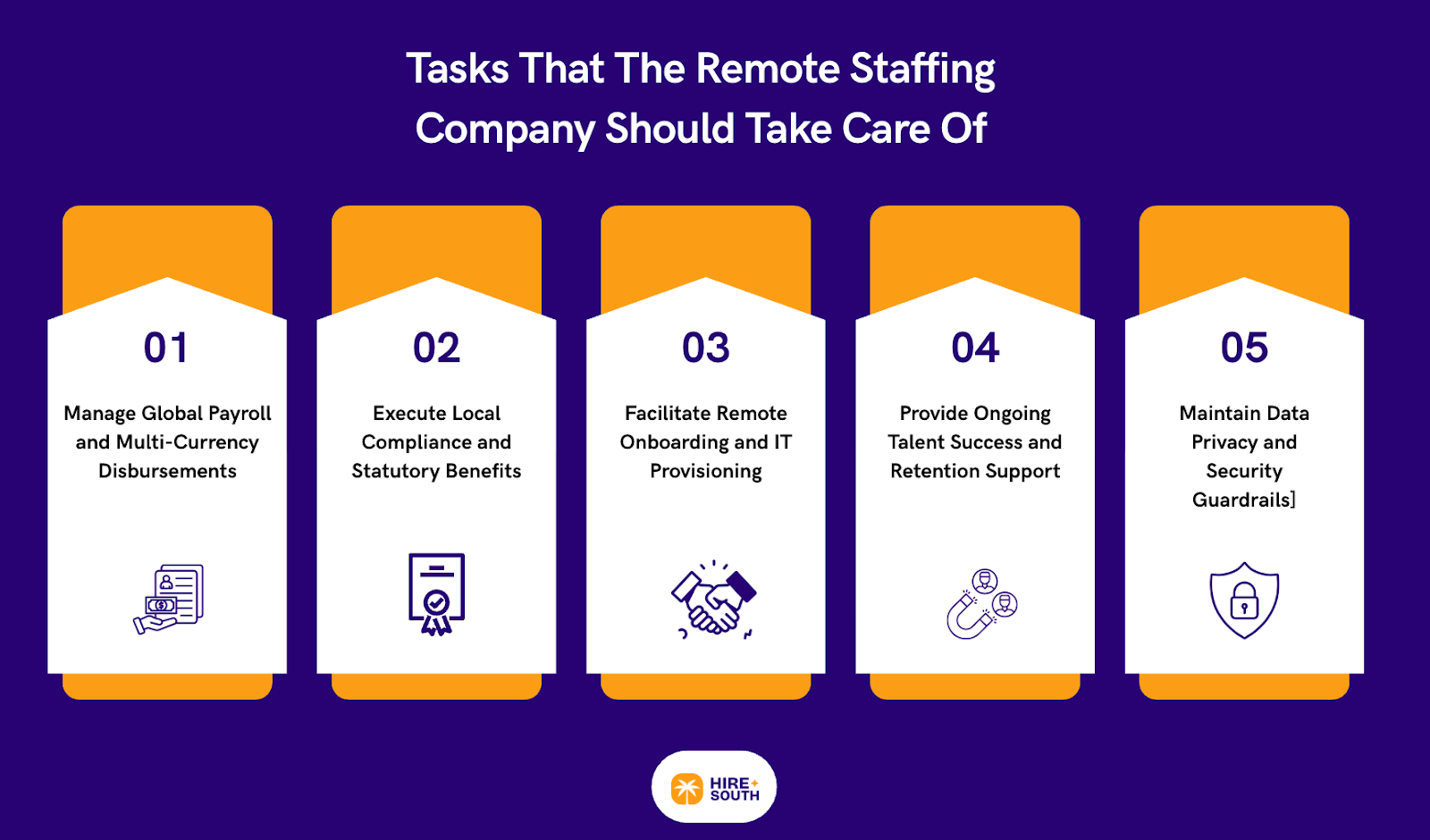
A true staffing partnership isn't just about sending resumes; it is about offloading the heavy operational lifting that kills your internal productivity. When you hire through a remote staffing firm, you are paying for an end-to-end talent engine.
According to Vena Solutions, the remote workplace services market is projected to reach $58.5 billion by 2027, largely because companies are outsourcing the increasingly complex "back-office" of global work. If you find yourself still chasing down tax IDs or troubleshooting a new hire's laptop, your staffing partner isn't doing their job.
Manage Global Payroll and Multi-Currency Disbursements:
Handling international payroll is a logistical nightmare. Different countries have different pay cycles, mandatory 13th-month bonuses, and fluctuating exchange rates. Your staffing company should act as a central hub, allowing you to pay one single invoice while they handle the granular distribution.
In 2026, governments are tightening reporting rules significantly. According to Thomson Reuters, European nations like Belgium and France are mandating "structured e-invoicing" this year, meaning your payroll data must be machine-readable and audit-ready at all times. A high-quality staffing firm automates this, ensuring you stay compliant without having to learn foreign tax codes.
Execute Local Compliance and Statutory Benefits:
Every country has its own "hidden" costs of employment. In some regions, healthcare is a private perk; in others, it is a non-negotiable social security contribution. Your staffing partner must navigate these local labor laws to protect you from "misclassification" lawsuits.
According to PeopleWorX, worker misclassification remains one of the most unstable compliance risks in 2026. A reputable firm takes on the "Employer of Record" role, meaning they assume the legal responsibility for the worker. They handle the contracts, social insurance, and termination protocols according to local statutes, shielding your business from expensive legal exposure.
Facilitate Remote Onboarding and IT Provisioning:
The first 48 hours of a remote hire's tenure determine their long-term success. A staffing company should manage the logistics of getting a new employee "work-ready." This includes everything from identity verification and background checks to ensuring the worker has the right hardware.
Leading firms now use automated "Smart Actions" for IT. According to Splashtop, 2026 trends show staffing providers are increasingly using autonomous endpoint management to patch devices and secure remote connections before the worker even logs in. They should ensure your new hire has a secure, high-speed setup so they can contribute on day one, not day ten.
Provide Ongoing Talent Success and Retention Support:
Hiring is only half the battle; keeping talent is where the real ROI lives. Your staffing partner should act as a "Remote HR" department, conducting regular check-ins and performance audits.
According to OrangeHRM, remote employees supported by modern workforce management systems are 35% to 40% more productive than those left to fend for themselves. The staffing firm should monitor "Engagement Indices" and offer "Remote Buddy" programs to prevent the isolation that leads to turnover. They should be your eyes and ears on the ground, flagging potential burnout or disengagement before it turns into a resignation.
Maintain Data Privacy and Security Guardrails:
In a distributed environment, your data is only as secure as the weakest home Wi-Fi connection. A sophisticated staffing firm takes responsibility for the security posture of the talent it provides.
According to NordLayer, 70% of successful data breaches in 2026 start at endpoint devices like home laptops. Your staffing partner should enforce "Zero-Trust" frameworks and Multi-Factor Authentication (MFA) as part of their standard placement process. They must also ensure that all candidate data handling aligns with GDPR or local privacy laws, providing you with a documented audit trail of how sensitive information is managed.
Evaluating the Best Remote Staffing Companies for Your Industry
Generic staffing is a relic of the past. In 2026, the global talent pool is so vast that "generalist" firms often struggle to vet technical nuances or industry-specific compliance. To find a partner that actually adds value, you need to look at how they solve problems unique to your vertical.
According to Staffing Industry Analysts (SIA), niche-focused staffing firms grew 18% faster than generalist agencies last year, driven by a desperate need for specialized domain expertise in fields like AI development, fintech, and renewable energy.
1. Scrutinize Industry-Specific Vetting Assessments
A firm that hires customer support reps might not be the best at hiring DevOps engineers or healthcare compliance officers. You should ask for a deep dive into their testing library. Are they using generic logic puzzles, or are they using industry-standard simulations?
For example, if you are in the tech sector, the firm should provide sandbox environments for live coding. According to HackerRank, technical assessments that mirror real-world job tasks are 2.5 times more predictive of on-the-job success than traditional whiteboard interviews. If the staffing company cannot show you a rubric specific to your industry’s latest standards, they are likely just a resume filter.
2. Validate the Depth of Their Talent Bench and Pipeline
High-growth companies can’t wait months for a key hire. You need to know if the staffing firm "owns" a community or if they are just scraping LinkedIn after you sign the contract. The best remote staffing companies maintain "active" benches, pre-vetted professionals ready to start within days.
According to ManpowerGroup, global talent shortages reached a 19-year high in 2025, affecting nearly 77% of employers. In 2026, the "best" firm is the one that has already solved this shortage by building exclusive talent communities in emerging markets like Brazil or Colombia. Ask for their "Time-to-Presentation" metrics for roles specific to your sector.
3. Verify Domain-Specific Compliance and Certifications
Different industries carry different legal weights. If you are in finance, your remote staff must understand SOC2 or PCI-DSS standards. In healthcare, HIPAA compliance is non-negotiable, even for remote administrative roles.
According to Compliance Week, regulatory fines for data mishandling by remote contractors have increased by 22% year-over-year. You must ensure the staffing firm provides specific training and background checks that meet your industry’s regulatory requirements. Look for firms that hold certifications like ISO 27001, proving they take your industry’s security requirements seriously.
4. Check Case Studies for Industry-Matched Success Stories
Social proof is your best friend when narrowing down a list of remote staffing companies. However, don't just look for "big names." Look for companies that look like yours.
If you are a mid-market SaaS company, a firm that only services Fortune 500 giants might not give you the agility you need. According to G2, peer-to-peer reviews that mention "industry relevance" are the number one factor business professionals use to validate a B2B service in 2026. Request at least two case studies that demonstrate how they handled a specific challenge in your niche, such as scaling a creative team or finding bilingual legal experts.
5. Analyze Cultural and Language Nuance Expertise
Industry expertise often overlaps with cultural nuance. For instance, a remote staffing company helping a New York law firm hire in Argentina needs to understand the specific legal terminology and professional etiquette of both regions.
According to Ethnologue, there are over 7,000 languages spoken globally, but business English remains the primary connector. However, "fluency" is a spectrum. The best firms use CEFR (Common European Framework of Reference for Languages) standards to grade their talent. Ensure your partner uses rigorous linguistic testing so your industry-specific jargon doesn't get lost in translation.
Ready to partner with a Top Remote Staffing Company?
Building a high-performing distributed team requires more than just a stable internet connection; it demands a partner who understands the friction points of global hiring. As the landscape shifts, the cost of a "bad hire" has climbed to nearly 30% of that employee’s first-year earnings, according to the U.S. Department of Labor, making precision vetting a financial imperative for your bottom line.
At Hire South, we eliminate the guesswork by connecting you with top pre-vetted talent across Latin America. We handle the heavy lifting of international compliance, multi-currency payroll, and cultural integration so you can focus on scaling your core operations. Whether you are looking to bridge a technical skills gap or expand your customer success team in a shared time zone, our battle-tested recruitment engine ensures your remote transition is seamless and secure. Schedule a free consultation to learn more!