


Building a world-class team no longer requires a local zip code or a soul-crushing commute to an overpriced office. If you are struggling to find specialized experts without draining your budget, the solution is likely waiting just a few time zones south.
Latin America has transformed into the premier destination for companies that value speed, cultural synergy, and high-level technical skill. Whether you are a startup founder or a seasoned executive, remote hiring in Latin America offers a way to scale your operations without the logistical nightmares of traditional offshoring.
According to Goldman Sachs, the Latin American tech ecosystem has seen a massive influx of venture capital, with investment growing by over 100% in recent years as the region matures into a global innovation powerhouse. This surge has created a workforce that isn't just "affordable," but truly elite.
In this guide, you will discover the financial benefits of nearshoring, the specific countries leading the tech revolution, and how to navigate the legal landscape of international payroll. It is time to stop settling for local talent shortages and start leveraging the massive potential of the LATAM market.
Why Hire Remote Talent in LATAM Instead of Other Regions

When you expand your search to global markets, the choices can feel overwhelming. You have likely looked at the massive scale of India or the deep engineering roots of Eastern Europe. However, hiring in Latin America offers a unique "nearshore" advantage that most offshore regions simply cannot replicate.
The primary differentiator isn't just the price tag; it’s the synchronization. While Asian markets often require a "hand-off" model where work happens while you sleep, LATAM allows for a "side-by-side" model.
1. High-Velocity Collaboration Through Time Zone Alignment
If you have ever managed a team in the Philippines or India, you know the "12-hour lag." You send an email at 5:00 PM, and you don’t get a response until the next morning. This delay can cripple Agile workflows and slow down product iterations.
When you hire remote talent in LATAM, you gain an average of 6 to 8 hours of workday overlap. According to McKinsey & Company, companies with at least six hours of workday overlap between in-house and remote teams complete projects 23% faster than those relying on asynchronous communication. This real-time access means your stand-ups, Slack chats, and emergency troubleshooting happen during your core business hours.
2. Superior Retention and Lower Turnover Rates
In traditional offshore hubs like India, developer turnover can be notoriously high, often exceeding 30% to 40% annually as workers jump between global firms for marginal raises. This constant churn forces you into a never-ending cycle of recruiting and onboarding, which drains institutional knowledge.
In contrast, the Latin American market currently shows much higher stability. According to Sciodev, nearshore partners in LATAM often maintain attrition rates under 15%. Because the work culture emphasizes long-term relationships and the time zones prevent the burnout associated with permanent night shifts, your team is more likely to stay intact for the long haul.
3. Unmatched Cultural Synergy and Communication
Effective remote work relies on more than just technical skill; it requires "cultural logic." Professionals in Latin America share a high degree of cultural affinity with North American and European business practices. They typically use the same Project Management tools (Jira, Trello, Asana) and follow identical Agile ceremonies without needing extensive cultural training.
Language proficiency is also a major factor. While regions like China or Southeast Asia have large talent pools, English proficiency can be a bottleneck. According to the 2025 EF English Proficiency Index, countries like Argentina, and Chile consistently rank in the "High" or "Moderate" proficiency categories, often outperforming major Asian outsourcing hubs in business-level communication.
4. Faster Problem-Solving and Issue Resolution
When a critical bug hits your production environment at 2:00 PM EST, you need a developer who is online right now. Working with a team in Eastern Europe often means waiting until the next morning to even start the fix.
According to Coderio, North American companies report 40% faster problem-solving cycles when working with Latin American developers compared to traditional offshore teams. This responsiveness doesn't just save time; it protects your customer experience and prevents revenue loss during technical outages.
How Remote LATAM Talent Can Solve the North American Talent Shortage
Addressing the Deficit of Senior Engineering Talent:
The shortage is most painful at the senior level. Many North American companies find themselves trapped in a cycle of "junior-heavy" teams because mid-to-senior level engineers are either too expensive or already locked into golden-handshake contracts at Big Tech firms.
The numbers are sobering. According to the U.S. Bureau of Labor Statistics, the United States is projected to face a deficit of more than 1.2 million software and IT professionals by 2026. This shortage is particularly acute in senior-level roles where production-ready experience is non-negotiable. LATAM fills this void with over 2 million high-skill IT professionals who have spent the last decade working for global giants, making them ready to lead your most complex projects from day one.
Closing the Critical Cybersecurity Skills Gap:
Cybersecurity has moved from a "nice-to-have" department to a foundational business requirement. Unfortunately, the talent supply has not kept pace with the threat landscape. Organizations are now entering a phase where vacancies remain open for six months or longer, leaving digital assets vulnerable.
According to CyberSeek, a project supported by the National Institute of Standards and Technology (NIST), the U.S. currently has around 465,000 unfilled cybersecurity positions. Globally, that number jumps to 3.5 million. By tapping into tech hubs in Brazil and Colombia, you gain access to a workforce that has rapidly specialized in security and compliance to serve international clients, effectively bypassing the domestic hiring logjam.
Supporting the Surging Demand for AI and Data Experts:
The hype around Artificial Intelligence has turned into a practical scramble for implementation. Whether you need to build MLOps pipelines or integrate Large Language Models (LLMs), the competition for local AI talent is fierce, and pricing is often prohibitive for mid-sized firms.
According to IDC, the worldwide shortage of full-time software developers, driven heavily by the AI boom, is expected to hit 4 million by 2025. Latin American universities have responded to this demand faster than many traditional institutions, churning out graduates with specific certifications in Python, R, and machine learning infrastructure. By looking south, you can secure the "AI-proof" talent your roadmap requires without waiting for the local graduate pipeline to catch up.
Mitigating Unrealized Revenue and Project Delays:
A talent shortage is more than just an HR headache; it is a direct hit to your bottom line. When key positions stay vacant, innovation stalls, and your competitors who have solved the talent puzzle begin to pull ahead.
The economic impact of these empty seats is staggering. According to Korn Ferry, unfilled tech roles and the resulting productivity gaps could lead to $8.4 trillion in unrealized global revenue by 2030. In the immediate term, IDC estimates that 90% of organizations will experience $5.5 trillion in losses by 2026 due to project delays and quality issues stemming directly from the talent shortage. Hiring in LATAM allows you to keep your development velocity high, ensuring you don't become part of those statistics.
Cost Advantages of Hiring LATAM Talent
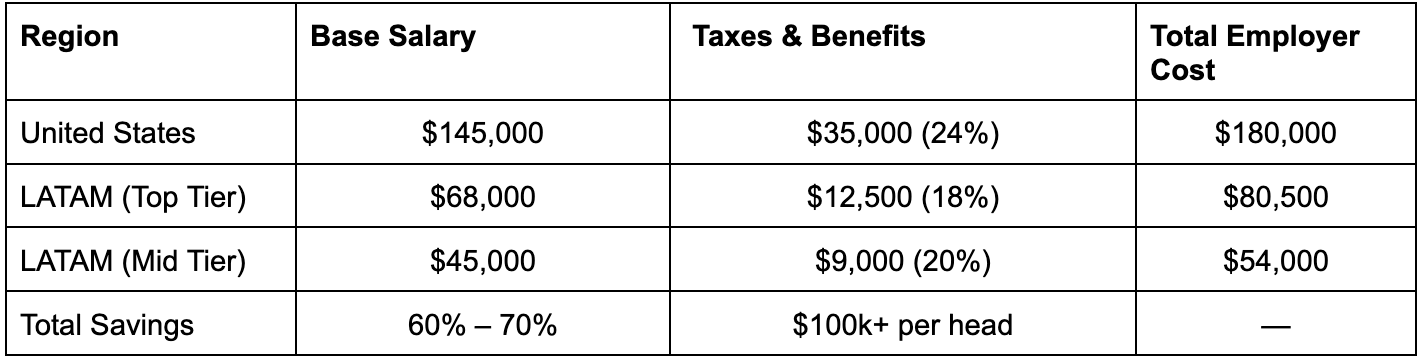
1. Drastic Reduction in Fully Loaded Labor Costs
In the United States, a developer’s base salary is only the starting point. Once you layer on health insurance premiums, 401(k) matching, payroll taxes, and office overhead, a $140,000 developer quickly costs your company over $185,000 annually.
When you hire remote talent in LATAM, the "fully loaded" math changes in your favor. According to Solvedex, a mid-level hire in the U.S. costs roughly $180,000 per year, including all taxes and benefits, while a comparable LATAM hire, even with a highly competitive regional salary, averages around $56,800 total. This 3x multiplier allows you to triple your team size without increasing your total budget.
2. Arbitrage Driven by a Lower Cost of Living
The primary reason you can secure world-class talent at these rates is the significant difference in purchasing power. A salary that might feel "entry-level" in San Francisco or New York provides an upper-middle-class lifestyle in Medellín or Buenos Aires.
According to Numbeo’s 2026 Cost of Living Index, major tech hubs in Latin America remain 20% to 55% cheaper than the average U.S. city. For example, a senior developer in Mexico earning $65,000 annually enjoys a higher quality of life than a U.S. developer earning $130,000. This disparity means you can offer a "locally elite" salary that drives intense loyalty and long-term retention, while still realizing massive corporate savings.
3. Saving on Infrastructure and Recruiting Overhead
The "empty seat" cost in the U.S. is often ignored until it’s too late. The time-to-hire in North America for specialized roles like AI or DevOps has climbed to over 60 days in many sectors, costing companies thousands in lost productivity.
According to Hirewithnear’s 2026 State of LatAm Hiring Report, companies save an average of $35,000 to $64,000 per hire simply by reducing recruiting cycles and avoiding high-cost domestic headhunting fees. Additionally, because these roles are inherently remote, you eliminate the $15,000 to $20,000 per-employee annual cost associated with physical office space and local infrastructure.
4. Niche Specialization Without the SV Premium
If you are looking for specific stacks like Rust, Go, or Machine Learning, you are likely competing with Google, Meta, and Apple for the same domestic talent. This "California Premium" can inflate local salaries to unsustainable levels for mid-market firms.
LATAM offers a way to bypass this bidding war. According to NextIdeaTech’s 2026 Salary Report, even high-demand roles like AI Engineers in Latin America command salaries between $68,000 and $84,600. In Silicon Valley, those same specialists often start at $250,000. By diversifying your talent pipeline, you ensure that niche technical needs don't become a financial liability that stunts your company's growth.
How to Navigate the Logistics of Remote Hiring in Latin America
Expanding your team into Latin America is a high-impact growth strategy, but the "how" is just as important as the "why." While the talent is ready, the administrative frameworks in countries like Brazil, Mexico, and Colombia are notoriously complex. You need a clear logistical roadmap to move from "candidate found" to "day one" without falling into a compliance trap.
Choosing the Right Engagement Model: EOR vs. Direct Hire.
The first hurdle is deciding how the individual will actually exist on your payroll. You generally have two paths: setting up a local entity or using an Employer of Record (EOR).
For most small to mid-sized firms, a local entity makes little sense. According to Europortage, establishing a legal entity in Brazil can take 30 to 90 days and cost upwards of $15,000 in setup fees alone. In contrast, an EOR allows you to hire in as little as 3 to 5 days by using their existing legal infrastructure.
According to Globalization Partners, 65% of companies entering the LATAM market now prefer the EOR model because it offloads the risk of local labor law compliance, tax filings, and benefits administration to a third party. If you plan to hire fewer than 20 people in a single country, the EOR model is typically the most efficient way to scale.
Automating Compliance and Tax Withholdings.
Each Latin American country has its own "Tax ID" system and mandatory social contributions that are non-negotiable. For instance, in Mexico, you must navigate the IMSS (Social Security) and INFONAVIT (Housing Fund) systems.
Manual management is a recipe for expensive audits. Modern hiring platforms now automate these withholdings in real-time. According to Rise, companies using automated compliance tools reduce their risk of "misclassification" fines, which can reach tens of thousands of dollars per employee, by nearly 98%. These tools ensure that your remote hires are categorized correctly as either full-time employees or independent contractors according to local 2026 regulations.
Managing Mandatory "13th Month" Salaries and Local Benefits.
One logistical quirk of remote hiring in Latin America is the "13th-month salary" or Aguinaldo. In many countries, this is a legal requirement where employees receive an extra month's pay, typically split between mid-year and December.
According to recent studies, failing to budget for these statutory bonuses can result in a 15% to 20% surprise increase in your annual labor costs. Beyond the mandatory "13th month," top talent in the region now expects "nearshore-standard" benefits, such as private health insurance (which often supersedes local public options) and stipends for high-speed internet. Integrating these into your payroll logistics is essential for maintaining the 80%+ retention rates seen in the region.
Streamlining Equipment and IT Logistics.
Sending a MacBook from San Francisco to Buenos Aires isn't just expensive, it’s a customs nightmare. Laptops often get stuck in "Aduana" (customs) for weeks or require heavy import duties that exceed the value of the hardware.
Smart companies solve this by using local procurement partners. According to Howdy, companies that provide locally sourced equipment and "Howdy Houses" (physical coworking hubs) see a 28% higher retention rate compared to those that leave developers to provide their own gear. By managing IT logistics locally, you ensure your new hire is productive on day one rather than waiting for a package to clear the border.
Ready to Hire Remote Talent in LATAM?
Building a high-performing remote team is no longer about finding the cheapest labor; it is about finding the smartest way to scale. By tapping into the Latin American market, you are positioning your company to benefit from a workforce that is technically elite, culturally synchronized, and strategically located within your own time zones.
At Hire South, we specialize in bridging the gap between North American ambition and Latin American expertise. We don’t just "fill seats", we curate the top 1% of the region’s talent pool to ensure your new hires are a long-term match for your company culture. We handle the entire lifecycle of the hire, from rigorous technical vetting and English assessments to localized payroll and legal compliance.
Whether you need to scale your engineering department or build out a world-class marketing team, we provide the infrastructure you need to hire with confidence and zero administrative friction. Contact us to start building your new team!
.jpg)