


Hiring remote talent in Perú has moved from a tactical option to a strategic advantage. As remote work becomes the norm, companies that look beyond their local markets gain faster access to skilled professionals and more hiring flexibility. Remote roles receive up to 2.6 times more applications than on-site positions, according to LinkedIn’s Global Talent Trends, making global hiring a clear competitive lever.
Perú is increasingly part of that equation. The country offers a growing base of tech and business professionals, strong time zone alignment with the US, and labor costs that remain competitive without sacrificing quality. With a young workforce and rising digital adoption, Perú’s remote talent ecosystem continues to expand.
This guide breaks down how to hire remote talent in Perú with confidence. You’ll explore why companies choose Peruvian professionals, which roles are most in demand, legal and compliance considerations, realistic salary expectations, and practical tips for managing remote teams long term. If you’re evaluating new hiring markets or scaling a distributed team, this article gives you the clarity you need to move forward.
Why Hire Remote Talent in Perú
1. Access to globally competitive professionals
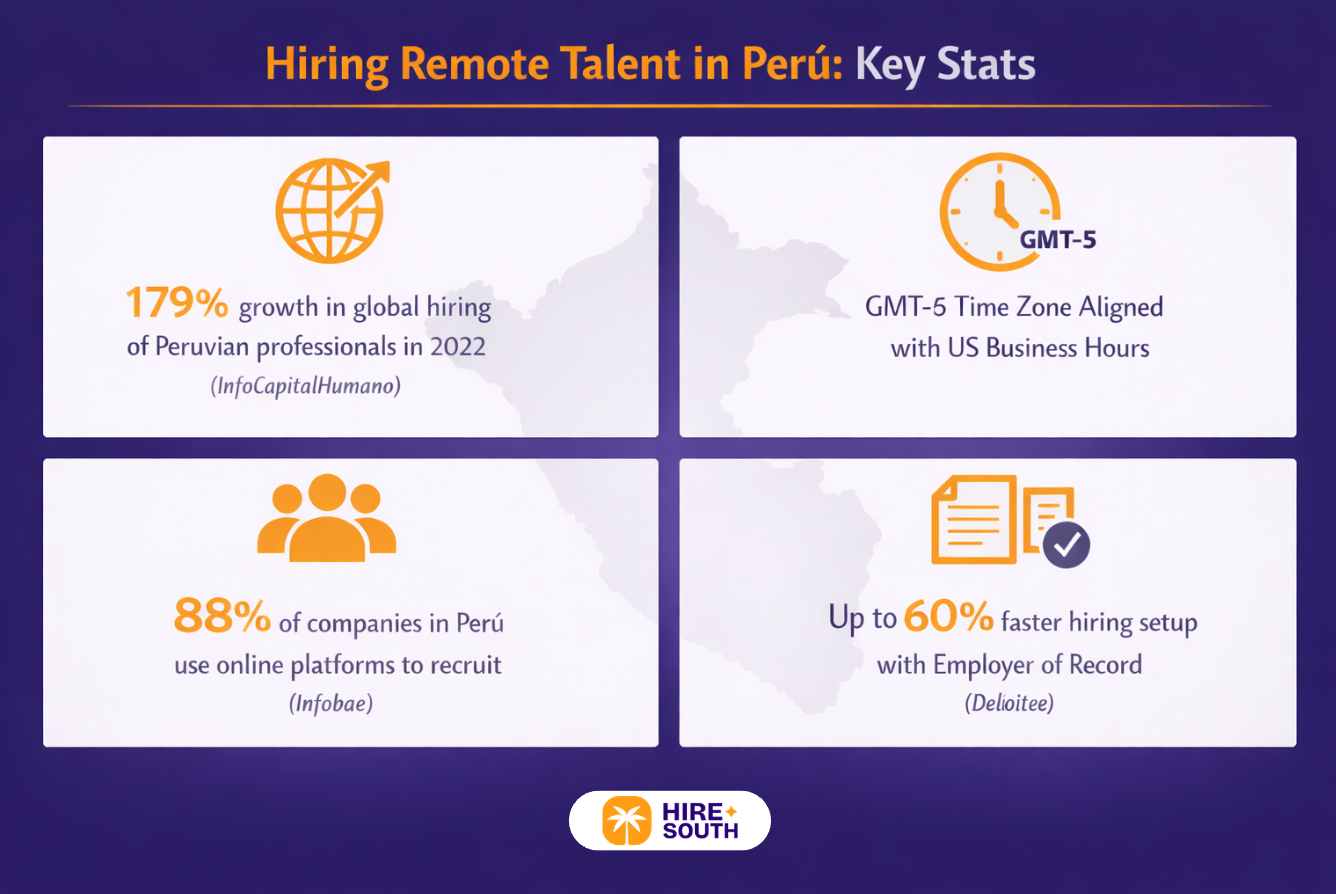
Hiring remote talent in Perú gives you direct access to professionals who are already working with international companies across tech, finance, operations, and support functions. Demand reflects that reality. Global hiring of Peruvian professionals grew 179 percent in 2022, according to InfoCapitalHumano, signaling strong international confidence in Perú’s remote workforce.
2. Real-time collaboration with North America
Perú operates on GMT-5 year-round, which aligns closely with US and Canadian business hours. That overlap removes friction from daily collaboration. Meetings happen in real time. Decisions move faster. You avoid the handoff delays common with more distant offshore locations.
3. Cost efficiency without compromising quality
Remote talent hiring in Perú allows you to manage labor costs while maintaining professional standards. Salaries remain competitive compared to the US and Western Europe, yet Peruvian professionals often bring experience working with international teams, modern tools, and agile workflows. This balance makes Perú especially attractive for long-term remote roles rather than short-term outsourcing.
4. Strong language skills and cultural compatibility
Many Peruvian professionals work comfortably in English, particularly in business-facing and technical roles. Beyond language, work culture tends to align well with North American and European expectations, with an emphasis on accountability, deadlines, and structured communication. That alignment reduces onboarding time and minimizes management friction.
5. A labor market built for digital hiring
Remote recruitment is already embedded in Perú’s hiring ecosystem. Eighty-eight percent of companies in Perú use online platforms to recruit, according to Infobae, which means candidates are familiar with virtual interviews, remote assessments, and distributed onboarding. For you, that translates into faster hiring cycles and smoother remote integration.
Together, these factors explain why more companies are choosing Perú as a reliable source of remote talent. The market is mature enough to support scale, yet flexible enough to adapt to your specific hiring needs.
Perú’s Talent Landscape
Perú’s workforce is young, digitally connected, and expanding into knowledge work. A significant portion of professionals hold degrees or certifications in technology, business, and services. These trends shape a talent pool that increasingly competes on a global scale.
The tech sector in Perú has grown steadily. Software development, data analysis, cloud engineering, and digital marketing are among the fastest-expanding skill categories. Universities and private institutes across Lima, Arequipa, and Trujillo produce thousands of graduates each year with technical training that aligns with global demand.
Beyond tech, there’s depth in other professional areas. Accounting, customer support, project coordination, and HR functions in Perú now often integrate tools like Salesforce, HubSpot, and Microsoft Azure. That familiarity with enterprise platforms makes it easier for you to onboard remote hires into existing workflows.
Peruvian professionals also tend to have high language proficiency. English fluency is common, especially among mid-level and senior roles, which reduces delays and misunderstandings during collaboration.
Digital adoption is strong. Most job seekers and employers in Perú use online recruitment platforms. Local employment portals and LinkedIn are hubs where remote talent showcases portfolios, certifications, and work histories.
Geographically, the talent is concentrated in urban centers with reliable internet and coworking spaces that support remote work. This means access to stable connectivity and professional environments even outside traditional offices.
Finally, Peru’s labor market is increasingly familiar with remote and hybrid work models. Many candidates already expect flexible work arrangements, which can shorten the transition from candidate selection to productive contribution.
Main Options To Hire Remote Talent in Perú
1. Hiring Peruvian Independent Contractors
One of the most common ways to hire remote talent in Perú is through independent contractor agreements. This option offers speed and flexibility. You can engage professionals quickly, define scope-based work, and avoid long-term employment commitments.
However, classification matters. Peruvian labor law closely examines contractor relationships. If the role looks like full-time employment in practice, you may face misclassification risk. This model works best for project-based roles, specialists, or short- to mid-term engagements with clear deliverables.
2. Hiring Full-Time Employees Through a Local Entity
If you already have a registered legal entity in Perú, you can hire remote talent directly as employees. This gives you full control over working hours, performance management, and long-term retention.
The trade-off is complexity. You must comply with Peruvian labor laws, payroll taxes, mandatory benefits, paid leave, and termination rules. This option makes sense when you plan to build a stable, long-term presence and scale local teams over time.
3. Using an Employer of Record in Perú
An Employer of Record, or EOR, allows you to hire full-time remote employees in Perú without setting up a local entity. The EOR becomes the legal employer while you manage the day-to-day work.
This option reduces compliance risk and streamlines the hiring process. According to Deloitte, companies using EOR models can reduce international hiring setup time by up to 60 percent, as reported in Deloitte Global Human Capital Trends. It’s often used for fast market entry or when internal legal resources are limited.
4. Partnering With Local Recruitment Firms
Local recruitment agencies specialize in sourcing and screening Peruvian remote talent. They understand salary benchmarks, candidate expectations, and local hiring dynamics.
This approach saves time during sourcing but does not remove legal responsibility. You still need a compliant hiring structure, such as contractors, an entity, or an EOR, to formally engage the talent.
5. Direct Hiring Through Online Platforms
Some companies choose to hire remote talent in Perú directly through global job platforms and professional networks. This gives you full visibility into the candidate pool and hiring process.
The downside is operational overhead. You handle vetting, contracts, payments, and compliance internally. This option works best if you already have experience managing international remote hires and legal frameworks.
How To Hire Remote Talent in Perú Step By Step-by-Step
1. Define the Role With Precision
Start by clarifying exactly what you need. Scope, seniority, core skills, and expected outcomes should be explicit. Remote talent in Perú is diverse, but vague role definitions slow hiring and increase mismatch risk. Clear requirements also help candidates self-select, which improves hiring efficiency.
2. Choose the Right Hiring Model
Decide early whether the role fits an independent contractor, full-time employee, or EOR structure. This choice affects compliance, costs, and speed. Project-based or specialist roles often align better with contractors, while long-term, operational roles usually require an employment structure compliant with Peruvian labor law.
3. Benchmark Compensation for the Peruvian Market
Set salary ranges based on local benchmarks, not home-country expectations. Compensation in Perú varies by role, experience, and English proficiency. Competitive offers are those aligned with the local market while reflecting the role’s complexity and business impact. Overpricing or underpricing can both limit candidate quality.
4. Source Talent Through Relevant Channels
Use channels where Peruvian professionals are already active. LinkedIn, local job boards, and specialized recruitment firms tend to deliver stronger candidate pipelines than generic global platforms. Targeted sourcing reduces time-to-hire and improves role fit.
5. Assess Skills With Real-World Signals
Focus interviews on practical scenarios rather than theory. Work samples, case discussions, or short assignments provide better insight into how candidates operate remotely. This is especially important for distributed teams where autonomy and communication matter as much as technical skill.
6. Validate Language and Communication Skills
Even when English is listed on a résumé, verify proficiency in live conversations. Clear communication reduces friction once the role starts. For client-facing or cross-functional roles, this step directly impacts performance and collaboration quality.
7. Handle Contracts and Compliance Carefully
Use written agreements that reflect Peruvian regulations and the chosen hiring model. Contracts should define scope, confidentiality, data protection, and termination terms. Misclassification is one of the most common risks when hiring remote talent in Perú, so legal alignment matters.
8. Prepare a Structured Remote Onboarding
A strong onboarding plan shortens ramp-up time. Provide access to tools, documentation, workflows, and communication norms from day one. Many Peruvian professionals already have remote experience, but clarity accelerates productivity.
9. Set Expectations and Performance Metrics Early
Define how success is measured. Clear KPIs, reporting cadence, and feedback loops help remote talent stay aligned without micromanagement. Consistency matters more than complexity, especially in distributed teams.
Best Practices When Hiring Remote Talent In Perú
Align Expectations From the Start.
Clarity matters more than speed. Define working hours, response times, and deliverables before the contract is signed. Peruvian remote professionals are accustomed to structured environments, and clear expectations reduce friction once work begins. Teams with well-defined goals are 21 percent more productive, according to Gallup, which directly impacts remote performance.
Prioritize Communication Over Tools.
Tools support collaboration, but habits drive results. Establish how updates are shared, when meetings are necessary, and what channels are used for urgent issues. Many professionals in Perú are comfortable with asynchronous communication, but alignment on norms prevents misunderstandings and delays.
Respect Local Work Culture and Holidays.
Understanding local customs improves retention. While Perú aligns well with North American business culture, national holidays and local observances still matter. Acknowledging them signals respect and builds trust without affecting productivity when planned.
Verify Remote Readiness, Not Just Skills.
Technical ability alone is not enough. Assess how candidates manage time, handle ambiguity, and communicate without constant supervision. Remote success depends heavily on autonomy and accountability, especially across borders.
Use Written Processes and Documentation.
Document workflows, decision paths, and escalation rules. Written guidance reduces dependency on meetings and supports faster onboarding. For remote talent in Perú, this structure allows quicker integration into distributed teams.
Build Feedback Into the Hiring Process.
Feedback should start early and remain consistent. Regular check-ins improve performance and engagement. Employees who receive frequent feedback are 3.6 times more likely to be engaged, according to Gallup, which is critical for remote retention.
Stay Compliant With Local Regulations.
Compliance is not optional. Ensure contracts, data protection clauses, and payment structures align with Peruvian labor and contractor regulations. Missteps here can create long-term risk and disrupt otherwise strong working relationships.
Invest in Long-Term Relationship Building.
Remote hiring works best when viewed as a partnership, not a transaction. Transparent communication, fair compensation adjustments, and growth opportunities help you retain top Peruvian talent in a competitive global market.
Applying these best practices helps you hire remote talent in Perú more effectively, while building teams that are stable, productive, and aligned with your business goals.
Ready to Hire Remote Talent in Peru?
Hiring remote talent in Perú requires more than access to candidates. It demands local market knowledge, compliant hiring structures, and a clear process that balances speed with long-term stability. When done right, Perú offers a deep talent pool, strong time zone alignment, and a workforce already integrated into global remote teams.
At Hire South, we help companies hire remote talent in Latin America through compliant, efficient hiring models built for scale. Our experience supporting international teams across Latin America allows us to reduce hiring timelines and operational risk. Companies that use structured global employment solutions can cut international hiring setup time by up to 60 percent, according to Deloitte Global Human Capital Trends. That’s the difference between testing a market and building a reliable remote team that lasts. If you are ready to start hiring, make sure to contact us now!