


Scaling a mid-market team is tough. Finding the right fit across borders is even harder. You need agile, culturally aligned talent. You need people who can jump straight into complex projects. So, you plug in an automated tracking system to speed up the nearshoring process. Then, the pipeline just dries up.
You are not imagining things. Automated hiring systems often break down when screening international resumes. They actively filter out the exact people you want to hire. In fact, 88 percent of employers admit that qualified candidates are routinely vetted out of the hiring process simply because they do not match exact criteria, according to Harvard Business School. The software demands very specific keywords. It completely misses the nuances of global experience, language proficiency, and diverse career paths.
This guide breaks down exactly why algorithm-driven hiring fails mid-market teams when nearshoring. You will discover the hidden financial costs of algorithmic mismatches. You will see why generic applicant profiles hurt specialized, cross-functional teams. Finally, you will learn practical ways to fix your global talent strategy.
Root Causes of Algorithm-Driven Hiring Failure
1. Misinterpreting Regional Resumes
Resume formatting varies wildly across the globe. U.S. professionals typically use strict, one-page templates with bulleted achievements. However, international talent pools often approach applications very differently.
Nearshore candidates might submit multi-page curriculum vitae. They often include extensive project portfolios, different date formats, or highly detailed educational histories. U.S.-built parsing software struggles to process these regional differences. The algorithm gets confused by the unfamiliar layout and fails to extract the right data. It might classify a senior software architect as an entry-level applicant just because the employment dates were formatted differently. You lose top-tier candidates before a human recruiter even knows they applied.
2. The Language Bias in Automated Parsing
Applicant tracking systems are incredibly literal. They rely on exact semantic matches to score and rank candidates. This creates a severe language bias when you are hiring outside of your native borders.
An international developer might possess expert-level Python skills and ten years of global experience. However, if they translate their previous job title slightly off-center, the software drops their match score. They might use regional terminology for certain frameworks or business processes. The algorithm cannot infer their expertise through context clues. It only counts exact keyword matches. This literalism punishes non-native English speakers who have the exact technical capabilities you need but lack the localized corporate jargon to beat the software.
3. False Positives in Skill Assessments
Automated screening often relies on timed technical tests and logic puzzles. These automated assessments are designed to measure raw capability quickly. Unfortunately, they frequently produce false positives that waste your time.
Some candidates excel at taking standardized coding tests. They memorize common assessment frameworks and pass the automated screening with perfect scores. Yet, they often struggle when placed in an actual agile work environment that requires creative problem-solving. Conversely, highly capable senior developers might fail an automated test simply because the rigid testing environment does not reflect real-world workflows. The software measures test-taking ability rather than true job readiness.
4. Overlooking Soft Skills in Remote Workers
Successful nearshoring requires exceptional communication skills. Your remote team members must proactively manage time zones, resolve conflicts, and adapt to your company culture. Algorithms cannot measure these critical human elements.
Software cannot evaluate resilience or cross-cultural empathy. It actually tends to penalize the very experiences that build these soft skills. Automated systems routinely flag non-linear career paths as negative traits. For example, software filters eliminate candidates with employment gaps of six months or longer for 49 percent of employers, according to Harvard Business School. This rigidly removes highly adaptable professionals who took time off for travel, caregiving, or continuing education. You are left with a sterile list of candidates who look perfect on paper but lack the emotional intelligence required for remote collaboration.
The Real-World Costs of a Bad Algorithmic Match
1. High Turnover Rates in Misaligned Hires
Algorithms are excellent at matching keywords, but they fail completely at predicting company culture fit. When you hire someone based solely on parsed resume data, you risk bringing in a professional who clashes with your core team dynamics. This misalignment almost always leads to early turnover. Replacing technical and management personnel ranges from 50 to 200 percent of their annual compensation, according to the Society for Human Resource Management. Your new remote developer might look flawless on a digital dashboard. However, if they cannot handle the pace of your agile sprints, they will leave within months. You are then forced to restart the expensive recruitment process from scratch.
2. Hidden Onboarding and Training Expenses
The direct cost of replacing a worker is only half the story. You also have to account for the invisible hours your current staff wastes bringing the wrong person up to speed. When an automated system pushes through a poor technical fit, your senior engineers bear the ultimate burden. They spend their valuable days explaining fundamental concepts instead of building your product. In fact, managers spend an average of 17 percent of their time dealing with underperforming employees, according to human capital firm HumCap. Every hour spent retraining a bad algorithmic match is an hour stolen from your product roadmap. Furthermore, the software licensing fees, cross-border hardware shipping costs, and administrative processing time vanish the moment that employee inevitably resigns.
3. Project Delays from Poor Technical Fit
Mid-market businesses usually turn to nearshoring because they have pressing development deadlines. You need functional code shipped, and you need it to integrate seamlessly. When your applicant tracking system approves a candidate who passed a standardized logic test but actually lacks practical, real-world experience, your entire project timeline shatters. The new hire struggles to deliver usable assets. Your quality assurance team catches constant errors, and cross-functional collaboration stalls completely.
This operational bottleneck quickly demoralizes your top performers. High-achieving developers deeply resent having to pick up the slack for unqualified peers. The algorithm promised to accelerate your project delivery, but a misaligned match actually brings your most critical business operations to a complete standstill.
How Mid-Market Teams Can Fix Their Nearshore Strategy
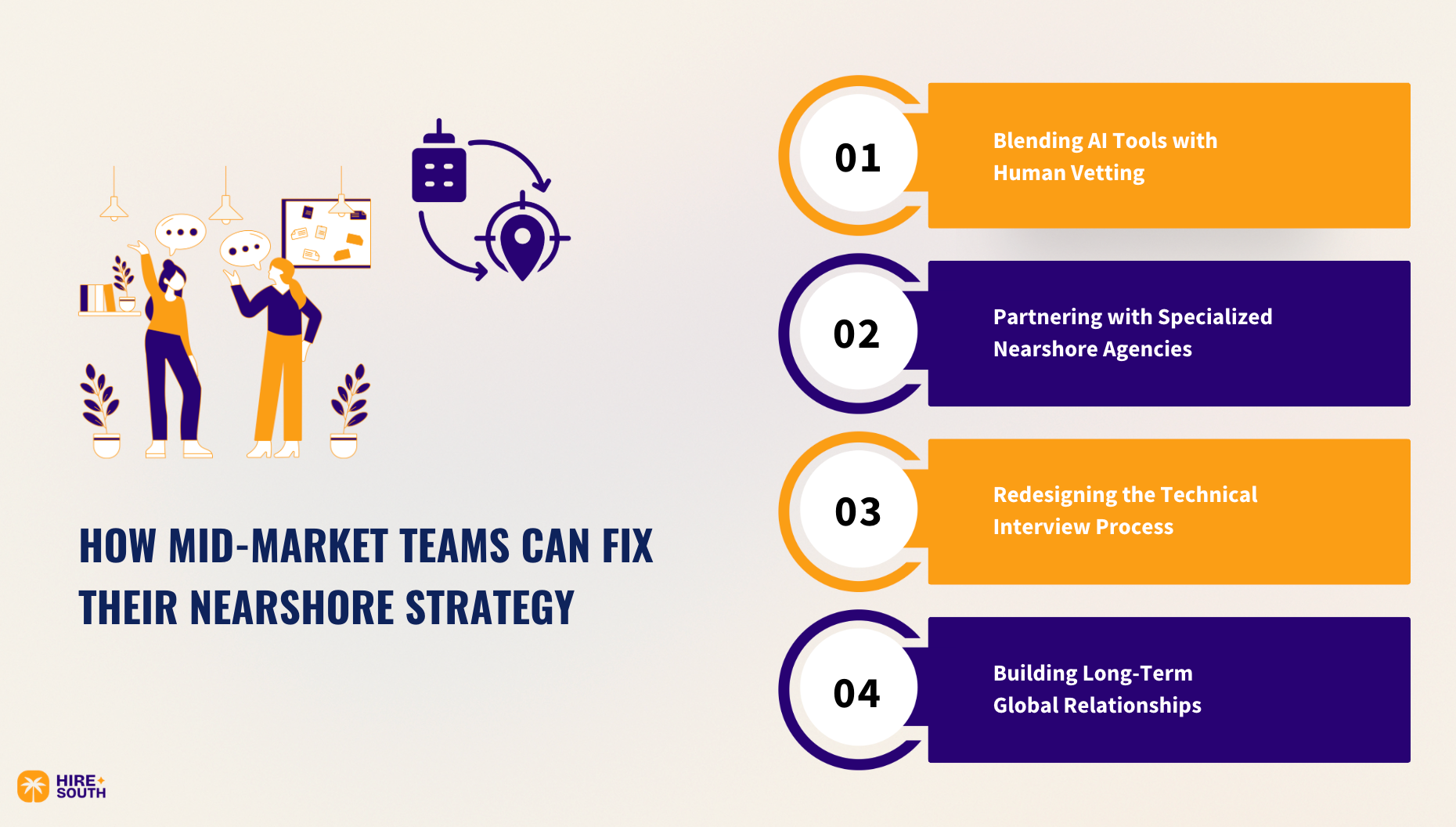
Companies need a better, more balanced approach to international hiring. Purely algorithmic filtering costs too much money and misses too much talent. Instead of relying solely on code, you must integrate actual human expertise into the vetting process. Blended hiring models increase employee retention by up to 50 percent, according to the Society for Human Resource Management. The technology should support your recruiters, not replace them entirely.
Blending AI Tools with Human Vetting.
Automation still has a place in your recruitment pipeline. You just need to change how you deploy it. Use applicant tracking systems to handle administrative logistics, like scheduling interviews or collecting basic contact data. Then, let human recruiters handle the actual resume review.
People understand context. A human can look at a non-traditional career path and spot a highly adaptable problem solver. Software just sees an employment gap. When you blend artificial intelligence with human oversight, you catch the top-tier candidates who format their resumes differently. This hybrid approach keeps your hiring pipeline moving fast while protecting the quality of your candidate pool.
Partnering with Specialized Nearshore Agencies.
Sometimes the most effective way to fix your hiring pipeline is to step outside your internal software entirely. Local recruitment agencies understand the cultural nuances of their specific regions. They already know which universities produce the best engineers, and they understand local corporate terminology.
Working with regional experts bypasses the rigid filters of your applicant tracking system. Specialized recruiters actively network with passive candidates who might never submit a resume through an automated portal. Companies that use specialized staffing agencies reduce their time-to-fill by an average of 25 percent, according to the American Staffing Association. You get a curated list of vetted professionals instead of a massive database of keyword matches.
Redesigning the Technical Interview Process.
Stop forcing international candidates to take automated logic tests. Standardized coding assessments rarely reflect the actual daily work your team performs. Instead, you need to evaluate how a candidate thinks and collaborates in real-time.
Shift your focus to paid trial projects or collaborative pair programming sessions. Give candidates a small, contained problem that mimics a real issue your company currently faces. Watch how they ask questions, communicate their thought process, and receive feedback. This method reveals exactly how a developer will perform within your mid-market team structure. It is a much better predictor of success than a high score on a standardized algorithm test.
Building Long-Term Global Relationships.
Transactional hiring hurts mid-market businesses. If you treat nearshoring as a quick fix to fill an immediate gap, you will constantly battle high turnover. You need to focus on building sustainable talent pipelines across borders.
Invest time in understanding the local tech ecosystems where you hire. Engage with international developer communities, sponsor regional tech meetups, and create an employer brand that appeals to nearshore professionals. Organizations with strong employer brands see a 43 percent decrease in cost per hire, according to LinkedIn. When you build real relationships in your target markets, you attract high-quality candidates naturally. You stop relying on software to find strangers and start welcoming familiar talent into your agile teams.
Conclusion
Relying on rigid algorithms to build your nearshore team will eventually cost you top-tier talent. You need a recruitment strategy that recognizes true global expertise instead of just scanning for arbitrary keywords.
That is exactly how we operate at Hire South. We know that finding the right cultural and technical fit requires actual human nuance. We do not just run resumes through an automated filter and hope for the best. Instead, our recruiters actively source from a private network of over 120,000 professionals across Latin America. We personally guide every candidate through rigorous English verifications, behavioral interviews, and practical work samples.
Because we manually evaluate the top one percent of LATAM talent, you only meet the most highly qualified finalists. Our blended vetting approach typically saves mid-market companies up to 10 days in hiring time and between $30,000 and $100,000 annually. We also take on all the heavy lifting regarding cross-border compliance, payroll, and onboarding.
You get dedicated, bilingual professionals working directly in your time zone, without the automated guesswork. Stop losing great candidates to broken applicant tracking systems. Let us help you build a nearshore team that actually lasts. Contact Us to get started today!