


If you have ever tried to schedule a 9 a.m. standup with a developer who is waking up at 3 a.m., you already know why US companies are looking south. Remote jobs in Latin America give you real working-hour overlap, deep talent pools and, in many cases, a hiring setup that does not need a local entity. A question asked at 10 a.m. gets answered before lunch, not tomorrow.
But “hire in LATAM” is not a strategy. Some roles travel very well across borders, and some do not. This guide covers the 10 remote jobs in Latin America that work best for US teams, what each one needs to succeed, what to budget for, where things go wrong, and how to hire remote workers in Latin America without learning the hard way.
What Are the Best Remote Jobs in Latin America for US Companies?
Remote Jobs in Latin America, Defined From the Employer Side
When most people search for remote jobs in Latin America, they are job seekers. This article is for the other side of the table. For a US founder or hiring manager, a “best” remote job in LATAM is a role that a bilingual, remote professional can fill well, in your working hours, at a cost and risk level that makes sense for your business.
That definition matters. A role can be popular and still be a poor fit for remote LATAM hiring if it depends on in-person presence, deep local-market licensing, or constant hallway conversations. Every role below passes a simple test: it can be done remotely, measured by outcomes and managed in US-friendly hours.
How We Picked These 10 Roles
We did not pick the roles by popularity alone. We looked at each one through four questions:
- Talent depth: Is there a large enough pool of qualified people in the region?
- Time zone fit: Does the role benefit from working the same hours as your US team?
- Cost gap: Is there a meaningful difference between hiring locally and hiring in LATAM, once you account for quality?
- Remote readiness: Can the work be measured by output, without someone sitting next to the person?
FOUNDER INPUT: Sol and Jared report the most common remote jobs in Latin America for US companies are usually sales development representatives and customer success specialists. They’ve also seen an uptick in remote accountant or AP/AR specialists in the last year. Beyond the typical positions, the IT staffing market continues to grow, with clients searching for AI developers and automation managers to optimize their internal workflows.
Why US Companies Hire Remote Workers in Latin America
1. Time Zone Overlap That Keeps Teams in Sync
Most of Latin America sits within a few hours of US time zones. Colombia matches US Eastern time in winter and US Central time during the daylight saving months, Mexico City is close to US Central time, and Argentina and Brazil are generally one to two hours ahead of US Eastern time.
One practical note: US daylight saving time shifts and many LATAM countries do not observe it, so the overlap changes twice a year. Check it before you commit to a meeting schedule.
That overlap is what makes real-time collaboration possible. Standups, code reviews, customer calls and quick “can you look at this?” messages all happen during the same working day. We go deeper in why Latin America time zones are key when outsourcing.
2. Talent Depth and English Level
Latin America has large pools of engineers, analysts, designers, customer-facing professionals and marketers, many of whom already work with US clients. English proficiency varies by country and profession, so test rather than assume. According to the EF English Proficiency Index 2026, Argentina ranks first in Latin America at 26th worldwide with a score of 563, followed by Honduras at 28th with 554, both in the “high proficiency” band. Uruguay (30th, 547) and Paraguay (37th, 528) fall in the moderate band, while Colombia (481), Brazil (469) and Mexico (431) score lower, with Mexico in the “very low” band.
The takeaway is simple. English level is not a regional guarantee, it is a candidate-by-candidate check. Treat it as a screening criterion, not a headline.
3. Fewer Compliance Hurdles Than Hiring in Other Regions
Hiring across borders can sound like a legal maze. In practice, many US companies hire LATAM professionals without setting up a local entity, using contractor arrangements or a hiring partner. According to DLA Piper, the key question in most countries is how much control the company has over how the work is done, not the label in the contract.
In Brazil, according to TozziniFreire, the Supreme Court lifted in June 2026 the suspension of labor cases involving independent contractors, but it has not yet issued a final ruling on their validity. In Mexico, according to L&E Global, Article 20 of the Federal Labour Law defines a labor relationship as a personal, subordinated service in exchange for a salary, and a genuine contractor is not subject to the client’s authority or work schedule. In Argentina, according to DLA Piper, the Labor Modernization Law enacted in March 2026 excludes independent contractors from the Labor Contract Law and limits the presumption of employment when the work is invoiced or paid through banking channels.
The details depend on the country, the role and how the relationship is structured. A good rule: do not copy a US employment setup into another country, and get local guidance before you sign anything long term. This is general information, not legal advice.
Best Remote Tech Jobs in Latin America
Tech roles are the backbone of nearshore hiring. They are measurable, they benefit from overlapping hours and the talent pools are deep.
1. Software Developers (Full-Stack, Backend, Frontend)
Developers are among the roles US teams most often hire in LATAM. Full-stack and backend developers working in JavaScript, Python, Java and React ecosystems are especially common requests. Working in the same hours as your product team means faster code reviews, easier pairing and fewer blockers waiting overnight.
What to screen for: a real code sample or technical exercise, written English in pull request comments, and experience shipping with a distributed team. A polished resume proves nothing, a clean pull request proves a lot.
2. QA Engineers and Test Automation Specialists
QA is a strong remote fit. Good QA engineers catch problems before customers do, and a lot of the work is asynchronous by nature. Manual testers are valuable early on, but automation specialists who write maintainable scripts in tools like Selenium, Cypress or Playwright pay off as your release pace grows.
What to screen for: how they write bug reports, whether they have built automated suites that run in a CI pipeline, and how they prioritize what to test when time is short.
3. DevOps and Cloud Engineers
DevOps and cloud engineers keep your systems running, deployments smooth and costs under control. Experience with major cloud platforms such as AWS, Azure or Google Cloud, plus infrastructure as code and CI/CD, is what US teams commonly ask for. Being in a nearby time zone helps a lot when something breaks at 4 p.m. instead of at 4 a.m.
What to screen for: how they handle incidents, what monitoring they set up and whether they document what they build. You want someone who leaves a trail, not a mystery.
4. Data Analysts and Data Engineers
Data roles are about turning scattered numbers into decisions. Analysts and BI specialists who work in SQL, Python and tools like Power BI or Tableau help teams answer questions faster. Data engineers build the pipelines that make that analysis possible.
What to screen for: a case study that shows a business question, the analysis and the decision that followed. Ask them to explain a chart to a non-technical manager. If they can do it in plain English, they will do well on a US team.
Best Remote Product and Design Jobs in LATAM
5. Product Managers and Product Owners
Product managers connect engineering, design, customers and the business. Remote product roles work best when the person is outcome-driven and writes clearly, because so much of the job happens in documents, tickets and async updates. Time zone overlap with your engineering team matters more here than for almost any other role.
What to screen for: a track record of shipped outcomes, not just managed tasks. Ask how they prioritized a roadmap, what they cut and what happened next.
6. UX/UI and Product Designers
Designers are a strong remote fit because design work is visual, shareable and easy to review asynchronously. The best LATAM designers combine craft with the ability to explain their decisions, which is what makes feedback loops fast.
What to screen for: a portfolio with process, not just final screens. Look for research, iteration and measurable results. Ask how they handle critique from engineers and stakeholders.
Best Remote Customer, Sales and Marketing Jobs in LATAM
7. Customer Support and Technical Support Specialists
Support is where bilingual talent and time zone alignment pay off quickly. Customers expect fast answers during US business hours, and nearby time zones make coverage much simpler than overnight shifts. Technical support roles add the ability to troubleshoot a product, not just apologize for it.
What to screen for: written and spoken English, empathy under pressure and a clear process for escalating issues. Run a mock ticket exercise. For a full walkthrough, see our guide on how to hire remote customer support representatives in Latin America.
8. Customer Success Managers
Customer success managers protect revenue by keeping customers successful, engaged and renewing. They need strong communication skills, comfort with CRMs and SaaS tools, and a proactive mindset. This is a relationship role, so cultural fit and tone matter as much as skills.
What to screen for: examples of retention or expansion they influenced, how they run a business review and how they handle an unhappy account.
9. Sales Development Reps (SDRs and BDRs)
Outbound sales roles benefit enormously from US-hour overlap because prospects answer calls and emails during their own business day. A bilingual SDR who understands US buyer expectations can book meetings without the awkwardness of a big time difference.
What to screen for: call or email samples, comfort with CRM and outreach tools, and resilience. Ask for their activity-to-meeting numbers from a previous role and check how they explain the results.
10. Digital Marketers (SEO, Paid, Content)
Digital marketing is naturally asynchronous. Campaigns, content calendars and dashboards can be managed across time zones, and LATAM marketers can bring multilingual skills and regional market knowledge that help US brands reach wider audiences. SEO specialists, paid media managers and content strategists are common hires.
What to screen for: campaign results with real metrics, writing quality in English and how they test and learn. Ask for one campaign that failed and what they changed.
What a Remote LATAM Hire Really Costs, and What Can Go Wrong
What to Count When You Budget a Remote LATAM Hire
Cost is the reason many teams look at LATAM first, but it is also the easiest place to mislead yourself. Salary ranges vary by country, seniority, English level and the hiring model you choose. According to Revelo’s 2026 salary guide, based on its own placements of engineers working remotely for US companies, the median software engineer salary in Latin America runs from $48,000 for juniors to $66,000 for seniors, with senior medians of $72,000 in Mexico, $70,000 in Argentina and $66,000 in Brazil, Colombia and Peru. For comparison, the median annual wage for all US software developers was $135,980 in May 2025, according to the US Bureau of Labor Statistics. For support roles, Near’s 2026 salary guide puts customer service representatives in Latin America at $12,000 to $30,000 a year and customer success managers at $18,000 to $42,000.
Instead of chasing one average number, compare the full picture:
- Base compensation: the person’s salary or contractor rate.
- Hiring and vetting costs: sourcing, interviewing and testing time, or the partner fee if you use one.
- Tools and equipment: software seats, laptop, security requirements.
- Management time: your own time in the first 90 days.
For current salary context, see our LATAM hiring velocity and salary benchmark guide. [LINK: confirm URL of the 2026 LATAM Hiring Velocity & Salary Benchmark Guide.]
The Seniority Sweet Spot by Role
Not every role pays off at the same seniority level. A useful rule of thumb is to hire senior where mistakes are expensive or autonomy is essential, and mid-level where the work is well defined and you have strong processes to guide it. For example, a first DevOps hire or a first product manager usually needs enough seniority to make decisions alone. A support or SDR team can often start with strong mid-level people who follow a playbook.
[FOUNDER INPUT: Add, according to Hire South, the seniority levels where clients tend to get the best return by role, based on real placements. This section is much stronger with one real example.]
Roles to Skip and Risks to Price In
Not everything belongs in a remote LATAM setup. Roles that need a physical presence, local licensing in the US, or a security clearance tied to US citizenship are a poor fit. The same goes for any role where you cannot define success without being in the same room.
Beyond role fit, price in a few structural risks:
- Attrition: good candidates can receive offers from other employers. Plan retention from the first month with clear growth paths and regular check-ins.
- Coverage gaps: local holidays differ from US holidays. Build a shared calendar from day one.
- Single points of failure: one remote hire with no backup or documentation is a risk in any country. Document processes and cross-train a second person.
- Communication drift: without clear written norms, small misunderstandings pile up. Agree on channels, response times and update formats in week one.
None of these are reasons to avoid LATAM. They are reasons to hire with a plan.
How to Hire Remote Workers in Latin America Step by Step
1. Define the Role, Scope and Success Metrics
Start with the outcome, not the title. What should this person have delivered in 30, 60 and 90 days? Which hours do you need them online? What tools will they use? A one-page role brief with those answers saves weeks of misaligned interviews.
2. Screen for Remote Readiness With a Five-Signal Scorecard
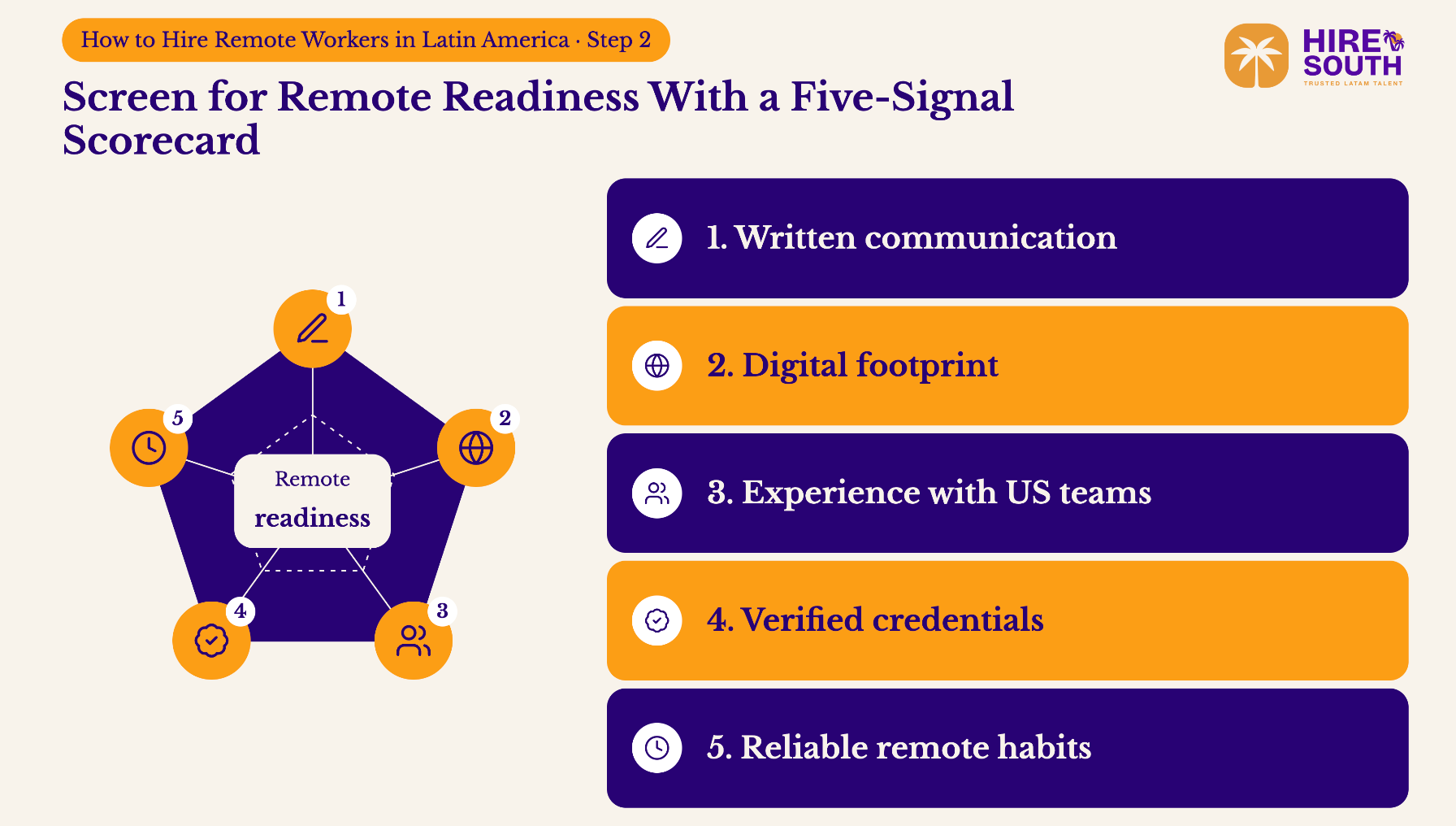
Skills are only half of the picture. A remote hire also needs to work well without supervision. Five signals are worth checking when you judge remote readiness:
- Written communication: Are their emails, messages and documents clear and structured? Ask for a short written summary of a past project.
- Digital footprint: Is their professional profile complete and consistent? Recent work, projects and clear descriptions show how they present themselves to a distributed team.
- Experience with US teams: Have they worked with US clients or managers? If not, look for international or cross-cultural collaboration.
- Verified credentials: Do their certifications match the role, and can you verify them? They help most in cloud, security, data and project management.
- Reliable remote habits: Do they meet deadlines, use project tools properly and flag blockers early? Ask for examples, then check references.
According to Hire South, its team evaluates technical ability, English proficiency and remote-work readiness before you see a profile, which shortens this step. This is where a hiring partner such as Hire South can save you time.
3. Pick Direct Hire or Staff Augmentation
There are two common ways to bring LATAM professionals onto your team. With direct hire, you hire and pay the person directly, and a partner handles sourcing and vetting. With staff augmentation, professionals join your team month by month as an extension of it, and the partner charges a fixed margin over the bill rate, according to Hire South.
Direct hire fits when you want the person on your own team long term and are ready to employ and pay them directly. Staff augmentation fits when you want to add capacity month by month with a lighter commitment. According to Hire South, the whole process typically takes about two weeks, from the intake call to a shortlist, interviews, an offer and onboarding.
4. Onboard Well and Avoid Five Early Mistakes
Many problems with remote hires show up in the first 90 days. Watch for these common mistakes:
- Starting without clear goals for week one and month one.
- Skipping a proper introduction to the team and tools.
- Assuming the person will “figure it out” without written documentation.
- Giving feedback too late, or only when something goes wrong.
- Treating the new hire as a vendor instead of a teammate.
[FOUNDER INPUT: Replace or add one or two mistakes seen in real Hire South placements, with a short example. Keep client details anonymous.]
FAQ: Hiring Remote Workers in Latin America
What Are the Best Remote Jobs in Latin America?
For US companies, the strongest remote jobs in Latin America are software developers, QA engineers, DevOps and cloud engineers, data analysts, product managers, UX/UI designers, customer support specialists, customer success managers, SDRs and digital marketers. They combine deep talent pools, measurable output and strong value from time zone overlap.
Can US Companies Hire Remote Workers in Latin America?
Yes. Many US companies hire LATAM professionals as contractors or through a hiring partner, without opening a local entity. The right structure depends on the country, the role and how long the relationship will last, so get local legal guidance before you commit.
How Much Does It Cost to Hire Remote Workers in Latin America?
It depends on the role, seniority, country and hiring model. As a reference point, Latin American software engineers earn a median of $58,000 at mid-level and $66,000 at senior level, according to Revelo’s 2026 salary guide, while the median for all US software developers was $135,980 in May 2025, according to the US Bureau of Labor Statistics. Customer service representatives in Latin America typically earn $12,000 to $30,000 a year, according to Near’s 2026 salary guide. Compare the total cost, including vetting, tools and management time, not only the base salary.
Which LATAM Countries Are Best for Remote Work With US Teams?
It depends on your hours and your role. Colombia and Mexico offer close alignment with US Eastern and Central time, and Argentina and Brazil are a good fit for teams that can work with a one to two-hour difference. Talent depth and English level also vary by country and profession, so evaluate candidates individually.
Ready to Hire Remote Talent in Latin America?
Finding the right role is the easy part. Finding the right person, quickly and without gambling on your first hire, is where many teams struggle. At Hire South, we connect US companies with bilingual, pre-verified remote professionals from Latin America, through direct hire or staff augmentation.
Schedule a free discovery call and tell us which role you need to hire first!