


You found a great backend developer in Bogota. She is sharp, bilingual and works in your time zone. Then someone on your team asks the question that stalls a lot of international hires: who is going to employ her?
For US companies hiring full time in Latin America, the usual answers are a local entity, a contractor agreement or an employer of record (EOR). This guide covers the third option: how an EOR works, what it costs, how to pick one, and how to run the hire from offer to day 90. It also covers the part most EOR guides skip, which is that an EOR employs people but does not find them.
Hire LATAM Employees with EOR Services: What It Is and When It Fits
What an Employer of Record Does for a US Company Hiring in Latin America
An employer of record is a company that becomes the legal employer of your worker in another country. It signs the local employment contract, runs payroll, pays employer taxes and social contributions, and handles mandatory benefits. You still decide what the person works on, who they report to and how their performance is judged.
Think of it as splitting the word "employer" in two. The EOR carries the legal and administrative side. You keep the management side. The employee works on your team, in your Slack and on your sprint board, but the contract and the paycheck come from a local employer.
Why US Teams Use an EOR Instead of Opening a Local Entity
Opening a legal entity in a Latin American country means registering a company, opening bank accounts, registering with tax and social security authorities, and hiring local accountants and lawyers, all before your first hire starts. That makes sense for a large, long-term presence. It is overkill for one backend developer and a support lead.
An EOR already has that infrastructure in place. You get a compliant employment relationship without building the machinery yourself, which is why EORs suit teams that want to hire a handful of people in a country without committing to a permanent setup.
What an EOR Does Not Do: Find, Vet and Retain Your Talent
Here is the gap in most EOR conversations: an EOR employs a person you already found. Its core product is employment, not hiring. It does not source candidates, run technical interviews or tell you whether someone fits your team. Some providers add recruiting as a separate service, but that is a different job from the one the EOR contract covers.
Retention works the same way. Payroll that arrives on time keeps a contract valid. It does not keep a good engineer engaged.
That is why hiring in LATAM works best as two jobs done by two specialists: one finds and vets the person, the other employs them. Hire South sits on the first job. According to Hire South, the process runs about two weeks: an intake call, a shortlist of two to five candidates, interviews with your top three, then negotiation, offer and onboarding. For a closer look at how the two types of provider differ, read our post Employer of Record vs Staffing Agency: How They're Different.
When it comes to service add-ons, a big one is equipment. Many direct-hire clients forget this service doesn’t typically include equipment delivery, and it’s something we’ve had to offer as an extra because we would never want to leave teams without their tech needs.
How an EOR Works When You Hire in Latin America
Who Is the Legal Employer and Who Manages the Work
Three parties, three jobs. The EOR is the legal employer: it holds the contract, files the paperwork and answers to local labor authorities. You are the day-to-day manager: you assign work, give feedback and decide promotions. The employee works for you in practice and is employed by the EOR on paper.
The agreement between you and the EOR, usually called a service agreement, sets how you split responsibility. Read it as carefully as the employee's contract, because it decides who pays for what when something changes.
How Payroll, Taxes and Benefits Work Across LATAM Countries
Each month, the EOR invoices you for the employee's gross salary, the employer-side taxes and social contributions required in that country, any mandatory benefits and its own fee. It then pays the employee in local currency, withholds the employee's share of taxes and sends the rest to the authorities.
The details change by country. Many Latin American countries require a year-end bonus, often called a 13th-month payment or aguinaldo, along with paid vacation and employer contributions to social security and health systems. These are not perks you can skip. They are part of the legal cost of employing someone. According to Pebl, employer contributions in Brazil can exceed 30% of payroll, and hiring costs in Mexico, centered on social security and housing benefits, often run well over 30% of base salary. In Argentina, according to EY, employer social security contributions are 24% or 26.4% depending on the employer.
How Local Contracts and IP Protection Work Under an EOR
The employee signs a contract under local labor law, not a US-style at-will agreement. Notice periods, probation, working hours and termination rules all come from local rules, and the EOR drafts around them.
Your intellectual property and confidentiality terms still matter. Ask how the contract assigns work created by the employee to you, since the EOR is the formal employer and you are the one benefiting from the work. A good provider will show you the clause instead of promising it exists. If your lawyer has never read a LATAM employment contract, this is a good week to introduce them.
EOR vs Other Ways to Hire International Employees
An EOR is one of three common routes to hire international employees. Here is how the other two compare, kept short because we cover them in depth elsewhere.
Contractors: Fast to Start, Risky When the Role Becomes Full-Time
Hiring an independent contractor is quick: sign an agreement, receive invoices, pay. It works well for defined projects with a clear end. It gets risky when the person works set hours, takes direction from your managers, uses your tools and works only for you. At that point the relationship looks like employment, and local authorities may treat it that way, which can mean claims for unpaid benefits and contributions. Our post Independent Contractor vs Employee: LATAM Staffing Breakdown goes deeper.
Your Own Local Entity: When the Math Starts Working
An entity gives you full control: your own payroll, your own contracts and no EOR fee per employee. It also brings setup work, ongoing accounting and filings, and local legal exposure. The math tends to favor an entity when you plan to hire many people in one country and stay for years. Below that point, the fixed cost of running an entity can outweigh a per-employee EOR fee. According to law firm Harris Sliwoski, it typically takes 4 to 8 weeks to form a business entity in Mexico, and according to GoGlobal, opening a corporate bank account there can take six weeks to three months.
EOR Plus a Recruiting Partner: How the Two Pieces Fit Together
The cleanest setup for many US teams is simple: a recruiting partner finds and vets the person, and the EOR employs them. The order matters. You choose the person first, then the EOR sets up their employment, so the contract starts when the person does.
Pricing models differ, so compare them separately. According to Hire South, its direct hire model charges a one-time fee of 20% of the estimated first-year salary, and the client hires and pays the employee directly (through an EOR if there is no local entity). According to Hire South, its staff augmentation model places talent month to month at a fixed margin over the bill rate, with about 65% of the bill rate going to the talent, compared with roughly 45% at a typical agency. In the example on the Hire South site, a senior developer billed at $6,000 a month carries a $2,100 margin.
Employer of Record Cost and Pricing in Latin America
Employer of Record Fees and EOR Pricing: Flat Rate vs Percentage of Payroll
EOR providers usually price in one of two ways. A flat monthly fee per employee stays the same whether the salary is $2,000 or $8,000 a month. A percentage of payroll scales with the salary, so a senior hire costs more to employ than a junior one. Percentage fees can look cheaper on junior roles and expensive on senior ones. At Hire South, we typically work with a flat monthly payment (depending on the role) or offer direct hire services with a fee of 15-20% of the first yearly salary.
Who Pays When a Hire Does Not Work Out
Hiring goes wrong sometimes. In many LATAM countries, ending employment without cause triggers notice and severance obligations set by local law, and someone has to fund them. Ask your EOR who does, whether it asks you to hold a reserve, and what happens to unused vacation and bonus accruals at exit.
A replacement guarantee is a separate thing. It is about finding a new person, not about what local law requires when an employment ends. At Hire South, our placements carry a 90-day replacement guarantee. Whatever provider you use, get both answers in writing: what the guarantee covers, and what termination costs under the employment contract.
FOUNDER INPUT: We once had a candidate take on volunteer work that coincided with the client’s evening working hours. While their performance had been positive so far, the candidate himself offered to step down from the position to avoid dropping productivity and hindering the client’s company progress. We found a replacement within 5 business days and onboarded them in record time, allowing for talent overlap to ensure no detail was left behind in the process.
Worked Example: Total Monthly Cost of One Hire in Latin America
Use this formula for any hire, then plug in numbers from your own quotes:
- Monthly gross salary
- Plus employer taxes and social contributions
- Plus the monthly accrual for the year-end bonus and paid vacation
- Plus a severance reserve, if your contract requires one
- Plus the EOR fee
- Plus payment and currency conversion costs
The sum is the total monthly cost of the hire.
Pick one role and start with a salary benchmark for that role and country. According to the Revelo 2026 salary guide, which draws on its own placements of engineers working remotely for US companies, the median senior software engineer in Mexico earns $72,000 a year, or $6,000 a month. Ask the EOR to quote lines two through six, add them up, and compare the result with the all-in cost of the same role on your US team. According to Hire South, companies can save up to 40% compared with hiring locally. Your own numbers will tell you whether that holds for your role.
How to Choose an EOR for Hiring in Latin America
What to Look for in an EOR for Latin America: Coverage, Entities and Support
No single EOR is the best fit for every company hiring in Latin America. The right one depends on which countries you hire in, how many people you plan to employ and how much support you need. Instead of a ranking, use these criteria:
- Country coverage that matches your hiring map: do they operate where you actually hire?
- Local depth: do they have in-country legal and payroll specialists, not just a global dashboard?
- Pricing clarity: is every fee written into the contract, including payment and conversion costs?
- Support: can you reach a person who understands local rules when a question comes up?
- Contract flexibility: can you start with one hire and scale up or down?
A long country list looks impressive on a sales page. If you hire in three countries, depth in those three matters more.
Own Local Entities vs Partner Networks: Why It Changes Your Risk
Some EORs employ your worker through their own legal entity in the country. Others work through a network of local partners. Both can be compliant. The difference shows up when something goes wrong: with an own entity, one company is accountable, and with a partner network, responsibility is split across companies.
Ask where the employment contract actually sits, who the named employer is and who you call when payroll is late.
EOR Contract Red Flags: Minimum Terms, Exit Fees and Conversion Buyouts
Read the service agreement before you read the brochure. Watch for:
- Minimum terms or annual commitments that outlast the hire
- Fees to end the agreement or to remove an employee
- A conversion or buyout fee if you later move the employee to your own entity or to direct employment
- Setup fees that were not in the quote
- Currency conversion markups folded into payroll funding
- Vague language on who pays severance and who owns the employee's data
Conversion fees deserve extra attention. If your team grows in one country, you may eventually want to move people onto your own entity. A provider that makes that expensive has priced your exit into the contract.
How to Hire LATAM Employees with an EOR, Step by Step
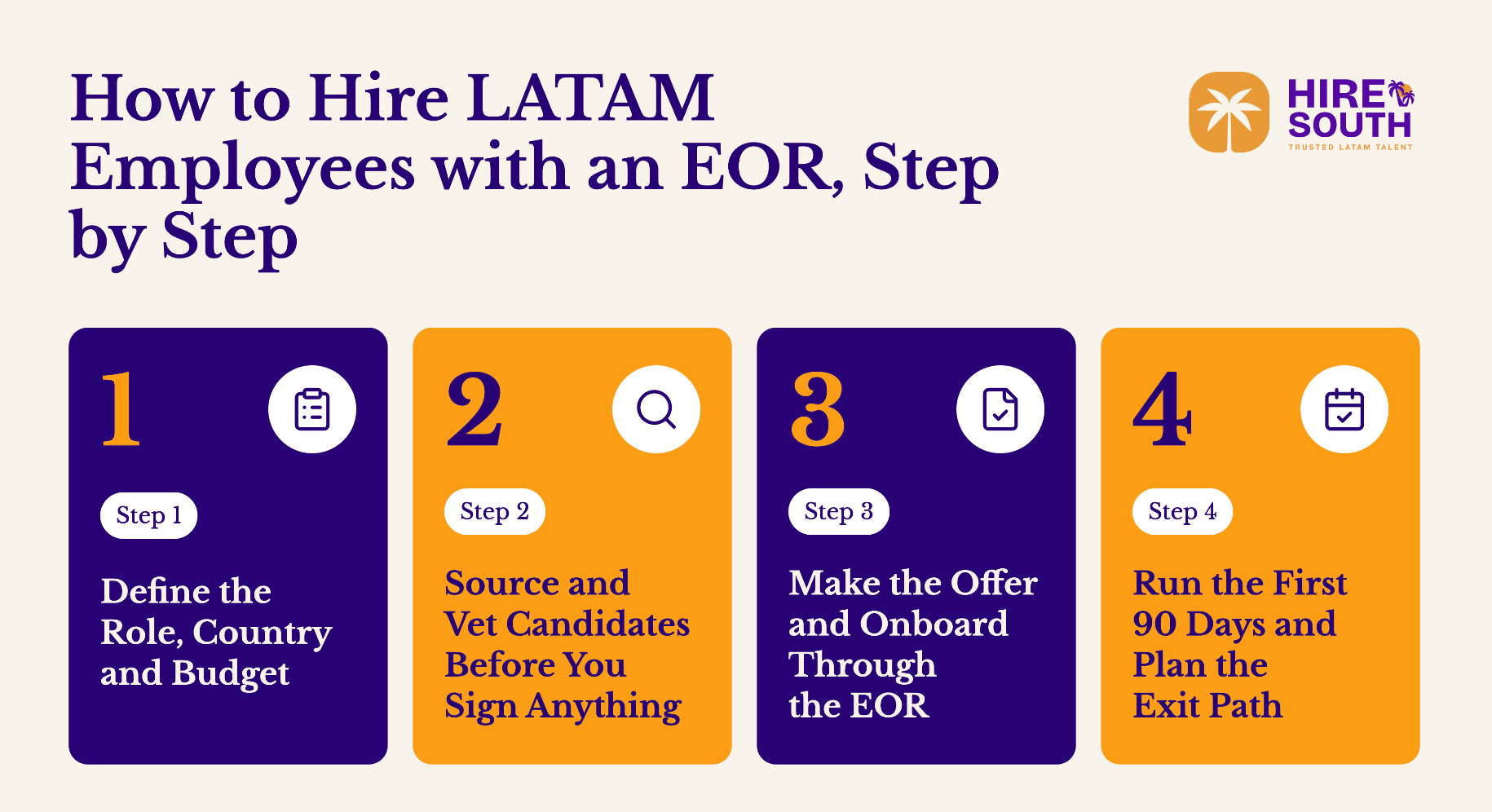
Step 1: Define the Role, Country and Budget
Start with the role and the problem it solves, then pick the country. Compare time-zone overlap with your team, the depth of the talent pool for that role and the total employer cost. Two countries with similar salaries can carry very different employer obligations.
Set a total monthly budget with the formula from the cost section before you talk to any provider.
Step 2: Source and Vet Candidates Before You Sign Anything
Resist the urge to sign an EOR agreement first. A signed agreement with no candidate is a contract waiting for a person. Start with a vetted shortlist: candidates checked for skills and English, then interviewed by you.
According to Hire South, its process takes about two weeks end to end, and most hires close in about 10 days. If you want to see what a shortlist looks like, Start Hiring with Hire South and we will walk you through it.
Step 3: Make the Offer and Onboard Through the EOR
Once the candidate says yes, the EOR drafts the local employment contract, you review the offer terms, and the EOR sets the start date and the first payroll cycle. Collect the documents the EOR needs early, because waiting on paperwork is an easy way to lose a week. Agree on equipment, tool access, and a first-week plan before day one.
FOUNDER INPUT: Our timeline from offer to first day tends to fall well ahead of schedule. Most candidates don’t need two weeks of notice, so they usually start the following Monday unless the client is hiring multiple people at a time and waiting for a group intake date.
Step 4: Run the First 90 Days and Plan the Exit Path
Employment setup is done. Integration is yours. Plan regular check-ins, give the new hire a clear first project and name a teammate to answer the small questions. Plan the exit path from day one as well. If you expect to hire several people in the same country, pick a headcount at which you will revisit opening your own entity, and confirm what moving someone off the EOR would cost, in line with the contract red flags above.
Common Mistakes When Hiring LATAM Employees Through an EOR
Treating the EOR Fee as the Whole Budget
Comparing quotes by monthly fee alone is how budgets get surprised. A low fee with extra charges for setup, payments and offboarding can cost more than a higher all-in price. Compare total monthly cost across providers using the same formula.
The US-Side Gaps an EOR Cannot Close
An EOR takes on the employment side in the local country. Some questions stay with you. The way you manage the worker can still raise worker classification questions. Your data security rules still apply to someone who accesses your systems from another country. And a team with real decision-making authority abroad can raise tax questions about your company's presence in that country, known as permanent establishment. We are not your lawyers, so have counsel review these points before you scale.
Assuming Compliance Solves Time-Zone and Management Fit
A compliant contract does not make a good working relationship. Time-zone overlap, communication habits and management style are still yours to set. Agree on core hours, a place for questions and how feedback works. All of this is cheap to set up and expensive to ignore.
FAQ: Hiring LATAM Employees with an EOR
How much does an employer of record cost for LATAM employees?
The EOR fee is one part of the cost. The rest is salary, employer taxes, mandatory benefits and bonuses. Fees are usually a flat monthly amount per employee or a percentage of payroll. According to Second Talent, which read 14 provider pricing pages in September 2026, published EOR fees run from $199 to $699 per employee per month. For Latin America, according to Remote People, fees run roughly 10% to 18% of gross salary. Use the formula in the cost section to compare quotes on a total basis.
What is the best EOR for hiring in LATAM?
It depends on your countries, your headcount, and the contract terms. Judge providers on country coverage, local depth, pricing clarity, and exit terms rather than on a generic ranking.
Can I hire international employees without an employer of record?
Yes. You can hire contractors, which suits project-based work but is risky for full-time roles, or open a local entity, which suits larger long-term teams. An EOR sits between the two: employment without the entity.
How long does it take to hire through an EOR in Latin America?
Finding the right person is the longest part. At Hire South, our hiring process runs about two weeks. Setting up employment through an EOR adds the time needed to draft the local contract and schedule the first payroll. According to Pebl, the average EOR hiring timeline is 1 to 2 weeks, while, according to SolidGigs, more complex jurisdictions such as Brazil and much of Latin America can take three to six weeks because of government registration and benefit enrollment requirements.
Ready To Make Your Next Hire?
Hiring in Latin America through an EOR comes down to three decisions: who employs the person, what the full monthly cost really is, and who finds someone worth employing. Get the first two right and payroll becomes boring, which is exactly what you want from payroll. Get the third right and the hire actually moves your business forward.
At Hire South, we take care of that third decision. An EOR employs the person you choose, and we help you choose well: an intake call, a shortlist of two to five pre-vetted bilingual candidates in your time zone, interviews with your top three, then negotiation, offer and onboarding. According to Hire South, the process takes about two weeks, most hires close in about 10 days, there are no upfront costs and every placement carries a 90-day replacement guarantee. The numbers go in the contract.
Stop guessing who your first LATAM hire should be. Book a Call now and we will map the role, the country and the shortlist with you.