


You post a remote role on a job board on Monday. By Wednesday, your inbox is full, and by Thursday you suspect several applicants are the same resume under different names. By Friday, you have two interviews booked and no idea who can actually do the job.
So, do you need a remote job board to hire talent in Latin America? Sometimes. A board gives you reach, and for some roles reach is all you need. For others, it hands you a pile of applicants and leaves the hard part, finding and vetting someone worth hiring, entirely to you. This guide covers what LATAM job boards can and cannot do, what they cost once you factor in your time, when a remote recruitment agency is the better call, and how to hire remote talent in Latin America without wasting a month.
LATAM Job Boards: What They Can and Cannot Do for Remote Hiring
What a Job Board Actually Gives You: Reach, Not Vetting
A job board is a place to publish a role and collect applications. That is the whole product. It puts your listing in front of people who are looking, and it gives you a way to receive their resumes. Everything that happens next, from screening and testing to interviewing, checking references and convincing the best person to say yes, is your job.
That is not a flaw. A board is built for distribution, and it does that well. The mistake is expecting distribution to do the work of selection.
Types of LATAM Job Boards: General, Regional and Niche
Most boards fall into three groups. General boards have the biggest audience and the widest range of quality, from excellent candidates to people applying to everything in sight. Regional boards focus on specific countries or on Spanish and Portuguese-speaking markets, which helps with local reach but may not reflect how US teams work. Niche boards focus on one profession, such as engineering or design, or on remote-only roles.
Each type trades reach for relevance. The more specialized the board, the fewer the applicants and the closer the match, usually. Unless a listing says otherwise, none of them verifies English, remote experience or technical skill on your behalf, so check what a board actually screens before you pay to post.
What a Job Board Cannot Do: Vet, Interview and Close
A job board will not tell you whether an applicant's English holds up on a live call, whether their last project was really theirs or whether they have worked remotely with a US team before. It will not discuss salary expectations across a border or keep a great candidate warm while you sort out a payroll question.
Those jobs belong to a recruiter, internal or external. If you do not have one with time to spare, you are the recruiter.
Hire Remote Workers in Latin America: The Real Cost of a Free Job Post
Your Hours Are the Price: Posting, Screening and Interviewing
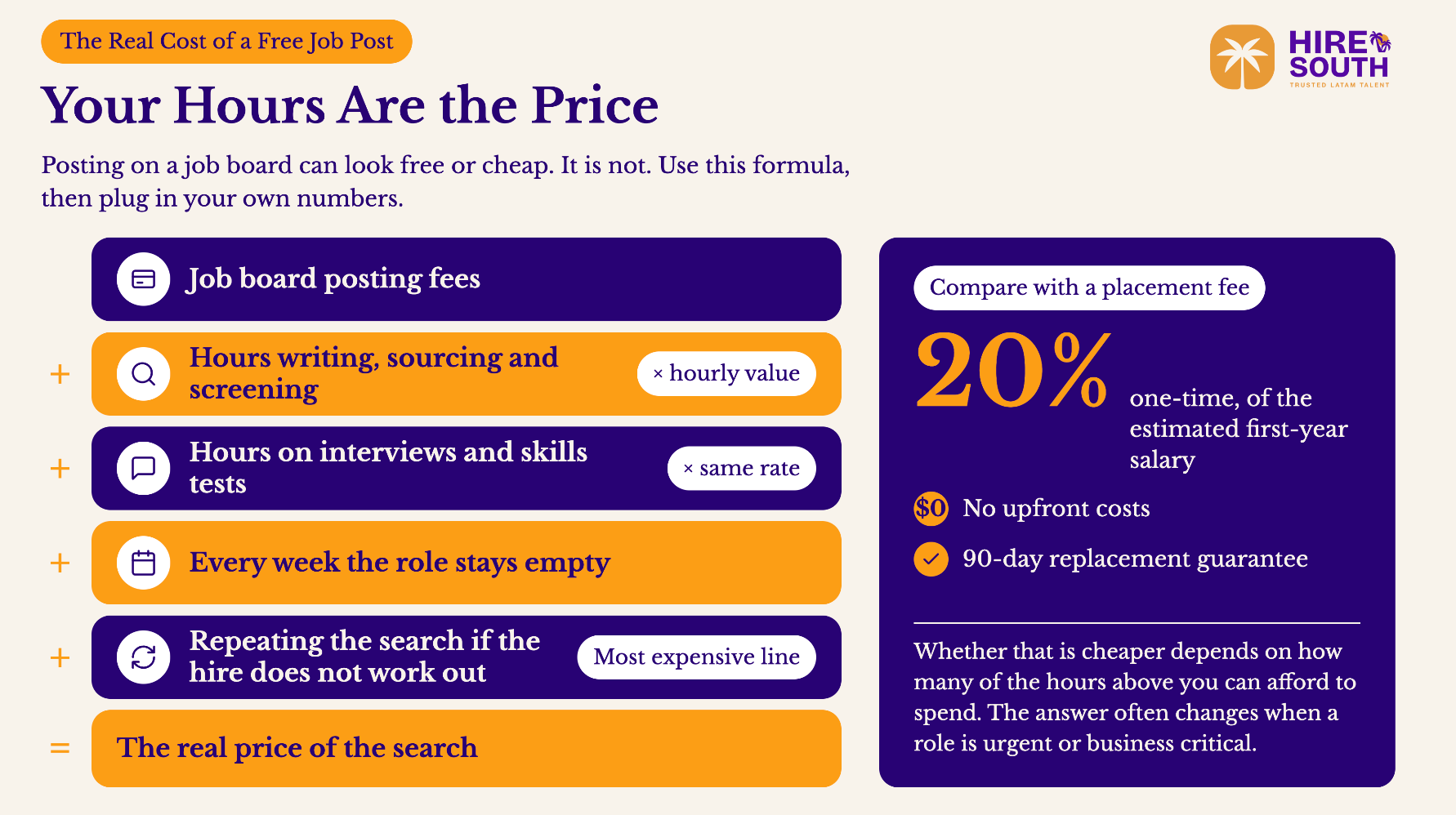
Posting on a job board can look free or cheap. It is not. You pay in hours, and hours have a price.
Count the work behind a single hire. Writing the job description and choosing where to post it. Reading resumes. Replying to applicants. Running first-round screens. Testing skills. Scheduling interviews across time zones. Checking references. Negotiating the offer. Each step takes a few hours, and every hour comes from someone whose time is worth more than a posting fee.
Founders feel this most. An hour spent reading resumes is an hour not spent on product, sales, or customers.That’s why at Hire South we review our resumes ourselves, and avoid AI tools because of their high unreliability in detecting small nuances that make or break the perfect fit for each unique role.
Worked Example: Total Cost of Filling One Role Yourself
Use this formula, then plug in your own numbers:
- Job board posting fees
- Plus hours spent writing, sourcing and screening, multiplied by the hourly value of the person doing them
- Plus hours spent on interviews and skills tests, multiplied by the same rate
- Plus the cost of every week the role stays empty
- Plus the cost of repeating the search if the hire does not work out
The sum is the real price of the search.
Now compare it with a placement fee. According to Hire South, its direct hire model charges a one-time fee of 20% of the estimated first-year salary, with no upfront costs. Whether that is cheaper depends on how many of the hours above you can afford to spend. The answer often changes when a role is urgent or business critical.
The Cost of a Bad Hire From an Unvetted Pool
The most expensive line in that formula is the last one. A hire who looks great on paper and fails in the first few months costs you salary, onboarding time, team morale and a second search. According to Gallup, replacing an employee can cost between one-half and two times their annual salary. A pool where nobody checked the claims on the resume before it reached you makes that outcome more likely.
Replacement protection changes the math. According to Hire South, its placements carry a 90-day replacement guarantee, so a miss in the first three months does not mean starting from zero.
Where Job Boards Fall Short for Remote Hiring in Latin America
The Passive Talent Gap: Strong Candidates Are Not Browsing
Many of the best professionals already have jobs and are not scrolling through listings. In a LinkedIn survey of 18,000 employed professionals across 26 countries from 2014, roughly three quarters described themselves as passive candidates, not actively looking for their next job. That survey is old and global, so treat it as a direction, not a Latin America statistic. A more recent signal comes from Mexico: according to the Market Research 2026 study by Pandapé and Computrabajo, as reported by Mexico Business News, nine out of ten employees are actively considering new job opportunities.
The implication is simple. A job board shows you the people who are looking today. Reaching the rest takes direct outreach, which is what recruiters do all day. For more on that approach, see our post Why Do You Need a Headhunter for Remote Jobs?
English on a Resume Is Not English on a Call
Almost every LATAM resume lists English. Fewer candidates can run a stand-up, explain a blocker or push back on a bad idea in English, live, with a little pressure. The gap is real and it varies by country. According to the EF English Proficiency Index 2025, Argentina ranked 26th out of 123 countries and was the highest in Latin America, with a score of 575 against a global average of 488. Most other countries in the region scored in lower bands, so a blanket assumption about English is risky in either direction.
The only reliable test is a live conversation about real work, and a board will not run it for you. Our guide How to Interview LATAM Tech Talent for Communication, Not Just Coding shows how.
FOUNDER INPUT: At Hire South, not only is every interview conducted in English, but all candidate communications follow the same principle as well. We want to ensure talent understands these are remote roles where they’ll work in an English-speaking environment for 8+ hours a day, and using translation apps or AI as a crutch will not cut it for our clients.
Remote-Readiness: Time Zone, Setup and Self-Management
A great engineer is not automatically a great remote engineer. Remote work asks for clear writing, self-direction, a stable internet connection and a workspace that does not double as a living room during meetings. A resume shows none of that.
Ask about past remote roles, how they handle blockers when nobody is online and what their setup looks like. Confirm time-zone overlap before the first interview, not after the offer. Most of Latin America overlaps with US working hours, but most is not all, so check each candidate.
Local Employment Details Nobody Puts in the Job Ad
A job post lists a salary and a title. It does not mention that many Latin American countries require year-end bonuses and paid vacation, that employment follows local labor law or that the person needs a legal way to be employed or paid. These details change the real cost of the hire and the way you structure the offer. According to the Chambers Employment 2024 guide, the Brazilian Constitution requires employers to pay a Christmas bonus (the 13th salary) equal to one extra salary per year. According to L&E Global, Mexican employers must pay a Christmas bonus of at least 15 days of salary by December 20, plus a 25% premium on the salary earned during vacation. In Colombia, according to L&E Global, every employee is entitled to 15 working days of paid vacation for every 12 months of service.
Decide how the person will be engaged, through a contractor agreement, an employer of record or your own entity, before you make the offer. Surprises are fun at birthday parties, not in payroll.
When a Job Board Is Enough and When It Is Not
Five Signs a Job Board Will Do the Job
- The role is junior or well defined, with skills that are easy to test
- You are hiring several people for the same role and need volume
- You have a recruiter or hiring manager with time to screen every week
- Your team already runs structured interviews and skills tests
- Saving on fees matters more than speed
If most of these describe you, post the role and enjoy the savings. No agency required, and we are happy to say so.
Five Signs You Need a Remote Recruitment Agency Instead
- The role is senior, specialized or business critical
- The person needs to communicate in English with your US team from day one
- Nobody on your team has hours to spare for screening
- You are hiring in Latin America for the first time and do not know the market
- A bad hire would cost more than the placement fee
If these sound familiar, a board will mostly add to your workload.
A Two-Minute Test: Should You Use a Job Board?
Answer four questions. Can you describe in one sentence what great looks like for this role? Do you have a few hours a week to screen applicants? Can you test the skill itself, not just read about it? Would you accept a longer search to save on fees?
Four yeses point to a job board. Two or more noes point to a recruiting partner. Anything in between calls for a hybrid, which the next sections cover.
FOUNDER INPUT: Many clients come to us after becoming disillusioned with freelancer platforms. They hope for long-term dedicated team members and find people working multiple gigs per day… It’s just not the typical place to look for that sort of talent. Job boards can be useful, but companies choosing staffing generally lack the bandwidth to conduct the entire recruitment process. That’s where we come in!
What a Remote Recruitment Agency Does That a Job Board Does Not
Sourcing From Passive Talent and Private Networks
A remote recruitment agency starts with people, not postings. It keeps relationships with professionals who are employed, open to the right offer, and invisible to any job board. When a role opens, it reaches out directly. According to Hire South, its network is made up of bilingual, pre-verified professionals across Latin America.
FOUNDER INPUT: We head-hunt for almost every role, unless we already have an existing talent pool for the position.
Vetting: Skills, English and Culture Fit Before You Meet Anyone
The practical difference shows up in what lands on your desk. A job board delivers applicants. An agency delivers a shortlist: people already screened for skills, English and fit with a remote US team. You still decide who gets the offer, but you choose among finalists, not from a stack.
What the Process Looks Like at Hire South
According to Hire South, the process runs about two weeks: an intake call to understand the role, a shortlist of two to five candidates, interviews with your top three, then negotiation, offer and onboarding. According to Hire South, most hires close in about 10 days, and its co-founders, Jared and Sol, stay involved, so the people who understand your role are the people you can call.
Pricing: Placement Fee or Monthly Margin
Agencies usually price in one of two ways. A placement fee is paid once, when you hire. A monthly model builds the cost into a rate for as long as the person works with you.
According to Hire South, its direct hire model charges a one-time fee of 20% of the estimated first-year salary. According to Hire South, its staff augmentation model places talent month to month at a fixed margin over the bill rate, with about 65% of the bill rate going to the talent, compared with roughly 45% at a typical agency. In the example on the Hire South site, a senior developer billed at $6,000 a month carries a $2,100 margin. To compare providers, read our post How To Choose the Right Remote Recruitment Agency.
How to Combine a Job Board and a Recruitment Agency
Use the Board for Volume Roles and the Agency for Critical Ones
This is not an either or decision. Many teams run both: a job board for roles that are easy to define and test, and a recruiting partner for hires that carry real weight. A support team that needs several similar agents suits a board. The engineering lead who will shape your product suits an agency. Match the channel to what a wrong hire would cost you.
How to Write a LATAM Job Post That Attracts the Right Applicants
A clear post filters for you. A vague one attracts everyone, and then you filter by hand. Include:
- The salary range in US dollars and how the person will be paid
- The time zone and the core hours you need
- A line saying English is required and how it will be tested
- A description of the first 90 days, not just a list of tools
- Your remote setup and equipment expectations
How to Screen Job Board Applicants in Four Steps
- Cut to a shortlist by hard requirements: relevant experience, time zone and English
- Run a short written exercise that mirrors real work
- Hold a live video call to test spoken English and how the candidate handles questions
- Check references from a recent remote or US-facing role
Steps three and four are where most hiring mistakes get caught, and they are the first ones busy teams skip.
Common Mistakes When Using LATAM Job Boards
Posting a US Job Description Word for Word
A US-style post can confuse candidates who read titles and benefits differently. Terms like 401(k), PTO or exempt role mean little in Latin America. Translate the ideas, not just the words: explain benefits in local terms and say how pay and time off work for the way you will engage the person.
Ignoring Salary Expectations and Local Benefits
Candidates compare your offer with local norms, which in many countries include mandatory year-end bonuses and paid vacation. A salary that looks generous in dollars can look thin once those are counted, and a salary far above the market can attract applicants who are only there for the money. Research the range before you post. For ranges by role, see our guide Average Salary for Senior LATAM Talent: Cost Per Role Breakdown. According to the Revelo 2026 salary guide, which draws on its own placements of engineers working remotely for US companies, the median senior software engineer earns $72,000 a year in Mexico and $70,000 in Argentina.
Treating Applicant Volume as a Quality Signal
Hundreds of applicants sounds impressive. It is also hundreds of resumes to read. Volume measures how visible your post was, not how good the candidates are. Track the number that matters: how many applicants pass your English call and skills test. If that number is small, more traffic will not fix it. A better process, or a partner who runs one for you, will.
FAQ: Hiring Remote Workers in Latin America
Do I need a job board to hire remote workers in Latin America?
No. A job board is one way to find candidates, not a requirement. You can also hire through referrals, direct outreach or a remote recruitment agency. A board makes sense for roles that are easy to test when you have time to screen. For senior or business-critical roles, a recruiting partner usually saves more time than a board saves in fees.
How do I hire remote workers in Latin America?
Define the role and the budget, source and vet candidates, interview a short list, make the offer and set up legal employment or a contractor agreement in the candidate's country. According to Hire South, a managed search runs about two weeks. Setting up employment adds time. According to global employment provider Pebl, employees must give 15 days of notice before resigning in Argentina and 30 days in Brazil, while Mexico and Colombia have no statutory notice period for resignations.
Can US companies hire remote foreign workers?
Yes. US companies can engage workers abroad as independent contractors, through an employer of record or through their own local entity, and each route carries different obligations. The right choice depends on the country and on how the person will work. We are not your lawyers, so have counsel review the structure before you hire. According to the IRS, compensation paid to a nonresident alien for services performed outside the United States is not considered wages and is not subject to withholding, and foreign persons who provide a valid Form W-8 are exempt from backup withholding and Form 1099 reporting. This covers US tax treatment only. How the relationship is classified under local labor law is a separate question.
Is a remote recruitment agency worth it?
It depends on the role and on what your time is worth. If a role is senior, urgent or hard to vet, an agency usually pays for itself in time saved and risk avoided. If the role is simple and you have time to screen, a job board may be enough. Run the cost formula from earlier with your own numbers.
How much does a remote recruitment agency cost?
Fees vary by model and by agency. According to Upwork, direct hire agencies typically charge a one-time fee of about 18% to 25% of a hire's first-year compensation. According to Hire South, its direct hire fee is a one-time 20% of the estimated first-year salary, and there are no upfront costs. Whichever agency you consider, ask what the fee covers, whether a replacement guarantee is included and what happens if the hire leaves.
Ready To Find Your Next Talent?
So, do you need a remote job board to hire talent in Latin America? Only if the role is easy to define and test, and you have the hours to screen every applicant. A board gives you reach. It does not give you vetting, speed or a safety net, and for the hires that matter most those are the parts you are paying for.
At Hire South, we handle the parts a board leaves to you. We source and vet bilingual, pre-verified candidates in your time zone, then hand you a shortlist of two to five people to interview. According to Hire South, the process takes about two weeks, most hires close in about 10 days, there are no upfront costs and every placement carries a 90-day replacement guarantee. The numbers go in the contract.
Skip the overflowing inbox. Book a Call With Jared & Sol and we will map the role, the country and the shortlist with you.