


Business leaders expect payroll software to streamline operations, but it often becomes a compounding budget leak. You sign up for a reasonable base fee, only to be hit with scaling per-employee charges and hidden implementation costs as your team expands.
Let’s face it, mid-market companies frequently absorb thousands of dollars in setup fees before running a single payroll cycle. When you attach these software seat licenses to inflated domestic salaries and state taxes, your total labor overhead skyrockets.
This guide breaks down exactly what you can expect to pay for legacy payroll platforms in 2026, including hidden module fees and document processing charges. You will discover how to audit your current vendor quotes and why relying on traditional domestic payroll models continuously drains your resources. We also suggest a highly capital-efficient alternative that bypasses these fees completely.
Keep reading to discover how you can eliminate domestic payroll software costs by integrating elite, fully-managed nearshore talent operating in your exact time zone.
Uncovering the True Cost of ADP in 2026
ADP pricing in 2026 is structured around a monthly base platform fee combined with a Per-Employee-Per-Month (PEPM) charge. Depending on the specific product tier, the base fee generally ranges from $59 to $150 per month, while the PEPM rate scales from $4 for basic payroll up to $30 or more for mid-market human capital management suites.
When executives forecast departmental growth, they frequently fixate on the software licensing cost while underestimating the compounding burden of the domestic salaries tied to those seats. A $25 PEPM fee feels manageable in isolation. However, when you attach that monthly software fee to a $130,000 domestic base salary, state employer taxes, and expensive healthcare premiums, your operational margin shrinks rapidly.
Software vendors deliberately structure their pricing to capture more value as your headcount grows. Every domestic hire you make increases your monthly software invoice and your compliance liability. If you are forecasting your departmental expansion this quarter, you can instantly compare fully loaded domestic US overhead against elite global talent rates using the free Hire South US vs. LATAM Salary Calculator.
Decoding the ADP Pricing Tiers: RUN vs. Workforce Now
ADP segments its pricing across distinct platforms tailored to company size, utilizing ADP RUN for small businesses, ADP Workforce Now for mid-market companies, and ADP TotalSource for enterprises seeking a co-employment PEO model.
Understanding this tier structure is essential for auditing your proposed contract. ADP RUN targets businesses with 1 to 49 employees, offering an Essential plan that generally starts at a $79 monthly base fee plus $4 per employee. Upgrading to advanced tiers that include background checks or wage garnishment requires custom quoting and pushes the PEPM rate significantly higher.
ADP Workforce Now serves the mid-market sector for companies with 50 to 999 employees. Base PEPM costs range between $10 and $30 depending on volume discounts. This tier shifts to modular pricing, meaning you pay a base rate for core payroll but must purchase entirely separate licenses for time tracking, performance management, and benefits administration.
The Auto-Renewal Trap: Understanding ADP Contract Terminations
ADP enterprise contracts routinely enforce strict 24- to 36-month terms governed by aggressive auto-renewal clauses. Missing the narrow 60- to 90-day cancellation window automatically locks your organization into another multi-year commitment, and terminating early often triggers severe financial penalties.
Software vendors rely on administrative fatigue to maintain their revenue streams. When executives decide to transition away from legacy payroll platforms, they frequently discover that backing out of an active ADP agreement carries heavy financial friction. According to recent 2026 industry contract audits, early termination fees can include paying out a percentage of the remaining contract value or absorbing high hourly rates, often up to $185 per hour, for setup work already incurred by the vendor.
Before you sign a new agreement or attempt to cancel your current services, demand complete transparency regarding the notice period, the exact delivery method required for cancellation, and any equipment return liabilities.
Agile organizations are abandoning these restrictive software contracts entirely. By transitioning to a zero-risk nearshore staffing model with Hire South, you operate without long-term retainers or platform lock-ins. You pay strictly for the elite LATAM talent you hire, backed by a 90-day replacement guarantee, giving you ultimate financial flexibility.
The Multi-State Tax Penalty: Hidden Costs of Domestic Remote Teams
As your domestic workforce becomes distributed, ADP charges compounding fees for multi-state tax compliance, requiring separate localized filings for every state your employees reside in. These escalating administrative costs drastically inflate your PEPM base rate compared to nearshoring global talent under a single, predictable vendor invoice.
Building a remote US-based team creates an immense compliance burden. If your company is headquartered in New York but hires remote developers in California and Texas, you are legally required to manage state-specific unemployment insurance, workers' compensation, and local tax withholdings across all three jurisdictions. Legacy payroll providers monetize this complexity by charging $10 to $50 per state, per month, rapidly inflating your initial software quote.
When you factor in these multi-state tax penalties and year-end W-2 processing fees, domestic remote hiring quickly breaks operational budgets.
The alternative is bypassing the US tax system entirely. When you hire elite, fully bilingual professionals in Latin America through an Employer of Record (EOR), the talent is legally employed in their home country. Your organization receives one clean B2B vendor invoice. You avoid domestic state taxes, compliance software upgrades, and multi-state filing fees entirely.
Real-World ADP Expense Benchmarks by Headcount
A 25-person startup utilizing ADP RUN typically spends between $400 and $750 per month on core payroll software. A 150-person mid-market firm on ADP Workforce Now generally spends between $1,800 and $3,200 monthly, completely excluding initial implementation fees and module upgrades.
To demystify the pricing matrix, evaluating realistic benchmarking scenarios based on recent anonymized transaction data provides vital context. A small digital agency with 25 employees running ADP RUN for core payroll and basic tax filing pays an approximate $80 base fee plus a $15 PEPM rate for an enhanced tier. Their total monthly software cost hovers around $455.
Conversely, a mid-market logistics firm with 150 employees utilizing ADP Workforce Now pays a $14 PEPM base rate. Because they employ hourly workers, they add a $4 PEPM time-tracking module. Their total monthly software cost reaches $2,700, and they must absorb a one-time $4,000 implementation fee just to migrate their historical data onto the platform.
The Hidden Fees Inflating Your Monthly Payroll Invoice
Base PEPM quotes rarely reflect the final vendor invoice. ADP monetizes year-end tax document processing, off-cycle manual payroll runs, and critical HR module add-ons, which regularly inflate initial estimates by 20% to 40%.
Relying solely on the initial sticker price is a critical budgeting mistake. When structuring domestic employment infrastructure, you must anticipate the hidden administrative fees baked into legacy platforms. Upgrading your package to include benefits administration typically costs an additional $3 to $8 PEPM, while talent management modules add another $4 to $10 PEPM.
Furthermore, generating year-end W-2 and 1099 forms incurs charges of $5 to $15 per document. If you need to issue an immediate termination check or an off-schedule bonus payment, these off-cycle payroll runs trigger manual processing fees of $50 to $150 per instance.
How to Audit an ADP Proposal Like an Insider
Reviewing an ADP quote requires isolating the base platform fees from the Per-Employee-Per-Month charges. Executives must demand line-item transparency for individual modules and aggressively negotiate the high-margin implementation and data migration fees.
Legacy software vendors often rely on bundled pricing to obscure the true cost of individual features. When evaluating your proposal, refuse bundled estimates entirely. Require the sales representative to list the exact PEPM cost for core payroll, benefits administration, and time tracking as separate line items.
Data migration and setup fees for Workforce Now generally span from $2,000 to $8,000. These fees carry exceptionally high margins for the vendor and can frequently be reduced or waived entirely during end-of-quarter negotiations. You should also audit the escalation clause within the contract terms, capping automatic annual price increases at 3% to 5% to prevent surprise budget spikes in year two.
Strategic Tactics to Shrink Your Domestic Payroll Burden
The most effective way to reduce ADP costs is to bypass domestic software seat fees by shifting headcount growth to global nearshore markets. Alternatively, domestic companies can consolidate redundant HR software and leverage annual prepayment discounts.
If you are locked into an existing domestic contract, optimizing your usage controls the budget bleed. Committing to multi-year agreements and paying annually often yields 15% to 25% discounts below initial quotes. You should also eliminate redundant technology. If your team relies on specialized external tools for recruiting, drop the equivalent built-in modules to strip unnecessary PEPM charges from your invoice.
However, the ultimate cost-reduction strategy involves changing your hiring geography. Every domestic US hire increases your software cost, employer tax liability, and benefits overhead. By pivoting toward nearshore staff augmentation, you eliminate these software seat costs. Premium nearshore agencies handle all international compliance and payroll internally, presenting you with a single, predictable vendor invoice.
Evaluating the True ROI of Enterprise Payroll Platforms
ADP provides unmatched processing scale and robust domestic tax compliance for massive enterprises managing thousands of US-based employees across multiple tax jurisdictions. However, for agile companies seeking lean operations and global talent, the heavy infrastructure and compounding PEPM fees drastically outweigh the benefits.
Determining ROI requires evaluating your company's specific operational complexity. ADP excels at navigating complex domestic union rules, multi-state wage garnishments, and massive corporate hierarchies. Their system is highly secure and deeply entrenched in the traditional US corporate ecosystem.
If your growth strategy involves lean teams, remote-first operations, and sourcing the best global talent, traditional domestic payroll software becomes an expensive bottleneck. You end up paying premium software subscription fees just for the privilege of paying inflated domestic salaries.
Modern Alternatives to Legacy US Payroll Systems
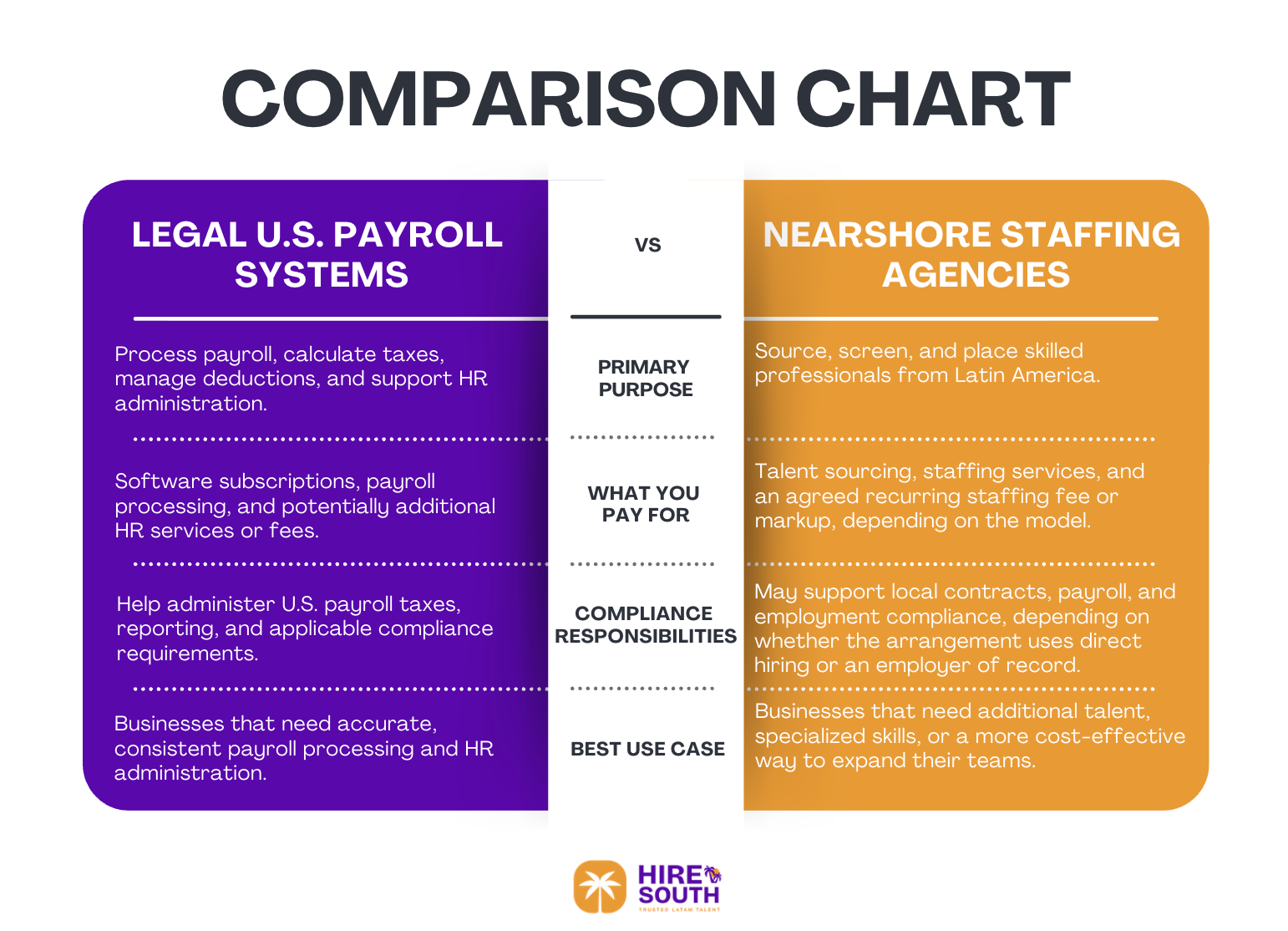
The payroll software market offers agile platforms like Gusto for small businesses and modern Human Capital Management tools like Rippling for tech-forward mid-market companies. Alternatively, boutique nearshore agencies offer a complete departure from traditional domestic payroll constraints.
Before renewing a legacy contract, evaluate the broader landscape of workforce management solutions to ensure alignment with your actual hiring strategy. Gusto remains a premier domestic solution for small businesses, averaging $6 to $12 PEPM with a $40 to $80 base fee, making it generally more affordable than ADP RUN. Rippling is built for IT-centric organizations, centralizing payroll and software provisioning with highly competitive core pricing.
Global Staffing Partners offer a completely different model. Instead of buying payroll software to manage expensive domestic workers, you partner with an agency that acts as the legal employer for an elite international team, absorbing all software, compliance, and tax burdens internally.
Traditional Domestic Software vs. Hire South's Nearshore Framework
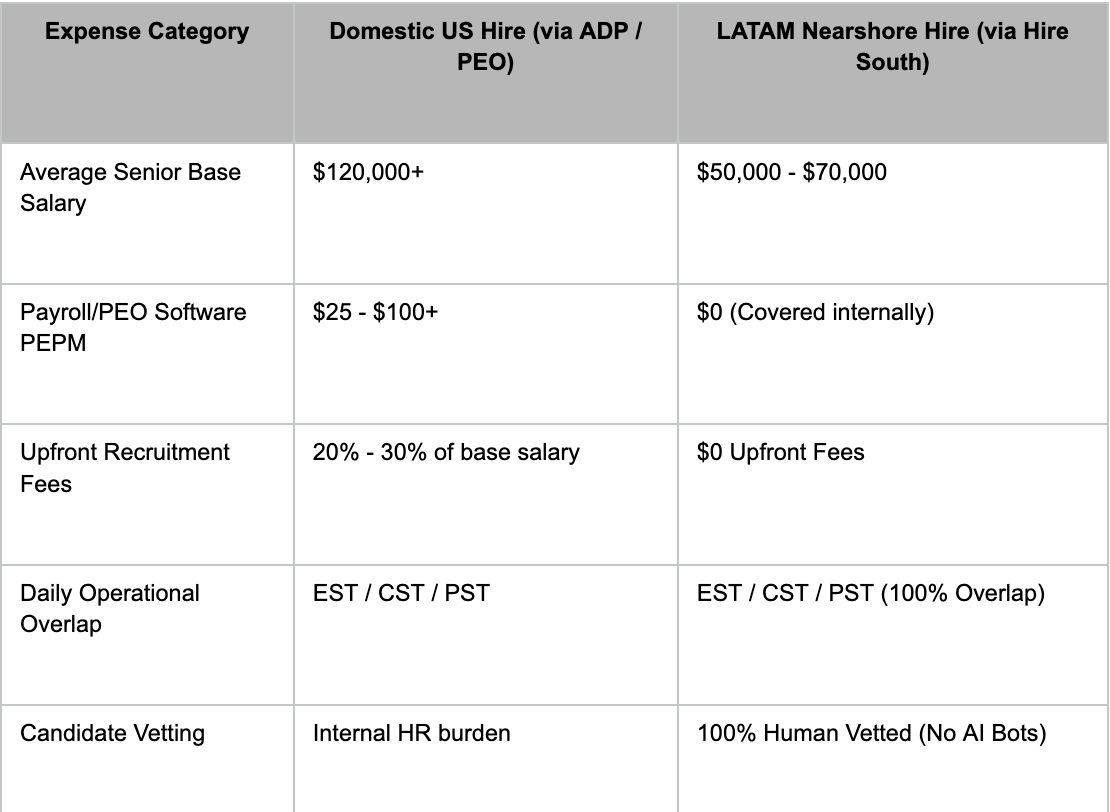
While ADP sells you expensive software to manage high-cost domestic employees, Hire South delivers elite, fully managed Latin American talent with zero added payroll software fees. Nearshoring your workforce allows you to bypass domestic inflation and legacy HR retainers entirely.
When comparing B2B Staffing solutions against domestic software platforms, you must evaluate your total labor overhead rather than just software subscription costs. Nearshoring to Latin America gives your organization access to highly educated, bilingual professionals operating in complete time zone parity with US Eastern, Central, and Pacific schedules.
Partnering with a founder-led agency like Hire South changes the financial equation entirely. We skip automated AI parsers and rely on 100% human-vetted technical interviews to guarantee elite execution. Co-founders Jared and Sol personally curate your candidate shortlists and maintain active oversight past the first 90 days. Because we operate on a success-based model backed by a 90-day replacement guarantee, you pay zero upfront fees or retainers. We handle the complex Employer of Record (EOR) operations, international contracts, and local statutory benefits. You receive one clean vendor invoice, completely eliminating the need for expensive domestic payroll seats.
2026 Operational Cost Comparison
The Escalating Risk of Multi-State Payroll Compliance
When a mid-market company transitions to a distributed remote workforce, the financial burden extends far beyond base salaries. Every time you hire a domestic employee in a new state, you trigger a cascade of localized compliance mandates. Your finance team must immediately register for new state unemployment insurance (SUTA) accounts, navigate varying state-level income tax withholdings, and secure jurisdiction-specific workers' compensation policies.
Legacy payroll platforms capitalize on this complexity. Rather than offering a flat rate for national coverage, software vendors typically charge compounding administrative fees for every new state added to your profile. This means your Per-Employee-Per-Month (PEPM) software costs artificially inflate as your geographic footprint expands, punishing your business for growing.
The most efficient strategy to halt this escalating compliance tax is to bypass domestic jurisdictional scaling altogether. When you partner with a nearshore staffing agency like Hire South to build your remote team in Latin America, you eliminate multi-state tax exposure entirely. The talent is legally employed in their home country, and Hire South manages all international payroll, benefits, and legal implications end-to-end. Your accounting department simply processes a single, predictable B2B vendor invoice, stripping away domestic state tax filings, software seat upgrades, and the hidden administrative drag of domestic remote work.
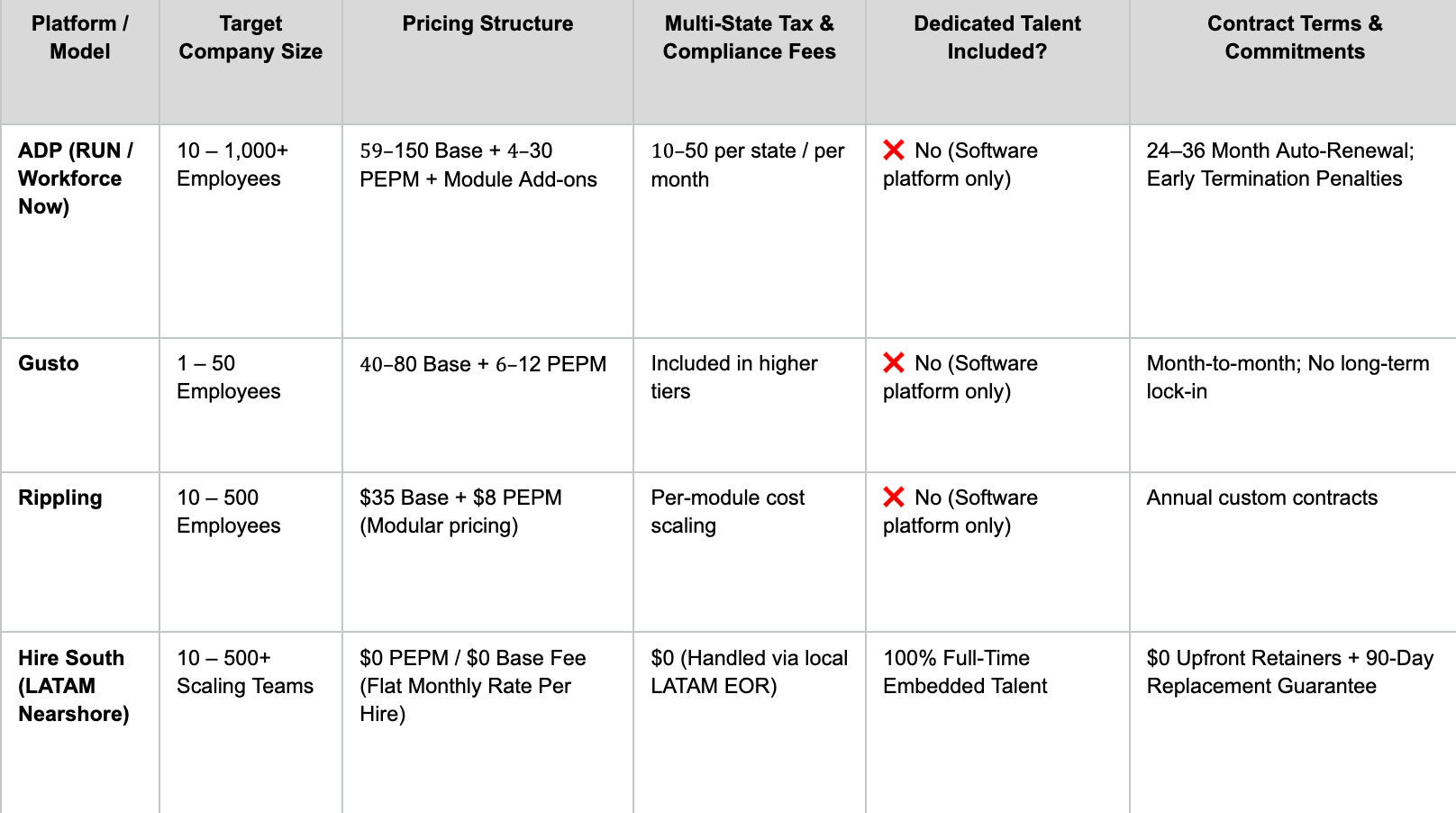
2026 Payroll & Staffing Platform Comparison: ADP vs. Competitors
To audit whether legacy enterprise software aligns with your operational goals, evaluate how ADP compares against modern domestic software and dedicated nearshore staffing models:
Frequently Asked Questions (FAQs)
Does ADP charge per employee or per payroll run?
ADP typically charges a flat monthly base platform fee combined with a Per-Employee-Per-Month (PEPM) fee. However, off-cycle payroll runs for off-schedule bonuses or immediate terminations routinely incur additional per-run processing fees ranging from $50 to $150.
What is an Employer of Record (EOR) and how does it bypass domestic payroll software?
An Employer of Record legally employs workers on your behalf in a foreign country, handling all local international payroll, taxes, and labor compliance. Because the staffing partner invoices your US entity as a B2B vendor expense, you completely bypass US payroll taxes, W-2 processing, and domestic software PEPM fees.
Are Latin American nearshore contractors subject to US payroll taxes?
No. When you utilize a nearshore staffing partner like Hire South, the talent is legally compliant within their home country. Your organization is not responsible for US payroll taxes, Medicare contributions, or domestic workers' compensation fees, drastically reducing your total labor overhead.
Can you negotiate legacy payroll implementation fees?
Yes. High-margin setup and data migration fees, which often run into the thousands of dollars, are frequently negotiable. Executives can often secure significant reductions or complete waivers by demanding line-item transparency and negotiating during the vendor's end-of-quarter sales cycles.
How does nearshoring eliminate software seat fees?
When you source talent through a dedicated nearshore staffing partner, that agency acts as the legal employer of record (EOR) in the candidate's home country. Because you are engaging them through a B2B service agreement rather than adding them to your domestic US payroll, you pay zero PEPM software seat fees, zero domestic payroll taxes, and zero W-2 processing charges.
What is the financial risk of hiring nearshore talent?
When working with a premium partner, the financial risk is nonexistent. Firms like Hire South operate with zero upfront retainers, meaning you only pay when you make a successful hire. Furthermore, every placement is backed by a 90-day replacement guarantee, ensuring your operational continuity is completely protected.
Stop Overpaying for Domestic Overhead - Hire South Instead
Transitioning from legacy domestic software to an agile global workforce requires strategic financial modeling. By auditing your total labor overhead, you can redirect bloated payroll software budgets into securing top-tier international talent.
Scaling a business in 2026 demands absolute capital efficiency. You can no longer afford to pay non-refundable agency retainers or absorb compounding domestic software fees for average talent. It is time to explore the definitive, risk-free nearshore alternative that keeps your team aligned and your budget intact.
Ready to build your team without the legacy overhead? Book a Free Discovery Call to review your hiring strategy and receive a custom candidate shortlist within 48 hours.