


If you’re looking for a tech ecosystem that combines Silicon Valley ambition with a relentless "get-it-done" attitude, you’ve arrived at the right place. Argentina isn't just about steak and football anymore; it has quietly become the backbone of the global nearshore market.
You might be surprised by the scale of what’s happening here. Despite navigating a complex economic landscape, the IT sector in Argentina is hitting its stride with a projected market size of $9.24 billion in 2026, according to Data Insights Market. That’s a massive leap that proves this region is more than just a cost-saving nearshore destination, it’s a center for high-end engineering and AI innovation.
In this guide, we’re going to pull back the curtain on Argentina's technology sector. You’ll discover why the talent pool is top-tier, which cities are outperforming expectations, and how new laws are making it easier for you to invest or hire LATAM professionals. Whether you’re a CEO looking to scale or a project manager seeking elite developers, consider this your roadmap to the Southern Cone's digital powerhouse.
A Quick Overview of Argentina’s Technology Sector
When you look at the IT sector in Argentina, you aren’t just looking at a regional player; you are looking at one of the top three technology exporters in Latin America. Despite its roller-coaster economic history, the country has successfully pivoted into a "knowledge-exporting" powerhouse. This resilience has made it a favorite for global firms seeking high-end software development without the time-zone friction of Eastern Europe or Asia.
Market Size and Economic Impact:
The scale of this industry might surprise you. As of early 2026, the Argentina ICT market is expected to reach a valuation of approximately $23.52 billion, according to Mordor Intelligence. This growth isn't a fluke. It is the result of a consistent 14.29% compound annual growth rate (CAGR) projected through 2031.
You’ll find that the sector's contribution to the national GDP is increasingly vital. Knowledge-based services (KBS) have become the country’s third-largest export category. In 2025 alone, exports of these services exceeded $9.6 billion, according to Argencon and CESSI. For a professional looking to partner with Argentine firms, this data signals a mature, stable industry that knows how to deliver value even when local currency markets are volatile.
A Hub for Global Innovation:
Argentina has a knack for producing "Unicorns", startups valued at over $1 billion. You likely already know names like Mercado Libre, Globant, and Ualá. These aren't outliers; they are the result of an ecosystem that currently supports over 340 fintech firms and a growing pool of roughly 12,000 AI-specific jobs, according to recent industry reports from Finnovista and the Buenos Aires Herald.
Why the Sector is Resilient:
Why does the industry keep growing? It comes down to a few key factors you should keep in mind:
- Talent Density: Argentina consistently ranks as a leader in English proficiency and technical education in Latin America.
- Infrastructure: Internet penetration has reached 90.6% of the population, according to Kepios, with median fixed download speeds hovering around 99.62 Mbps.
- Strategic Time Zone: If you are based in New York or Chicago, your workday overlaps almost perfectly with teams in Buenos Aires or Córdoba.
While the local economy faces challenges like inflation, the tech sector operates largely in a "parallel reality" fueled by US dollars and global demand. This decoupling means that when you hire or invest here, you are tapping into a workforce that is highly motivated to maintain international standards of excellence.
The Key Tech Hubs Rising in Argentina
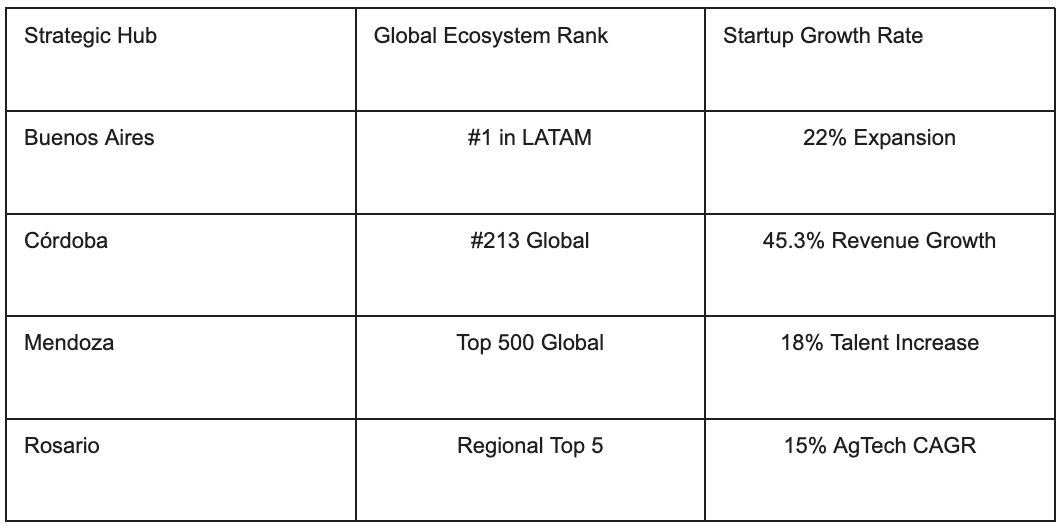
While Buenos Aires often steals the spotlight, the IT sector in Argentina is actually a decentralized network of innovation. You will find that talent is distributed across several key metropolitan areas, each offering a specific flavor of expertise. These hubs aren't just secondary locations; they are independent engines of growth that provide unique advantages in terms of cost and specialization.
1. Buenos Aires:
If you are looking for sheer volume, the capital is your starting point. Buenos Aires accounts for nearly 85% of the tech hub activity in Argentina, according to the International Telecommunication Union (ITU). The city is home to over 1,200 tech companies and is the birthplace of the country's most famous "unicorns," including Mercado Libre and Globant.
You’ll find a high concentration of talent here, particularly in the Technological District (Distrito Tecnológico) in the Parque Patricios neighborhood. This area was specifically designed to cluster software firms, providing them with tax incentives and proximity to top-tier universities like the University of Buenos Aires (UBA).
2. Córdoba:
Often called the second-most important tech ecosystem in the country, Córdoba has moved up 13 spots in the global rankings to reach #213 worldwide, according to the StartupBlink Ecosystem Index 2026. This city is a powerhouse for Software Factories, Healthtech, and Edtech.
What makes Córdoba different for you?
- A Young Workforce: It is home to the National University of Córdoba, one of the oldest and most prestigious in the region.
- Institutional Support: The Córdoba Technology Cluster (CTC) was the first privately led tech organization in the country, fostering a highly collaborative environment.
- High Growth: Nearly 45.3% of startups in Córdoba grew their revenue by more than 20% year-over-year in 2025, according to the Córdoba Startup Monitor.
3. Mendoza and Rosario:
Beyond the top two, you should keep an eye on Mendoza and Rosario. Mendoza has pivoted from being a wine capital to a thriving hub for Cloud Computing and AI. Because of its proximity to Chile, it serves as a strategic bridge for companies looking to expand across the Andes.
Rosario, on the other hand, is the heartbeat of Argentina’s AgTech sector. Located in the core of the country's agricultural belt, Rosario leverages its engineering talent to build custom software for the global food supply chain. According to local government data, the city is the third-largest provincial economy, contributing significantly to the national GDP through its diversified industrial and third-sector development.
Emerging Players: La Plata and Mar del Plata
You shouldn't overlook smaller, "boutique" hubs like La Plata and Mar del Plata.
- La Plata: Located near the capital, it focuses heavily on Cybersecurity and Automation, drawing from the National University of La Plata.
- Mar del Plata: Traditionally a coastal city, it has developed a growing community of remote-first developers and small software firms that offer some of the most competitive rates in the country.
All The Competitive Advantages of Argentinian Tech Talent
The secret to why the IT sector in Argentina has become a global favorite isn't just about price. It is about a specific combination of cultural alignment, linguistic fluency, and high-level technical expertise that is difficult to replicate in other outsourcing hubs. When you hire here, you are tapping into a workforce that consistently ranks at the top of international skill benchmarks.
1. Regional Leadership in English Proficiency
Communication is often the biggest hurdle in remote collaboration, but Argentina has largely removed that barrier. You will find that the country consistently holds the title for the best English skills in Latin America.
According to the 2025 EF English Proficiency Index, Argentina ranks #26 globally with a score of 575 points. This puts the country well ahead of its regional peers and even ahead of several European nations. For you, this means smoother stand-ups, fewer misunderstandings in documentation, and developers who can participate directly in stakeholder meetings without a translator.
2. High-Density Technical Skill Sets
The technical quality of the talent pool is remarkably high, driven by a tradition of strong public and private education. Argentina doesn't just produce "coders"; it produces software engineers who understand architecture and problem-solving.
According to the 2025 Coursera Global Skills Report, Argentina achieved a 100% skill index in the Technology category, earning the top position globally. The report classifies Argentine talent as "Cutting-Edge," a distinction it shares with countries like Switzerland and Germany. You are essentially accessing a talent pool that is statistically peerless in the Americas for technical proficiency.
3. Strategic Time Zone Overlap (GMT-3)
One of the most practical advantages for North American businesses is the clock. Argentina operates on GMT-3, which provides a near-perfect overlap with the U.S. East Coast and significant crossover with Central and Pacific times.
- Real-time Collaboration: You can have daily stand-ups at 9:00 AM EST, and your Argentine team will be starting their peak productivity hours.
- Reduced "Lag": Unlike offshore teams in India or Vietnam, where a question asked at 5:00 PM might not get an answer until the next morning, an Argentine developer can respond instantly.
- Agile Compatibility: Because the workdays align, your team can follow true Agile and Scrum methodologies with continuous feedback loops.
4. A Massive and Growing Talent Pool
The sheer volume of professionals ensures that you can scale teams quickly without sacrificing quality. As of early 2026, the country is home to over 150,000 IT specialists, according to data from CESSI. This growth is sustained by a pipeline of approximately 27,000 STEM graduates entering the market annually.
5. Cultural Synergy and Work Ethic
You’ll notice that Argentine developers tend to have a "proactive" work style. The culture emphasizes critical thinking and creative problem-solving, often referred to locally as rebusque—the ability to find innovative solutions under pressure. This cultural alignment with Western business values makes the integration process significantly faster than with teams from more hierarchical corporate cultures.
The Key Market Trends For The Argentinian Technology Sector in 2026
The landscape of Argentina’s technology sector is shifting rapidly as you enter 2026. The industry has moved past being a simple "cost-savings" destination and has matured into a strategic hub for high-complexity engineering. If you are monitoring this market, you’ll notice that several specific subsectors are currently outperforming regional averages, driven by a unique mix of high-speed digital adoption and a workforce that is inherently "AI-ready."
The Surge of Native AI and Generative Models.
You are seeing a massive pivot toward Artificial Intelligence across the board. In 2026, AI is no longer a peripheral experiment but a core business driver. According to a recent report by TrueBridge for Forbes, 20 out of the 25 Argentine companies identified with "unicorn potential" for 2026 are developing projects centered on AI.
Furthermore, the integration of AI within established sectors is deep. According to the Argentine Fintech Chamber, as of early 2026, roughly 79% of local fintech firms have already implemented AI solutions, with another 19% in the immediate pipeline. You will find that "Generative AI" leads the charge, accounting for 27% of these implementations, followed closely by Machine Learning at 23%.
Fintech 2.0: Consolidation and Crypto Adoption.
The IT sector in Argentina remains a global leader in financial technology. While other markets are cooling, Argentina’s fintech ecosystem is projected to grow by 35% through 2026, according to Radio Nacional and industry surveys.
You should keep an eye on these specific fintech shifts:
- Tokenization of Real-World Assets (RWA): There is a growing trend of using blockchain to digitize agricultural land and energy credits.
- B2B Dominance: More than half of the country’s 1,027 active fintech firms now focus on B2B models, helping other businesses automate their financial stacks.
- Profitability: Unlike the "growth at all costs" era, roughly 80% of these firms are now self-financed and have reached financial break-even, according to the Chamber's latest relevamiento.
The Infrastructure Boom: 5G and Data Centers.
Connectivity is the backbone of any tech hub, and Argentina is currently undergoing a massive hardware refresh. According to Mordor Intelligence, the Argentina ICT market is expected to jump from $20.58 billion in 2025 to $23.52 billion in 2026. This is largely fueled by the aggressive rollout of 5G infrastructure in major corridors like Buenos Aires and Córdoba.
Additionally, the demand for local processing power is skyrocketing. The Argentina data center market is on a trajectory to reach $2.59 billion by 2034, with 2026 serving as a critical year for new "green" data center groundbreakings. According to IMARC Group, this demand is being driven by the rapid shift to cloud computing, which is growing at a compound annual rate of nearly 9%.
Knowledge-Based Services as a Primary Export.
You should view Argentina as a "service export" engine. According to the data from Argencon and CESSI, exports of knowledge-based services exceeded $9.6 billion in the most recent annual cycle (ending June 2025). This represents a 20.6% year-over-year increase.
- Main Destination: The United States remains the top buyer, accounting for nearly 47% of all software exports.
- Talent Growth: The sector now employs over 150,000 professionals, making it the second-largest generator of new jobs in the country after the agricultural sector, according to CESSI.
The "Green ICT" and Sustainable Tech Movement.
A newer trend for you to watch is the rise of sustainable technology. Argentine firms are increasingly being required to meet international "Green ICT" procurement mandates. Projects like the "Inversor Verde" platform, a joint venture between CONICET and UNSAM, are now providing data to guide sustainable investments in the country's northern regions. This shift is positioning Argentine firms as ideal partners for EU and US companies with strict ESG (Environmental, Social, and Governance) requirements.
Ready to Hire Remote Talent in Argentina?
Building a cross-border team is a competitive necessity as the IT sector in Argentina moves toward a billion-dollar valuation in 2026. You have seen the data: world-leading English proficiency and a 100% technical skill index on global benchmarks.
At Hire South, we turn these statistics into your operational reality by navigating local nuances, from the Knowledge Economy Law to specific salary expectations in hubs like Córdoba and Buenos Aires. Our services remove the friction from your expansion by providing pre-vetted talent and handling all payroll, benefits, and legal compliance. We focus on rapid scaling, typically presenting high-quality candidates within days. If you are ready to start your staffing journey in Argentina or any Latin American country, make sure to schedule a free consultation!