


You already know hiring is changing faster than we could’ve predicted. Degrees and job titles no longer tell you who can actually do the work; skills do. But how do you ensure you find the right people then, especially when hiring nearshore talent?
That’s why skills-first hiring puts proven capabilities ahead of credentials, and it’s reshaping how global teams are built. According to LinkedIn data, the use of skills-based searches has grown by more than 60 percent since 2020, as companies look for faster, more accurate ways to identify qualified talent.
In this article, you’ll learn what skills-first hiring really means, why it’s gaining traction worldwide, and how it applies specifically to LATAM talent. You’ll see how to implement a skills-first hiring model step by step, which skills matter most, and how to avoid common mistakes when putting skills first. If you’re focused on building high-performing teams in Latin America, this guide shows how to do it with clarity and confidence.
What Is Skills-First Hiring
Skills-first hiring is a hiring approach where you evaluate candidates primarily on their proven skills, practical abilities, and job-ready competencies rather than degrees, job titles, or years of experience. The focus is on what someone can do today, not where they studied or how linear their career path looks on paper. This model relies on evidence. That proof may come from skills assessments, work samples, structured interviews, or real-world simulations tied directly to the role.
How Skills-First Hiring Differs From Traditional Hiring:
Traditional hiring filters candidates early based on credentials such as college degrees or brand-name employers. Skills-first hiring flips that logic. Credentials become optional signals, not gatekeepers.
Research from Harvard Business School shows that degree-based hiring screens out up to 70 percent of skilled workers, particularly those from nontraditional or international backgrounds. Skills-first hiring reduces that exclusion by widening the qualified talent pool without lowering performance standards.
What Counts as a Skill in Skills-First Hiring:
In a skills-first model, a skill is something that can be demonstrated, measured, or validated. This includes technical skills such as programming, data analysis, or accounting, as well as applied capabilities like problem-solving, communication, and process execution.
The key distinction is relevance. Only skills that directly impact job performance matter. Nice-to-have qualifications carry less weight than proven ability to deliver outcomes.
How Skills-First Hiring Is Applied in Practice:
In practice, skills-first hiring starts with rewriting job requirements around outcomes and capabilities. Screening focuses on skills signals such as assessments or portfolio work. Interviews are structured to test how candidates apply their skills in realistic scenarios.
The result is a hiring process that is more objective, easier to scale across regions, and better suited for evaluating global talent markets like LATAM, where skills and experience often matter more than formal credentials.
Why Skills-First Hiring Is Gaining Employer Trust:
Employer confidence in skills-first hiring is backed by performance data. IBM reports that employees hired for skills rather than degrees perform just as well, and often stay longer, than traditionally hired peers.
That combination of performance parity and expanded access to talent explains why more companies are putting skills first as a long-term hiring strategy, not a short-term experiment.
Skills-First Hiring Advantages
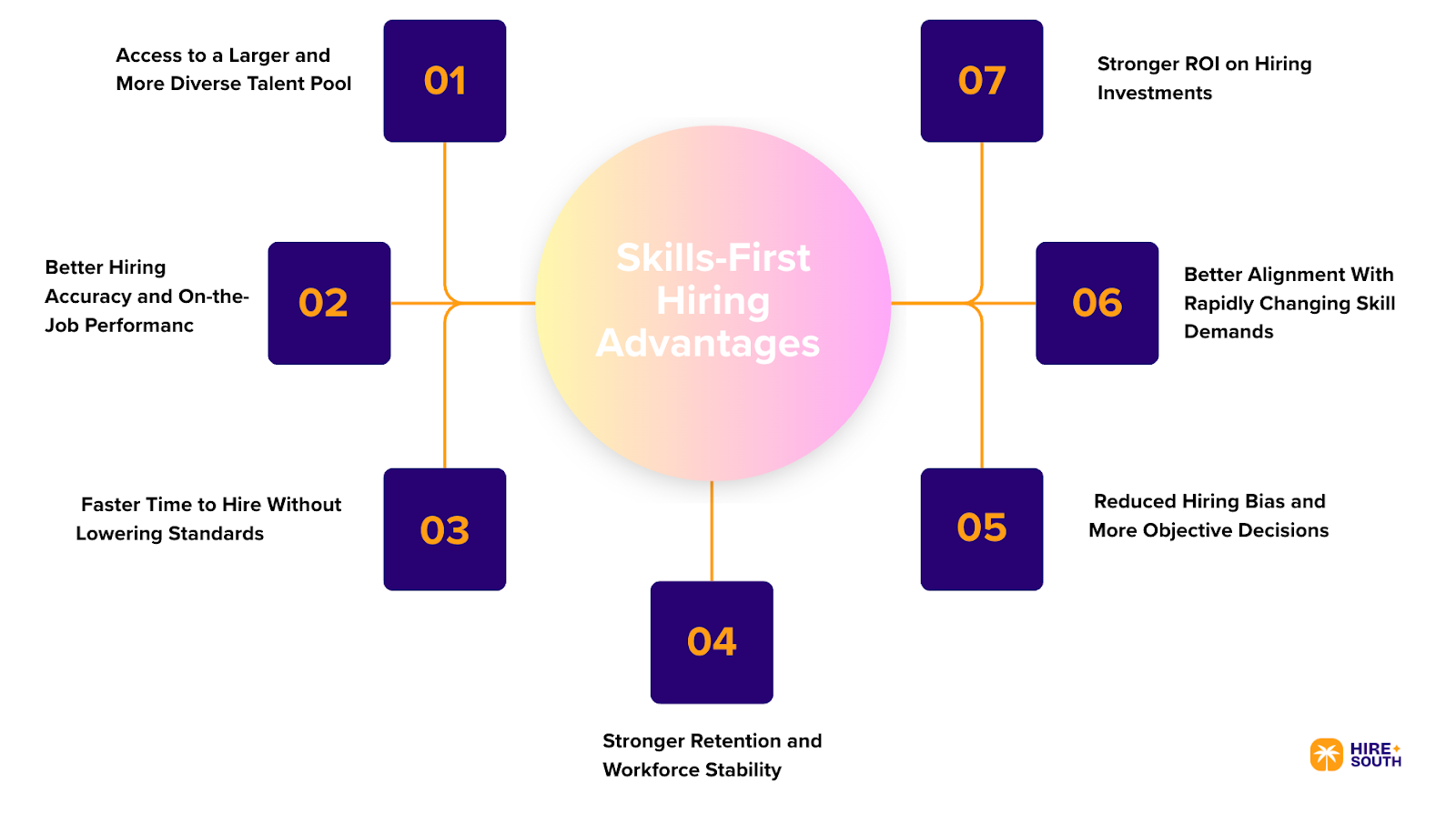
1. Access to a Larger and More Diverse Talent Pool
Skills-first hiring removes unnecessary barriers such as degree requirements or rigid career paths. That immediately expands your reach to candidates who have the right capabilities but were previously filtered out.
Harvard Business School research shows that degree requirements exclude more than two-thirds of qualified candidates for many middle-skill and high-skill roles, particularly in international markets. By focusing on skills, you unlock talent that traditional hiring models overlook.
2. Better Hiring Accuracy and On-the-Job Performance
When hiring decisions are based on demonstrated skills, performance becomes easier to predict. You are evaluating how candidates solve problems, apply knowledge, and execute tasks that mirror real work.
LinkedIn’s Global Talent Trends report found that 75 percent of recruiters believe skills-based hiring improves the quality of hires, and companies using skills data report higher confidence in candidate-job fit. That translates into fewer mis-hires and stronger early performance.
3. Faster Time to Hire Without Lowering Standards
Skills-first hiring simplifies screening. Instead of filtering through proxies like degrees or employer brand names, you focus on a smaller set of role-critical skills.
According to more LinkedIn data, companies that adopt skills-based hiring are more likely to fill roles faster because assessment criteria are clearer and easier to standardize. Speed improves without sacrificing quality, which is critical in competitive hiring markets.
4. Stronger Retention and Workforce Stability
Hiring for skills increases alignment between the role and the employee’s actual capabilities. That alignment reduces early frustration and burnout.
IBM reports that employees hired based on skills rather than credentials show similar or better retention rates compared to traditional hires. When people are placed in roles they are equipped to handle, they tend to stay longer and perform more consistently.
5. Reduced Hiring Bias and More Objective Decisions
Skills-first hiring shifts the focus from background signals to measurable ability. That reduces unconscious bias linked to education, geography, or career gaps.
Structured skills assessments and standardized interview criteria create a more consistent evaluation process. This improves fairness while also making hiring decisions easier to defend and replicate across teams.
6. Better Alignment With Rapidly Changing Skill Demands
Roles evolve faster than job titles or degree programs. Skills-first hiring allows you to adapt as requirements change.
McKinsey research shows that nearly 40 percent of core skills are expected to change within the next five years. A skills-based approach makes it easier to update hiring criteria in real time, without rewriting entire role frameworks.
7. Stronger ROI on Hiring Investments
Hiring based on skills improves outcomes across the full employee lifecycle. You spend less time rehiring, less money correcting bad fits, and fewer resources onboarding people who struggle to meet expectations.
By tying hiring decisions directly to performance-driving skills, you increase the return on every hire while building teams that are better prepared for long-term growth.
Tools and Frameworks That Support Skills-First Hiring
1. Skills Taxonomies and Skills Mapping Frameworks
Skills-first hiring starts with a shared language for skills. Skills taxonomies define which capabilities matter for specific roles and how they relate to each other.
Frameworks such as the World Economic Forum’s global skills taxonomy help organizations standardize skill definitions across teams and regions. This reduces ambiguity and makes skills easier to assess, compare, and track over time, especially in distributed hiring environments.
2. Competency-Based Job Architecture
Competency-based frameworks translate roles into clear, skill-driven requirements. Instead of listing credentials, roles are built around core, supporting, and emerging skills tied directly to outcomes.
According to SHRM, organizations that use competency-based frameworks report better alignment between hiring criteria and job performance, which improves consistency across hiring managers and geographies.
3. Skills Assessments and Work Sample Testing
Validated skills assessments are a cornerstone of skills-first hiring. These tools measure how candidates apply their knowledge in real or simulated work scenarios.
Research published in the Journal of Applied Psychology shows that work sample tests are among the strongest predictors of job performance, outperforming unstructured interviews and resume screening. This makes them a high-confidence signal when evaluating skills objectively.
4. Structured Interviews and Skills-Based Evaluation Rubrics
Structured interviews reduce subjectivity by asking all candidates the same skill-focused questions and scoring responses against predefined criteria.
Google’s internal hiring research has shown that structured interviews significantly improve hiring quality and decision consistency compared to informal interviews. When paired with evaluation rubrics, they create a repeatable and defensible hiring process.
5. Skills, Intelligence, and Labor Market Analytics Tools
Skills intelligence platforms analyze labor market data to identify in-demand skills, emerging capabilities, and regional talent availability.
LinkedIn Economic Graph data shows that skills data helps employers adapt faster to changing role requirements. Using these insights allows you to update hiring criteria based on real market signals rather than outdated job profiles.
6. Learning and Skills Validation Platforms
Continuous skills validation matters after hiring as well. Learning platforms that track skill acquisition and proficiency levels support long-term workforce planning.
According to Deloitte, organizations that connect hiring data with learning and development systems are better positioned to close skills gaps internally, reducing reliance on constant external hiring.
7. ATS and HR Systems With Skills-Based Capabilities
Modern applicant tracking systems increasingly support skills tagging, skills-based filtering, and assessment integration.
These systems allow you to search, compare, and shortlist candidates based on verified skills rather than resumes alone. This improves transparency, supports compliance, and makes skills-first hiring easier to scale across multiple roles and regions.
Core Skills Employers Should Prioritize When Hiring in LATAM
Role-Specific Technical Skills.
Technical proficiency should map directly to the work you need done. For software and IT roles, that means validated experience with relevant programming languages, frameworks, cloud platforms, or data tools. For non-technical roles, it may include financial modeling, CRM management, QA processes, or operational analytics.
Skills verification matters. Work samples and practical tests are more reliable than resumes, especially across different education systems in Latin America.
English Proficiency and Business Communication Skills.
English fluency is a practical requirement for many global teams. LATAM talent performs well in this area, particularly in countries with strong bilingual education systems.
According to the EF English Proficiency Index, Argentina and Chile consistently rank among the highest English-proficiency countries in Latin America. Clear written and spoken communication reduces friction in meetings, documentation, and cross-functional collaboration.
Remote Collaboration and Digital Work Skills.
Most LATAM hires work with distributed teams. You should prioritize candidates who already know how to operate in remote environments.
This includes experience with collaboration tools, asynchronous communication, task management platforms, and basic cybersecurity hygiene. GitLab’s Remote Work Report shows that teams with strong async and documentation skills move faster and make fewer errors, regardless of location.
Problem-Solving and Applied Critical Thinking.
Problem-solving skills often differentiate high performers from average ones. This is especially important when working across borders, where ambiguity is common and real-time supervision is limited.
The World Economic Forum consistently ranks analytical thinking and problem-solving among the top core skills employers need. In LATAM markets, candidates who can independently troubleshoot and adapt tend to perform better in fast-growing companies.
Time Management and Accountability Skills.
Working across time zones requires strong self-management. LATAM’s time zone overlap with North America is an advantage, but it only pays off if professionals manage priorities effectively.
Look for evidence of deadline ownership, workload planning, and experience working with minimal oversight. These skills directly affect delivery speed and reliability.
Cultural Awareness and Cross-Border Team Skills.
Successful LATAM hires understand how to work within global business norms while maintaining local context. This includes adaptability, feedback openness, and awareness of cultural differences in decision-making and communication styles.
According to McKinsey research, teams with strong cross-cultural collaboration skills are more likely to outperform peers on productivity and execution, especially in international setups.
Data Security and Compliance Awareness.
As remote work expands, basic data protection skills are no longer optional. Candidates should understand secure access practices, confidentiality standards, and compliance expectations tied to their role.
This is particularly relevant for roles handling customer data, financial information, or proprietary systems. Prioritizing this skill reduces operational and legal risk from day one.
Learning Agility and Skills Adaptability.
LATAM talent markets evolve quickly. Skills that matter today may change within a year.
McKinsey reports that nearly 40 percent of job-related skills are expected to shift by 2030. Candidates who demonstrate learning agility, upskilling habits, and openness to change are better long-term hires in skills-first models.
Ready to Hire LATAM Talent? We Can Help You Find Your Next Team!
At the end of the day, skills-first hiring works because it aligns hiring decisions with real performance, not assumptions. When skills are clearly defined and properly assessed, teams scale faster, hiring risk drops, and talent quality becomes easier to measure across regions. Plus, with more than 60% of employers globally now prioritizing skills over degrees, companies that operationalize this shift early gain a measurable edge against industry competitors.
At Hire South, we help companies apply skills-first hiring to LATAM talent in a structured, transparent way. Our team builds skill-based role profiles, validates candidates through practical assessments, and supports compliant hiring across multiple Latin American markets. Our focus is simple: connect you with LATAM professionals who can do the work from day one. If you are ready to enhance your hiring process, schedule a free consultation today!