

Finding the right talent used to mean looking in your own backyard. Today, your backyard is as big as you want it to be. If you are looking to scale your team without the headache of massive overhead or disconnected time zones, Panama’s remote talent is likely already on your radar.
This isn't just about saving a few bucks on payroll. It is about tapping into a dollarized economy with a tech-savvy workforce that operates in real-time alongside your North American HQ. Whether you are a startup founder or a seasoned HR director, hiring in the Hub of the Americas offers a unique mix of cultural alignment and professional expertise.
In this guide, you will find a breakdown of exactly how to hire remote talent in Panamá without getting tripped up by local labor laws. You will explore the legal essentials of Law 126, which serves as Panama’s framework for telework. You will also discover where to find the best bilingual pros and how to handle payroll and the mandatory 13th-month pay. Finally, we will delve into the specific cultural nuances that contribute to the long-term success of Panamanian teams.
The shift is already happening. By 2027, 74% of organizations plan to permanently shift more roles to nearshore models to stay competitive, according to Gartner. Ready to see why remote talent hiring in Panamá is becoming the go-to move for smart businesses? Let’s dive into the details!
Why You Should Hire Remote Talent in Panamá
Hiring in Central America often brings to mind cost savings, but the reality of the Panamanian market is much more sophisticated. You aren't just looking for lower overhead; you are looking for a strategic bridge between North and South American business cultures. Panama has positioned itself as a premier destination for distributed teams because it offers a rare combination of financial stability, infrastructure, and a workforce that understands global standards.
Strategic Time Zone Alignment for Real-Time Collaboration:
One of the most immediate benefits you will notice is the lack of "scheduling gymnastics." Panama operates on Eastern Standard Time (EST) nearly year-round, as the country does not observe Daylight Saving Time. This means your team in New York or Toronto can jump on a Zoom call with their Panamanian colleagues at 10:00 AM without anyone waking up at dawn or staying late.
Seamless communication is the backbone of remote success. When your developers and project managers work the same hours as your home office, you eliminate the 24-hour delay common with offshore teams in Asia or Eastern Europe. This synchronous workflow is a major reason why roughly 45% of U.S. companies now prioritize Latin America for their nearshoring needs, according to Rise.
A Dollarized Economy That Simplifies Your Payroll:
Managing international currency fluctuations can be a nightmare for your accounting department. Fortunately, Panama has used the U.S. Dollar as its legal tender (alongside the Balboa) for over a century. This provides a level of fiscal transparency and stability that is virtually unmatched in the region.
When you negotiate a salary, you are dealing in a currency you already know. You don't have to worry about sudden inflation spikes devaluing your employee’s take-home pay or complicating your budget mid-quarter. This "territorial tax logic" and dollar-based environment make Panama a regional business hub that attracts over $2 billion in foreign direct investment annually, according to the U.S. Department of State.
Access to a High-Quality, Multilingual Talent Pool:
You will find that Panama’s workforce is highly educated and increasingly bilingual, particularly within the urban centers like Panama City. The country’s commitment to digital transformation has created an edge in finding talent for technology, customer success, and financial services.
Education and innovation are high priorities here. In fact, Panama has shown steady progress in global innovation sub-indices, ranking 58th for infrastructure and 64th for creative outputs, according to the World Intellectual Property Organization. Whether you need a software engineer familiar with modern tech stacks or a bilingual marketing specialist, the local talent pool is built for modern, international work.
High Productivity and Retention Rates:
Remote work isn't just a trend in Panama; it is a structural transformation that workers actively seek out. Data shows that remote professionals often see a 13% increase in productivity compared to their in-office counterparts, according to Virtual Latinos.
By offering remote roles in Panama, you are positioning your company as a preferred employer. Around 59% of remote workers are more likely to stay with an employer that provides location flexibility, according to Gallup. For you, this translates to lower turnover costs and a more dedicated, long-term team that grows alongside your business.
Panamá’s Talent Landscape
A Specialized Workforce Rooted in Global Services.
Panama's economy is roughly 75% service-based, which has created a natural pipeline of professionals experienced in international standards. You will find a high concentration of talent in sectors like banking, logistics, and telecommunications. This background is invaluable for remote roles because these workers are already accustomed to the rigor and compliance requirements of multinational operations.
By 2026, Panama’s labor force is projected to remain a vital engine for regional growth, with over 2.2 million people actively participating in the production of goods and services, according to the World Bank. This provides you with a significant pool of candidates who understand how to navigate complex, cross-border business environments.
The Surge of Technical and Digital Proficiency.
The "digital-first" mindset has firmly established itself in the local market. You can now easily source Panamanian talent for high-demand roles like software engineering, data analysis, and digital marketing. Local universities, such as the Technological University of Panama (UTP), are churning out graduates with specialized knowledge in modern tech stacks, including Python, SQL, and AWS.
The availability of specialized technical talent is no longer a bottleneck. In fact, approximately 87% of millennials in the workforce consider career development and acquiring new digital skills a top priority, according to Intuition. This means when you hire in Panama, you are likely engaging with a professional who is actively pursuing the latest certifications and methodologies.
Language and Cultural Fluency.
English proficiency is a major differentiator in the urban centers. While Spanish is the official language, the influence of the Panama Canal and the presence of hundreds of multinational headquarters have made English the "lingua franca" of business in Panama City. You will find that many professionals are not just bilingual but are culturally attuned to North American and European business etiquette.
This cultural bridge reduces the "onboarding friction" often found in other offshore locations. American English teachers and bilingual programs are highly sought-after in the country, ensuring a steady stream of communication-ready professionals for customer success and project management roles, according to The TEFL Academy.
High Retention and Remote-Capable Talent.
Panama’s talent pool isn't just skilled; it is loyal. Because remote work allows local professionals to earn competitive wages while maintaining a high quality of life in their home country, retention rates tend to be higher than in saturated markets like the U.S. or India.
The data backs this up: remote workers globally are 13% more likely to stay in their current roles compared to their on-site counterparts, according to Stanford SIEPR. In Panama, where the "new normal" has stabilized at roughly 1.25 remote days per week for local firms, offering a 100% remote position makes your company an extremely attractive employer of choice.
Main Options To Hire Remote Talent in Panamá
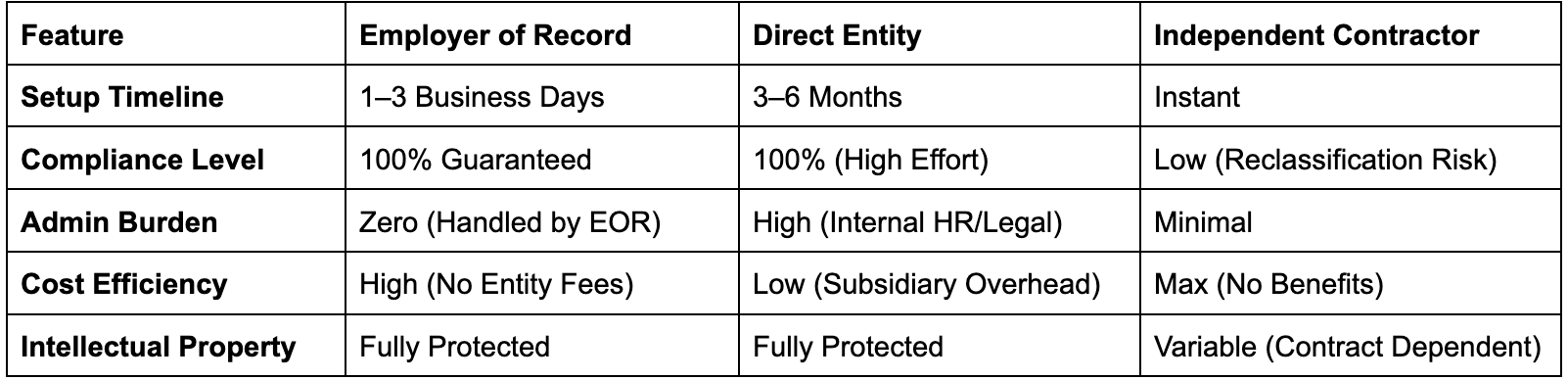
Hiring across borders requires a choice between speed, control, and compliance. When you look at Panamá's remote talent, you aren't just choosing a person; you are choosing a legal structure. Each path has distinct implications for your tax liability and your relationship with the worker.
1. Engaging Independent Contractors for Maximum Flexibility
If you have a short-term project or need a specific deliverable, hiring an independent contractor is the fastest route. You avoid the complexities of the Panamanian Labor Code because the relationship is commercial rather than an employment one. You simply pay a flat fee for services rendered, and the contractor handles their own taxes and social security.
However, you must be cautious of "misclassification." If a contractor works set hours, uses your equipment, and follows your direct supervision, Panamanian authorities may reclassify them as a full employee. This could leave you liable for back-dated benefits and social security contributions, which total roughly 13.75% for employers, according to Multiplier. For a specialized software engineer, the average monthly cost for a contractor in 2026 is approximately $6,000, according to Howdy.
2. Utilizing an Employer of Record (EOR) for Compliance Without an Entity
An Employer of Record (EOR) is often the most strategic move for businesses that want full-time dedication without the cost of a local subsidiary. The EOR acts as the legal employer on paper, handling payroll, local taxes, and the mandatory 13th-month pay. You maintain the day-to-day management of the talent, while the EOR absorbs the legal risk.
This "entity-free" hiring is remarkably fast, with onboarding often taking just 1 to 3 days. While service fees apply, ranging from $200 to $700 per employee monthly, you save thousands in legal fees and local administrative costs. This model ensures you are fully compliant with Law 126, which mandates that remote workers receive the same rights as office-based staff, according to Rivermate.
3. Direct Hiring via a Local Entity
If you plan to hire a large team (typically 10+ people) or establish a long-term footprint in the region, opening a local branch or subsidiary is the traditional path. This gives you the highest level of control and direct "brand" presence in Panama. You will be responsible for registering with the Ministry of Labor (MITRADEL) and the Social Security Fund (CSS).
Keep in mind that direct employment in Panama carries a "fully-loaded" cost. Beyond the base salary, you must factor in roughly 38% in additional costs, including social security (12.25%), educational insurance (1.5%), and the 13th-month bonus (8.33%), according to Deel. This approach requires significant legal and accounting support to navigate local bureaucracy.
4. The Panama Digital Nomad Visa (Short-Stay Visa)
For workers you already employ who want to relocate to Panama, or for foreign freelancers living in the country, the Digital Nomad Visa is a powerful tool. It allows individuals to live and work in Panama for up to 18 months as long as their income (at least $36,000 annually) comes from outside the country, according to Planet Nomad.
This is an excellent option for "talent retention" if an existing team member wants to move to a tropical hub. It allows them to stay legally without requiring you to sponsor a traditional work permit or navigate the 10% foreign worker cap that applies to local Panamanian companies.
How To Hire Remote Talent in Panamá: Step-by-Step
Step 1: Define Your Legal Employment Model
Before you post a single job opening, you must decide how you will legally "own" the relationship. You essentially have three paths: setting up a local subsidiary, using an Employer of Record (EOR), or hiring independent contractors. If you choose the EOR route, you can often bypass months of bureaucratic setup.
Step 2: Source Talent Through the Right Channels
Panama City is a dense hub of bilingual professionals, but you have to know where they hang out online. While LinkedIn is the gold standard for executive and tech roles, you should also leverage local platforms and university career portals. Because roughly 87% of millennial workers in the region prioritize digital skill acquisition, according to Intuition, focusing your search on "digital-first" communities will yield higher-quality technical candidates.
Step 3: Conduct Localized Interviews and Assessments
When you move to the interview stage, remember that Panamanian labor culture values personal connection alongside technical merit. Since you are hiring remotely, video interviews are standard, but adding a localized technical assessment is highly recommended for IT roles. This stage typically takes about 8 days of your total hiring timeline, according to 2026 SHRM data.
Step 4: Draft a Compliant Written Contract
Under Panama’s Law 126, a written contract is not just a "best practice"—it is a legal requirement for telework. Your contract must be in Spanish (or dual-language) and clearly specify whether the work is "complete" or "partial" remote. You must also include the specific address where the employee will work, as this affects workplace risk insurance.
Step 5: Register with Social Security (CSS) and Tax Authorities
If you are hiring directly, you must register each new hire with the Caja de Seguro Social (CSS). This triggers your obligation to contribute 12.25% of the gross salary toward social security and 1.5% for educational insurance, according to RemoFirst. If you are using an EOR, they handle this step for you, but you should still verify that the worker is being reported at their full salary to avoid future liability.
Step 6: Set Up Your Payroll for the 13th-Month Cycle
Panama uses a unique "13th-month" bonus system. You don't pay this as a lump sum at the end of the year. Instead, you must divide one month’s salary into three equal installments paid on April 15th, August 15th, and December 15th. Managing this cycle is critical; missing these dates can lead to significant fines from labor authorities.
Step 7: Finalize Onboarding and Equipment Stipends
The final step is getting the "tools of the trade" to your new hire. Law 126 suggests that employers should cover costs related to the provision of the service, such as internet and electricity. Many companies now provide a standard monthly stipend of roughly $50 to $75 to cover these home-office utilities. Once the equipment is delivered and the contract is filed with MITRADEL, your new Panamanian team member is officially ready to start.
The Best Practices When Hiring Remote Talent In Panamá
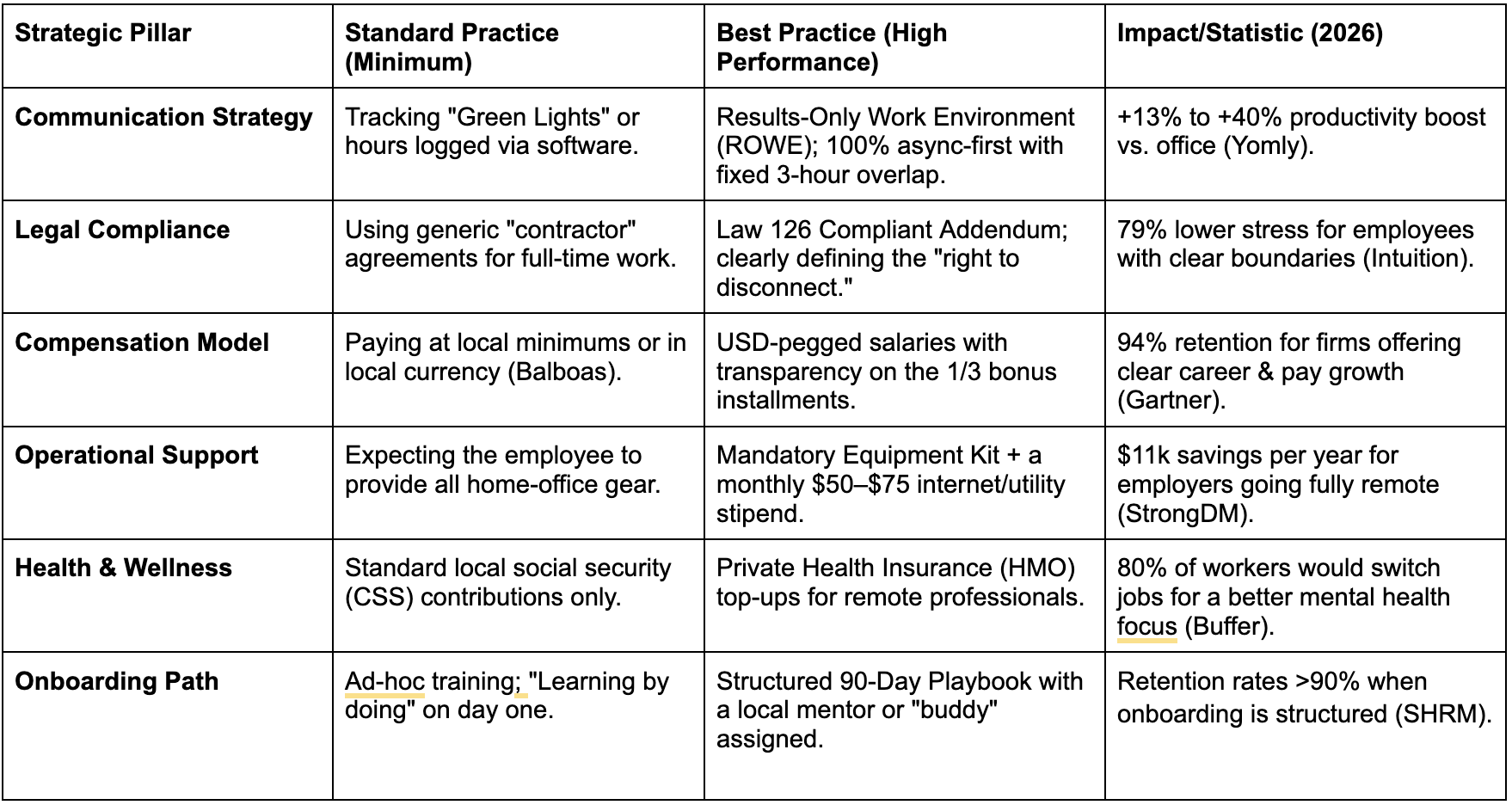
Success in the Panamanian market requires more than just a laptop and a Zoom link. Because the local workforce is highly specialized, you must blend modern remote management with respect for established Panamanian labor standards. To maximize retention and stay competitive in 2026, focus on building a relationship based on transparency and legal compliance.
1. Prioritize Clear, Outcome-Based Communication
When managing a team in Panama, you should move away from tracking "desk time" and focus on clear deliverables. Professionals here value autonomy but also appreciate structured expectations. Setting core overlapping hours, typically between 9:00 AM and 12:00 PM EST, ensures your team can collaborate in real-time without burning out.
Data shows that teams focusing on outcomes over hours see a significant jump in performance. Organizations that prioritize results-oriented cultures often report that remote workers perform 13% to 40% better than their in-office counterparts, according to Yomly.
2. Invest in the "Right to Disconnect"
Panama’s Law 126 specifically outlines the "right to disconnect," ensuring employees are not obligated to answer emails or messages outside of their agreed working hours. To foster a healthy culture, you should explicitly respect these boundaries.
Avoiding after-hours communication isn't just a legal courtesy; it is a retention strategy. Roughly 79% of remote professionals report lower stress levels when they have clear boundaries between work and home life, according to Yomly. By championing this, you reduce the risk of burnout, which is a leading cause of turnover in the tech and finance sectors.
3. Provide Comprehensive Equipment and Utility Stipends
Under local regulations, the employer is responsible for providing the tools necessary for the job. This includes not just a laptop, but often the software, security tools, and even a contribution toward increased utility costs like high-speed internet and electricity.
Rather than reimbursing every tiny receipt, many companies opt for a monthly stipend. In 2026, providing a home-office allowance is becoming the global standard to stay competitive. In fact, companies can save up to $11,000 per employee per year by going partially remote, according to StrongDM, so reinvesting a small portion of those savings into a $50–$100 monthly utility stipend is a win-win for both parties.
4. Foster Personal Connection Through "Small Talk"
Panamanian business culture is deeply rooted in personal relationships and trust. You will find that jumping straight into a meeting agenda can feel abrupt or even cold to a local professional.
A best practice is to dedicate the first five minutes of your calls to "socializing", asking about family, weekend plans, or local news. This isn't wasted time; it’s the glue that holds a remote team together. Since 97% of remote employees would recommend this work style to others, according to StrongDM, maintaining that human connection ensures your Panamanian talent feels like a valued part of the company, not just a line item on a spreadsheet.
5. Implement a Structured Feedback Loop
Remote workers in Panama appreciate knowing exactly where they stand regarding career progression. Because you aren't seeing them in the hallway every day, you need to be intentional about feedback.
Regular one-on-ones are vital. Statistics show that 60% of candidates will drop out of an interview process if a company’s remote policies or growth tracks are unclear, according to Yomly. By providing quarterly performance reviews and clear KPIs, you give your talent a roadmap for success that mirrors the stability of an in-person office.
Ready to Hire Remote Talent in Panamá?
Building a distributed team in Panama is more than a cost-saving measure; it is a strategic investment in a dollarized, high-growth economy that functions as the literal "Hub of the Americas." As the local market matures, businesses that lean into this talent pool are finding that the combination of EST time zone alignment and a 75% service-based economy creates a frictionless environment for scaling operations. With roughly 97% of remote professionals now recommending this work model for the long haul, according to Buffer, the window to secure top-tier Panamanian talent before the market tightens is wide open.
At Hire South, we specialize in bridging the gap between your ambitious growth goals and the exceptional professionals waiting in Latin America. We understand that navigating Law 126 and the complexities of the 13th-month pay can be daunting for any HR leader. Our dedicated nearshoring services handle the entire lifecycle, from vetting the top 1% of bilingual talent to managing localized payroll and compliance, so you can focus on your core mission. Whether you need a single specialized hire or a full operational team, we ensure your expansion into LATAM is seamless, compliant, and optimized for long-term success. When you are ready, please make sure to book a free consultation!
.jpg)