


Ecuador’s technology sector has long started to promote digital innovation and tech-driven growth. If you’re looking to hire remote talent in Latin America, this changes the game, adding one more play to consider as your go-to nearshoring destination.
In this guide, you’ll get a clear picture of Ecuador’s IT landscape, from its digital economy and core tech industries to the cities that are emerging as innovation hubs. You’ll also explore where the talent is, how startups are gaining traction, and the challenges companies face when scaling here.
Whether you’re considering expanding operations, hiring local tech talent, or investing in Ecuador’s digital future, this guide breaks down what matters most, with real numbers and trends to help you make informed decisions.
Let’s dive into the opportunities and dynamics shaping Ecuador’s technology sector.
Overview of Ecuador’s Technology Sector
Ecuador’s technology sector is shifting from a small, emerging market into a more structured and scalable ecosystem. This change is not just about more internet users or more apps. It’s about how businesses are digitizing operations, governments are pushing digital transformation, and local tech companies are growing beyond domestic boundaries.
The IT industry in Ecuador has been expanding steadily. The number of tech companies grew from roughly 500 in 2011 to over 3,000 by 2023, according to Accelerance, showing real entrepreneurial momentum and demand for digital solutions. This is not a one-off spike, but a clear trend of maturation and capacity-building in the market.
Market Size and Economic Footprint:
Ecuador’s ICT market has gained serious economic weight in recent years. Estimates place the ICT market value at around $4.8 billion, according to ConectNext, reflecting strong uptake of software services, cloud systems, and digital infrastructure across the economy.
Growth projections remain strong, with the sector expected to rise toward $7.7 to $7.8 billion in the late 2020s, according to Nacion Logistica. This growth is being driven by increased digital adoption among businesses and by stronger infrastructure investment.
Industry Composition and Innovation:
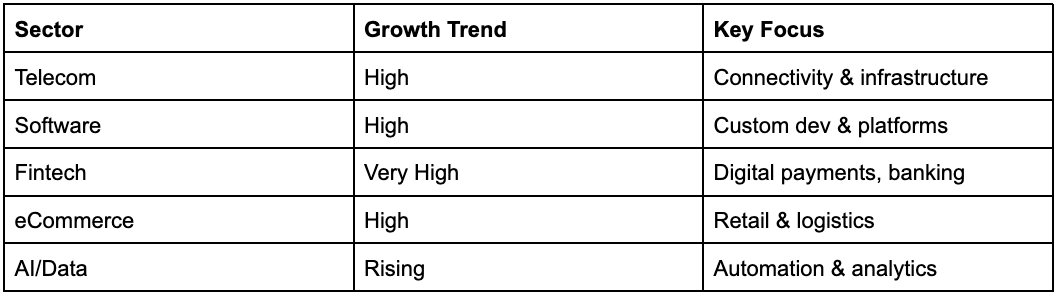
Ecuador’s tech sector is not dominated by a single segment. It includes telecommunications, software development, fintech, e-commerce, and cloud services. Telecommunications remains one of the fastest-growing areas, as broadband and mobile access expand across urban and rural regions, according to the US. Trade and Development Agency.
Fintech and digital banking are also expanding quickly. Digital payment adoption and online banking services are increasingly common among Ecuadorian consumers, especially in larger cities.
Export and Global Positioning:
Ecuador’s tech sector is beginning to reach beyond its borders. Technology and digital services exports surpassed $1.46 billion in 2024, according to El Universo, showing that Ecuadorian tech companies are becoming competitive internationally.
This growth is supported by trade agreements and an open export framework, making it easier for local tech firms to enter foreign markets. As Ecuador continues to integrate into regional digital networks, the tech sector is becoming a stronger pillar of the national economy.
The Key Tech Hubs Rising in Ecuador
Ecuador’s tech scene is not centralized in one city. Instead, it’s spreading into multiple hubs, each with its own strengths. If you’re evaluating where to find talent, build partnerships, or scale tech operations, these are the places that matter most.
1. Quito, the Main Tech Hub and Government Innovation Center
Quito is Ecuador’s largest tech hub, and it’s where most major public sector digital initiatives originate. You’ll find the highest concentration of software firms, IT consultancies, and digital service providers in the capital. This makes Quito the natural place for projects that require strong government integration or regulatory alignment.
It’s also where you’ll see the most mature talent pool. Quito’s universities and tech schools produce a steady stream of developers, engineers, and digital specialists. This concentration makes it easier to recruit teams quickly, especially for enterprise-level projects.
2. Guayaquil, the Commercial Tech Engine
Guayaquil is Ecuador’s economic powerhouse, and its tech sector reflects that. The city’s technology activity is strongly tied to commerce, logistics, fintech, and customer-focused digital services.
If your priority is business velocity and market-driven tech, Guayaquil is the hub that delivers. You’ll find a more commercial mindset among tech firms here, with a strong focus on building scalable solutions and fast deployment.
3. Cuenca, the Growing Tech and Innovation Cluster
Cuenca is emerging as a significant tech hub, especially for software development and creative tech services. Its tech community is smaller than Quito or Guayaquil, but it’s growing fast, driven by a mix of local talent and remote workers.
Cuenca’s appeal is its growing ecosystem, with a strong emphasis on digital services and smaller tech studios. If your strategy involves building a high-quality development team with lower operational pressure, Cuenca is increasingly attractive.
4. Tech Talent and University Networks Driving Growth
Across all major hubs, universities play a crucial role. Quito, Guayaquil, and Cuenca are home to Ecuador’s leading engineering and computer science programs, which feed the local talent pipeline. This means the best tech hubs in Ecuador are not just about businesses, they’re about consistent talent supply.
If you’re hiring in Ecuador, you’ll often find the strongest teams near these university clusters, where talent is continuously refreshed and updated.
Why These Hubs Matter for Business Strategy
The rise of these hubs matters because they represent different types of tech capability. Quito is stronger in institutional and enterprise-level IT. Guayaquil is more commercial and market-driven. Cuenca is becoming a talent and development hotspot. And smaller cities offer cost efficiency and niche skills.
Understanding this distribution helps you decide where to recruit, where to partner, and where to invest in Ecuador’s tech ecosystem.
All The Competitive Advantages of Ecuadorian Tech Talent
Ecuadorian tech talent is often overlooked, but there are measurable reasons why companies are now paying attention. If you’re scouting tech teams or planning hiring strategies, Ecuador’s talent pool offers advantages that can directly impact productivity, cost efficiency, and long-term scalability.
1. High Technical Skill Levels with Global Relevance
Developers and engineers in Ecuador are trained in widely used languages and modern frameworks. You’ll find strong proficiency in JavaScript, Python, Java, C#, and PHP, which align with global demand. Many local professionals also have experience with React, Node.js, .NET, and cloud platforms such as AWS and Google Cloud. This means you can integrate Ecuadorian engineers into international tech stacks without heavy retraining.
2. Cost Efficiency Compared to North American and Western European Talent
Hiring in Ecuador typically costs less than equivalent talent in the US. or Europe. Salary benchmarks from regional labor studies show that software engineers in Ecuador earn significantly lower average wages than their US. counterparts, often 40–60% less for comparable skill levels, while still delivering high-quality work. This makes Ecuador competitive for companies seeking to optimize budgets without sacrificing technical output.
3. Strong Academic Foundations and Continuous Learning
Ecuador’s universities produce a consistent flow of tech graduates every year. Engineering and computer science programs emphasize practical software development skills alongside theoretical foundations. Many professionals supplement formal education with certifications in data science, cloud architecture, cybersecurity, and modern DevOps practices. This commitment to learning means you’ll often encounter talent that is up to date with current industry practices.
4. Bilingual and Multilingual Capabilities in the Workforce
Language skills are a significant advantage when working with distributed teams. A growing portion of Ecuadorian tech professionals speak English at intermediate to advanced levels, particularly in major tech hubs like Quito and Guayaquil. This reduces communication friction and supports smoother collaboration with US., Canadian, and European clients.
5. Cultural Alignment With US. and Latin American Markets
Ecuadorian professionals often share work and communication styles that align well with both North American and Latin American business cultures. This includes an emphasis on team collaboration, responsiveness, and clear communication, which enhances project coordination across LATAM time zones.
6. Strategic Time Zone Alignment for Real-Time Collaboration
Ecuador’s time zone (GMT-5) closely matches that of the US. Eastern Time Zone for most of the year. This means you can have real-time overlap with teams in New York, Miami, and Toronto, enabling live communication and faster decision-making compared with teams based in far-off time zones.
7. Adaptability and Remote Work Readiness
Ecuadorian tech professionals adapted quickly to remote and hybrid work models following global shifts in work patterns. Many are experienced in remote collaboration tools like Git, Jira, Slack, Zoom, and Teams, making onboarding smoother and reducing ramp-up time.
8. Growing Local Tech Community and Knowledge Sharing
The tech community in Ecuador is increasingly active. Meetups, coding groups, and developer workshops are spreading in cities like Quito, Guayaquil, and Cuenca. This ecosystem encourages peer learning, upskilling, and cross-pollination of ideas, which benefits companies that tap into local networks for talent and innovation.
9. Lower Operational Costs Without Quality Trade-Offs
Beyond salaries, operational expenses like office space, benefits, and local overhead are generally lower in Ecuador compared with major tech markets. You can often allocate more of your budget toward innovation instead of fixed costs, enhancing your project’s cost structure without compromising quality.
10. Increasing Participation in International Projects
More Ecuadorian professionals are working on offshore and global projects. Their exposure to international standards, agile methodologies, and cross-border workflows strengthens their ability to integrate into distributed teams and meet global expectations.
The Key Market Trends For The Ecuadorian Technology Sector in 2026
1. Faster Digital Adoption Across the Economy
Ecuador’s digital economy is expanding quickly, driven by increasing internet access and mobile usage. Internet penetration reached 83.7% in 2026, according to DataReportal, showing the market is ready for broader digital services and online-first business models.
This creates stronger demand for software, cloud solutions, and digital customer experiences. You’ll see more companies moving beyond basic IT upgrades and investing in full digital transformation.
2. Tech Exports Continue to Rise
Ecuador is growing as a digital services exporter. Technology and digital services exports surpassed $1.46 billion in 2024, according to El Universo, reflecting stronger global demand for Ecuadorian software and IT services.
This trend indicates Ecuador’s tech sector is becoming more competitive internationally, not just domestically.
3. Talent Shortages Shape Hiring Strategy
Demand for tech talent is rising faster than supply. Ecuador needs roughly 9,000 technology professionals annually, according to Bloomberg Línea, meaning hiring is increasingly competitive, especially for software developers, AI specialists, and cloud engineers.
This trend is forcing businesses to rethink how they recruit, retain, and train technical teams.
4. Digital Transformation Moves Beyond Basic IT
In 2026, digital transformation is less about “going digital” and more about redesigning workflows. Companies are investing in automation, paperless operations, and digital identity solutions. Government and enterprise projects are adopting digital signatures and unified digital services to improve efficiency and customer experience.
This shift is driving demand for integrated platforms rather than isolated tech tools.
5. Fintech and Digital Finance Growth
Digital finance is accelerating fast in Ecuador. More than 60% of adults now use mobile payment services, according to ConectNext, compared to 38% in 2019. This shows a strong shift toward digital wallets, real-time payments, and online banking.
Fintech is no longer a niche; it’s becoming a mainstream part of Ecuador’s financial ecosystem.
6. Connectivity and Infrastructure Improvements
Ecuador is strengthening its telecom and connectivity infrastructure, expanding broadband and mobile networks. These improvements support faster data speeds and more reliable service, which is essential for cloud adoption, remote work, and digital services.
This trend also enables more remote tech teams and distributed workforce models.
7. Regional Digital Gaps Drive Strategic Investment
Digital progress is uneven across regions. Urban centers like Quito are advancing faster in tech jobs and infrastructure, while some provinces lag in connectivity and digital access. This creates opportunities for targeted investment, especially in regional talent development and digital inclusion programs.
Ready to Hire Remote Talent in Ecuador?
Ecuador’s technology sector is moving into a phase where scale and quality matter as much as speed. Digital adoption, talent growth, and export momentum are creating real business opportunities, and the companies that understand the market’s nuances will gain the biggest advantage.
At Hire South, we help businesses navigate this landscape with clarity and results. Our LATAM-focused teams connect you with vetted tech talent, supported by structured recruitment, compliance, and ongoing support. This matters because the gap between demand and supply is widening, and hiring the right tech professionals in Latin America requires local insight, proven processes, and a reliable talent pipeline.
If you’re building a new development team, scaling an existing operation, or exploring nearshore options in Latin America, we can help you move faster with lower risk and higher quality. You just need to schedule a discovery call to get started!


.jpg)