


When you hire LATAM talent, planning around Ecuadorian holidays is not just a nice-to-have, it’s a must-do. Vacation time directly affects the productivity, payroll, and compliance of your outsourced team, no matter the country. And in this case, Ecuador recognizes 11 official national public holidays, many of which can be moved to create long weekends, according to Ecuador’s Ministry of Tourism.
This guide provides a comprehensive and up-to-date overview of all holidays in Ecuador, including fixed national dates, movable holidays, and province-specific observances. You’ll find a clear breakdown of national, regional, civic, and religious holidays, plus a month-by-month calendar for quick reference.
If you manage teams, run operations, or work with talent in Ecuador, this article helps you plan, avoid surprises, and align work schedules with local regulations, without digging through scattered sources. Keep reading to learn more!
First Things First: How Ecuador’s Holiday Calendar Is Updated Each Year
Ecuador’s Legal Framework for Public Holidays:
Ecuador’s holiday calendar is governed by national law, not informal announcements or private schedules. The legal basis comes from the Ley de Feriados, complemented by provisions in the Código del Trabajo and the Ley Orgánica del Servicio Público, which define how many public holidays exist, which ones are mandatory, and how they are applied across the public and private sectors, according to the National Assembly of Ecuador.
This framework applies nationwide and creates a single, authoritative reference point for employers, payroll teams, and operations managers.
The Role of the Executive Decree:
Each year, Ecuador formalizes its holiday calendar through an Executive Decree issued by the President. This decree confirms the official list of public holidays for the upcoming year and specifies which dates will be observed when holidays are moved to create long weekends, according to the National Assembly of Ecuador.
Once the decree is published, those dates become legally binding. Both public institutions and private employers are required to observe them as official non-working days.
How Holiday Dates Are Adjusted:
Ecuador follows a structured holiday transfer system designed to encourage internal tourism and predictable long weekends. The rules are consistent year over year and are defined directly in law.
If a holiday falls on a Tuesday, it can be moved to the previous Monday. If it falls on a Wednesday or Thursday, it can shift to Friday. Holidays landing on weekends may move to either Friday or Monday, depending on the day, according to the National Assembly of Ecuador.
Some holidays are excluded from this system. New Year’s Day, Christmas Day, and Carnival Tuesday are fixed and cannot be moved under any circumstances, as established by national holiday regulations.
Which Institutions Publish the Final Calendar:
The Viceministerio de Turismo is typically responsible for publishing and distributing the official holiday calendar once the Executive Decree is signed. This calendar is widely used by companies, banks, and public institutions as the primary planning reference, according to Ecuador’s Ministry of Tourism.
In recent years, Ecuador has published multi-year projections. For example, official calendars covering 2026 to 2030 have already been released, allowing organizations to plan staffing and operations several years ahead, according to data published by the Ministry of Tourism.
What This Means for Business Planning:
Because Ecuador updates and confirms its holiday calendar annually through a formal legal process, you’re not dealing with uncertainty or last-minute changes. You can align payroll cycles, project timelines, and workforce availability months in advance, knowing the dates are backed by law and enforced nationwide.
This predictability is especially relevant when managing distributed teams or coordinating across multiple provinces, where local holidays may stack on top of national ones.
All National Public Holidays in Ecuador

How Many National Public Holidays Does Ecuador Recognize:
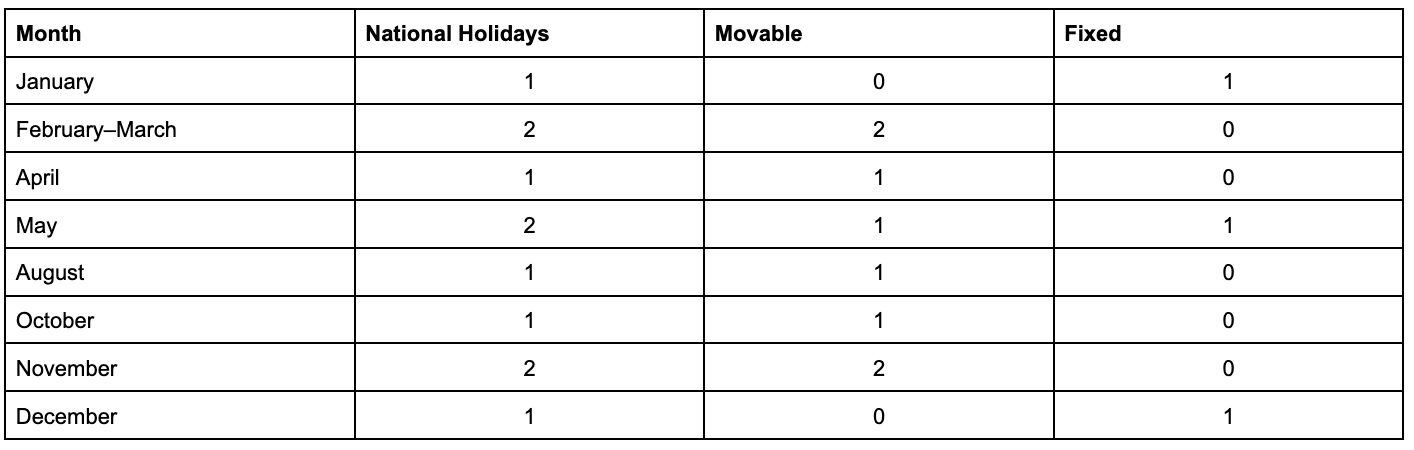
Ecuador officially recognizes 11 national public holidays each year. These holidays apply across the entire country and are mandatory for both public and private sector employers, according to Ecuador’s Ministry of Tourism and the National Assembly of Ecuador.
While the number of holidays stays consistent, the observed dates may change due to Ecuador’s holiday transfer system, which allows certain holidays to move to create long weekends.
Complete List of Ecuador’s National Public Holidays:
The following holidays are considered national public holidays, meaning they are observed nationwide regardless of province or municipality, according to Ecuador’s Ministry of Tourism.
- New Year’s Day on January 1
- Carnival Monday (movable, based on the liturgical calendar)
- Carnival Tuesday (movable, fixed to Carnival week)
- Good Friday (movable, based on Easter)
- Labor Day on May 1
- Battle of Pichincha Day on May 24
- First Cry of Independence on August 10
- Independence of Guayaquil on October 9
- All Souls’ Day on November 2
- Independence of Cuenca on November 3
- Christmas Day on December 25
These holidays are established in national law and reaffirmed annually through an Executive Decree, according to the National Assembly of Ecuador.
Fixed vs Movable National Holidays:
Not all national holidays behave the same way. Some are fixed-date holidays, while others change every year.
Fixed holidays include New Year’s Day, Labor Day, Battle of Pichincha Day, First Cry of Independence, Independence of Guayaquil, All Souls’ Day, Independence of Cuenca, and Christmas Day, as defined by Ecuador’s holiday legislation.
Movable holidays include Carnival Monday, Carnival Tuesday, and Good Friday, which are tied to religious calendars and confirmed annually by government decree, according to Ecuador’s Ministry of Tourism.
Which National Holidays Can Be Moved:
Several national holidays can be shifted to different weekdays to create long weekends. This applies to Labor Day, Battle of Pichincha Day, First Cry of Independence, Independence of Guayaquil, All Souls’ Day, and Independence of Cuenca, based on the holiday transfer rules established by the National Assembly of Ecuador.
However, New Year’s Day, Christmas Day, and Carnival Tuesday cannot be moved, regardless of the day they fall on, as stated in Ecuador’s holiday law.
The Religious Holidays Observed Across Ecuador
1. Carnival: A Religious Holiday With Nationwide Impact
Carnival is one of Ecuador’s most significant religious holidays and is observed on Carnival Monday and Carnival Tuesday, both of which are national public holidays. The dates change every year because Carnival is tied to the Catholic liturgical calendar and precedes Lent, according to Ecuador’s Ministry of Tourism.
Although Carnival has a festive and cultural tone, it remains a religious observance at its core. From a planning perspective, you should expect two consecutive non-working days nationwide, regardless of province or industry.
2. Good Friday and Holy Week Observance
Good Friday is the most solemn religious public holiday in Ecuador. It commemorates the crucifixion of Christ and is observed nationwide as a mandatory day off, according to Ecuador’s Código del Trabajo.
Good Friday falls during Semana Santa (Holy Week), a period marked by large public processions, reduced commercial activity, and limited government services in many cities. Quito’s Jesús del Gran Poder procession is one of the largest in the region, drawing tens of thousands of participants each year, according to the Municipality of Quito.
3. Easter Sunday and Its Business Implications
While Easter Sunday is not an official public holiday under Ecuadorian labor law, it still influences business operations. Many employees travel or extend time off around Holy Week, which can affect availability even after Good Friday, according to patterns reported by Ecuador’s Ministry of Tourism.
For workforce planning, Easter weekend often functions as an informal extension of the Good Friday holiday.
4. All Souls’ Day as a Religious Observance
All Souls’ Day on November 2 is both a religious and national public holiday in Ecuador. Rooted in Catholic tradition, it honors the dead through rituals such as visiting cemeteries and preparing traditional foods like colada morada, according to Ecuador’s Ministry of Culture.
From an operational standpoint, this holiday is treated as a full non-working day nationwide and is frequently moved under Ecuador’s holiday transfer system to create a long weekend.
What You Should Expect During Religious Holidays
Religious holidays in Ecuador often lead to lower workforce availability, limited government office hours, and slower response times across sectors. These effects are predictable and recur every year, making planning essential.
Because these holidays are backed by national law and cultural practice, they carry more operational weight than informal observances and should always be accounted for in annual calendars and workforce planning.
The Impact of National Holidays on Businesses and Work Travel
National public holidays in Ecuador are legally recognized non-working days, which means most offices close or operate with reduced staff. This applies across industries, including finance, professional services, logistics, and government-related operations, as established in the Código del Trabajo.
For planning purposes, you should assume limited availability on the holiday itself and slower response times on adjacent days, especially when holidays are moved to create long weekends.
1. Productivity Shifts Around Long Weekends
Ecuador’s holiday transfer system concentrates time off into long weekends, which changes how work weeks function. According to Ecuador’s Ministry of Tourism, long weekends consistently generate spikes in domestic travel, with increases of 20 percent or more in internal mobility during major holidays.
From a business standpoint, this often translates into shorter effective work weeks, delayed approvals, and rescheduled meetings, particularly when holidays fall on Mondays or Fridays.
2. Impact on Domestic and International Work Travel
National holidays directly affect work travel. Flights, intercity transport, and hotels experience higher demand during long weekends, which can limit availability and raise costs. The Ministry of Tourism reports that long holiday periods are among the highest travel-demand windows of the year, especially during Carnival, Good Friday, and November holidays.
If travel is unavoidable, booking earlier than usual becomes critical. Otherwise, many companies shift trips to non-holiday weeks to avoid congestion and scheduling risk.
3. Government Services and Compliance Timelines
On national holidays, public institutions are closed, including ministries, municipalities, and regulatory offices. Deadlines tied to government processing, filings, or approvals are effectively paused, according to Ecuador’s public sector regulations.
This matters for businesses managing permits, labor filings, or compliance-related processes, where a single holiday can push timelines back by several days.
4. Workforce Availability and Remote Teams
Even in remote or hybrid setups, national holidays remain in effect. Employees based in Ecuador are entitled to time off on official holidays, regardless of whether they work remotely or onsite, as outlined in national labor law.
In practice, availability often drops beyond the official holiday itself, especially during major observances like Carnival or All Souls’ Day. Planning workloads and deliverables around these dates reduces friction and missed expectations.
5. Planning Takeaways for Business and Travel
National holidays in Ecuador don’t just mark days off. They reshape workweeks, influence travel logistics, and slow administrative processes in predictable ways. Because holiday dates are published in advance and backed by law, their operational impact is one of the few variables you can reliably plan around each year.
Ready to Start Nearshoring in Ecuador?
Understanding Ecuador’s holiday calendar isn’t just about knowing which days are off. It’s about planning operations, payroll, and travel with clarity in a country where 11 national public holidays and multiple movable dates can reshape entire workweeks, according to Ecuador’s Ministry of Tourism.
From our perspective at Hire South, this level of local detail is exactly what makes the difference when working with talent in LATAM. Our team supports companies hiring and managing professionals across the region, helping them stay compliant with labor regulations, holiday pay rules, and scheduling realities defined by the local law. When you understand the calendar, you reduce risk. When you pair that knowledge with on-the-ground expertise, you operate with confidence. Contact us to learn more!
.jpg)