
.jpg)

Brazil’s technology sector is no longer an emerging story. It is a mature, fast-scaling market that plays a central role in the country’s economy. The IT and ICT industries account for nearly 7 percent of Brazil’s GDP, according to Brasscom, placing technology among the most relevant economic sectors nationwide.
This guide breaks down what that really means for you. You’ll gain a clear understanding of the IT sector in Brazil, including its market size, growth trends, and the forces shaping Brazil’s technology sector today.
You’ll also explore where innovation is happening, how deep the tech talent pool runs, and which segments, from software development to fintech and cloud services, are driving demand.
By the end, you’ll understand how Brazil fits into the global technology landscape and what to expect if you’re considering expansion, partnerships, or long-term investment in the Brazilian tech market.
Overview of Brazil’s Technology Sector
Brazil’s technology sector is a key driver of the country’s digital economy. The broader Information and Communication Technology (ICT) sector, including IT, software, services, and telecom, represented about 6.5 % of Brazil’s GDP in 2024, according to more info from Brasscom. This highlights how technology has become a central component of national economic output.
Growth Trends and Forecasts:
Brazil’s technology sector has outpaced many traditional industries in recent years. Tech investments grew by approximately 13.9 % in 2024, according to IT Forum Brazil, exceeding global averages. Forecasts show that total tech investments could reach R$774 billion by 2028, according to Brasscom, driven by cloud computing, AI, data analytics, and enterprise software adoption.
Workforce and Talent Dynamics:
The ICT sector supports a large, skilled workforce, with over 2 million professionals employed, according to TiInside. Many of these workers earn above the national average salary, reflecting the high value placed on tech skills in areas such as software development, cybersecurity, and digital services.
Regional and Global Standing:
Brazil’s tech sector accounts for more than one-third of all IT investment in Latin America, according to IT Forum Brazil, establishing the country as a regional technology leader. While challenges like infrastructure gaps and regulatory complexity exist, Brazil continues to offer a strategic platform for both domestic and international companies to innovate and scale.
The 5 Key Tech Hubs Rising in Brazil
Brazil’s technology sector is expanding across multiple cities, each offering unique advantages for talent, investment, and innovation. Understanding where the key hubs are can help you make smarter decisions when entering the market or scaling operations.
1. São Paulo
São Paulo is the largest technology hub in Brazil and Latin America, hosting about 1,911 startups, according to Sebrae. It attracts the most venture capital and corporate innovation programs, supported by top universities, research centers, and established accelerators. The density of tech companies and investors makes São Paulo a natural first stop for companies seeking access to talent and infrastructure.
2. Campinas
Located near São Paulo, Campinas is a leader in engineering, telecommunications, and applied sciences. It is home to major research centers and tech parks, including CIATEC and TechnoPark, according to NexUhub, which provide strong support for advanced R&D. Companies benefit from access to skilled technical talent and a lower cost base than São Paulo.
3. Recife
Recife’s Porto Digital is one of Brazil’s most recognized innovation parks, supporting hundreds of companies and thousands of workers, according to NexUhub. The hub leverages partnerships with universities and public incentives to foster growth in software, digital product design, and creative industries, offering cost-effective access to talent in the Northeast.
4. Florianópolis
Florianópolis is growing as a tech destination by combining quality of life with a strong developer community. Its startup ecosystem is expanding quickly, supported by universities and industry networks, according to Gini Talent, attracting early-stage companies and remote teams seeking focused talent.
5. Rio de Janeiro
Rio’s tech hub is increasingly important for sectors like media tech, energy tech, and fintech. The city offers access to corporate clients, public projects, and investment opportunities, making it strategic for companies seeking integration with creative, financial, and industrial industries, according to NexUhub.
All The Competitive Advantages of Brazilian Tech Talent
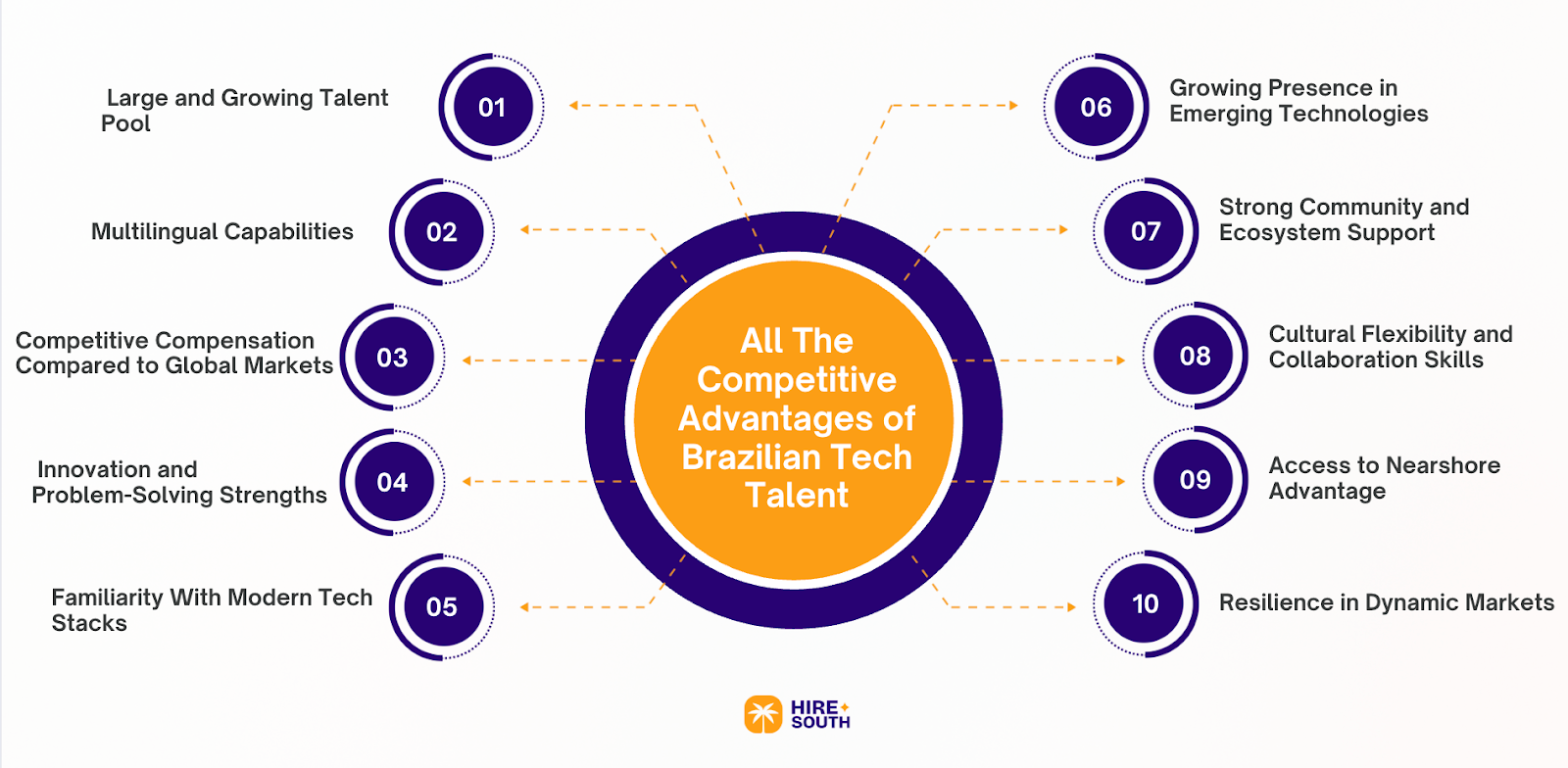
1. Large and Growing Talent Pool
Brazil has one of the largest tech talent markets in Latin America. The broader Information and Communication Technology (ICT) sector employs over 2 million professionals, according to TiInside, spanning developers, data specialists, cybersecurity experts, and digital product teams. This scale gives you access to a variety of skill levels without being confined to a single city or region.
2. Multilingual Capabilities
Many Brazilian tech professionals are bilingual or multilingual. Portuguese is the primary language, but English proficiency has grown significantly, especially among developers and tech leaders. This reduces communication barriers when working with international teams or clients.
3. Competitive Compensation Compared to Global Markets
While wages in Brazil’s tech sector are higher than in some neighboring countries, they remain competitive compared to North America and Western Europe. This balance lets you attract experienced talent while managing overall project costs, especially for long‑term engagements or distributed teams.
4. Innovation and Problem‑Solving Strengths
Brazilian engineers and developers are known for adaptive thinking and creative problem solving. You’ll find strong capabilities in building resilient systems for complex environments, from fintech platforms handling high‑volume transactions to mobile apps optimized for varying network conditions.
5. Familiarity With Modern Tech Stacks
Brazilian tech professionals work with contemporary tools and frameworks. Skilled developers are experienced in languages like Java, Python, JavaScript, and Go, and frameworks such as React, Angular, and Node.js. Cloud platforms like AWS, Azure, and Google Cloud are widely adopted, aligning local skills with global standards.
6. Growing Presence in Emerging Technologies
Brazil’s talent pool isn’t static. Increasing numbers of professionals specialize in AI, machine learning, data analytics, and cybersecurity. This trend reflects growing demand from domestic and international companies alike and signals deeper expertise in future‑focused tech domains.
7. Strong Community and Ecosystem Support
Tech communities and meetups are active in major hubs like São Paulo, Campinas, and Florianópolis. These networks support knowledge sharing, skill development, and recruitment. Events, hackathons, and open‑source contributions help keep the talent base engaged and current with global trends.
8. Cultural Flexibility and Collaboration Skills
Brazilian tech professionals often exhibit strong collaboration capabilities. Work culture tends to value adaptability and teamwork, which can help when integrating cross‑border teams or working in agile environments. This cultural flexibility supports smoother execution and delivery.
9. Access to Nearshore Advantage
For companies in North America and Europe, Brazil’s time zones are favorable, reducing coordination friction. You’ll find overlapping business hours with major markets, which can accelerate decision‑making and reduce delays compared to more distant offshore locations.
10. Resilience in Dynamic Markets
Brazilian tech talent is accustomed to variable market conditions and rapidly shifting business priorities. This resilience can translate into faster pivots and more creative solutions when projects face unexpected challenges or evolving requirements.
The Key Market Trends For The Brazilian Technology Sector in 2026
AI and Machine Learning Become Strategic Priorities.
Artificial intelligence is now central to Brazilian tech operations. Companies in finance, healthcare, logistics, and retail are embedding AI into core processes for predictive analytics, automation, and personalization, shaping digital services throughout 2026, according to TiInside.
Cloud Services Drive Digital Infrastructure Transformation.
Cloud adoption continues to accelerate. 77 % of Brazilian firms now rely on cloud services daily, and 61 % consider it their primary infrastructure environment, according to Panorama Cloud 2025, enabling scalability, flexibility, and integration with AI and IoT platforms.
Fintech and Digital Payments Expand Market Reach.
Brazil’s fintech ecosystem is growing rapidly, particularly through mobile wallets and real‑time payment systems. The adoption of Pix and automated recurring payments is projected to significantly increase transaction volumes in 2026, according to Ebanx research.
Industry 4.0 and Manufacturing Digitization Advance.
Industrial digitization is expanding under public and private initiatives. Adoption of IoT in manufacturing is expected to rise from 15 % to 35 % by 2026, according to EditorialGE, while robotics integration is projected to increase from 8 % to 25 %, improving operational efficiency and competitiveness.
Cybersecurity Investment Rises With Digital Adoption.
As digital transformation deepens, companies are increasing cybersecurity investments. Brazilian businesses are prioritizing data protection, threat monitoring, and governance frameworks to manage rising risks, according to ABES.
Data Sovereignty and Local Infrastructure Gain Importance.
Organizations are focusing on local data storage and cloud infrastructure to comply with regulatory requirements and protect sensitive information. Expansion of sovereign cloud solutions is a major strategic trend, according to TiInside.
Cross‑Sector Tech Adoption Expands.
Digital tools are now widely adopted outside traditional tech industries. Agriculture, logistics, healthcare, and professional services increasingly use analytics platforms, IoT sensors, and automation technologies, transforming operations and decision-making according to RealEstateZone.
Domain-Specific AI and Decision Intelligence Models.
Brazilian enterprises are implementing domain-specific AI and decision intelligence frameworks that integrate local language and sector knowledge. These systems improve operational insight, accuracy, and decision-making speed, according to TiInside.
Ready to Hire Brazilian IT Talent?
Brazil’s technology sector continues to expand at a remarkable pace, with IT and digital services contributing nearly 7 % of GDP, according to Brasscom. From AI adoption to cloud migration, fintech innovation, and industrial digitization, the market offers both opportunities and challenges for companies aiming to scale efficiently.
At Hire South, we help organizations tap into this dynamic ecosystem by connecting you with top Latin American tech talent, from software engineers to AI specialists. By leveraging our expertise, you can access skilled professionals, reduce hiring friction, and accelerate your projects in a market where demand for qualified tech talent is growing steadily, with over 2 million professionals in the ICT sector, according to TiInside. Partnering with us can ensure you gain strategic access to Brazil’s tech workforce while navigating the complexities of recruitment, compliance, and workforce optimization. Contact us to learn more!