


Hiring remote talent in Brazil has moved from a cost-saving tactic to a strategic growth decision. You get access to one of the deepest talent pools in Latin America, strong technical skills, and time zone alignment with North America and Europe.
Brazil alone represents close to 40 percent of Latin America’s developer workforce, according to the Stack Overflow Developer Survey, making it the largest single source of tech talent in the region. That scale changes how fast you can hire and how selectively you can do it.
This guide breaks down how remote talent hiring in Brazil actually works. You’ll learn what roles are easiest to hire, what it costs, how local labor rules affect your options, and the best hiring models depending on your goals. If you’re evaluating Brazil’s remote talent for long-term growth, this article gives you the practical context to make the right call.
Why You Should Hire Remote Talent in Brazil
1. Access to One of the Largest Talent Pools in Latin America
Brazil has the biggest workforce in Latin America and one of the largest tech communities globally. The country counts more than 1.5 million software developers, according to the Stack Overflow Developer Survey. That scale matters when you need to hire quickly or build teams with specific skill combinations.
For you, this means less competition for niche roles compared to smaller markets. It also means more senior profiles, not just junior or mid-level talent.
2. Strong Technical and Digital Skills
Brazilian remote talent is particularly strong in software engineering, data, cloud infrastructure, QA, and product-related roles. According to GitHub’s State of the Octoverse, Brazil consistently ranks among the top five countries worldwide by number of active developers, reflecting both skill depth and ongoing upskilling.
This translates into practical experience with modern frameworks, distributed systems, and agile environments, not just academic knowledge.
3. Favorable Time Zone Alignment
Brazil operates mainly between UTC-2 and UTC-5, depending on the region. That puts most Brazilian remote talent within one to four hours of US time zones and overlapping workdays with Western Europe.
For you, this reduces delays, simplifies collaboration, and makes real-time meetings realistic without forcing early mornings or late nights on either side.
4. Competitive Costs Without Sacrificing Quality
Hiring remote talent in Brazil typically costs 30 to 50 percent less than equivalent roles in the US, according to data from Glassdoor and PayScale. These savings come from local market conditions, not lower skill levels.
You can invest the difference into retention, better tooling, or faster team expansion instead of compromising on talent quality.
5. Cultural Compatibility With Global Teams
Brazilian professionals are used to working with international companies and distributed teams. English proficiency is not universal, but Brazil scores above the global average for English skills among tech professionals, according to the EF English Proficiency Index.
In practice, this means smoother communication, fewer misunderstandings, and faster onboarding when you integrate Brazilian remote talent into global workflows.
6. High Retention Potential
Job stability matters in Brazil’s labor market. According to LinkedIn Economic Graph data, Brazilian professionals tend to stay longer in roles that offer growth, remote flexibility, and predictable workloads.
For you, that often results in lower attrition compared to more volatile hiring markets, especially when you offer clear expectations and long-term opportunities.
7. A Mature Remote Work Culture
Remote work adoption in Brazil accelerated after 2020 and stayed strong. The Brazilian Internet Steering Committee reports that over 40 percent of professionals in knowledge-based roles work remotely at least part of the time remotely.
This maturity reduces friction. You are hiring people who already understand remote accountability, async communication, and performance-based evaluation.
Brazil’s Talent Landscape
Size and Depth of the Workforce.
Brazil has the largest labor force in Latin America, with over 108 million economically active professionals, according to the Brazilian Institute of Geography and Statistics. Within that base, tech, digital, and business services talent continues to expand faster than the national average.
For you, scale matters. A larger market reduces hiring bottlenecks and increases the odds of finding candidates with both technical depth and industry context.
Regional Talent Hubs That Power Remote Hiring.
Brazil’s talent is not concentrated in a single city. São Paulo remains the main hub, but cities like Campinas, Belo Horizonte, Curitiba, Porto Alegre, and Recife have developed strong engineering and digital ecosystems.
According to the Brazilian Association of Information and Communication Technology Companies, more than 60 percent of Brazil’s tech workforce is now based outside São Paulo. This geographic spread increases salary flexibility and improves availability for remote-first roles.
Educational Output and Skill Formation.
Brazil produces a high volume of STEM graduates each year. UNESCO data shows that the country graduates over 400,000 students annually in science, technology, engineering, and mathematics-related fields.
While formal education varies in quality, many professionals complement it with private bootcamps, certifications, and hands-on experience. You often see profiles that combine university training with practical, project-based learning.
Seniority Distribution and Role Availability.
Brazil’s talent landscape is not limited to junior profiles. LinkedIn workforce insights indicate a growing concentration of mid-level and senior professionals with 5 to 10+ years of experience, especially in engineering, product, QA, data, and operations.
For you, this supports more than just execution roles. You can hire team leads, architects, and specialists who contribute to decision-making, not just delivery.
Language and Communication Readiness.
English proficiency varies, but it is stronger among professionals working in tech, finance, and international services. Brazil ranks in the moderate proficiency tier globally, according to the EF English Proficiency Index, with significantly higher scores among urban and technical talent.
In practice, this means you can expect functional business-level English for most remote-ready roles, especially when hiring candidates with prior international experience.
Talent Supply vs Demand Dynamics.
Demand for skilled professionals still outpaces supply in certain areas, particularly software engineering and data. Brazil’s National Confederation of Industry estimates a shortfall of hundreds of thousands of qualified tech professionals through the end of the decade.
Main Options To Hire Remote Talent in Brazil
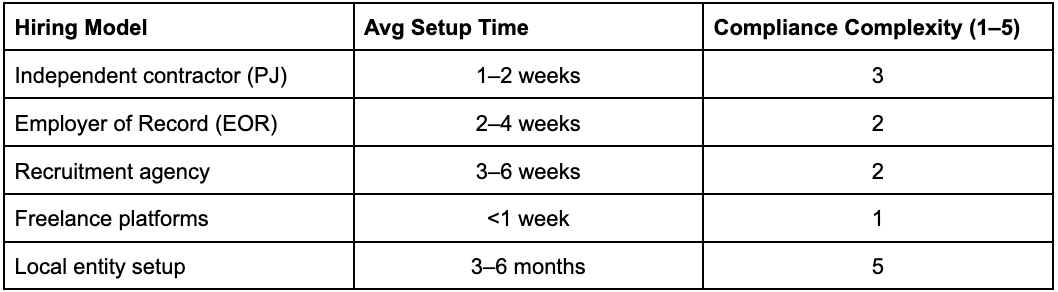
Hiring Independent Contractors in Brazil:
Hiring Brazilian professionals as independent contractors is one of the fastest ways to access remote talent. This model is common for developers, designers, and specialized consultants.
According to Brazil’s Federal Revenue Service, independent contractors operate under simplified tax regimes such as Simples Nacional or MEI, which reduces administrative friction when structured correctly. For you, this option offers speed and flexibility, but it also requires careful role definition to avoid worker misclassification under Brazilian labor law.
Using an Employer of Record (EOR) in Brazil:
An Employer of Record allows you to hire remote talent in Brazil without setting up a local legal entity. The EOR becomes the legal employer while you manage the day-to-day work.
This model is increasingly popular. Grand View Research estimates the global EOR market will grow at over 6 percent annually through 2030, driven largely by cross-border remote hiring. For you, EORs simplify payroll, benefits, and compliance, especially when hiring full-time employees for long-term roles.
Working With Remote Staffing or Recruitment Agencies:
Staffing and recruitment agencies based in Brazil specialize in sourcing, vetting, and sometimes managing remote talent. Many focus on tech, finance, and professional services roles.
According to LinkedIn Talent Solutions, companies using specialized recruitment partners reduce time-to-hire by up to 40 percent, particularly in competitive markets. For you, this option trades higher upfront costs for speed, local market insight, and access to pre-vetted candidates.
Hiring Through Global Freelance Platforms:
Global freelance platforms give you direct access to Brazilian remote talent across technical and non-technical roles. This approach works best for project-based or short-term needs.
Data from the World Bank shows Brazil is one of the top five countries worldwide for online freelance participation, reflecting a mature gig economy. For you, platforms offer flexibility and fast onboarding, but consistency and long-term retention can be harder to achieve.
Opening a Local Entity in Brazil:
Setting up a Brazilian entity allows you to hire employees directly and build a long-term presence in the market. This option provides maximum control over contracts, compensation, and company culture.
However, Brazil ranks among the top 10 most complex countries for labor regulation, according to TMF Group’s Global Business Complexity Index. For you, this model makes sense at scale, but it requires significant legal, tax, and HR infrastructure from day one.
Choosing the Right Hiring Option for Your Needs:
Each hiring model serves a different purpose. Contractors and freelancers prioritize speed. EORs balance compliance and simplicity. Agencies optimize hiring efficiency. Local entities support long-term expansion.
How To Hire Remote Talent in Brazil: Step-by-Step
1. Define the Role With Local Market Context
Start with a clear scope. Specify seniority, core responsibilities, and expected outcomes. In Brazil, titles can vary by company, so align on skills and deliverables rather than labels.
Market clarity matters. According to LinkedIn Talent Insights, roles with clearly defined requirements receive up to 30 percent more qualified applicants, which directly improves hiring speed and quality.
2. Choose the Right Hiring Model Early
Decide whether the role fits a contractor, full-time employee, or project-based setup. This choice affects compliance, costs, and timelines.
Brazilian labor law strongly protects employees. Misalignment between role structure and hiring model increases legal risk, according to Brazil’s Ministry of Labor. For you, selecting the right model upfront avoids costly corrections later.
3. Set Competitive and Realistic Compensation
Benchmark salaries using Brazil-specific data, not global averages. Compensation expectations differ by city, seniority, and industry.
PayScale and Glassdoor data show that remote-friendly roles often command 10 to 20 percent higher pay than local-only positions due to international demand. Transparent ranges improve acceptance rates and reduce negotiation friction.
4. Source Talent Through the Right Channels
Use channels that match your hiring model. Professional networks and referrals work well for senior roles. Freelance platforms suit short-term needs. Local recruiters help when speed or specialization matters.
According to LinkedIn, more than 70 percent of Brazilian professionals find roles through networking or recruiter outreach, not job boards alone. For you, proactive sourcing is often more effective than passive posting.
5. Interview for Skills and Remote Readiness
Assess technical ability, but also evaluate communication, autonomy, and time management. Remote success depends on more than hard skills.
Harvard Business Review research shows that remote hires with strong self-management skills outperform peers by up to 20 percent in distributed teams. Structured interviews and practical assessments help surface these traits.
6. Verify Legal, Tax, and Classification Requirements
Before making an offer, confirm the legal structure of the hire. Contractors may need to issue invoices through a registered entity. Employees require compliant contracts and benefits.
Brazil ranks among the most regulated labor markets globally, according to the World Bank’s Doing Business indicators. For you, legal review at this stage reduces compliance risk and future disputes.
7. Make a Clear and Localized Offer
Present offers in plain language. Include compensation, payment terms, working hours, and expectations around availability.
Clarity builds trust. According to PwC workforce studies, transparent offers reduce early-stage attrition by nearly 25 percent, especially in cross-border hires.
8. Onboard With Structure From Day One
Provide documented processes, clear goals, and access to tools immediately. Do not assume prior context.
Gallup data shows that structured onboarding improves employee performance by over 70 percent. For you, early investment shortens ramp-up time and sets the tone for long-term performance.
9. Track Performance and Adjust Quickly
Set measurable goals in the first 30, 60, and 90 days. Focus on outcomes, not hours logged.
Brazilian professionals are accustomed to performance-based evaluation in remote settings. Regular feedback loops help you identify gaps early and strengthen retention without micromanagement.
The Best Practices When Hiring Remote Talent In Brazil
1. Align Contracts With Real Working Conditions
Start by matching the legal structure to how the role actually operates. If the work looks and feels like full-time employment, structure it that way. Brazil’s labor courts tend to prioritize substance over form.
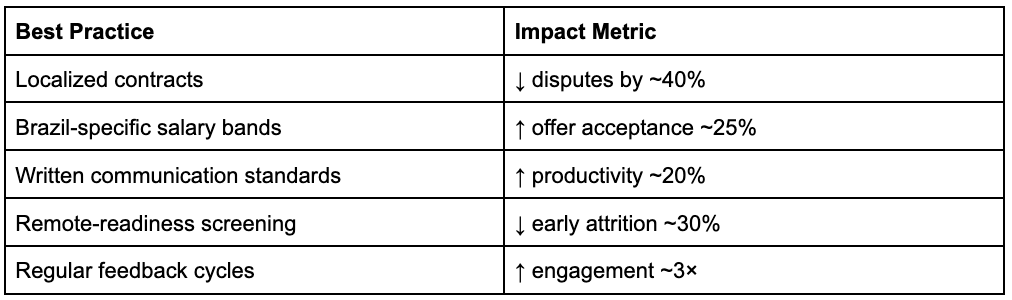
According to Brazil’s Superior Labor Court, misclassification disputes are among the most common labor claims nationwide. For you, clear alignment between contracts, schedules, and expectations is the first line of risk control.
2. Use Brazil-Specific Compensation Benchmarks
Avoid importing salary ranges from other markets. Brazil has wide regional differences, and remote roles often command premiums based on seniority and language skills.
3. Prioritize Clear Communication From Day One
Define communication norms early. Set expectations around response times, meeting cadence, and documentation.
According to McKinsey research, teams with structured communication practices are up to 25 percent more productive, particularly in remote environments. For you, clarity reduces friction and prevents avoidable performance issues.
4. Screen for Remote Readiness, Not Just Technical Skill
Strong resumes do not always translate to remote effectiveness. Evaluate autonomy, problem-solving, and written communication during interviews.
GitLab’s Remote Work Report shows that teams who assess remote-specific skills experience lower burnout and higher engagement. For you, this improves long-term performance and retention.
5. Respect Local Work Culture and Calendar
Brazilian professionals value flexibility but also structure. Be mindful of local holidays and regional observances when planning deadlines.
According to the Brazilian Institute of Geography and Statistics, over 80 percent of workers prefer predictable schedules, even in remote roles. For you, respecting these norms builds trust and consistency.
6. Document Processes and Decision-Making
Do not rely on verbal alignment. Written processes, playbooks, and decision logs create consistency across time zones.
Harvard Business Review notes that documented workflows reduce execution errors by up to 32 percent in distributed teams. For you, documentation protects continuity as teams scale.
7. Invest in Ongoing Feedback, Not Annual Reviews
Frequent feedback works better than infrequent performance cycles. Short check-ins help surface issues early and reinforce accountability.
Gallup research shows that employees who receive regular feedback are nearly three times more likely to be engaged. For you, this directly impacts productivity and retention.
8. Protect Data and Intellectual Property
Use clear IP clauses and enforce access controls from the start. Brazil’s General Data Protection Law applies to cross-border operations.
According to the International Association of Privacy Professionals, LGPD enforcement has increased steadily since 2021. For you, proactive compliance reduces legal exposure and strengthens trust with remote talent.
Ready to Hire Remote Talent in Brazil?
Hiring remote talent in Brazil gives companies access to one of the deepest and most competitive professional markets in Latin America, with strong technical skills, scalable availability, and time zone alignment that supports real collaboration.
At Hire South, we help companies navigate remote talent hiring in Brazil and all of Latin America with a structure-first approach. Our teams support compliant hiring models, market-aligned compensation, and end-to-end talent operations built on real regional data and on-the-ground experience. The result is faster hiring, lower risk, and remote teams in LATAM that scale with confidence and clarity. Contact us when you are ready to start hiring! !