


Panama has one of the most structured holiday calendars in Latin America, with more than a dozen national public holidays each year, according to Panama’s Ministry of Labor and Labor Development. These dates can affect everything from office availability to payroll calculations and project timelines.
In this guide, you’ll find a complete list of local, national, and regional holidays in Panama, clearly organized and easy to reference. It breaks down patriotic and religious observances, explains which holidays are mandatory under Panamanian labor law, and highlights how local celebrations can vary by province.
Whether you’re planning operations, managing remote teams, or scheduling travel, this article gives you the context you need to stay compliant and avoid surprises when holidays in Panama come around.
First Things First: How Panama’s Holiday Calendar Is Updated Each Year
Panama’s holiday calendar isn’t set in stone. It’s updated through a mix of constitutional rules, national laws, and annual government announcements. That means the list of official holidays can shift slightly from year to year, especially when special commemorations or public events are declared.
The Legal Basis for Panama’s Holiday Schedule.
The backbone of Panama’s holiday calendar is the country’s legal framework. Many public holidays are defined by law or the constitution, which makes them recurring and stable. But there are also holidays created by presidential decree, which can change based on the government’s priorities or national circumstances.
How New Holidays Get Added.
When a new holiday is proposed, it usually goes through the National Assembly or is announced through a presidential decree. These are not casual decisions. Adding a holiday affects the economy, labor costs, and business operations. So changes are deliberate and documented.
The Role of the Official Government Calendar.
Every year, the Panamanian government publishes an official list of public holidays. This is the authoritative reference for employers, banks, schools, and the general public. If a holiday isn’t on the official list, it’s not considered a legal public holiday, even if it’s widely celebrated.
Why Holidays Sometimes Move.
Some holidays are fixed to a specific date, like Independence Day. Others are movable, such as religious observances tied to the lunar calendar. That means you can’t assume the same date every year. If you’re planning schedules, it’s better to check the official calendar each year than rely on past dates.
When Holidays Get “Transferred”.
Panama sometimes shifts holiday observances to the nearest weekday to create long weekends. This isn’t random. It’s a decision often made to reduce disruption to business operations while still honoring the holiday. The government announces these changes ahead of time, so you can plan accordingly.
What You Should Watch for Each Year.
If you’re running operations in Panama or working with Panamanian teams, the key action is simple: verify the official holiday calendar annually. Even small changes can impact staffing, payroll, and deadlines. A holiday that falls on a weekday can change your entire month’s workflow.
Where Can You Confirm the Official Panama Holiday List?
The most reliable source is the official government announcement. You can also cross-check with Panama’s Ministry of Labor and Labor Development, which provides updates on labor-related rules and public holiday observance. This helps ensure your plans are based on official policy, not hearsay.
All National Public Holidays in Panama
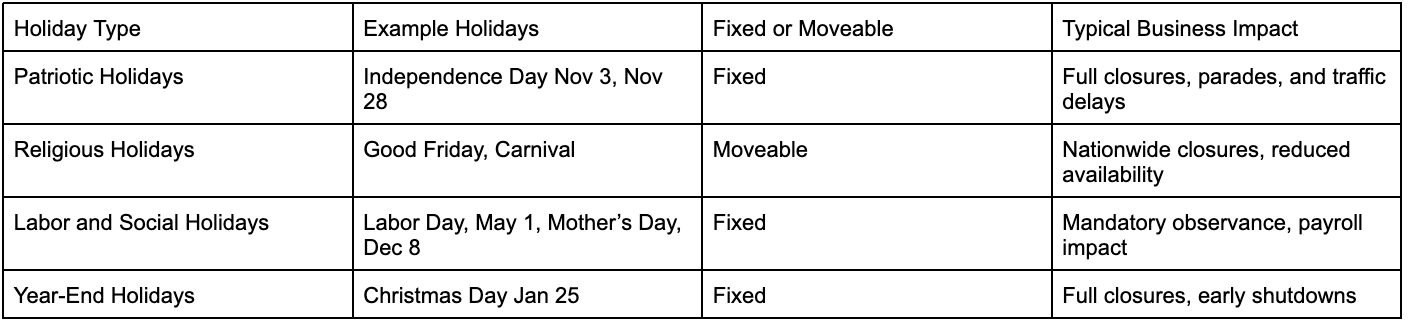
Below is the complete list of national public holidays in Panama, including fixed dates and movable holidays. These are the official days recognized across the country, and they are the ones that most directly impact business operations, government offices, and payroll.
1. New Year’s Day (Año Nuevo) – January 1
This holiday is a fixed date and is observed nationwide. It is treated as a full public holiday under Panamanian labor law, meaning most businesses close and employees are entitled to holiday pay if they work.
2. Martyrs’ Day (Día de los Mártires) – January 9
This holiday commemorates the 1964 riots and is observed nationwide. It is a mandatory public holiday and is recognized as a day of national remembrance.
3. Carnival (Carnaval) – Monday and Tuesday before Ash Wednesday
Carnival is a movable holiday, based on the liturgical calendar. It is one of Panama’s most celebrated national holidays, with widespread closures and public events. Most businesses treat both days as full holidays.
4. Good Friday (Viernes Santo) – Friday before Easter Sunday
Good Friday is another movable holiday. It is recognized nationally and typically results in closures for banks, government offices, and many private businesses.
5. Labor Day (Día del Trabajo) – May 1
A fixed date and a national public holiday, Labor Day is observed across Panama with official closures and labor-focused events.
6. Separation Day from Colombia (Día de la Separación) – November 3
This national holiday marks Panama’s separation from Colombia in 1903. It is a fixed date and is observed nationwide.
7. Flag Day (Día de la Bandera) – November 4
Observed nationally, this holiday celebrates Panama’s flag and is often paired with patriotic events and official ceremonies.
8. Independence Day from Spain (Primer Grito de Independencia de la Villa de Los Santos) – November 10
This national holiday celebrates Panama’s early independence movement and is observed nationwide with civic events.
9. Independence from Spain (Independencia de Panamá) – November 28
This holiday marks Panama’s independence from Spain in 1821. It is a fixed national holiday and one of the most important dates on the Panamanian calendar.
10. Mother’s Day (Día de la Madre) – December 8
A fixed national holiday, Mother’s Day is widely observed and treated as a legal holiday across Panama.
11. Christmas Day (Navidad) – December 25
A fixed date and national public holiday, Christmas is observed across the country, with most businesses closed.
The Religious Holidays Observed Across Panama
Good Friday (Viernes Santo):
Good Friday is one of Panama’s most observed religious holidays. It is a national public holiday, so most businesses, banks, and government offices close. It is based on the Easter calendar, so the date changes each year.
Many organizations treat the entire week as a slower period, especially in sectors like banking and government services.
Holy Week (Semana Santa) Observances:
Holy Week is the period leading up to Easter Sunday, and while not all days are official holidays, many businesses and schools operate with reduced schedules. Religious processions and community events are common, especially in coastal regions and smaller towns.
If you have teams in Panama, expect reduced productivity during this week, even outside the official holiday date.
Corpus Christi:
Corpus Christi is celebrated in Panama with religious ceremonies and public observances. The date is movable, based on the Catholic calendar, so it varies year to year.
It is not always treated as a national holiday in the same way as Good Friday, but it remains a major religious event and can affect local operations, especially in smaller provinces.
Christmas Eve and Christmas Day Observances:
Christmas Day is an official national holiday. Christmas Eve is not a formal public holiday, but it is widely observed with early closures and reduced business hours.
For businesses, the key takeaway is that the holiday impact starts before December 25, with many offices operating at a slower pace.
Religious Traditions and Regional Variations:
Religious holidays in Panama often include regional traditions. For example, some provinces hold major processions or local events that can disrupt traffic and normal operations.
If your team is spread across the country, these local variations matter. A holiday in one province may not be a national holiday, but it can still impact local employees and service delivery.
Planning Tip: Expect Higher Absenteeism:
Religious holidays can cause higher absenteeism even when not officially mandated. People may take extra days off to travel or attend family events.
This makes it important to build flexibility into project schedules around major religious dates.
The Impact of National Holidays on Businesses and Work Travel
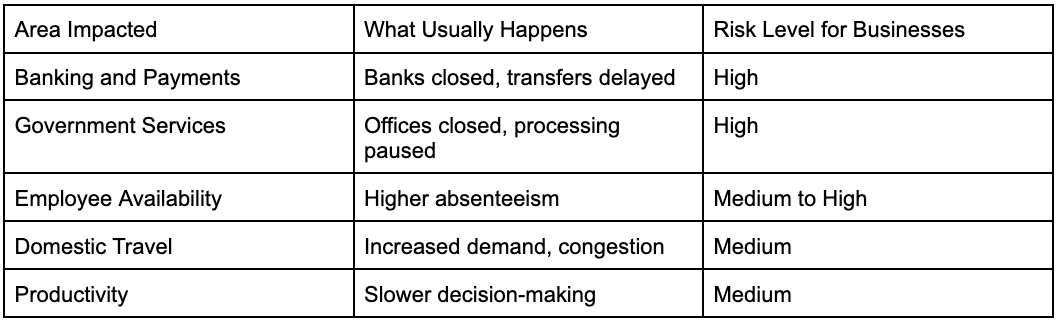
National holidays in Panama can reshape your workweek, especially if you’re coordinating across time zones or managing teams on the ground. These dates affect not just closures, but also travel logistics, customer expectations, and operational efficiency.
1. Reduced Business Hours and Service Availability
On national holidays, most banks, government offices, and many private businesses close entirely. Even when businesses remain open, they often run on limited hours.
If you rely on banking services for payments or transfers, expect delays. The same goes for government-related processes like permits, registrations, or legal filings. Those won’t move forward until the next business day.
2. Higher Demand for Transportation and Accommodation
Work travel during holidays can be tricky. Panama’s national holidays often create spikes in domestic travel, especially around long weekends. That increases demand for flights, hotels, and rental cars.
If your plans include in-person meetings or site visits, booking early is the safest strategy. Last-minute travel during holiday periods can become costly and unpredictable.
3. Traffic Congestion and Public Event Disruptions
National holidays often come with parades, civic events, and large public gatherings. These can cause major traffic congestion, especially in Panama City and other urban centers.
If you’re scheduling meetings or site visits, factor in extra travel time. Even if your destination is not a parade route, the surrounding areas may still experience delays.
4. Higher Absenteeism and Reduced Productivity
Holiday weeks often come with increased absenteeism, even when the day itself isn’t a full holiday. People take extra time off to travel or extend the weekend.
That can affect your project timelines, especially if key stakeholders are unavailable. It’s common for decision-making to slow down during these periods.
5. Planning Around Payroll and Overtime
National holidays are legally protected days. If employees work on these dates, they typically qualify for holiday pay or overtime, depending on the rules in your contract and Panamanian labor law.
This can increase labor costs, especially if you require staff coverage during holidays. If your operations depend on consistent staffing, consider whether holiday scheduling is worth the expense.
6. Cross-Border Coordination Challenges
If you work with teams or clients in other countries, national holidays in Panama can create scheduling gaps. Your partners may assume availability, but Panamanian teams might be offline.
To avoid misalignment, confirm holiday schedules in advance and set clear expectations for response times during those periods.
7. Strategic Tip: Use Holiday Calendars for Risk Planning
The most effective approach is to build a holiday calendar into your annual planning. That helps you identify high-risk windows for delays, travel issues, and staffing gaps.
When you know the dates in advance, you can protect project timelines, adjust deadlines, and reduce last-minute disruptions.
Conclusion
National holidays in Panama shape more than just your calendar; they affect payroll, operations, and project timelines. When you plan, you reduce the risk of unexpected closures, staffing gaps, and travel disruptions that can slow business momentum.
At Hire South, we help companies build and manage remote teams across Latin America with clarity and compliance. Our experience working with Latin American labor rules and local holiday calendars means you get accurate planning support, reliable staffing, and smoother operational execution. If your business needs consistent coverage during holidays or a workforce that adapts to local schedules, we can help you stay on track without sacrificing productivity. Contact us to schedule a discovery call!