
.jpg)

Mexico’s technology sector is shifting fast, and you can feel the momentum. What used to be a manufacturing-heavy economy is now a leading hub for software development, fintech, cloud services, and nearshore IT operations.
In this guide, you’ll get a clear overview of Mexico’s IT sector, from its economic impact to the industries driving the most growth. You’ll explore the country’s major tech hubs, understand the talent pipeline, and see where global companies are finding the strongest opportunities. You’ll also get a transparent look at ongoing challenges, plus the trends shaping Mexico’s digital economy over the next decade.
If you’re evaluating markets, expanding a team, or exploring nearshore development, this article gives you the structure and insights to navigate Mexico’s technology landscape with confidence.
Overview of Mexico’s Technology Sector
Mexico’s Technology Sector at a Glance.
Mexico’s technology sector has become one of the fastest-expanding pillars of its economy. You see this in the way IT services, software engineering, fintech, and digital infrastructure have grown in parallel. The country’s digital economy already accounts for over 5 percent of national GDP, according to Mexico’s Ministry of Economy, reflecting a shift toward higher-value industries rather than traditional manufacturing alone.
Demand is coming from both domestic companies and international firms that use Mexico as a nearshore base. You’re working with a market that blends a strong internal tech ecosystem with global integration, which gives Mexico a competitive edge in North America.
Rapid Expansion of IT Services and Software Development.
IT services hold a central role in Mexico’s technology sector. The market is expected to reach about US $21.3 billion in 2025, according to Mordor Intelligence, driven by cloud migration, cybersecurity needs, and software outsourcing.
You’ll find that companies across finance, retail, logistics, and manufacturing are adopting more advanced digital operations. This creates continuous demand for software engineering, DevOps, data analytics, and enterprise IT support. The steady flow of U.S. partnerships accelerates the industry’s maturity, making Mexico’s IT environment far more sophisticated than it was even five years ago.
Growth of Digital Industries and Innovation.
Mexico’s technology sector includes much more than outsourcing. Innovation-heavy industries are expanding quickly. For example, the fintech ecosystem now hosts more than 650 fintech startups, according to Finnovista, making Mexico the largest fintech hub in Latin America.
There’s also strong traction in AI, automation, and Industry 4.0. You’re looking at a sector powered by cloud adoption, digital payments, mobile connectivity, and a young, digitally native consumer base. These aren’t isolated trends, they feed into each other and strengthen the overall tech ecosystem.
Strong Government Support and Policy Direction.
The Mexican government has made digital transformation a national priority. Programs focused on connectivity, STEM education, cybersecurity standards, and tech investment incentives support the sector’s expansion.
Initiatives like the National Digital Strategy, referenced by the Office of the President, aim to improve digital infrastructure, expand e-government services, and strengthen public-private tech collaboration. These efforts help stabilize long-term growth and make the technology sector more predictable for companies analyzing market entry.
Integration Into Global Technology Value Chains.
Mexico’s technology sector is tightly connected to international supply chains. You see this clearly in software outsourcing, electronics manufacturing, cloud service adoption, and digital operations centers supporting North American businesses.
Its strategic location, time zone alignment, and large bilingual workforce position the country within a broader continental tech value chain. This integration helps Mexico attract foreign investment, expand enterprise-level capabilities, and keep up with global digital trends.
Why This Sector Matters for Business Leaders.
Mexico’s technology sector matters because it gives you access to skilled talent, growing digital markets, and a stable nearshore ecosystem. It’s a sector shaped by real demand and measurable economic impact, not hype. For business professionals evaluating opportunities in North America, understanding Mexico’s tech landscape is no longer optional, it’s part of staying competitive.
Key Tech Hubs Rising in Mexico
1. Mexico City
Mexico City has become the country’s most diversified tech hub. You’ll find a concentration of enterprise IT, cloud service providers, fintech companies, and multinational tech offices. The city hosts more than 250 fintech firms, according to Finnovista, making it a central node for digital payments, open banking solutions, and financial software.
Mexico City also benefits from a deep talent pool and a strong university network. Its ecosystem supports everything from AI research to large-scale enterprise development projects. The density of corporate headquarters accelerates collaboration between global companies and local tech teams, giving the city a unique advantage.
2. Guadalajara
Guadalajara is widely known as the country’s most mature innovation hub. It earned the nickname “Silicon Valley of Mexico” thanks to its long history with electronics, semiconductor assembly, and software engineering. The region now hosts over 600 tech companies, according to the Jalisco Ministry of Innovation, ranging from global giants to newly created startups.
You’ll see strong clusters in embedded systems, IoT, hardware engineering, and backend software development. The city’s universities feed a consistent stream of engineers into the market, which is one reason so many U.S. and Asian tech firms have built long-term operations there. Guadalajara is also home to Mexico’s largest annual tech events, which strengthen its role in digital innovation.
3. Monterrey
Monterrey stands out for its strong engineering culture and corporate environment. It’s a hub for enterprise software development, data analytics, cloud operations, and advanced manufacturing technology. The region has one of the country’s highest concentrations of skilled technical professionals, supported by institutions such as Tecnológico de Monterrey, ranked among the top universities in Latin America by QS.
Companies in Monterrey often focus on automation, AI-assisted manufacturing, and digital transformation for industrial sectors. You’re working with a market that blends heavy industry with high-tech capabilities, giving Monterrey a distinct position in Mexico’s tech ecosystem.
4. Querétaro
Querétaro is rising quickly thanks to its investments in data centers, cloud services, and connectivity infrastructure. The state has attracted some of the world’s largest cloud and colocation providers. According to the Mexican Data Center Association, Querétaro accounts for more than 30 percent of the country’s total data center capacity, making it a cornerstone of Mexico’s digital backbone.
Its stability, access to energy resources, and proximity to Mexico City boost its appeal. You’ll also find an emerging community of cybersecurity firms and infrastructure-focused engineering teams supporting this expansion.
5. Tijuana
Tijuana benefits from its direct connection to Southern California’s tech economy. You get a cross-border environment where companies share talent, research, and business operations. The region has become a strong hub for software development, UX design, digital products, and startup activity.
According to Mexico’s National Institute of Statistics, Tijuana’s tech employment has grown steadily over the past decade, supported by universities graduating thousands of engineers each year. The city’s proximity to the U.S. border also makes project coordination faster for teams working with American clients.
6. Puebla
Puebla is emerging as a mid-sized hub with a growing software development ecosystem. Its universities produce a large number of IT graduates, which helps local companies scale development teams without the talent shortages seen in larger cities. You’ll see activity in software engineering, digital operations support, and systems integration for regional businesses.
Puebla may not have the same visibility as Mexico City or Guadalajara, but its steady workforce growth and lower operating costs make it an increasingly relevant tech destination.
Why These Hubs Matter for Mexico’s Technology Sector
Mexico’s rising tech hubs give you access to specialized ecosystems rather than a single centralized market. Each city offers different strengths, whether you need enterprise-scale engineering, cross-border collaboration, startup energy, or data center infrastructure. Understanding these hubs helps you choose the right location for operations, partnerships, or talent acquisition based on real industry dynamics and verified data.
All The Competitive Advantages of Tech Talent in Mexico
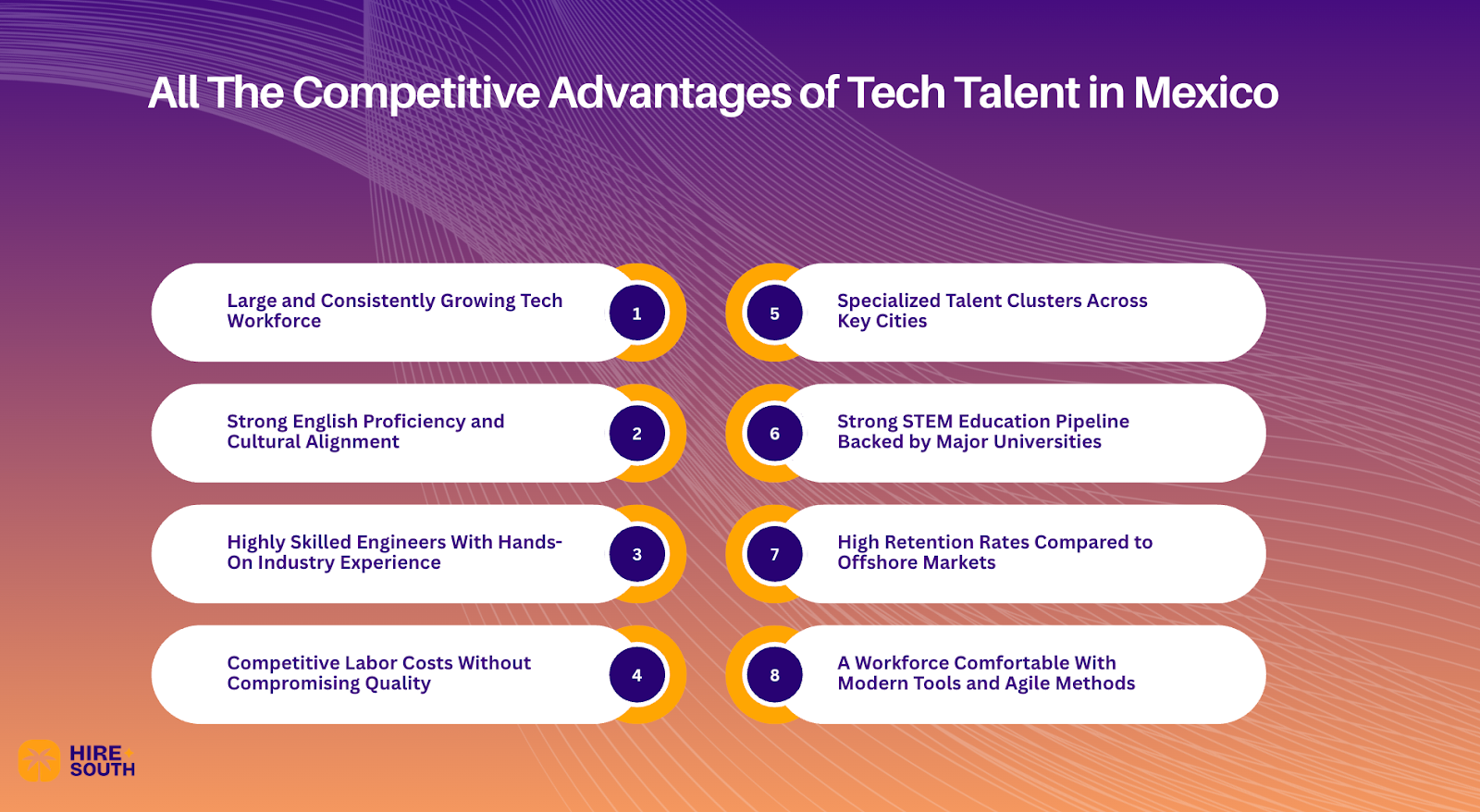
Large and Consistently Growing Tech Workforce.
Mexico offers one of the largest tech talent pools in Latin America. According to Mexico’s National Association of Universities and Higher Education Institutions, ANUIES, the country graduates over 130,000 engineering and technology students each year, placing it among the top global producers of STEM talent. This steady supply helps you scale teams without facing the severe shortages present in many U.S. and European markets.
The workforce also spans a wide range of roles, from full-stack developers to cybersecurity specialists, enabling companies to build full product teams in-country.
Strong English Proficiency and Cultural Alignment.
Mexico ranks among the top three countries in Latin America for English proficiency, according to EF’s English Proficiency Index. This matters when you need real-time collaboration with North American teams. Communication barriers are lower, and project cycles are easier to manage because of shared work styles and cultural familiarity.
You also benefit from near-identical time zones, which reduces delays in code reviews, product discussions, and agile workflows.
Highly Skilled Engineers With Hands-On Industry Experience.
Mexico’s tech professionals are known for practical problem-solving skills. Many engineers build experience early through internships, tech bootcamps, and university programs tied to real industry projects. You see this reflected in the country’s long-standing partnerships with global companies in software development, automotive technology, electronics, and cloud computing.
The presence of more than 600 multinational tech firms, according to the Mexican Ministry of Economy, gives engineers exposure to modern tech stacks and enterprise-grade development environments.
Competitive Labor Costs Without Compromising Quality.
Tech salaries in Mexico remain significantly lower than U.S. averages while still supporting strong workforce stability. According to Glassdoor and Indeed aggregated market data, senior software engineers in Mexico typically earn 40 to 60 percent less than their U.S. counterparts.
This cost structure allows companies to expand technical teams at scale while maintaining high standards in engineering output. It also creates more room for experimentation in product development cycles, since staffing costs don’t become a limiting factor.
Specialized Talent Clusters Across Key Cities.
Mexico’s tech hubs aren’t interchangeable. Each region develops specific strengths. Guadalajara is strong in embedded systems and electronics engineering. Mexico City leads in fintech, cloud services, and enterprise IT. Monterrey focuses on data analytics, automation, and industrial technology. Querétaro has become a center for cloud infrastructure and cybersecurity.
This clustering helps you find talent that fits exact technical needs rather than relying on a one-size-fits-all market.
Strong STEM Education Pipeline Backed by Major Universities.
Mexico’s university network provides a solid foundation for long-term tech workforce development. Institutions such as UNAM and IPN rank among the most respected in Latin America for engineering and computer science. Many programs collaborate with global companies to update curricula and align training with real-world industry demands.
You also see continuous growth in private bootcamps and certification programs that accelerate upskilling in areas like machine learning, DevOps, cloud architecture, and cybersecurity.
High Retention Rates Compared to Offshore Markets.
Employee turnover is generally lower in Mexico than in popular offshore regions. Studies from the Mexican Institute for Competitiveness (IMCO) show that tech roles in Mexico have more stable multi-year retention patterns than markets in South Asia or Eastern Europe.
This stability helps you build long-term product knowledge, maintain consistent code ownership, and avoid productivity dips caused by frequent employee churn.
A Workforce Comfortable With Modern Tools and Agile Methods.
Agile adoption is widespread in the country’s tech sector. Developers commonly work with continuous integration, cloud-native deployment, automated testing, and modern collaboration tools. You’ll find strong proficiency in frameworks like React, Python, Java, Node.js, .NET, Kubernetes, and AWS.
Because teams regularly collaborate with North American companies, processes tend to align closely with U.S. product development standards.
Key Market Trends For Mexico’s Technology Sector in 2026
1. Continued Shift from Hardware to Services and Cloud-Centric Models
Mexico’s tech industry is moving away from hardware and telecom infrastructure as digital services take the lead. Local analysts reported a clear slowdown in hardware sales alongside faster expansion in cloud and managed services, according to El Economista.
For your planning, the takeaway is simple: spending is shifting toward SaaS, cloud migrations, cybersecurity, and advanced IT services. Companies building transformation roadmaps will face fewer barriers when adopting digital-first models in 2026.
2. Cloud Adoption to Surge With Hybrid Models Becoming Standard
Cloud usage is accelerating quickly. According to Mexico Business News, around 45 percent of companies used cloud services intensively in 2024, and that share is expected to reach about 58 percent in 2026. More organizations are combining public cloud with private infrastructure to meet regulatory and performance requirements.
Hybrid nearshore models are also becoming more common as cross-border teams look for lower latency and better integration with U.S. operations, according to Mordor Intelligence.
3. Fintech and Embedded Finance Driving a New Wave of Digital Growth
Fintech remains one of the strongest engines of Mexico’s tech sector. Embedded finance reached around US $17 billion in value in 2024, with growth expected to continue through 2030, according to GlobeNewswire’s industry analysis.
This momentum is reshaping demand for payment infrastructure, digital credit, identity verification, compliance automation, and risk modeling, core areas where Mexican companies are investing heavily heading into 2026.
4. High Demand for Cybersecurity, Data Analytics, and AI Solutions
As companies migrate more workloads to the cloud, demand for cybersecurity, analytics, and AI tools is rising fast. Enterprises are prioritizing secure cloud architectures, data governance, and AI-driven decision systems, according to Mordor Intelligence.
If your operations depend on regulated environments, finance, healthcare, and public services, expect these categories to account for a larger share of IT budgets in 2026.
5. Nearshore Outsourcing and Global Delivery Centers Expanding
Mexico’s nearshore model continues gaining traction. Delivery operations based in the country are projected to grow at a double-digit annual rate, driven by time-zone alignment, bilingual talent, and lower risk compared with offshore regions.
More U.S. companies are rebalancing their tech teams to include nearshore centers for product development, cloud engineering, QA, and DevOps.
6. Rapid Professionalization of SMEs and Mid-Size Tech Providers
Small and mid-size IT companies are expanding their capabilities and building more mature service models. That shift means a wider selection of reliable vendors, more specialized expertise, and better-quality service delivery for companies entering the market.
7. Public-Sector Budget Pressure Shifting Innovation to Private Companies
Government IT spending has faced budget cuts and uneven execution, according to El Economista, which places more responsibility on the private sector to drive modernization.
Fintech firms, cloud service providers, and digital-first enterprises are filling that gap by accelerating the adoption of modern architectures, faster product cycles, and open-banking systems.
8. Diverging Growth: Strong Services, Weak Hardware, and Telecom
Growth across Mexico’s tech market isn’t uniform. Hardware, personal computing, and traditional telecom gear continue to decline, while SaaS, cloud, data center, and digital services remain the most dynamic parts of the industry.
If you’re evaluating where to invest or build partnerships, the strongest gains in 2026 will be concentrated in software, infrastructure-as-a-service, cybersecurity, and analytics.
Ready to Hire Remote Talent in Mexico?
Mexico’s tech landscape is shifting fast, and the companies that tap into these changes early tend to capture the strongest operational and cost advantages. With the country’s IT services market projected to exceed $27 billion by 2026, according to Statista, businesses that act now position themselves ahead of a rapidly accelerating curve.
At Hire South, we help companies build nearshore teams that match this momentum. Our work is grounded in verified labor data, long-term regional experience, and transparent hiring processes that reduce risk and improve outcomes. Whether you're scaling engineering, expanding product capabilities, or establishing a long-term nearshore strategy, we ensure you gain reliable access to high-performing talent across Latin America.
As market pressures grow and digital transformation demands move faster, having a trusted partner becomes a strategic advantage, not a convenience. We’re committed to delivering nearshore staffing solutions that are efficient, compliant, and built for sustainable growth. Let’s help you move forward with a team that’s ready for the next phase of your business. Ready to find your next talent? Contact us to schedule a free strategy call!