
.jpg)

Colombia’s technology sector has evolved into one of the most dynamic in Latin America, and you can feel its growth in the staffing industry the most. With more global companies expanding into the country each year, Colombia has become a top choice for nearshore IT services, software development, and tech innovation.
You’ll see why quickly. The IT sector now represents more than 3 percent of Colombia’s GDP, according to the Ministry of Information and Communications Technologies, and the country hosts over 10,000 tech companies across software, fintech, AI, and outsourcing. That growth didn’t happen overnight, and the combination of talent availability, government incentives, and maturing tech hubs is reshaping the national economy.
In this guide, you’ll explore how the Colombian IT sector works, where the top innovation hubs are located, which technologies lead the market, and what it takes to work successfully with local IT providers. Ready to make smarter decisions when evaluating Colombia as a strategic tech location?
A Quick Overview of Colombia’s Technology Industry
A Diversified, Innovation-Driven Sector.
Colombia’s technology sector isn’t dominated by one specialty. Instead, it benefits from a wide mix of software engineering firms, fintech startups, BPO and IT outsourcing providers, cybersecurity companies, and data-driven organizations. Fintech alone has become a major contributor, with over 300 fintech startups, according to Finnovista’s LATAM Fintech Radar.
This diversification helps stabilize the market and gives you access to multiple technology capabilities within a single national ecosystem. It also creates competition, which keeps service quality high and encourages constant innovation.
Government Policy Supporting Digital Growth.
Strong public policy has helped the IT sector scale. Programs under MinTIC, such as the national digital transformation strategy and incentives for software development companies, have accelerated the adoption of cloud infrastructure, e-government tools, and digital connectivity. Colombia recently expanded broadband coverage to reach 70 percent of households, according to DANE, strengthening the foundation needed for a modern tech-driven economy.
For businesses evaluating the possibility of hiring remote talent in Colombia, this policy environment reduces barriers and boosts long-term stability.
A Talent Ecosystem Built for Scale.
The strength of the technology sector is also tied to Colombia’s talent pipeline. Universities and technical institutes graduate more than 13,000 STEM professionals per year, based on data from the National Education Ministry. Combined with private training programs and international bootcamps, the country is generating a younger, increasingly specialized IT workforce.
That depth positions Colombia as one of the most reliable talent markets in LATAM for software development, nearshore teams, and emerging tech capabilities.
Why Colombia’s Tech Sector Holds Global Attention.
The combination of economic stability, workforce supply, and policy support has turned Colombia into a strategic technology hub for North American and European organizations. The country is now recognized in multiple global rankings, including the IMD World Digital Competitiveness Ranking, which highlights Colombia’s growing digital capabilities in areas like business agility and tech integration.
For companies seeking a nearshore partner or a scalable tech market, Colombia’s technology sector offers a blend of maturity, affordability, and growth potential that stands out in the region.
Key Tech Hubs Rising in Colombia
1. Bogotá’s Expanding Innovation Corridor
Bogotá has become Colombia’s most influential tech hub, thanks to its concentration of talent, universities, and corporate headquarters. The city hosts more than 45 percent of Colombia’s IT companies, according to Invest in Bogotá, and continues to attract new startups and foreign firms seeking a stable business environment.
You benefit from a broad talent pool here. Bogotá produces the highest number of technology and engineering graduates in the country, supported by institutions like Universidad de los Andes and Universidad Nacional. The city also leads in high-speed connectivity and digital infrastructure, which accelerates software development, cloud adoption, and data-driven services.
Its mix of enterprise demand and startup activity makes Bogotá one of the most reliable centers for large-scale technology operations.
2. Medellín’s Smart City Transformation
Medellín’s evolution into a global “smart city” has shaped its reputation as a top-tier tech ecosystem. The city has invested heavily in innovation districts such as the Ruta N complex, which hosts more than 350 technology companies and R&D teams, according to Ruta N’s annual report.
You see a strong coordination between government, academia, and industry. This collaboration model has made Medellín a preferred location for advanced engineering, AI experimentation, and automation projects. The city was even recognized by the World Economic Forum as a center for the Fourth Industrial Revolution, adding global credibility to its tech agenda.
Medellín’s affordability, compared to other innovation hubs in the region, also keeps it competitive for long-term tech investment.
3. Cali’s Growing Software and Analytics Scene
Cali has steadily expanded its role in Colombia’s technology map, especially in software development, digital health, and data analytics. According to Invest Pacific, Cali hosts more than 400 IT and business service companies, supported by a rising number of specialized academic programs and private bootcamps.
You get access to a younger talent pool here, with a strong emphasis on system engineering, data science, and biotech-related technology. Cali’s industrial base also creates consistent demand for digital modernization, giving local firms real-world opportunities to scale their capabilities.
The city’s strategic focus on research and applied technology makes it an emerging contender in the national tech landscape.
4. Barranquilla’s Nearshore and BPO Strength
Barranquilla has carved out a niche in nearshore operations, BPO services, and cloud-enabled IT support. The city’s port infrastructure and regional connectivity give it advantages for companies working across the Americas. According to ProBarranquilla, the city is home to more than 200 BPO and technology service companies, many focused on bilingual support and managed IT services.
You also gain from rapid improvements in connectivity. Barranquilla has become one of Colombia’s fastest-growing cities for fiber-optic expansion, which supports remote and hybrid tech work.
Its combination of operational stability and bilingual talent makes it a practical hub for service delivery and customer-facing technology roles.
All The Competitive Advantages of Colombian Tech Talent
1. Strong STEM Output and a Consistent Talent Pipeline
Colombia produces one of the largest pools of STEM graduates in Latin America. The Ministry of National Education reports more than 13,000 new STEM professionals every year, creating a steady flow of software engineers, data analysts, and IT specialists. This scale makes it easier for you to find talent across multiple skill levels, not just entry-level roles.
The country also invests heavily in technical education. Programs like Misión TIC 2022, which trained over 100,000 people in programming and digital skills (MinTIC), have accelerated the development of junior and mid-level engineers. This ongoing talent creation gives Colombia a long-term advantage in meeting rising global demand for software development and IT roles.
2. High English Proficiency for a Spanish-Speaking Market
Colombia consistently ranks among the top English-speaking countries in Latin America. In the 2023 EF English Proficiency Index, Colombia reached its highest score to date, with cities like Bogotá, Medellín, and Barranquilla classified in the “moderate proficiency” tier.
For you, that translates into smoother communication, easier collaboration, and faster onboarding of teams working with US or European clients. English exposure is especially strong among younger engineers, who often train in bilingual programs, international coding bootcamps, or English-forward private universities.
3. A Culture of Adaptability and Problem-Solving
Colombian tech professionals are known for their adaptability, a trait highlighted frequently by multinational companies operating in the country. Many engineers manage complex projects from early in their careers due to the high concentration of outsourcing firms, BPO providers, and nearshore development centers operating locally.
This environment builds resilience, cross-functional thinking, and comfort with agile methods. It also gives you access to talent that’s familiar with remote workflows, iterative development, and rapid feedback cycles.
4. Experience Working With US and Global Clients
Colombian tech teams often have direct exposure to US processes, tools, and standards. Data from ProColombia shows that more than 400 multinational companies operate tech or digital service centers in the country, giving local engineers consistent experience with North American timelines, compliance expectations, and development frameworks.
This background helps reduce onboarding time. It also strengthens soft skills, especially in areas like stakeholder communication, documentation, and product thinking.
5. Competitive Costs Without Sacrificing Quality
While costs vary by city and seniority, Colombian software developer salaries remain 30 to 50 percent lower than US averages, according to public compensation benchmarks from local recruiting data. You get access to a highly qualified workforce at a cost structure that supports scaling engineering teams without sacrificing capability.
The difference is especially notable in senior technical roles, cloud engineers, and full-stack developers, where talent quality is strong, but competition from local employers is still manageable.
6. A Workforce With Strong Retention Rates
Compared to other major LATAM markets, Colombia has relatively stable tech retention. A study by Invest in Bogotá found that turnover rates in the city’s tech sector are lower than regional averages, helped by a maturing industry and strong university-industry alignment.
For you, this means less churn, longer project continuity, and smoother knowledge transfer, a valuable advantage when building long-term engineering capacity.
7. Growing Expertise in Emerging Technologies
Colombian engineers are quickly adopting new technologies. LinkedIn’s Workforce Insights shows rising specialization in AI engineering, cloud architecture, DevOps, cybersecurity, and data analytics. Medellín and Bogotá, in particular, have become known for cloud-native development and automation skills thanks to partnerships with AWS, Microsoft, and Oracle training programs.
This shift gives you access to a workforce capable of handling modern tech stacks rather than only traditional software roles.
8. Time Zone Alignment With North America
Colombia’s alignment with US Eastern Time (UTC-5) is one of its strongest operational advantages. You gain real-time collaboration without the scheduling friction that comes with offshore teams. For agile teams or product squads that require daily standups, sprint reviews, or UX iterations, this time zone fit is a major productivity booster.
9. A Strong Work Ethic Rooted in Professionalism
Multinational employers consistently point to Colombian tech talent’s commitment to quality, punctuality, and team collaboration. The culture places a high value on reliability and professional communication, which matters when building remote or hybrid teams that need trust and consistency.
These combined advantages make Colombian tech talent one of the most competitive in the region, especially for companies looking for scalability, specialization, and long-term stability.
The Key Market Trends For Colombia’s Technology Sector in 2026
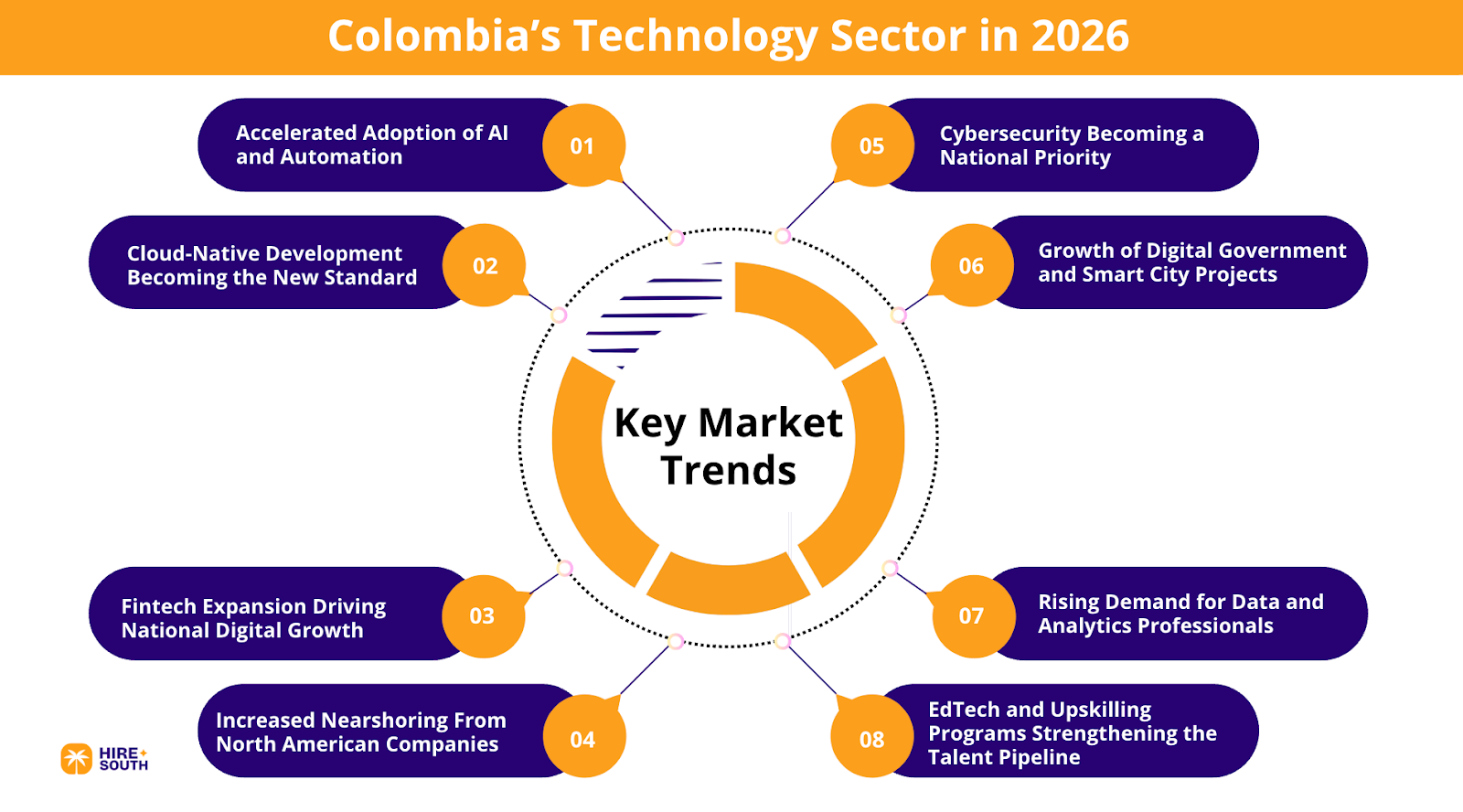
Accelerated Adoption of AI and Automation.
AI adoption is expected to scale sharply across Colombian enterprises by 2026, driven by growing investment in automation, predictive analytics, and machine learning. IDC Latin America reports that AI spending in the region is rising at an annual growth rate of more than 20 percent, placing Colombia among the fastest adopters in Spanish-speaking markets.
You can expect more companies to implement AI for fraud detection, supply chain optimization, and customer service automation. Local universities and training programs are also expanding AI coursework, which will fuel demand for data scientists and AI engineers.
Cloud-Native Development Becoming the New Standard.
Cloud services usage continues to rise across Colombia, and by 2026, cloud-native development is projected to dominate new software deployments. According to MinTIC, cloud adoption in companies increased by over 25 percent in the past three years, and ongoing government digitalization initiatives will accelerate this shift.
For you, this means greater availability of cloud engineers, DevOps specialists, and architects familiar with Azure and Google Cloud certifications. Cloud-native tooling will also make local software teams more competitive on global projects.
Fintech Expansion Driving National Digital Growth.
Colombia’s fintech ecosystem remains one of LATAM’s strongest, with Finnovista reporting more than 300 active fintech startups and sustained year-over-year growth. By 2026, digital payments, embedded finance, and compliance technology are expected to dominate investment.
This growth creates more opportunities for specialists in cybersecurity, blockchain development, and regulatory tech. It also strengthens Colombia’s digital infrastructure, giving you a more advanced financial services environment to collaborate with.
Increased Nearshoring From North American Companies.
Colombia continues to gain traction as a nearshore destination, and the trend is forecast to intensify in 2026. ProColombia states that hundreds of multinational firms have opened tech or digital service operations in the country, and rising demand for bilingual talent is pushing even more organizations toward Colombian cities.
Time zone alignment and cost efficiency remain core drivers. The result is a more globally integrated tech workforce and stronger local specialization in US-facing development and support roles.
Cybersecurity Becoming a National Priority.
With digital transformation accelerating, cybersecurity investment is growing across both public and private sectors. The Colombian Cybersecurity Observatory reported a significant increase in incident monitoring capabilities, and spending on cyber defense is expected to keep rising through 2026.
This demand gives you access to a deeper pool of cybersecurity analysts, SOC specialists, and penetration testers trained on modern threat management tools. It also signals that cyber readiness is becoming a core part of Colombia’s technology strategy.
Growth of Digital Government and Smart City Projects.
Government digitalization is reshaping Colombia’s tech landscape. Programs such as Gov.co’s modernization push and Medellín’s smart city initiatives are creating consistent demand for IoT solutions, advanced data platforms, and citizen-focused digital tools.
By 2026, you can expect more R&D programs, city-level innovation labs, and opportunities for collaboration in areas like mobility tech, public data analytics, and connected infrastructure.
Rising Demand for Data and Analytics Professionals.
Colombia’s digital economy is generating more demand for data professionals than ever. DANE reports that data-driven industries, including finance, logistics, and retail, are expanding at rates above 10 percent annually.
This shift is creating new openings for data engineers, analysts, and BI specialists. For companies working with Colombian teams, 2026 will bring a stronger analytics talent market and broader adoption of modern data stack tools.
EdTech and Upskilling Programs Strengthening the Talent Pipeline.
To keep up with demand, Colombia is increasing its investment in tech education. Public programs such as MinTIC’s digital talent initiative and private bootcamps like Holberton School and Platzi are scaling aggressively. Platzi alone reports over 3 million learners across Latin America, with a strong presence in Colombia.
For you, the result is a continuously growing pipeline of junior developers trained on real-world tech stacks, ready to advance into mid-level roles over the next few years.
Ready to Hire IT Talent in Colombia?
Colombia’s technology sector continues to scale at a pace that outperforms much of Latin America, supported by expanding STEM education, rising AI adoption, and a growing base of multinational tech operations. With hundreds of global companies already operating in the country and strong projections for cloud, fintech, and cybersecurity growth, the market is evolving into a reliable hub for long-term digital capability.
At Hire South, we help companies navigate the Latin American landscape with clarity, structure, and data-driven insights. Our team specializes in assembling high-performing development and operations talent across LATAM's strongest tech hubs, ensuring you gain access to the right skills, time zone alignment, and operational reliability from day one. If you’re building or scaling teams in Latin America, we make the process faster, more transparent, and aligned with your long-term growth strategy. Contact us to start working together!