


If you work with Mexican teams, plan travel to Mexico, or do business across Latin America, knowing the full calendar of local holidays is a must. Mexico doesn’t just have a handful of national days off, there are dozens of official public holidays, cultural observances, regional festivals, and local traditions that affect business rhythms, school calendars, and social life. According to one source, the holiday provider list for 2025 registers 19 holidays for Mexico.
In this article, you will find a complete breakdown of all Mexican holidays: from nationally mandated days off to celebrated civic dates, religious observances, and regional festivities. You’ll discover when and why each holiday is observed, how some are “official” while others are widely recognized but optional, and how the mix of dates can impact business operations, travel, and work planning. You’ll also get a month-by-month holiday calendar and tips for aligning your projects or trips around key Mexican holidays.
Whether you need to sync with a remote team in Mexico, schedule client calls around public holidays, or simply want to understand the rhythm of Mexican business culture and leisure, this list will be your go-to reference for all holidays in Mexico.
First Things First: How Mexico’s Holiday Calendar Is Updated Each Year
How the Federal Government Sets Official Public Holidays.
Mexico’s official public holidays are established through the Ley Federal del Trabajo (LFT) and published by the Diario Oficial de la Federación (DOF). Each year, the DOF reconfirms mandatory rest days and clarifies which dates will be moved to the nearest Monday. This process ensures consistency for employers, schools, and government offices. Most changes are communicated between October and December, giving you enough time to plan staffing, operations, and travel.
Why Some Holiday Dates Shift Annually.
Not every holiday lands on the same weekday. Constitution Day, Benito Juárez’s Birthday, and Revolution Day are legally designated as “puentes” holidays, meaning the observance shifts to a Monday even when the date doesn’t. The LFT formalized this in 2006 to support long weekends and improve nationwide tourism demand. According to Mexico’s Ministry of Tourism, long-weekend holiday periods can boost domestic travel activity by up to 25 percent during peak years, making these adjustments economically relevant.
How Religious and Cultural Holidays Are Added to the Calendar.
Religious and cultural observances, like Semana Santa or Día de la Virgen de Guadalupe, don’t fall under mandatory rest laws, but they are widely recognized. Their dates are confirmed each year by religious institutions or regional governments, then incorporated into national and state calendars used by schools and businesses. Semana Santa changes yearly based on the liturgical calendar, which follows astronomical rules tied to the spring equinox. As a result, these holidays require extra attention when you plan staffing or coordinate with Mexican teams.
Where Updated Holiday Calendars Are Published.
The DOF serves as the official source for final confirmation of national holidays, but state governments often publish their own complementary calendars. Public school calendars come from the Secretaría de Educación Pública (SEP) and typically include additional observances or teacher-training days. Many companies rely on the SEP calendar as a proxy for planning internal schedules because it reflects real behavioral patterns across the country.
Why Businesses Monitor the Calendar Beyond Official Dates.
Mexico’s holiday calendar influences everything from workforce availability to consumer spending. Even non-mandatory holidays can trigger regional slowdowns, early office closures, or shifts in productivity. Keeping track of DOF updates, SEP school cycles, and regional festivities helps you anticipate operational impacts before they hit. For companies with remote or hybrid teams in Mexico, this awareness is essential for forecasting attendance and meeting deadlines.
All National Public Holidays in Mexico
January 1 – New Year’s Day (Año Nuevo)
January 1 is a fixed national holiday and one of the most consistently observed non-working days in Mexico. It marks the start of the annual holiday cycle and is required by law as a paid day of rest according to the LFT.
First Monday of February – Constitution Day (Día de la Constitución)
Although Constitution Day falls on February 5, the official observance takes place on the first Monday of February. The shift was introduced to encourage long weekends and smoother workforce planning, according to Mexico’s federal labor regulations.
Third Monday of March – Birthday of Benito Juárez (Natalicio de Benito Juárez)
Benito Juárez’s birthday is March 21, but the mandatory rest day moves to the third Monday of March. This adjustment supports tourism demand, which can rise by up to 25 percent during long-weekend holiday periods, according to Mexico’s Ministry of Tourism.
May 1 – Labour Day (Día del Trabajo)
Labour Day is observed every May 1 and does not shift. It remains one of the country’s foundational civic holidays and is recognized as a mandatory paid rest day according to the LFT.
September 16 – Independence Day (Día de la Independencia)
Independence Day is a fixed national holiday and one of the most important dates in Mexico’s cultural calendar. It always falls on September 16 and is legally required as a nationwide day off.
Third Monday of November – Revolution Day (Día de la Revolución Mexicana)
Although the historical date is November 20, the national observance takes place on the third Monday of November. This adjustment reflects the same long-weekend model used for other civic holidays under Mexico’s labor law.
December 25 – Christmas Day (Navidad)
Christmas Day is always a mandatory national rest day. For many companies and public institutions, this marks the beginning of reduced activity leading into year-end.
Special Case – Presidential Transition Holiday (Every Six Years)
When Mexico transitions presidential power, a mandatory holiday applies. The official transition date may fall on October 1 depending on constitutional adjustments. This holiday activates only during transition years and is recognized nationwide.
The Religious Holidays Observed Across Mexico
Christianity’s Influence on Mexico’s Holiday Calendar:
Roughly 78% of Mexico’s population identifies as Catholic, according to the National Institute of Statistics and Geography (INEGI). With such a large majority following Catholic traditions, religious observances strongly shape social and business rhythms, even when they aren’t official public holidays. Many offices, schools and regional governments adapt their schedules around these dates because participation is so widespread.
Semana Santa (Holy Week):
Semana Santa is one of the most significant religious periods in Mexico. It includes Palm Sunday, Maundy Thursday, Good Friday, Holy Saturday and Easter Sunday. The observance follows the liturgical calendar, so the dates change every year.
Even though Holy Week is not classified as a mandatory paid holiday under the Ley Federal del Trabajo, many private companies and nearly all schools close for at least two days. According to INEGI, tourism activity during Holy Week can surge by 20% or more, which also leads to adjusted working schedules in travel-heavy regions.
If you coordinate with teams in Mexico, plan for reduced availability from Thursday through Sunday, and in some cases, the entire week.
Día de la Virgen de Guadalupe (December 12):
The Feast of Our Lady of Guadalupe honors Mexico’s patron saint and draws tens of millions of participants each year. According to the Basilica of Guadalupe, the site receives over 10 million pilgrims annually during this celebration, making it one of the most visited religious events in the world.
Despite its importance, December 12 is not an official federal holiday, so business closures vary. Some companies grant the day off, particularly in central Mexico, while others operate on regular schedules. If you’re managing cross-border work, confirm availability early, as this date often affects productivity even without a legal mandate.
Día de los Muertos (November 1–2):
Day of the Dead blends Indigenous and Catholic traditions and is observed nationwide. Families build ofrendas, visit cemeteries and participate in cultural festivals. UNESCO recognizes the celebration as Intangible Cultural Heritage, which reflects its cultural weight.
These dates are not federal rest days, but many local businesses, schools and municipal offices modify their hours. Some regions, especially in central and southern Mexico, treat November 2 almost like an unofficial holiday. For business planning, expect slower communication and possible closures during this period.
Other Widespread Religious Observances:
Mexico also observes dozens of regional patron-saint days, processions and local festivals. Their impact ranges from minor schedule adjustments to full-day shutdowns depending on the community. States like Oaxaca, Puebla and Jalisco have some of the highest concentrations of local religious events, according to regional tourism boards.
If you work closely with a specific region, it’s smart to ask about local observances that might not appear on national calendars.
The Impact of National Holidays on Businesses and Travel
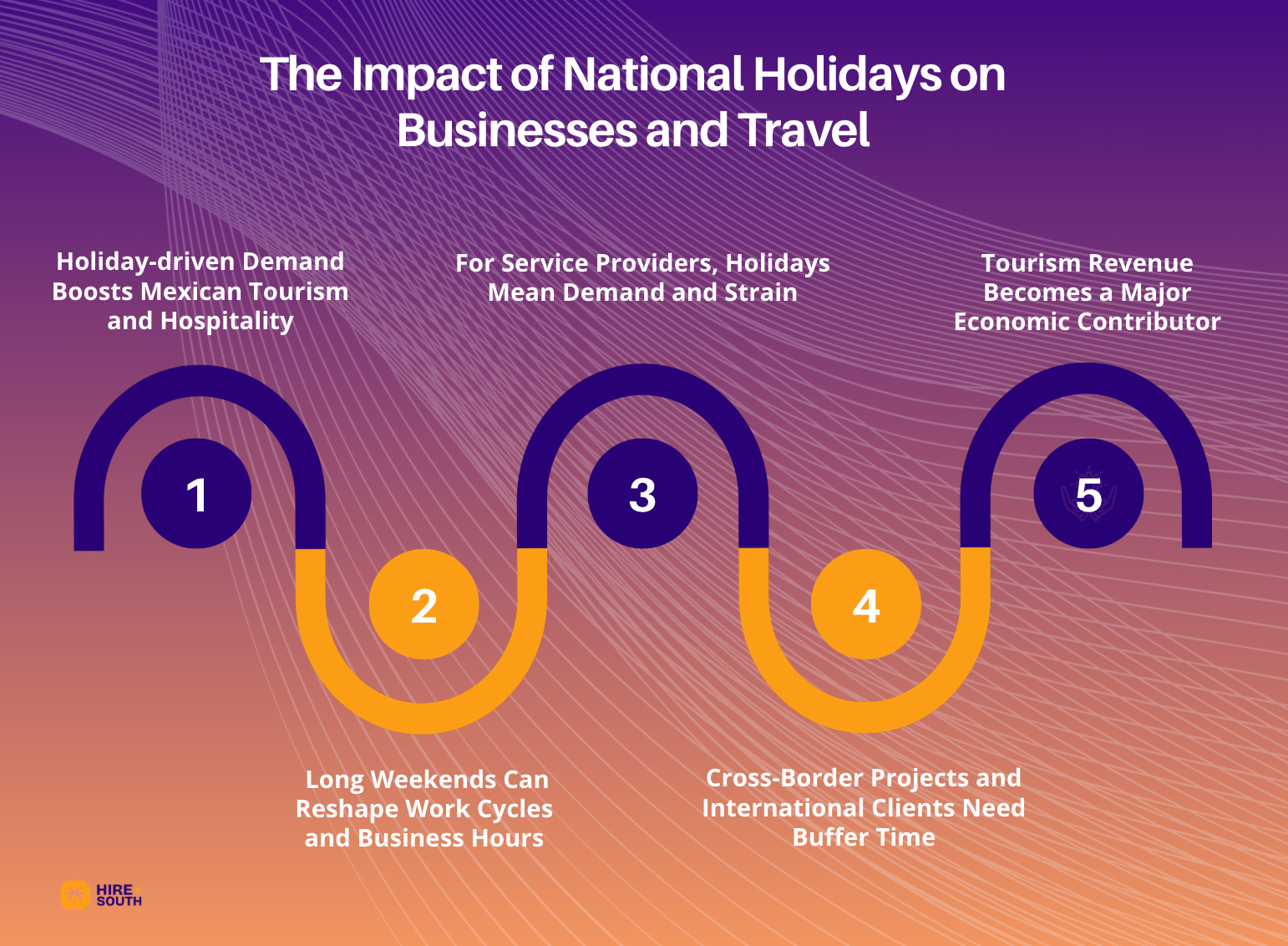
1. Holiday-driven Demand Boosts Mexican Tourism and Hospitality
National holidays and “puente” long weekends in Mexico consistently trigger surges in domestic tourism and hotel occupancy. For example, during the first long weekend of 2025 (January 31–February 3), the government projected a revenue boost of roughly US $2.453 billion in tourism-related spending. During that period, about 1.5 million tourists stayed in hotels, a 5.2 % increase compared to the same holiday in the previous year.
2. Long Weekends Can Reshape Work Cycles and Business Hours
When official holidays are shifted to Mondays, creating long weekends, many companies, institutions, and even some private businesses adjust operating hours or close altogether. This effect influences not only internal work schedules, but also supply-chain timing, client support availability, and cross-border coordination. Planning around these dates ensures smoother operations and fewer surprises.
3. For Service Providers, Holidays Mean Demand and Strain
Sectors like retail, hospitality, transport, and leisure often see heavy demand during public holidays. For travel-related businesses, this can mean full bookings, higher rates, and increased workload. For companies depending on suppliers or services (logistics, shipping, procurement), the holiday calendar may cause delays or reduced service capacity.
4. Cross-Border Projects and International Clients Need Buffer Time
If working with international partners or clients, it’s smart to assume that during national holidays business responsiveness might drop. Emails may go unanswered, deliveries delayed, or meetings rescheduled. To protect timelines, build in buffer days around known Mexican public holidays, especially those generating long weekends.
5. Tourism Revenue Is a Major Economic Contributor Around Holidays
Holiday-driven travel and leisure contribute substantially to Mexico’s tourism economy. Peaks during long weekends and official holidays help sustain demand in hospitality, food & beverage, and retail sectors. This helps balance economic activity during slower months and supports small and medium enterprises that depend on seasonal demand.
Holiday Impact Varies by Region and Sector
Not all regions or industries feel the holiday effect equally. Tourist-heavy destinations, resort towns, cultural heritage cities, beach zones, benefit the most from holiday spikes. By contrast, sectors less tied to travel or retail (e.g., manufacturing, long-term services) may suffer from reduced workforce availability. Understanding your business’s exposure helps mitigate risk or seize opportunity.
Your Planning Wins When You Track Holiday Patterns
To avoid disruptions and take advantage of holiday-related demand, build a routine to track the yearly public holiday calendar early, when it's confirmed for the year. Align staffing, deliverables, and timelines. For travel- or client-facing operations, prepare for higher demand and fluctuating service levels. That way, holidays become a strategic factor, not an afterthought.
Ready to Start Nearshoring?
Mapping out Mexico’s local and national holidays gives you a clearer view of how the year really operates, from workforce availability to regional slowdowns to sudden spikes in travel and consumer activity. With tourism alone generating more than 8% of Mexico’s GDP, according to the World Travel & Tourism Council, these dates shape both economic behavior and day-to-day operations more than many teams expect.
At Hire South, we help companies stay ahead of these patterns by building remote teams in Latin America that operate with predictable schedules, transparent communication, and clear holiday planning built in from the start. Our approach makes it easier for you to collaborate across borders, maintain continuity during peak holiday periods, and scale efficiently with talent that aligns to your business rhythms. If you are ready to start, make sure to contact us to schedule a free strategy call!