


Brazil’s holiday calendar is more than a list of days off; it reflects history, culture, religion, and local pride. Whether you’re planning business activities, managing teams, or scheduling travel, knowing Brazil’s holiday list helps you stay ahead of closures and peak times.
From the nine to twelve national holidays most Brazilians observe each year to dozens of state and municipal celebrations, this guide breaks down all Brazilian holidays you need to know in one place. You’ll find federal holidays like Independence Day, moving observances such as Carnival, regional dates unique to São Paulo or Bahia, and cultural festivals that shape work rhythms across the country.
Did you know Brazil typically has around 12 national holidays on its calendar? According to Brasilescola. That places it among countries with a high number of public holidays, making strategic planning essential for business professionals.
Let’s explore Brazil’s national, regional, and cultural holidays so you can navigate the calendar with confidence.
First Things First: How Brazil’s Holiday Calendar Is Updated Each Year
Understanding how Brazil’s holiday calendar is set helps you plan business operations, staffing, and compliance without guesswork. In Brazil, every public holiday starts with a formal legal process; it isn’t decided by tradition or custom alone, according to Wikipedia.
At the national level, holidays are established by federal law. The core set of Brazil’s official public holidays, like New Year’s Day, Independence Day, and Christmas, comes from statutes such as Law #662/1949, Law #6.802/1980, and updates consolidated under Law #9.093/1995, which specify which dates are holidays for the entire country, according to Wikipedia.
States and municipalities have the authority to add local holidays based on their own calendars. A state might declare a holiday to mark its founding day or an important local event. Municipalities can also designate up to four municipal holidays per year, including religious observances tied to local tradition.
Holiday dates that change each year, like Carnival and Easter-related observances, are handled differently. They’re based on rules tied to other events, such as Easter Sunday. Because these are not fixed to a specific calendar date, each year they are calculated using astronomical or liturgical formulas before governments publish the official schedule.
Every year, the federal government (often through a Ministry ordinance published in the Diário Oficial da União) confirms the list of national holidays and pontos facultativos, days off that aren’t technically holidays but are treated as non-working days in public administration, according to Folha do Litoral. States and municipalities do the same through official decrees in their regional gazettes.
This structured legal framework means you can’t assume a holiday will occur unless it’s codified by law or official decree, according to Wikipedia. For employers and planners, that clarity reduces risk and helps you align staffing, deadlines, and service delivery with Brazil’s dynamic holiday calendar.
All National Public Holidays in Brazil
When you refer to all national public holidays in Brazil, you’re talking about dates recognized by federal law as non-working days across the country, according to Pukspeed. Brazil observes 11 official national holidays each year.
New Year’s Day — January 1
This marks the start of the year and is celebrated nationwide as a public holiday, according to Pukspeed.
Carnival — Variable dates in February or March
Carnival Monday and Tuesday are widely observed, though they are sometimes classified as pontos facultativos rather than fixed statutory holidays, according to Pukspeed.
Good Friday — Friday before Easter
A mandatory national holiday, Good Friday is observed throughout Brazil as part of Easter Week, according to Pukspeed.
Tiradentes Day — April 21
This holiday honors Joaquim José da Silva Xavier, a leader in Brazil’s independence movement, according to Pukspeed.
Labor Day — May 1
International Workers’ Day is recognized nationwide as a legal holiday, according to Pukspeed.
Corpus Christi — Variable date in June
Observed 60 days after Easter, Corpus Christi is recognized as a national holiday in many sectors, according to Pukspeed.
Independence Day — September 7
Commemorating Brazil’s independence from Portugal in 1822, this day is a national holiday according to Wikipedia.
Our Lady of Aparecida — October 12
Honoring Brazil’s patron saint, this date is federally recognized as a public holiday according to Pukspeed.
All Souls’ Day — November 2
Known as Finados, it is observed nationally to honor deceased loved ones, according to Pukspeed.
Republic Proclamation Day — November 15
Marking the proclamation of the republic in 1889, this date is recognized nationwide according to Pukspeed.
Black Awareness Day — November 20
Also called Dia da Consciência Negra, it honors Afro-Brazilian heritage and is a national holiday, according to Wikipedia.
Christmas Day — December 25
Widely observed and legally recognized, Christmas is a national public holiday in Brazil, according to Pukspeed.
The Religious Holidays Observed Across Brazil
Brazil’s calendar includes several religious holidays that influence business schedules, public services, and cultural life. Most are rooted in Catholic tradition but are observed widely across society. Brazil has one of the highest numbers of religious holidays worldwide, with a majority of national holidays linked to faith and tradition.
1. Carnival
Carnival falls before Lent and is both a cultural and religious observance. While its legal classification can vary, many businesses close or operate on reduced hours during Carnival Monday and Tuesday, making it one of the most impactful dates for planning.
2. Good Friday
Commemorating the crucifixion of Jesus, Good Friday is a mandatory public holiday in most states. Religious services and solemn observances dominate the day, affecting public and private operations alike.
3. Easter Sunday
Easter marks the resurrection of Christ. Although not always a statutory holiday, it is widely observed through church services and community events, shaping work rhythms and tourism activity.
4. Corpus Christi
Celebrated 60 days after Easter, Corpus Christi honors the Eucharist in Catholic tradition. Many municipalities treat it as a civic holiday, and large public processions can lead to temporary street closures, impacting transport and logistics.
5. Our Lady of Aparecida
October 12 celebrates Brazil’s patron saint, drawing large-scale pilgrimages and ceremonies nationwide. It is a federal holiday, making it a critical date to plan around for national operations.
6. All Souls’ Day (Finados)
November 2 is dedicated to remembering the deceased. Many Brazilians visit cemeteries or attend services, which affects work schedules and public services, even though commercial observance can vary.
In addition to these national religious holidays, regions host locally significant faith-based events. The Círio de Nazaré procession in Pará attracts millions each year, effectively becoming a regional holiday, while the Procession of the Fogaréu in Goiás and the Festival of Our Lady of Navigators in Porto Alegre shape local calendars and business activity.
Religious observances in Brazil therefore, directly influence staffing, commercial activity, and community engagement, making it essential to account for them when planning operations or public events.
The Impact of National Holidays on Businesses and Work Travel
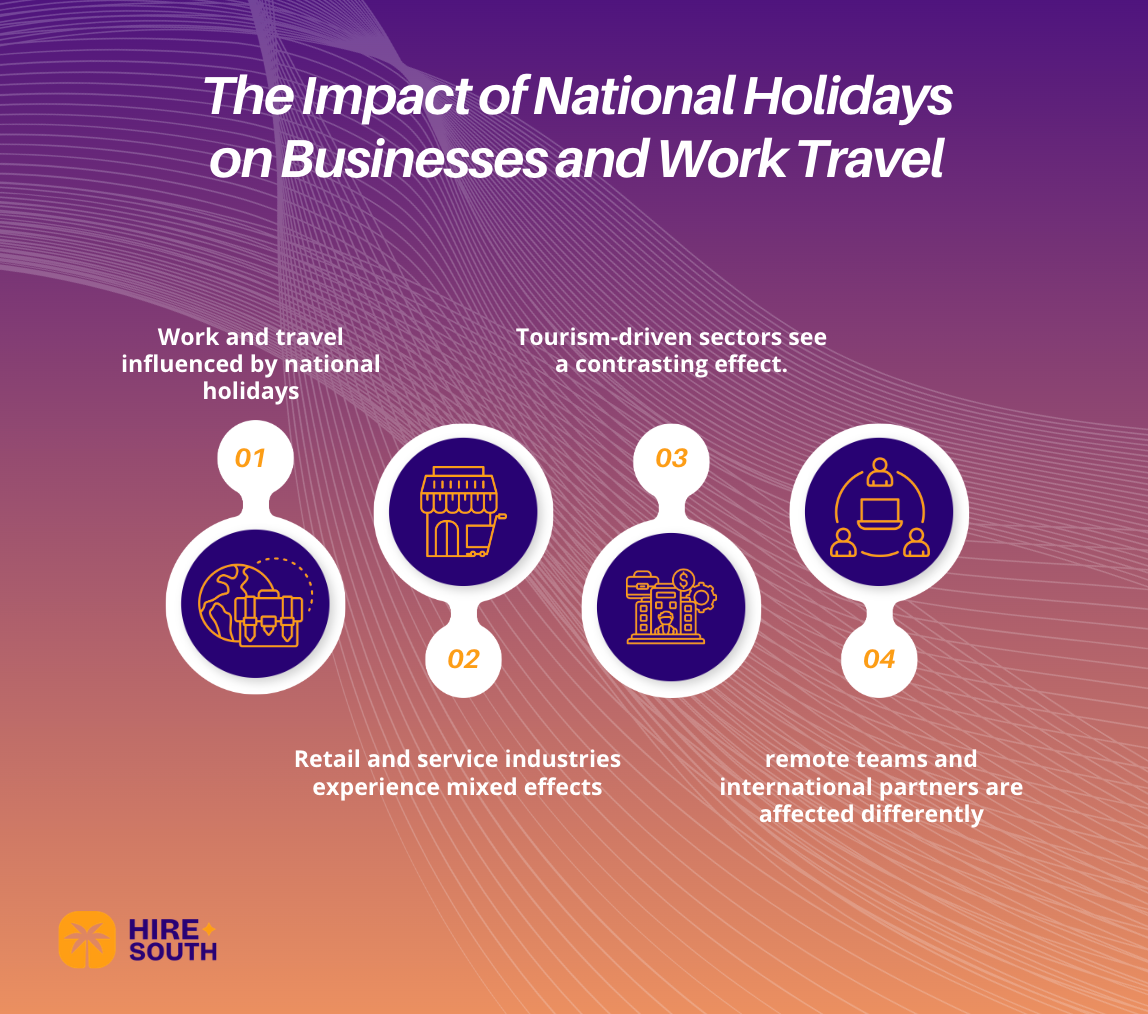
National holidays in Brazil have a direct effect on business operations, staffing, and travel planning. On official public holidays, government offices, banks, and most private companies close, which can delay project timelines and limit access to essential services.
For businesses operating across multiple states, understanding which holidays are observed federally versus regionally is critical. While federal holidays apply nationwide, states and municipalities can add local holidays that affect only part of your workforce or clients. This means you may need to adjust schedules for payroll, client deadlines, and supply chain operations.
Work travel is also influenced by national holidays. Airports, train stations, and bus services often experience peak demand during Carnival, Christmas, and Easter, with domestic flights up to 30% more expensive during these periods, according to Brazil’s National Civil Aviation Agency. Planning trips around these dates can save time and costs while reducing stress.
Retail and service industries experience mixed effects. Many retail stores remain open on holidays, but staffing can be limited, leading to slower service. For B2B operations, holidays often cause delays in shipping, procurement, and administrative processes, making it important to build buffers into project timelines.
Tourism-driven sectors see a contrasting effect. Hotels, restaurants, and entertainment venues often report occupancy and revenue spikes during Carnival, Corpus Christi, and Our Lady of Aparecida celebrations. Businesses involved in logistics or hospitality must anticipate these peaks to optimize staffing and resource allocation.
Finally, remote teams and international partners are affected differently. You may find that emails and requests sent on national holidays receive delayed responses, impacting cross-border project coordination. Proactively planning meetings and deadlines around known holidays ensures smoother operations and avoids workflow bottlenecks.
Understanding the interplay between national holidays and business activity helps you reduce operational risk, improve workforce planning, and manage travel expenses effectively in Brazil’s unique calendar.
Ready to Hire Remote Talent in Brazil?
Brazil’s complex holiday calendar can significantly influence business operations, travel, and workforce planning, with companies often experiencing up to 20% slower administrative processing during national holidays, according to data from the Brazilian Institute of Geography and Statistics. Understanding when federal, state, and municipal holidays occur is essential for maintaining productivity and avoiding costly delays.
At Hire South, we specialize in helping businesses navigate these challenges by connecting you with highly skilled remote teams across Latin America. Whether you need support managing projects, coordinating operations, or maintaining workflow during Latin America's busiest holiday periods, we provide tailored solutions to ensure your business stays on track year-round. Contact us to schedule a free discovery call today!