


Uruguay’s technology sector is no longer a niche story. It’s a major economic force, with the industry generating over US $3.3 billion in revenue in 2023 and accounting for about 4.4 % of the country’s GDP, a growth trajectory that’s turning heads across Latin America, according to AméricaEconomía.
In this guide, you’ll get a clear picture of the IT sector in Uruguay, exploring how it’s structured, why global companies are tapping into Uruguayan tech talent, and what challenges lie ahead. You’ll learn how the workforce is evolving, where the biggest opportunities are right now, and how policy and exports are shaping the broader technology ecosystem.
Whether you’re evaluating Uruguay as a nearshore destination, planning to hire tech teams, or researching market trends, this overview will give you the context and insights you need to navigate the country’s thriving technology landscape with confidence.
Overview of Uruguay’s Technology Sector
What Defines Uruguay’s Technology Sector Today.
Uruguay’s technology sector is built around software development, IT services, and digital products created for export markets. Most technology companies operate with an international mindset from day one, designing solutions for clients in North America, Europe, and other parts of Latin America. This export-first structure shapes everything from pricing models to talent profiles and project management standards.
How the IT Sector Fits Into Uruguay’s Broader Economy.
Unlike commodity-driven industries, Uruguay’s IT sector is knowledge-based and relatively resilient to external shocks. Technology exports do not depend on logistics chains or raw materials, which makes them more stable during global disruptions. This has positioned the sector as a long-term growth engine rather than a cyclical one.
Public and private investment have reinforced this role. Technology is consistently prioritized in national development strategies, with strong alignment between economic policy, education, and export promotion. As a result, IT services have become one of Uruguay’s top export categories by value.
Export Orientation and International Demand.
A defining feature of Uruguay’s technology sector is its reliance on international clients. The majority of revenue comes from exports, particularly software development, SaaS platforms, and IT consulting services. The United States remains the primary destination, followed by Europe and regional markets, according to data published by Uruguay XXI.
This export focus has pushed companies to adopt global best practices early. You’ll see widespread use of agile methodologies, English-first documentation, and compliance with international security and data protection standards.
Market Maturity and Business Stability.
Uruguay’s IT sector is not emerging, it is established. Many technology companies have been operating for over a decade, with repeat international clients and stable delivery models. Business continuity, legal certainty, and low levels of political volatility support long-term contracts and ongoing partnerships.
From a risk perspective, this maturity matters. Uruguay consistently ranks among the most stable and transparent countries in Latin America, which reduces operational uncertainty for technology-driven projects, according to World Bank governance indicators.
Positioning Within Latin America’s Tech Landscape.
Uruguay does not compete on volume. It competes on reliability, quality, and predictability. While larger markets offer scale, Uruguay’s technology sector stands out for its consistency and ease of doing business. This positioning has helped the country maintain a strong reputation despite its smaller population.
For business professionals evaluating technology ecosystems in the region, Uruguay is best understood as a high-trust, export-oriented IT market with proven delivery capacity and a clear international focus.
Key Tech Hubs Rising in Uruguay
- Montevideo
Montevideo concentrates the largest share of Uruguay’s technology companies, startups, and IT talent. The capital hosts the majority of software firms, digital service providers, and multinational tech offices operating in the country. According to Uruguay XXI, over 60 percent of Uruguay’s technology companies are based in Montevideo, making it the undisputed core of the national IT ecosystem.
You benefit from a dense network effect here. Talent, universities, accelerators, and investors operate within a compact geographic area, which simplifies collaboration and speeds up hiring and project execution.
- Zonamerica and Technology-focused Business Districts
Zonamerica stands out as one of Uruguay’s most established technology clusters. It hosts hundreds of companies operating in software development, shared services, fintech, and data-driven industries. According to Zonamerica’s published figures, more than 40 percent of companies operating in the zone are linked to technology and knowledge-based services.
These zones matter because they combine tax incentives with modern infrastructure, strong connectivity, and proximity to skilled professionals. For tech operations that depend on stability and long-term planning, this concentration reduces operational friction.
- Emerging Hubs Beyond the Capital
While Montevideo leads, secondary cities are gaining relevance. Locations such as Punta del Este and Colonia are attracting smaller technology teams, digital nomads, and product-focused startups. Improved connectivity and remote-first work models are driving this shift.
These emerging hubs are not competing with Montevideo. They complement it. You’ll often see distributed teams where core operations remain in the capital, while satellite teams operate from lower-density cities with a high quality of life.
- Role of Universities and Innovation Centers
Technology hubs in Uruguay are closely tied to academic institutions. Universities such as Universidad de la República and ORT Uruguay play a direct role in talent development and applied research. According to national education data, Uruguay graduates thousands of students annually in engineering, computer science, and related fields, feeding local tech ecosystems year after year.
Innovation centers, incubators, and public-private programs frequently operate near these institutions, reinforcing local hubs with early-stage talent and applied innovation.
- Infrastructure and Digital Readiness of Tech Hubs
Uruguay’s tech hubs benefit from strong digital infrastructure. The country consistently ranks at the top of Latin America for internet penetration and fiber-optic coverage. According to the International Telecommunication Union, Uruguay has one of the highest fixed broadband penetration rates in the region, which directly supports distributed software teams and cloud-based operations.
Reliable connectivity, combined with compact urban layouts, makes these hubs efficient environments for technology-driven work.
All The Competitive Advantages of Uruguayan Tech Talent
1. Strong Technical Foundation and Problem-solving Skills
Uruguayan tech professionals are known for solid fundamentals in software engineering, system architecture, and analytical thinking. University programs place heavy emphasis on math, logic, and applied computer science, which shows up in how teams approach complex technical challenges. You tend to work with developers who understand not just how to code, but why systems behave the way they do.
This foundation reduces rework and shortens onboarding time, especially on long-term or product-driven projects.
2. High English Proficiency for Global Collaboration
English fluency is one of the clearest competitive advantages. Uruguay consistently ranks at the top of Latin America for English skills. The country placed first in Latin America in the EF English Proficiency Index, according to Education First, outperforming much larger markets in the region.
For you, this means fewer communication barriers. Technical discussions, documentation, and stakeholder meetings happen without constant translation or clarification.
3. Cultural Alignment With International Business Teams
Uruguayan tech talent tends to align well with North American and European work cultures. There is a strong emphasis on punctuality, accountability, and direct communication. Feedback cycles are typically transparent, which helps keep projects moving without unnecessary friction.
This alignment is not accidental. Many professionals have years of experience working with overseas clients, often embedded in distributed teams across multiple time zones.
4. Time Zone Compatibility and Real-time Collaboration
Uruguay operates in a time zone that closely overlaps with the United States and parts of Europe. This allows for real-time collaboration during standard business hours, rather than relying on asynchronous communication alone.
For agile teams, this matters. Daily standups, sprint planning, and live troubleshooting are easier to manage when schedules naturally align.
5. Experience With Export-driven Technology Work
A large share of Uruguayan developers build software for foreign markets. According to Uruguay XXI, the majority of technology sector revenue comes from exports, which means local talent is accustomed to international quality standards, security requirements, and delivery expectations.
You’re not working with teams that are learning global delivery from scratch. The experience is already there.
6. Education Quality and Continuous Upskilling
Uruguay’s education system supports long-term talent development. The country has one of the highest literacy rates in Latin America, exceeding 98 percent according to UNESCO, and strong public access to higher education in technical fields.
Beyond formal education, continuous learning is common. Developers regularly update their skills in cloud platforms, modern frameworks, and emerging technologies to stay competitive in export markets.
7. Reliability and Low Attrition Compared to Regional Peers
Talent stability is another advantage. Uruguay’s technology workforce shows lower volatility than many regional markets, supported by political stability and a high quality of life. This reduces the risk of sudden turnover and knowledge loss inside technical teams.
For you, that stability translates into continuity, deeper product knowledge, and more predictable delivery over time.
Key Market Trends For Uruguay’s Technology Sector in 2026
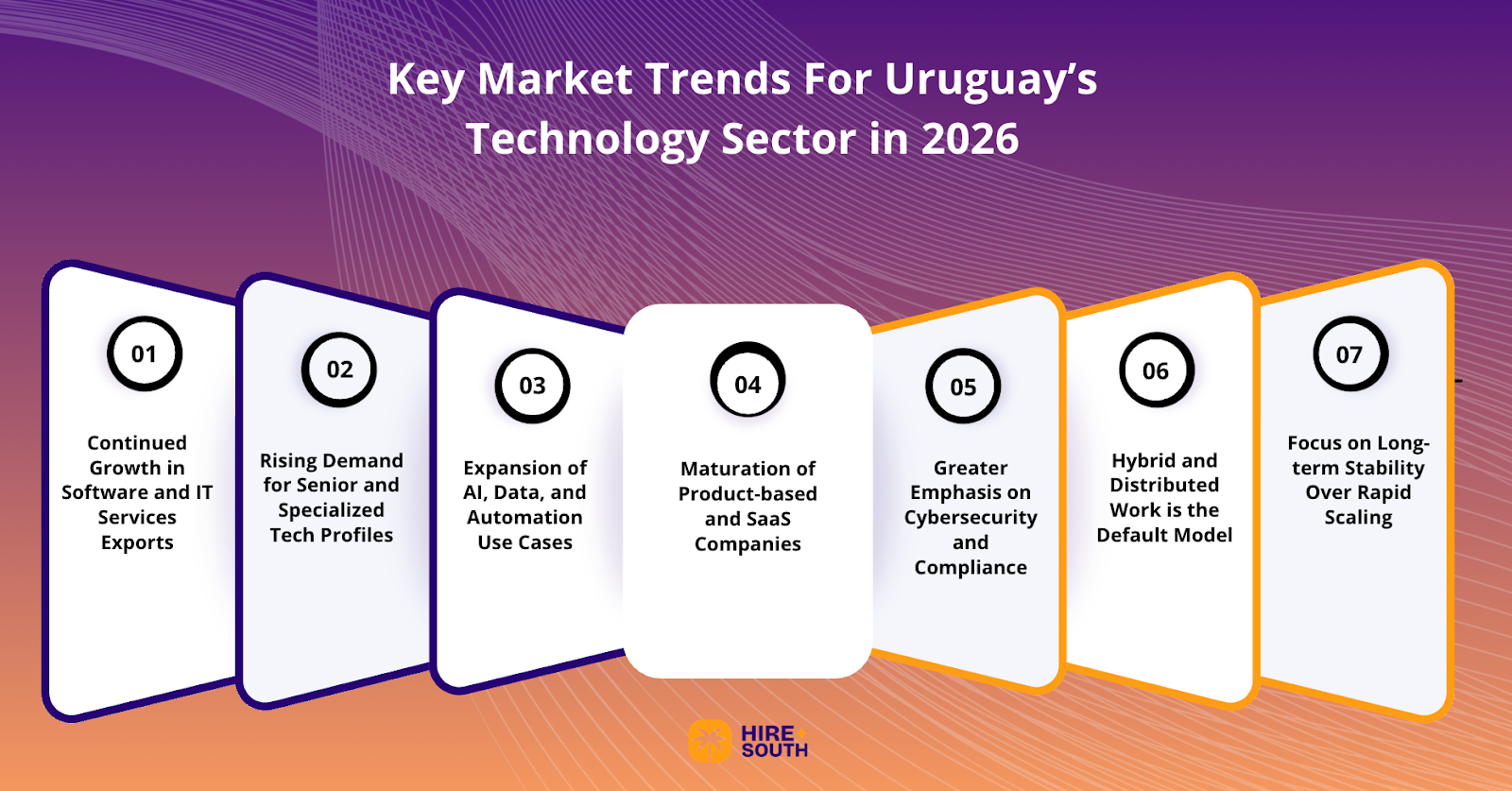
Continued Growth in Software and IT Services Exports:
Export-driven growth remains the strongest trend heading into 2026. Uruguay’s technology sector continues to rely heavily on international demand, especially from the United States and Europe. According to Uruguay XXI, technology and software services are among the country’s top export categories by value, with exports steadily increasing year over year.
You can expect companies to double down on export-oriented delivery models, prioritizing scalability, security compliance, and long-term client relationships over short-term projects.
Rising Demand for Senior and Specialized Tech Profiles:
The market is shifting toward experience. Demand is growing fastest for senior developers, architects, and specialists in areas such as cloud infrastructure, data engineering, and AI-driven systems. This reflects a broader move away from staff-heavy models toward smaller, highly skilled teams.
For you, this trend signals tighter competition for advanced talent and a stronger emphasis on retention and continuous upskilling.
Expansion of AI, Data, and Automation Use Cases:
Artificial intelligence is no longer experimental within Uruguay’s tech sector. Companies are increasingly integrating AI into existing products, analytics platforms, and internal processes. According to the Inter-American Development Bank, AI adoption across Latin America is accelerating as companies focus on productivity and efficiency gains, and Uruguay is among the countries best positioned due to its digital readiness.
The focus in 2026 is on practical AI, automation that reduces costs, improves decision-making, and integrates smoothly into existing systems.
Maturation of Product-based and SaaS Companies:
Uruguay’s technology sector is seeing a gradual shift from pure service delivery toward product development. More local companies are building SaaS platforms aimed at global niches, especially in fintech, logistics, and enterprise software.
This trend increases the need for long-term product thinking, UX design, and lifecycle management skills, not just coding capacity.
Greater Emphasis on Cybersecurity and Compliance:
Security is becoming a baseline requirement, not a differentiator. As Uruguayan tech companies handle more sensitive data for international clients, compliance with global standards is gaining importance. According to the World Economic Forum, cybersecurity risks remain one of the top global business concerns, pushing technology providers to strengthen governance and security practices.
You’ll see increased investment in secure architectures, DevSecOps, and compliance frameworks aligned with international regulations.
Hybrid and Distributed Work is the Default Model:
Remote and hybrid work models are fully embedded in Uruguay’s technology sector. This is no longer a pandemic-driven adjustment. It’s a structural shift. Uruguay’s strong broadband infrastructure supports this trend, with the International Telecommunication Union consistently ranking the country among Latin America’s leaders in connectivity.
By 2026, distributed teams are the norm, allowing companies to operate across cities while maintaining centralized delivery standards.
Focus on Long-term Stability Over Rapid Scaling:
The final trend is strategic caution. Rather than chasing rapid headcount growth, many technology firms are prioritizing stability, predictable revenue, and sustainable margins. Uruguay’s relatively small labor market reinforces this approach.
For business professionals, this means a technology sector that favors reliability, quality, and continuity as defining competitive advantages going into 2026.
Ready to Hire Tech Talent in Uruguay?
Uruguay’s technology sector has proven it can deliver consistency, export capacity, and long-term value in a region often defined by volatility. With software and IT services generating billions in revenue and representing around 4.4 percent of national GDP, the sector has moved well beyond an emerging-market narrative.
At Hire South, we work directly with this ecosystem every day. We help companies access vetted Latin American tech talent, build compliant hiring structures, and scale teams with clarity around costs, timelines, and risk. Our approach is grounded in local expertise and real operating experience, so you can make informed decisions when expanding or nearshoring technology operations in Uruguay and all of LATAM. Contact us to learn more!