

The technology sector in the Dominican Republic is gaining momentum, and if you’re evaluating the market for expansion, partnerships, or nearshore talent, understanding the landscape is key. This guide walks you through the structure of the Dominican Republic's IT sector, its rapid growth, and where real opportunities are emerging.
Digital adoption is already strong. About 91 percent of the population uses the internet, according to DataReportal, creating a solid foundation for software development, IT services, and digital business models. You’ll explore the main technology industries, workforce skills, infrastructure, government support, and the challenges companies should consider when developing their strategy.
Whether you’re comparing LATAM markets or assessing the Dominican Republic’s technology sector as a nearshore option, this article gives you a clear, practical view of what’s happening on the ground and what to expect next.
If you want, I can keep this same structure and sourcing style consistent across the entire article.
Overview of the Dominican Republic’s Technology Sector
The technology sector in the Dominican Republic has evolved beyond basic IT services and is now an integral part of the country’s economy and digital transformation strategy. Growth isn’t just anecdotal, the Dominican Republic climbed eight places in the Latin America and Caribbean Information and Communication Technology Development Index, landing 15th among 33 regional economies and scoring 75/100 points according to the International Telecommunication Union (ITU), demonstrating measurable progress in connectivity, access, and ICT capability.
At its core, the Dominican Republic’s tech landscape is shaped by a mix of digital services, software development initiatives, telecom advancements, and an expanding ICT workforce. National strategies aim to strengthen digital government, cybersecurity, governance frameworks, and technological innovation, positioning ICT as a driver of competitiveness and economic efficiency.
The sector’s structure reflects both domestic and export-oriented activities. Traditional IT services and business process outsourcing operate alongside emerging tech verticals like fintech, cloud solutions, and digital platforms. Free trade zones and investment incentives have attracted technology firms and foreign partners, especially in software, data centers, and nearshore service models.
Education and workforce development are key pillars in this ecosystem. Institutions and government programs have been increasing technical training and digital skills creation, with organizations like INFOTEP and ITLA expanding programs in software, cloud, cybersecurity, and related fields to meet rising industry demand.
On the market front, the IT services segment in the Dominican Republic is forecast to generate approximately US $737.6 million in revenue in 2025, with outsourcing as a dominant sub-segment and projected compound annual growth through 2030 of nearly 6 percent, underscoring steady expansion in technology services demand.
Despite these gains, tech adoption within broader society remains uneven. E-commerce penetration and advanced digital utilization still lag behind regional peers, indicating room for deeper integration of tech across industries and consumer markets.
Overall, the Dominican Republic’s tech sector blends structural growth, targeted public policy, and expanding talent pipelines, making it increasingly relevant for local and international business strategies.
Key Tech Hubs Rising in The Dominican Republic
1. Santo Domingo as the Core Technology Hub
Santo Domingo is the country’s most mature and concentrated tech hub. The city hosts the Parque Cibernético de Santo Domingo, one of the Dominican Republic’s first technology-free zones, designed specifically for IT services, software development, and export-oriented digital companies. Its proximity to Las Américas International Airport and access to modern infrastructure make it a natural center for large-scale tech operations, according to information published by the Parque Cibernético administration.
2. Academic Talent Concentration in the Capital
The capital’s ecosystem is reinforced by higher education institutions with strong engineering and technology programs. Instituto Tecnológico de Santo Domingo (INTEC) plays a central role in supplying software engineers, data specialists, and systems professionals to the local market, according to institutional data from INTEC. This steady talent pipeline helps sustain growth across startups, multinational IT firms, and digital services providers.
3. Santiago de los Caballeros as a Secondary Tech Hub
Santiago de los Caballeros has positioned itself as the Dominican Republic’s second most important technology hub. The city combines a large urban workforce with lower operating costs compared to the capital, making it attractive for software development and IT outsourcing. Its growing relevance is tied to a strong academic base and expanding private sector activity, according to regional technology ecosystem analyses.
4. University-Driven Growth in Santiago
Universities play a defining role in Santiago’s tech momentum. Universidad Tecnológica de Santiago (UTESA) supports the local ecosystem through multi-campus technical education and applied technology programs, according to UTESA institutional publications. This academic presence contributes to a consistent supply of junior and mid-level tech professionals entering the market each year.
5. Puerto Plata and the Punta Bergantín Innovation Hub
On the northern coast, Punta Bergantín Innovation Hub near Puerto Plata represents a strategic government-backed effort to decentralize innovation. The project is designed to connect startups, universities, investors, and public institutions under a single innovation framework, according to the Dominican Republic digital economy overview published by the US International Trade Administration. The focus is on entrepreneurship, technology transfer, and scalable digital ventures.
6. Punta Cana’s Emerging Tech and Outsourcing Scene
Punta Cana is gradually evolving beyond tourism into a supporting tech and outsourcing location. Improved infrastructure, international connectivity, and a growing professional population are driving interest from IT services and support operations, according to regional nearshore and outsourcing market reports. The city appeals to companies, balancing operational efficiency with lifestyle considerations for talent.
7. Smaller Cities Entering the Tech Ecosystem
Cities such as La Vega and Puerto Plata are beginning to attract early-stage technology companies and SMEs seeking lower costs and regional incentives. These locations benefit from government-supported digital inclusion and regional development programs, according to Dominican policy and regional development publications, helping broaden the national tech footprint beyond major urban centers.
8. A More Distributed National Tech Landscape
Together, these hubs reflect a shift toward a more geographically distributed technology sector. While Santo Domingo remains the primary anchor, secondary and emerging hubs are expanding the Dominican Republic’s capacity to support software development, IT services, and digital innovation across multiple regions, strengthening resilience and long-term scalability.
All The Competitive Advantages of the Dominican Tech Talent
1. Strong Nearshore Time Zone Alignment
The Dominican Republic operates on Atlantic Standard Time, GMT-4, with no daylight saving changes. This creates near-perfect overlap with U.S. East Coast business hours and solid alignment with Central and South America. For you, that means real-time collaboration, faster feedback loops, and fewer delays caused by asynchronous work.
This time zone consistency is one of the most practical advantages for distributed engineering and product teams.
2. Growing and Diversified Tech Talent Pool
The country has made sustained investments in technology education over the last decade. According to the World Bank, the Dominican Republic has expanded tertiary enrollment in science, technology, engineering, and mathematics programs as part of its digital economy strategy.
You’ll find talent across software development, QA, data analytics, cloud support, and IT operations, not just entry-level roles.
3. Competitive Labor Costs Without Skill Compromises
Tech salaries in the Dominican Republic remain significantly lower than in the U.S. while maintaining strong technical standards. According to PayScale and regional labor market data, software developer salaries in the Dominican Republic are often 40 to 60 percent lower than U.S. equivalents, depending on role and seniority.
This cost efficiency allows you to scale teams sustainably without sacrificing delivery quality.
4. High English Proficiency in the Tech Sector
While Spanish is the official language, English proficiency is notably higher within the tech and professional services workforce. According to EF Education First’s English Proficiency Index, the Dominican Republic ranks in the moderate proficiency category, with stronger performance in urban and professional populations.
For global teams, this reduces friction in documentation, meetings, and cross-functional communication.
5. Cultural Compatibility With North American Teams
Dominican professionals are accustomed to working with U.S. and international clients, especially in IT services, BPO, and software development. Business norms, communication styles, and project management frameworks closely mirror North American practices.
This cultural alignment shortens onboarding time and lowers the risk of misaligned expectations.
6. Stable Connectivity and Digital Infrastructure
According to the International Telecommunication Union, internet penetration in the Dominican Republic exceeds 85 percent, with reliable broadband access concentrated in major cities like Santo Domingo and Santiago.
For remote and hybrid tech teams, consistent connectivity is a baseline requirement, not a bonus.
7. Government Support for the Tech and Digital Economy
The Dominican government has prioritized technology and innovation through national digital agendas and free trade zones that support IT services. According to ProDominicana, the country actively promotes software development and technology exports as part of its economic growth strategy.
This policy environment supports long-term talent availability and ecosystem maturity.
8. Proven Track Record in Nearshore Delivery
Dominican tech professionals already support companies across various sectors, including fintech, SaaS, e-commerce, healthcare, and logistics. The nearshore model is established, not experimental.
For you, this translates into teams that understand remote delivery standards, security requirements, and performance expectations from day one.
Key Market Trends For The Dominican Republic’s Technology Sector in 2026
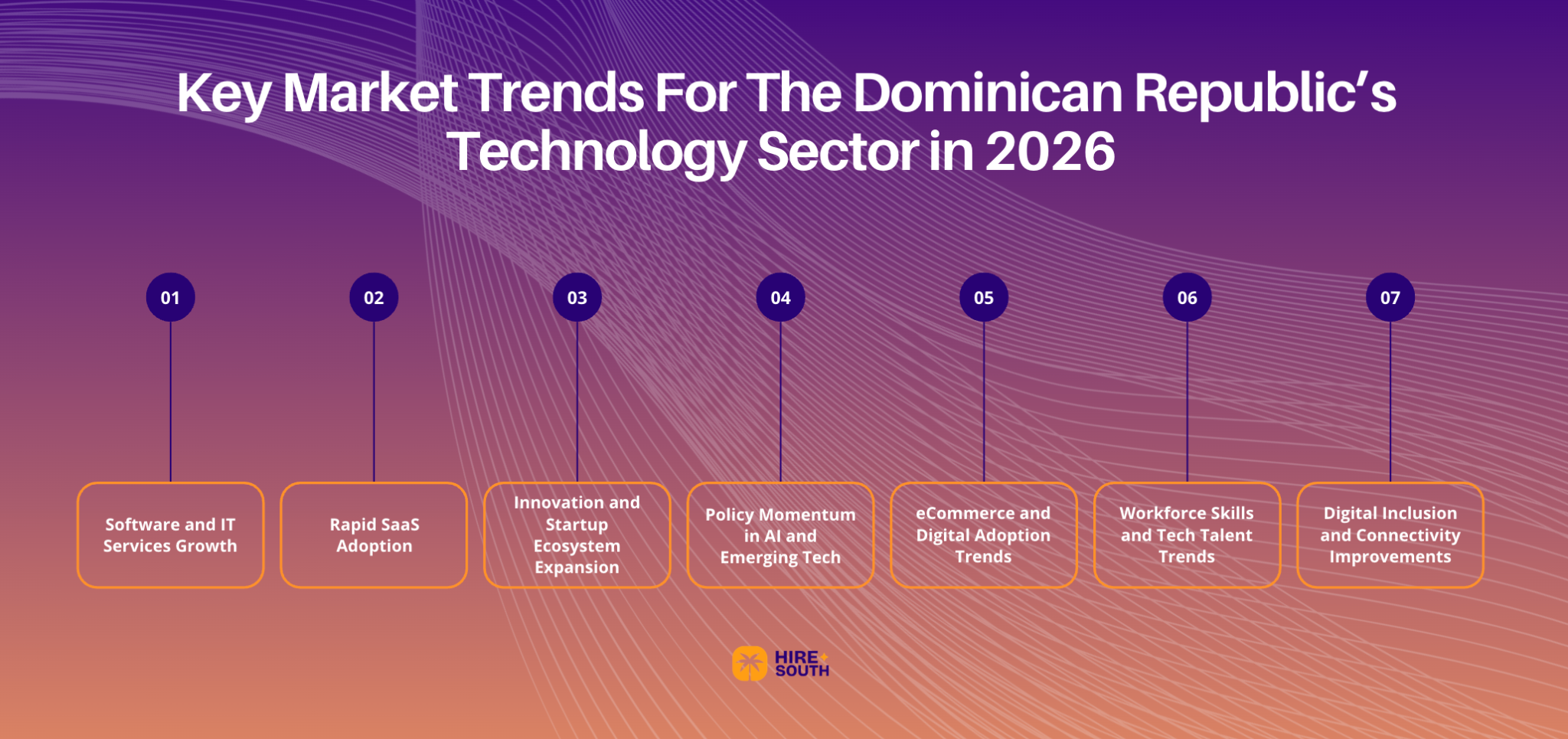
1. Software and IT Services Growth
In 2026, software and IT services will be major growth drivers across the Dominican Republic’s technology sector. The software market is projected to generate about US $350.42 million in revenue in 2025, and this segment is forecast to continue expanding with an expected compound annual growth rate of 5.56 percent through 2030, indicating rising adoption of business and enterprise applications.
IT services, specifically, including outsourcing, are also expanding. Forecasts show that overall IT services revenue is expected to reach US $737.56 million in 2025, driven by growing investment in infrastructure and digital transformation initiatives. According to Statista, this reflects a broad shift toward managed services, cloud adoption, and scalable IT support models.
2. Rapid SaaS Adoption
Cloud-based software solutions are becoming a standout trend. The Software as a Service (SaaS) market in the Dominican Republic is projected to grow rapidly, with revenue expected to hit around US $139.36 million in 2025 and double by 2030 on strong adoption of subscription-based tools.
SaaS growth aligns with broader digital transformation goals and helps smaller companies access enterprise-quality software without high upfront costs.
3. Innovation and Startup Ecosystem Expansion
Innovation is gaining strategic support through targeted programs and hubs. The Innovation Hub Punta Bergantín in Puerto Plata and government-led Semilleros Digitales are expanding technology training, startup incubators, and R&D activity, boosting early-stage tech entrepreneurship and skills readiness. According to the U.S. Trade & Development Agency, these initiatives aim to strengthen the overall digital economy and retain local tech talent.
This trend will position the Dominican Republic as a more attractive environment for local founders and international investors by 2026.
4. Policy Momentum in AI and Emerging Tech
Public policy is increasingly focused on advanced technologies. National strategies like Agenda Digital 2030, the National Innovation Policy 2030, and a dedicated National AI Strategy are emphasizing artificial intelligence, talent development, and innovation infrastructure. According to the OECD, these frameworks include initiatives such as Centres of Excellence, digital transformation training, and public-private incubator networks that elevate research and commercial adoption.
This prioritization signals that AI, data analytics, and automation will become more central to strategic planning across sectors.
5. eCommerce and Digital Adoption Trends
E-commerce remains underpenetrated compared with regional peers, but its growth potential is significant. Broader internet access and mobile usage support the expansion of online retail and digital payment solutions, especially as SMEs increasingly adopt digital workflows. According to industry dossiers, rising entrepreneurship activity, measured at 42 percent in early-stage entrepreneurial engagement nationally, suggests strong interest in digital business models, which should drive e-commerce and platform-based services forward. adminstituto.prodominicana.gob.do
Expect continued digital adoption among both consumers and businesses through 2026.
6. Workforce Skills and Tech Talent Trends
A critical trend for 2026 lies in workforce readiness. Public programs aimed at training in AI, modern software development, and emerging technologies are expanding. These efforts help align skills with industry needs and reduce mismatches, where approximately 40 percent of employers report difficulties filling skilled tech roles, according to World Bank reporting. According to the World Bank, this trend highlights both opportunity and challenge, you’ll need targeted training to support next-generation tech roles.
Strengthening the talent pipeline will be a strategic focus as demand for skilled tech professionals grows through 2026.
7. Digital Inclusion and Connectivity Improvements
Improvements in connectivity underpin many 2026 projections. The Dominican Republic scored well on regional ICT benchmarks, showing internet usage around 85.2 percent and 4G coverage nearing 97.6 percent, which supports broader digital engagement across the economy. According to INTEC reporting on ICT development, these connectivity gains expand your potential market for digital products and services.
This momentum in infrastructure will continue to encourage digital adoption across industries.
Ready to Hire Tech Talent in The Dominican Republic?
Peru’s technology sector continues to mature, supported by rising digital adoption, expanding tech talent, and sustained demand for software, cloud, and data capabilities. With e-commerce volumes projected to more than double between 2023 and 2026 and tech job demand growing sharply in areas like cloud and cybersecurity, according to data from the U.S. International Trade Administration and regional labor reports, the market is moving from early growth to execution at scale.
From our perspective, at Hire South, this creates a clear opportunity for companies looking to build or extend teams in Peru with speed and confidence. We work directly with vetted Peruvian tech professionals and manage the operational, legal, and compliance layers that often slow down cross-border hiring. That allows businesses to focus on delivery, while accessing a market that is increasingly central to LATAM’s technology landscape. Contact us to learn more!