


Peru is undergoing a quiet technological transformation. With internet penetration reaching around 82% of the population in late 2025, nearly 28.4 million people across the country are now online, according to Global Digital Insights This change is powering dynamic growth across sectors, from cloud computing and software services to e-commerce and digital banking, making Peru’s tech ecosystem increasingly relevant not only for local businesses, but also for international investors and outsourcing firms.
In this guide, you will get a clear view of how Peru’s technology sector is structured, how fast it’s growing, and what industries are driving demand. You will explore where tech clusters and innovation hubs are concentrated, how infrastructure and connectivity are evolving, and what the talent pool looks like. You’ll also see how government policy and regulation shape opportunities, plus a realistic look at key challenges and risks.
By the end, you’ll have a practical roadmap for understanding, or even entering, Peru’s IT and technology market, whether you’re a business leader, investor, or someone exploring digital-economy trends in Latin America.
Overview of Peru’s Technology Sector
Peru’s technology sector has shifted from emerging to essential, powered by widespread digital adoption across cities and regions. Internet usage now reaches roughly 82 percent of the population, according to DataReportal, which means around 28.4 million Peruvians are active online. This level of connectivity sets the foundation for stronger IT services, cloud adoption, and software-driven business models.
Digital Adoption and Connectivity.
Internet penetration has climbed rapidly over the last decade. Usage among individuals aged 6 and older reached nearly 79 to 82 percent in 2025, according to Peru’s national statistics agency INEI. That growth reflects how digital tools have become part of daily life for both consumers and businesses.
On the infrastructure side, Peru recorded over 4.27 million fixed internet connections in Q3 2025, according to OSIPTEL. Fibre-optic connections made up more than 80 percent of that total, a sign that bandwidth quality has improved significantly. Mobile connections also exceed the total population, according to DataReportal, which shows how common it is for users to maintain multiple lines or devices.
Comprehensive Digital Inclusion.
Digital access is spreading beyond major metropolitan areas. Over 92.6 percent of Peruvian households reported having internet access in 2024, according to OSIPTEL survey data, regardless of whether the connection was mobile or fixed. That shift marks a major improvement in nationwide digital inclusion.
Daily usage is also high. More than 90 percent of internet users go online every day, according to INEI, demonstrating consistent engagement with digital platforms, apps, and online services.
Growing Demand for Digital Services and IT Solutions.
Stronger connectivity has triggered a noticeable rise in demand for IT solutions, software development, and cloud-based tools. Peru’s digital economy is expanding quickly, with the IT-services segment showing robust growth potential, according to the U.S. International Trade Administration (ITA).
E-commerce growth reinforces this momentum. Online retail continues to build market share in Peru’s urban and semi-urban regions, according to ITA, creating new opportunities for platforms, logistics partners, and payment-processing providers.
Structural Strengths: Infrastructure and Government Support.
The country’s digital infrastructure has matured considerably. Peru now hosts several data centers and internet exchange points that reduce latency and improve local content delivery, according to the Internet Governance Observatory. These upgrades help businesses provide more stable services to users across the country.
Government support has also become a key driver. Policies promoting digital transformation, cloud adoption, and broadband expansion continue to strengthen the sector. These initiatives help companies operate more efficiently while improving overall market readiness for advanced digital services.
Key Tech Hubs Rising in Peru
1. Lima
Lima remains the center of Peru’s technology ecosystem. The city hosts more than a dozen major data centers and over 10 Internet Exchange Points, according to DIG.WATCH, which makes it the country’s highest-capacity digital infrastructure cluster. This concentration supports faster local content delivery, lower latency, and stronger connectivity for enterprise tech operations.
Lima also offers the most mature mix of software firms, cloud providers, and innovation labs. Its dense corporate landscape attracts IT professionals from across Peru, reinforcing its place as the country’s primary digital hub.
2. Arequipa
Arequipa has transformed into one of the strongest regional tech hubs thanks to its academic ecosystem and steady investment in digital skills training. The city’s universities bring in a large share of students from other regions, generating between 840 and 960 million soles annually for the local economy, according to AQP. That inflow of talent fuels a vibrant pipeline for software development roles and technical services.
The city has also earned attention as a potential “southern innovation cluster.” Some reports cite Arequipa as one of Peru’s emerging alternatives for software outsourcing, according to Nearshore Americas.
3. Trujillo
Trujillo is becoming increasingly relevant for companies exploring regional tech expansion. Several software and IT-services firms operate in the city, supported by a steady supply of technically trained professionals, according to ACLTI. The north also stands out for sector-specific innovation. The wider region has seen growth in IoT adoption within agriculture, according to ASD Reports, which positions Trujillo as a strategic location for agritech and logistics-focused development.
This blend of talent and industry-specific digital transformation makes the northern corridor an attractive option for diversifying operations beyond Lima.
All The Competitive Advantages of Peruvian Tech Talent
1. Strong and Growing Pool of Skilled Developers
Peru has a sizable community of tech professionals. The country counts more than 38,000 IT workers, according to N-iX, actively contributing to software development, IT services, cloud engineering, and data roles. This gives you access to a broad set of technical skills across multiple disciplines, making it easier to staff full end-to-end projects.
2. Solid Educational Foundations and STEM Strength
A large share of Peru’s workforce comes from STEM programs. Roughly 30% of tertiary graduates specialize in science, technology, engineering or mathematics, according to UNESCO-referenced data cited by N-iX. This foundation improves the availability of talent trained in analytical thinking, coding, math-heavy problem solving, and engineering workflows.
Peru also ranks 45th globally in the Global Skills Report 2025 for digital skills, according to Infobae. That ranking highlights the country’s progress in technical learning and modern digital capabilities such as programming, data analysis, and cloud fundamentals.
3. Competitive Cost Structure for Global Hiring
Hiring talent in Peru is typically more cost-efficient than in many North American or Western European markets. Peruvian developers offer competitive rates relative to similar skill levels elsewhere, according to TECLA. This lets you scale teams, run pilot initiatives, or support long-term projects without overshooting budget constraints.
4. English Proficiency That Supports Cross-Border Collaboration
Language capability gives Peruvian professionals an additional edge. Tech workers with English proficiency have 80% higher employment opportunities, according to Andina, which shows how common it is for local professionals to invest in bilingual communication skills. This directly improves collaboration for remote, nearshore, or multinational projects.
5. High Market Demand That Maintains Skill Relevance
Demand for tech professionals in Peru grew between 50% and 60% from 2021 to 2023, according to the Peruvian government’s PROInnóvate program. High demand signals that talent stays active in real digital transformation projects, keeping skills fresh and aligned with modern technologies used in the market.
6. Time-Zone Alignment and Nearshore Efficiency
Peru’s geographic position creates a strong time zone overlap with North America and much of Latin America. This makes real-time communication, agile ceremonies, and cross-border teamwork easier to manage, according to CloudDevs. You get nearshore responsiveness with fewer coordination challenges than far-shore outsourcing models.
7. Strong Cultural Fit and Continuous Learning Mindset
Peruvian IT professionals increasingly pursue ongoing upskilling through global online learning platforms. The country’s placement in the global top tier for digital-skill development, according to Infobae, shows how committed the workforce is to keeping pace with evolving technical frameworks. This adaptability becomes a real advantage when your projects require people who can absorb new tools quickly.
Key Market Trends For Peru’s Technology Sector in 2026
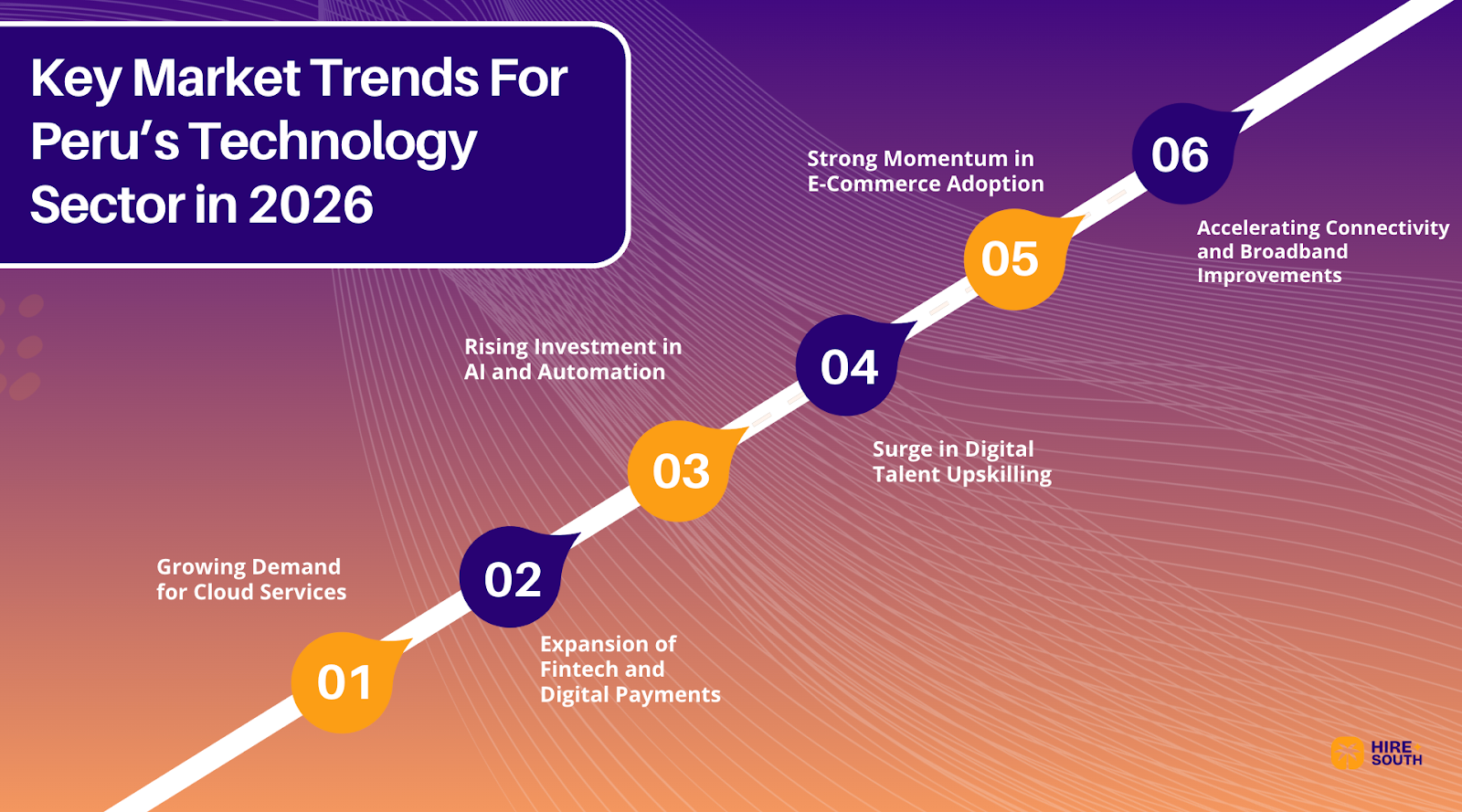
Growing Demand for Cloud Services:
Cloud adoption is accelerating across Peruvian companies as more organizations migrate core systems to digital environments. Cloud spending in Latin America is projected to reach 38.4 billion dollars by 2026, according to IDC. This regional momentum directly influences Peru’s market, pushing businesses to modernize infrastructure, improve scalability, and adopt multi-cloud strategies. You can expect Peru’s cloud ecosystem to expand through new certifications, wider enterprise adoption, and stronger demand for cloud-native developers.
Expansion of Fintech and Digital Payments:
Fintech remains one of the most dynamic segments of Peru’s tech industry. The country already hosts more than 250 fintech startups, according to Finnovista, and that number is expected to rise in 2026 as digital payments, online lending, and fraud-prevention tools continue growing. The shift toward electronic payments is also accelerating, driven by a steady increase in mobile-wallet usage and government-backed financial inclusion programs. For you, this means a more active environment for fintech integrations and B2B software partnerships.
Rising Investment in AI and Automation:
Artificial intelligence is emerging as a core priority among local enterprises. AI adoption in Peru grew 22% year over year, according to the Peruvian Digital Transformation Observatory, and the pace is expected to increase through 2026. Companies are prioritizing automation for customer support, logistics, analytics, and cybersecurity operations. As demand rises, you’ll see greater interest in AI engineers, data scientists, and automation specialists who can support AI-first business processes.
Surge in Digital Talent Upskilling:
Peruvian professionals are investing heavily in talent development to keep pace with global tech requirements. Peru ranks in the top 50 worldwide for digital skills, according to the Coursera Global Skills Report. This trend is shaping 2026 as a year of widespread upskilling across cloud engineering, data analytics, cybersecurity, and DevOps. For global companies hiring in Peru, this means you gain access to talent that’s actively improving technical capabilities and aligning with international standards.
Strong Momentum in E-Commerce Adoption:
E-commerce adoption continues to rise quickly as consumer behavior shifts toward online purchasing. Peru’s e-commerce sector expanded by more than 30%, according to the Lima Chamber of Commerce, and this momentum is expected to carry into 2026. Retailers, logistics providers, and payment platforms are now investing in automation, customer-experience tools, and advanced analytics to handle higher transaction volumes. You’ll see more opportunities in platform development, last-mile technology, and digital-commerce integrations.
Accelerating Connectivity and Broadband Improvements:
Peru’s digital infrastructure is improving year over year. The country recorded over 4.9 million fixed-internet connections, according to OSIPTEL, and ongoing public-sector investments aim to close connectivity gaps by 2026. Better broadband coverage supports the growth of remote work, cloud app adoption, video collaboration tools, and cybersecurity services. These improvements make Peru a more reliable nearshore environment for distributed tech teams.
Ready to Hire Remote Talent in Peru?
Peru’s technology sector is moving fast, shaped by stronger digital talent, expanding infrastructure, and a business ecosystem that’s finally scaling at a regional level. Companies that adapt early to these shifts gain access to a market where tech adoption keeps rising year over year and where demand for digital solutions outpaces local supply.
At Hire South, we help organizations navigate this landscape with clarity and precision. Our team specializes in connecting companies with vetted nearshore talent from across Latin America, including Peru’s growing pool of cloud engineers, AI developers, and product teams. We combine regional expertise, transparent processes, and measurable performance standards so you can build high-impact teams without compromising quality or speed. If you’re looking to scale confidently in a rapidly evolving tech market, we’re ready to support every step of that growth. Contact us to get started with a free consultation!