


Uruguay has one of the most structured holiday systems in Latin America, and it directly affects how you plan operations, payroll, and team availability. With around 15 public holidays each year, including fixed, movable, and locally observed dates, understanding the calendar is not optional if you employ talent in the country, according to Uruguay’s Ministry of Labor and Social Security.
This guide breaks down all holidays in Uruguay, from national public holidays to local and departmental observances. You’ll find clear explanations of non-working versus working holidays, how movable dates are handled, and what actually changes for employers and teams.
Whether you’re scheduling projects, managing a distributed workforce, or evaluating Uruguay as a nearshore destination, this article gives you a practical, business-focused view of Uruguay’s holidays list, without the guesswork.
First Things First: How Uruguay’s Holiday Calendar Is Updated Each Year
Who Defines the Official Holiday Calendar.
Uruguay’s public holiday calendar is set at the national level by the Executive Branch and regulated through laws and decrees. The MTSS and the Presidency of Uruguay are the authoritative sources that confirm which dates are considered official non-working or working holidays each year.
Once approved, the calendar applies nationwide. This includes the private sector, public administration, and most collective labor agreements, unless a specific agreement states otherwise.
When the Holiday Calendar Is Confirmed.
The official holiday framework is stable. Most dates are fixed by law and do not change year to year. Movable holidays, such as Carnival and Tourism Week, are tied to the Christian calendar and are usually confirmed well in advance.
In practice, the full list for a given year is known before the year begins, allowing employers to plan schedules, payroll, and capacity without uncertainty. This predictability is one reason Uruguay consistently ranks as one of the most institutionally stable countries in Latin America, according to World Bank governance indicators.
Fixed vs Movable Dates and What Actually Changes.
Uruguay has approximately 15 public holidays per year, a mix of fixed date holidays and movable observances, according to MTSS data.
Fixed holidays like Independence Day or Labour Day never change. Movable holidays follow predefined rules, not ad hoc decisions. Carnival is always celebrated on Monday and Tuesday preceding Ash Wednesday. Tourism Week aligns with Holy Week and shifts annually but remains consistent in duration.
No last-minute changes. No surprise long weekends added at the federal level.
The Role of “Working” and “Non-Working” Designations.
Each holiday is also classified as either non-working or working, which determines legal pay obligations. This classification is part of the annual framework and does not fluctuate during the year.
Non-working holidays require paid time off or premium pay if work is performed. Working holidays allow normal operations, although collective agreements or company policies may impose additional benefits.
Understanding this distinction early in the year avoids payroll errors and compliance issues.
Where to Verify the Calendar Each Year.
The most reliable sources for updates are
- Official communications from the Ministry of Labor and Social Security
- Publications from the Presidency of Uruguay
- National legal bulletins and decrees
Third-party calendars often omit local observances or mislabel working holidays. For compliance and planning, official government sources should always be the reference point.
All National Public Holidays in Uruguay
What Counts as a National Public Holiday in Uruguay:
National public holidays in Uruguay are established by law and apply nationwide. They are regulated by the Ministry of Labor and Social Security and affect both the public and private sectors, unless a collective bargaining agreement sets different conditions.
Uruguay officially recognizes around 15 national public holidays each year, according to data published by the Ministry of Labor and Social Security. Each holiday is legally classified as either working or non-working, which determines how pay and time off are handled.
Fixed Date National Holidays:
Fixed date holidays always fall on the same day of the calendar year. These holidays do not change and are among the easiest to plan around from an operational and payroll perspective.
New Year’s Day is observed on January 1. Labour Day is fixed on May 1 and is one of the most strictly enforced non-working holidays. Constitution Day takes place on July 18, followed by Independence Day on August 25. Christmas Day closes the year on December 25. Because these dates are written into law, they provide long-term predictability for workforce planning.
Movable National Holidays:
Movable holidays shift each year but follow predefined legal rules rather than discretionary decisions. Their timing is known well in advance.
Carnival is celebrated on the Monday and Tuesday preceding Ash Wednesday and is one of the longest public observances in the country. Tourism Week coincides with Holy Week and typically spans several consecutive days. The Day of the Races is observed in October and commemorates cultural heritage rather than a fixed historical date.
Even though the calendar dates change, the legal treatment of these holidays remains consistent year to year.
Non-Working National Holidays:
Non-working holidays require paid time off under Uruguayan labor law. If work is performed on these dates, employees are entitled to premium pay, as enforced by the Ministry of Labor and Social Security.
This category includes some of the most operationally sensitive dates, such as New Year’s Day, Labour Day, Independence Day, and Christmas Day. These holidays typically result in reduced availability across offices, banks, and public services.
Working National Holidays:
Working holidays are officially recognized at the national level, but do not require businesses to close. Normal operations are allowed unless an internal policy or collective agreement establishes different conditions.
Examples include Constitution Day, the Landing of the 33 Orientals, and the Day of the Races. These holidays often confuse because they are legally holidays, but do not automatically trigger paid time off or premium compensation.
The Religious Holidays Observed Across Uruguay
Why Religious Holidays Look Different in Uruguay.
Uruguay is one of the most secular countries in Latin America. Church and state have been formally separated since 1917, under the Uruguayan Constitution. As a result, religious holidays are observed nationally but are framed using civic or cultural names rather than explicitly religious ones.
This approach shapes how holidays appear on the official calendar and how they are applied in the workplace. You will not see overt religious language in labor regulations, even when the origin of the holiday is clearly religious.
Tourism Week and Its Religious Origins.
Tourism Week is the clearest example. It aligns with Holy Week in the Christian calendar, but it is officially referred to as Semana de Turismo. The dates shift every year based on Easter, yet the designation remains secular.
Despite the name, it is one of the most widely observed holiday periods in the country. According to Uruguay’s Ministry of Tourism, Tourism Week is consistently one of the highest domestic travel periods each year, with hundreds of thousands of residents traveling internally.
For employers, this week often results in extended absences, even beyond the legally mandated non-working days.
Christmas and Easter in a Secular Context.
Christmas Day is a fixed national holiday and is officially recognized as a non-working day. While the cultural meaning is tied to Christianity, its legal treatment is purely civic.
Easter itself is not labeled as such on the official calendar. Instead, its impact is absorbed into Tourism Week. This distinction matters for planning because there is no separate Easter holiday outside that period.
Carnival and Religious Timing.
Carnival is another major observance tied indirectly to religion. It takes place immediately before Ash Wednesday, marking the start of Lent in the Christian calendar.
Uruguay’s Carnival is one of the longest in the world, lasting over 40 days in total celebrations, according to Uruguay’s Ministry of Education and Culture. However, only Carnival Monday and Tuesday are recognized as national public holidays from a labor law perspective.
Religion and the Workforce Reality.
While Uruguay is secular, religion still plays a cultural role. According to the Pew Research Center, approximately 38 percent of Uruguay’s population identifies as Christian, one of the lowest percentages in Latin America.
In practice, this means religious holidays are more about collective downtime than religious observance. Attendance expectations, business closures, and productivity changes are driven by national custom rather than religious obligation.
What You Will Not See on the Official Calendar.
There are no legally recognized religious holidays outside the Christian tradition. Dates tied to other faiths are not included in the national holiday framework and do not create mandatory time off.
Any additional religious observance depends entirely on internal company policies or individual agreements, not national law.
The Impact of National Holidays on Businesses and Work Travel
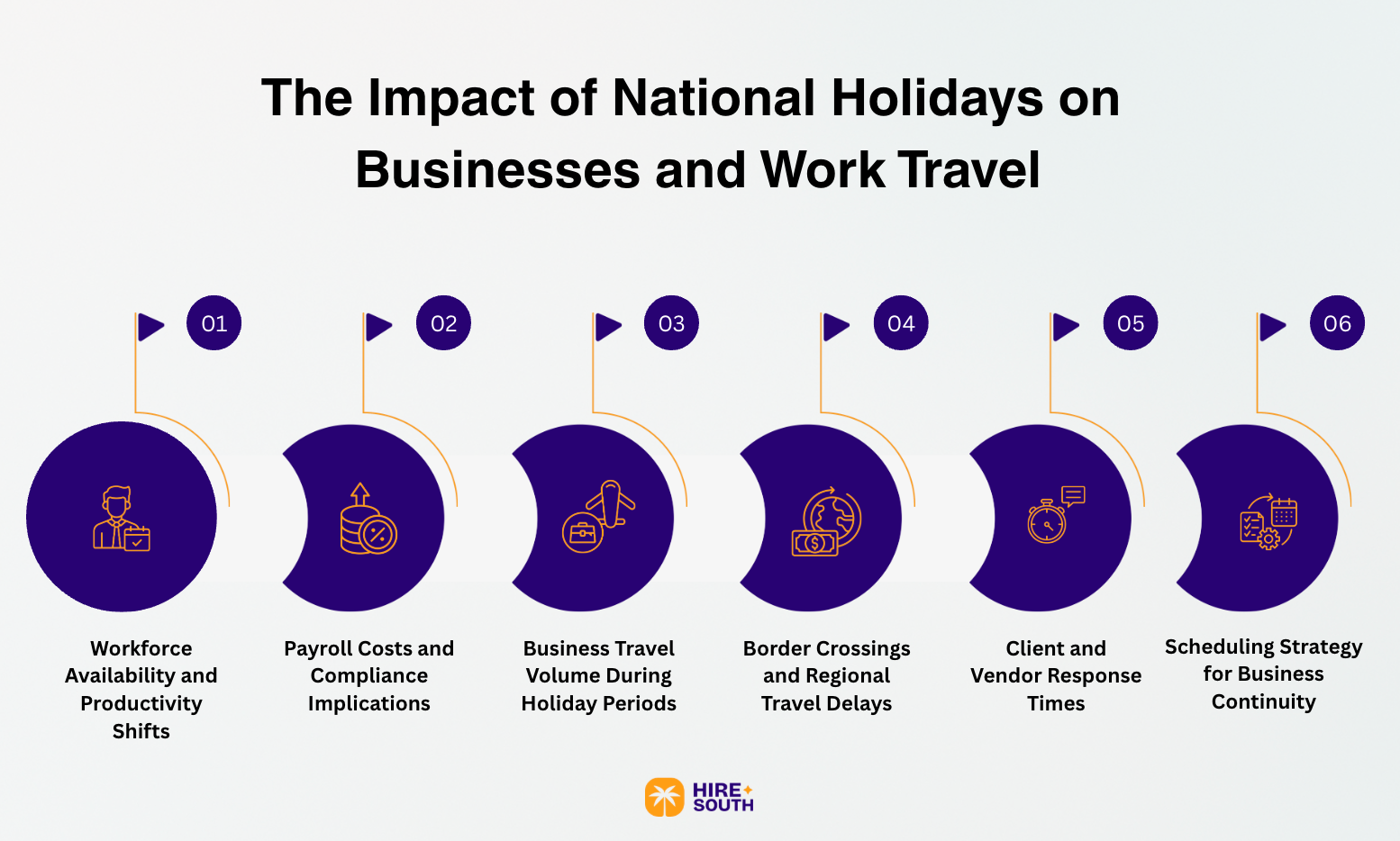
1. Workforce Availability and Productivity Shifts
National holidays in Uruguay create predictable dips in workforce availability, especially on non-working holidays and during multi-day observances. According to the Ministry of Labor and Social Security, non-working holidays legally require paid time off, which directly reduces staffing levels across most sectors.
Even on working holidays, productivity often slows. Schools, courts, banks, and public offices typically operate with reduced hours or skeleton staff. If your operations depend on approvals, documentation, or in-person coordination, timelines tend to stretch around these dates.
2. Payroll Costs and Compliance Implications
National holidays have a direct impact on labor costs. Uruguayan labor law mandates premium pay when employees work on non-working holidays. This requirement is enforced by the Ministry of Labor and Social Security and is a common source of compliance errors for employers unfamiliar with the calendar.
Because Uruguay recognizes around 15 national public holidays per year, misclassifying even one holiday can create payroll discrepancies. Accurate classification matters more than the total number of holidays.
3. Business Travel Volume During Holiday Periods
Domestic and regional travel increases sharply around certain national holidays. Tourism Week is the most significant example. Data from Uruguay’s Ministry of Tourism shows that Tourism Week consistently ranks as one of the busiest travel periods of the year, with a high volume of internal travel and limited hotel availability.
This affects flight prices, accommodation costs, and last-minute travel flexibility. Business travel during these periods requires earlier booking and higher budgets.
4. Border Crossings and Regional Travel Delays
Uruguay’s national holidays often align or partially overlap with holidays in Argentina and Brazil. When this happens, border crossings and ferry routes experience congestion.
The Ministry of Transport and Public Works regularly reports delays at ports and land borders during long weekends. If your work travel includes cross-border meetings or regional operations, these delays are not exceptions. They are patterns.
5. Client and Vendor Response Times
Response times slow noticeably during national holidays, even in sectors that remain operational. Email replies, contract reviews, and approvals often pause, particularly when holidays fall midweek.
This is not a cultural anomaly. It reflects a country where holidays are widely respected across industries. Planning deliverables without accounting for these pauses increases the risk of missed deadlines.
6. Scheduling Strategy for Business Continuity
The practical impact of national holidays is not limited to the holiday itself. Many teams schedule vacation days around fixed holidays, extending absences beyond the official date.
For continuity, critical meetings, audits, and travel should be scheduled outside peak holiday windows whenever possible. In Uruguay, the calendar is stable. The disruption is predictable if you plan around it.
Ready to Start Nearshoring in Uruguay?
Uruguay’s holiday calendar is clear, predictable, and governed by law, but it still has a real impact on staffing, payroll, and delivery timelines. With around 15 national public holidays each year, split between working and non-working days, accurate planning is what keeps operations running smoothly.
At Hire South, we help companies hire and manage talent in Uruguay and in all of Latin America with full visibility into local labor rules, holiday classifications, and compliance requirements. Our team handles the operational details so you can plan projects and capacity with confidence, backed by on-the-ground expertise and a deep understanding of how Uruguay’s employment framework works in practice. Contact us to learn more!


.jpg)