

Understanding the full calendar of public and local holidays in the Dominican Republic helps you plan operations, staffing, and travel with fewer surprises. This guide breaks down national holidays, religious observances, and regional celebrations, all in one place. You’ll also see how movable holidays work and why some dates consistently create long weekends.
The Dominican Republic observes around 12 official public holidays each year, according to the Dominican Ministry of Labor, combining civic milestones, Catholic traditions, and cultural events that directly affect business schedules and government services.
If you manage teams, coordinate projects, or work with partners in the country, this complete list of All Holidays in the Dominican Republic and the full Dominican Republic holidays list gives you the clarity you need to plan and avoid disruptions.
First Things First: How The Dominican Republic’s Holiday Calendar Is Updated Each Year
Who Officially Sets the Dominican Republic Holiday Calendar.
The Dominican Republic’s holiday calendar is governed by national labor legislation and overseen by the Ministry of Labor. The legal framework comes from Law No. 139-97, which regulates public holidays and establishes which dates are fixed and which can be moved.
This means holiday rules are not optional or advisory. If a date appears on the official calendar published by the Ministry, it applies across the country, regardless of industry or company size.
When the Holiday Calendar Is Published Each Year.
The official holiday calendar is typically released before the start of each calendar year, usually in the final weeks of December. According to the Dominican Ministry of Labor, the publication includes confirmation of fixed holidays and adjusted dates for movable observances.
For planning purposes, this early release allows you to finalize annual schedules, payroll calendars, and operational timelines before January begins.
How Movable Holidays Are Decided and Adjusted.
Under Law No. 139-97, several holidays are legally shifted to Mondays to encourage internal tourism and reduce midweek disruptions. According to the Ministry of Labor, holidays tied to historical events are often moved, while religious holidays generally remain on their original dates.
For example, Independence Day and Restoration Day may be observed on a Monday if they fall midweek. Good Friday and Christmas Day are never moved. This distinction is critical when forecasting short workweeks or long weekends.
What Happens If a Holiday Falls on a Weekend.
If a public holiday falls on a Saturday or Sunday, it is not automatically replaced with an extra weekday off, unless explicitly stated in the annual calendar. According to the Dominican Ministry of Labor, only the holidays listed as movable are eligible for date changes.
This detail is often overlooked and can lead to incorrect assumptions about employee availability.
Where to Verify the Official and Updated Calendar.
The most reliable source is the annual resolution published by the Dominican Ministry of Labor, which is considered the final authority. Secondary sources such as banks or travel sites often summarize the dates, but they rely on the Ministry’s release.
For compliance, workforce planning, and accurate scheduling, the Ministry’s published calendar should always be your reference point.
Why Annual Updates Matter for Business Planning.
Even though the number of public holidays stays relatively stable at around 12 per year, according to the Ministry of Labor, the exact dates can change annually due to movable observances. That variability affects payroll cutoffs, SLA timelines, government office closures, and project delivery windows.
Reviewing the updated calendar each year is not a formality. It’s a practical step to avoid missed deadlines, staffing gaps, and compliance issues.
All National Public Holidays in The Dominican Republic
What Counts as a National Public Holiday.
National public holidays in the Dominican Republic are dates officially recognized by law and enforced nationwide. They apply to both the public and private sectors and are regulated under Law No. 139-97, according to the Dominican Ministry of Labor. When a holiday is classified as national, employers are legally required to observe it, with specific compensation rules if employees work on those days.
These holidays are not symbolic. They have direct implications for payroll, staffing levels, and business continuity.
Official List of Dominican Republic National Holidays:
The Dominican Republic observes approximately 12 national public holidays each year, according to the Dominican Ministry of Labor. These include fixed-date holidays and movable observances adjusted annually. The nationally recognized holidays are:
- New Year’s Day January 1
- Three Kings Day Epiphany January 6
- Our Lady of Altagracia Day January 21
- Duarte Day January 26
- Independence Day February 27
- Good Friday date varies
- Labor Day May 1
- Corpus Christi date varies
- Restoration Day August 16
- Our Lady of Mercedes Day September 24
- Constitution Day November 6
- Christmas Day December 25
Each of these dates is confirmed every year in the official holiday calendar published by the Ministry of Labor.
Fixed vs Movable National Holidays.
Not all Dominican public holidays stay on the same calendar date. Under Law No. 139-97, several civic holidays may be moved to Mondays. According to the Ministry of Labor, the goal is to reduce midweek work disruptions and support domestic tourism.
Religious holidays such as Good Friday and Christmas Day are always observed on their original dates. Civic holidays, including Constitution Day and Restoration Day, are commonly shifted.
How National Holidays Affect the Workday.
On national public holidays, most government offices, banks, and courts are closed. According to the Central Bank of the Dominican Republic, financial institutions generally follow the Ministry of Labor calendar, which impacts payment processing and clearing timelines.
If employees work on a national holiday, Dominican labor law requires premium pay. This applies regardless of whether the holiday is fixed or movable.
Where to Verify the Final Holiday Dates.
The only authoritative source for national public holidays is the annual resolution issued by the Dominican Ministry of Labor. While many websites publish Dominican Republic holiday lists, they rely on this official release.
For accurate workforce planning and compliance, the Ministry’s calendar should always be your primary reference.
The Religious Holidays Observed Across The Dominican Republic
Why Religious Holidays Matter in the Dominican Calendar:
Religious holidays in the Dominican Republic are deeply embedded in national life and officially recognized in the labor calendar. This is largely tied to the country’s religious makeup. About 49 percent of Dominicans identify as Catholic, according to the Pew Research Center, which explains why Catholic observances shape public holidays, business closures, and community activity.
For planning purposes, these dates are not informal traditions. They are legally observed and affect availability across sectors.
Good Friday and Holy Week Observance:
Good Friday is one of the most strictly observed religious holidays nationwide. It always falls on a Friday during Holy Week and is never moved, according to the Dominican Ministry of Labor. Most businesses close or operate with limited staff, and government offices remain shut.
While only Good Friday is a legal public holiday, the surrounding Holy Week period often sees reduced productivity, especially in tourism-heavy regions.
Corpus Christi as a National Religious Holiday:
Corpus Christi is a movable religious holiday tied to the Catholic liturgical calendar. It is officially recognized as a public holiday and usually falls on a Thursday, though the exact date changes each year.
According to the Ministry of Labor, Corpus Christi is treated the same as other national holidays for payroll and labor compliance, making it relevant for scheduling and workforce planning.
Our Lady of Altagracia Day:
Observed on January 21, Our Lady of Altagracia Day honors the patron saint of the Dominican Republic. This holiday has both religious and national significance and is observed across the country.
Pilgrimages, church services, and public events are common, particularly in Higüey. Business operations may slow even outside government-mandated closures.
Our Lady of Mercedes Day:
Celebrated on September 24, Our Lady of Mercedes Day honors the country’s spiritual protector. It is recognized as an official public holiday under Dominican law, according to the Ministry of Labor.
As with other religious holidays, banks and public institutions typically close, and private employers follow the national calendar.
Christmas Day as a Fixed Religious Holiday:
Christmas Day, observed on December 25, is a fixed religious and national holiday. It is never moved and marks one of the most consistent shutdown dates across all sectors.
According to the Dominican Ministry of Labor, Christmas Day carries the same legal weight as civic holidays, including mandatory observance and premium pay rules if employees work.
Key Differences Between Religious and Civic Holidays:
Unlike civic holidays, religious holidays are rarely shifted to Mondays. According to Dominican labor regulations, religious observances tied to the liturgical calendar remain fixed to preserve their meaning.
This distinction is important when forecasting long weekends, payroll cycles, and operational downtime throughout the year.
The Impact of National Holidays on Businesses and Work Travel
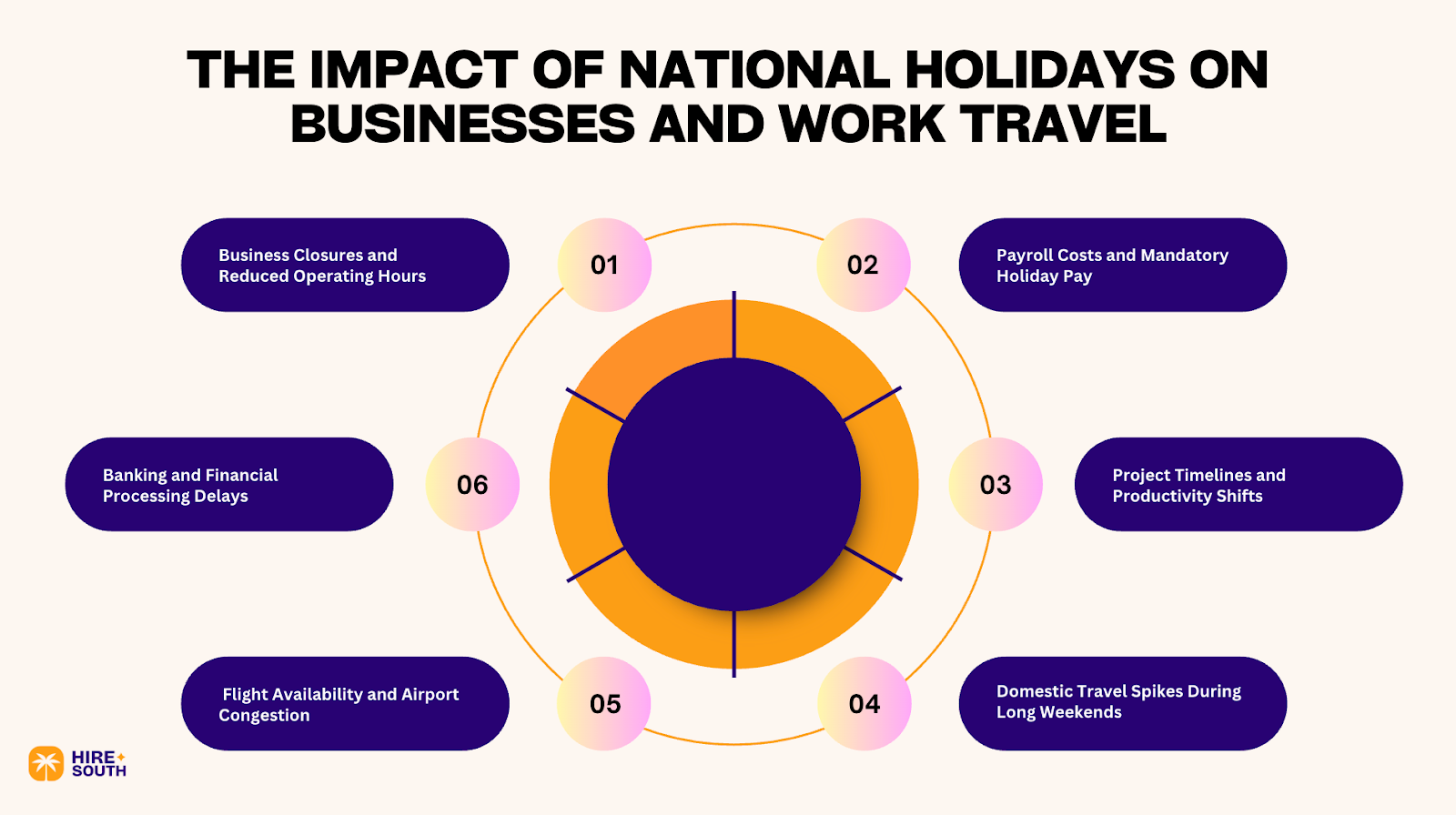
1. Business Closures and Reduced Operating Hours
National public holidays in the Dominican Republic trigger widespread closures across the public sector. Government offices, courts, and most banks close in line with the official calendar issued by the Dominican Ministry of Labor. Private businesses often reduce hours or operate with skeleton teams, especially on religious and civic holidays with nationwide observance.
For you, this affects approvals, document processing, banking transactions, and any activity that depends on public institutions.
2. Payroll Costs and Mandatory Holiday Pay
When employees work on a national public holiday, Dominican labor law requires premium compensation. According to the Ministry of Labor, work performed on an official holiday must be paid at a higher rate than a standard workday.
This has a direct impact on payroll forecasting and cost control, particularly in industries that operate continuously such as hospitality, healthcare, logistics, and customer support.
3. Project Timelines and Productivity Shifts
Even when offices remain open, productivity often drops around national holidays. Movable holidays that create long weekends can shorten workweeks without reducing workload.
With around 12 national public holidays per year, according to the Dominican Ministry of Labor, unplanned delays can add up if holiday dates are not built into delivery schedules and SLA expectations.
4. Domestic Travel Spikes During Long Weekends
Movable holidays shifted to Mondays are designed to promote internal travel. According to the Dominican Ministry of Tourism, long weekends consistently increase domestic travel activity, particularly to beach and resort destinations.
For business travel, this means higher demand for flights, limited hotel availability, and increased prices around holiday weekends.
5. Flight Availability and Airport Congestion
Airports typically remain operational on holidays, but passenger volumes rise sharply during long weekends. The Dominican Civil Aviation Institute has reported higher passenger movement during national holidays tied to Monday observance.
If travel is unavoidable, booking earlier and allowing buffer time becomes essential.
6. Banking and Financial Processing Delays
The Central Bank of the Dominican Republic follows the national holiday calendar, which means interbank transfers, check clearing, and certain payment processes pause on holidays.
For finance teams, this can affect cash flow timing, payroll execution, and vendor payments if deadlines fall near a holiday.
Ready to Start Nearshoring in The Dominican Republic?
Public and local holidays in the Dominican Republic are not just dates on a calendar. With around 12 nationally mandated public holidays each year, according to the Dominican Ministry of Labor, these observances directly influence availability, payroll costs, government operations, and project timelines.
At Hire South, we help companies navigate these realities when building and managing teams in the Dominican Republic and all of Latin America. Our services are designed around local labor regulations, official holiday calendars, and real-world operating conditions, so your workforce planning stays compliant, predictable, and aligned with how business is actually done on the ground. Are you ready to start your own nearshore project? Contact us to get started!