


Peru’s holiday calendar is one of the most diverse in Latin America, blending national celebrations, regional traditions, and centuries-old Indigenous rituals. If you operate across markets or manage teams in the region, knowing when and why these holidays happen helps you plan better, avoid operational slowdowns, and stay aligned with local expectations.
Across the year, Peru observes more than a dozen national public holidays, and the Ministry of Labor regularly adds non-working days to boost internal tourism, an initiative that helped generate over S/ 1.5 billion in domestic travel revenue in 2023, according to PROMPERÚ. Local observances, from Cusco Day to Puno Week, can also impact workflows, travel plans, and staffing needs.
In this guide, you’ll find a full list of local holidays in Peru, explanations of their cultural or historical importance, and insights into how they influence business, travel, and daily life. You’ll also get clarity on long weekends, regional celebrations, and Indigenous festivals that many companies overlook.
First Things First: How Peru’s Holiday Calendar Is Updated Each Year
Official Publication Through Supreme Decrees (Decretos Supremos).
Peru updates its national holiday calendar through Decretos Supremos issued by the Ministry of Labor and Employment Promotion (MTPE). These decrees formalize the list of national public holidays for the upcoming year and clarify which days qualify as non-working, paid, or mandatory.
In 2024, for example, the MTPE confirmed 14 official national holidays, a number that has remained stable for the past several years.
Annual Additions of “Días No Laborables” to Boost Tourism.
Beyond the official list, the government often designates extra non-working days to extend long weekends and stimulate internal travel. These days are not full holidays, but many businesses follow them because the hours must be “made up” later.
The Council of Ministers usually announces these dates between October and December for the coming year, giving you enough time to adjust staffing plans and operational schedules.
Regional Governments Announce Their Own Local Holidays.
Local and regional authorities also publish their holiday calendars each year, especially in areas with major cultural or religious events. Cusco, Arequipa, and Puno typically release their local observances through municipal resolutions posted on regional government websites and official gazettes.
Regional dates can significantly affect attendance, public services, and workforce availability, even if they’re not recognized nationally.
Public Sector Rules Often Guide the Private Sector.
Peru’s public sector automatically adheres to all declared non-working days. The private sector, however, can choose whether to apply them as long as it respects labor compensation rules.
Because government institutions set the standard, many companies align their calendars accordingly to avoid service delays and coordination issues with public offices.
Updates Are Centralized in El Peruano, Peru’s Official Gazette.
All final decisions, including national holidays, regional observances, and administrative non-working days, must appear in El Peruano, the official state newspaper. This is the most reliable source for cross-checking dates.
Once published, the information becomes binding and forms part of the national holiday calendar that businesses and institutions use for planning.
All National Public Holidays in Peru
Peru observes a consistent set of national public holidays each year, and these dates shape everything from business hours to travel patterns. These holidays are recognized nationwide and apply to public institutions and most private employers. They also form the baseline for your annual scheduling, payroll planning, and staffing strategies.
The national list includes New Year’s Day on January 1, Maundy Thursday or Good Friday during Holy Week (which shifts each year based on the religious calendar), and Labor Day on May 1. June 29 marks the Feast Day of Saints Peter and Paul, followed by the two-day Independence Day celebrations on July 28 and July 29. August 30 is dedicated to Santa Rosa de Lima, one of Peru’s most important religious figures. October 8 commemorates the Battle of Angamos, while November 1 is All Saints’ Day. The year concludes with two widely observed holidays: the Feast of the Immaculate Conception on December 8 and Christmas Day on December 25.
These holidays matter because they affect how businesses and government offices operate. Public institutions fully close, and many private-sector companies either suspend activities or reduce operating hours. Under national labor law, these dates qualify as paid holidays when observed by employers, which means they require planning to avoid unexpected payroll or staffing challenges. Since the holidays apply across all regions, you can expect consistent nationwide impact, whether your teams are in Lima, Arequipa, Cusco, or smaller provincial areas.
It’s also important to note that not every date is fixed. Holy Week varies each year, and its placement can influence everything from seasonal travel demand to operational workloads. Although Peru’s core holiday list remains stable, authorities may add additional non-working days to extend long weekends or support domestic tourism, so it’s smart to verify the upcoming year’s calendar through official publications like El Peruano or announcements from the Ministry of Labor before locking in operational plans.
The Religious Holidays Observed Across Peru
Major Catholic Celebrations Recognized Nationwide:
Religious holidays in Peru reflect centuries of Catholic influence, and several of these dates hold nationwide significance. Holy Week is the most important period, drawing millions of Peruvians to processions and church ceremonies across the country. According to the Peruvian Episcopal Conference, more than 75% of the population participates in Holy Week events each year, making it one of the largest annual religious movements in the region. These observances vary by city, and the intensity of the celebrations often affects business hours and local transit.
Another widely observed holiday is the Feast of the Immaculate Conception on December 8. It’s recognized as a national holiday and marks the start of the country’s busiest religious season. Christmas Day on December 25 brings a nationwide pause as families gather for midnight masses and community celebrations. These events often reshape work schedules because they fall during peak travel periods.
Celebrations Dedicated to Peru’s Patron Saints:
Peru’s patron saints also have dedicated holidays that influence cultural and community life. August 30 honors Santa Rosa de Lima, the first saint of the Americas and a defining figure in Peruvian identity. Her feast day often results in major public gatherings, especially in Lima, where thousands visit the sanctuary dedicated to her. June 29 celebrates Saints Peter and Paul, a day tied to deep coastal traditions. Fishing communities organize maritime processions, which can lead to closures in ports and smaller coastal towns.
These events matter for your planning because they consistently generate local traffic spikes and public-sector delays. Many municipalities adjust their service hours during these feast days, and some regions treat them as multi-day observances rather than single events.
Iconic Religious Traditions With Deep Local Impact:
Beyond nationally mandated holidays, several religious traditions carry significant local influence. The Lord of Miracles procession in Lima, held throughout October, is considered one of the largest Catholic processions in the world. Lima’s municipal authorities estimate that up to 2 million people participate across multiple dates, which affects mobility, staffing, and business operations in the capital. While it’s not a national holiday, its scale creates conditions similar to one, especially in central districts.
Another major tradition is All Saints’ Day on November 1. Families travel to cemeteries and host gatherings that can stretch into the next day in some regions. The observance leads to increased travel between provinces, and businesses often see adjusted operating hours because of the movement of people.
The Impact of National Holidays on Businesses and Work Travel
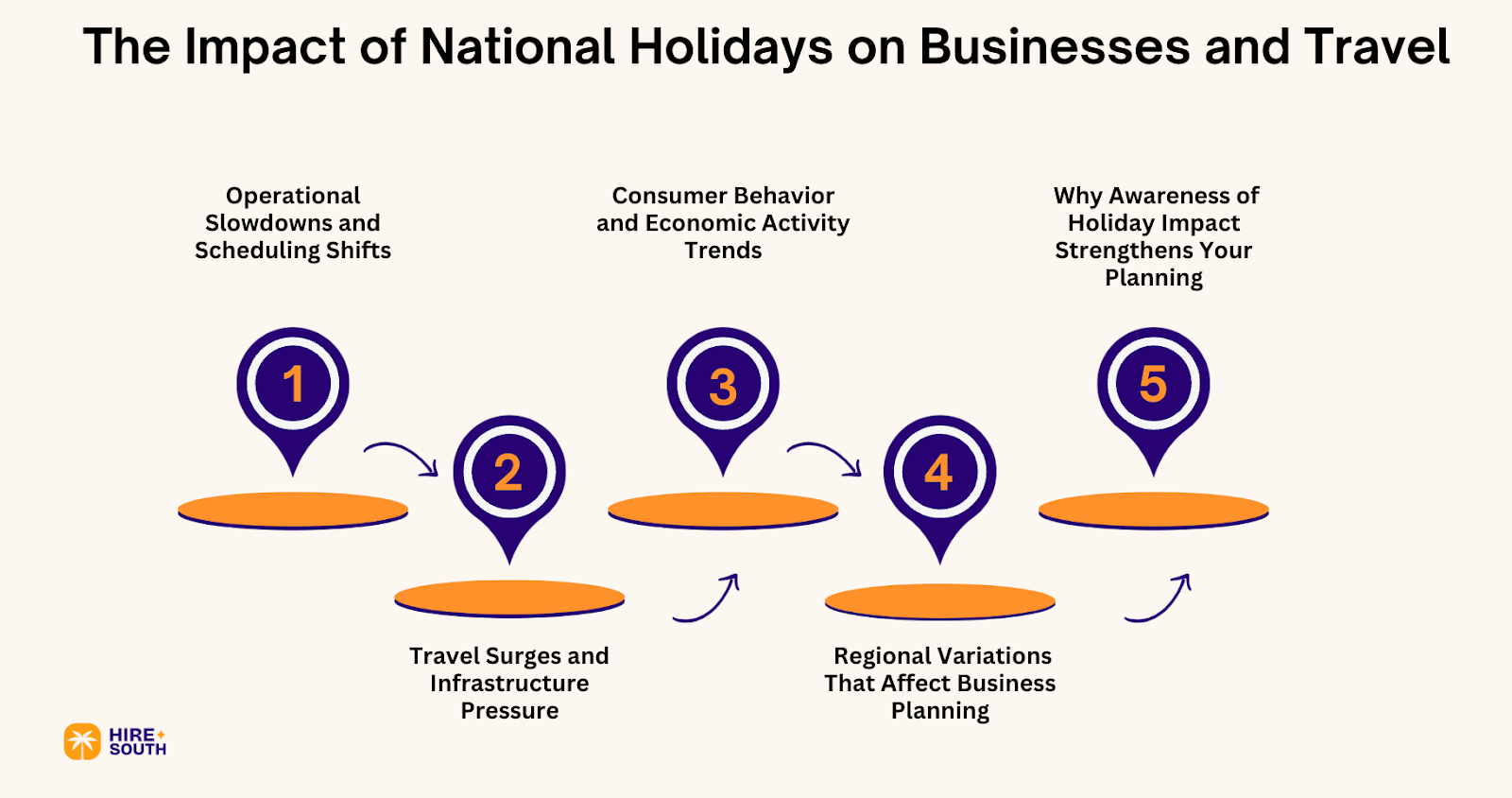
1. Operational Slowdowns and Scheduling Shifts
National holidays in Peru consistently influence how organizations plan their workflows. Public institutions close fully on these dates, and private-sector companies often reduce hours or reorganize shifts to maintain essential operations. These adjustments can slow response times, delay administrative processes, and push project timelines forward by several days. Payroll teams must also account for holiday pay rules established by the Ministry of Labor, which classify national holidays as fully paid days when observed.
For businesses with distributed teams or cross-border clients, aligning meeting schedules around Peru’s holiday calendar is key. A single holiday can reduce workforce availability nationwide, especially during back-to-back observances like Independence Day on July 28 and 29. When these fall near weekends, productivity dips are even more noticeable.
2. Travel Surges and Infrastructure Pressure
Travel patterns change dramatically during Peru’s national holidays. Long weekends, especially those tied to Independence Day or the Feast of the Immaculate Conception, generate significant movement across regions. According to PROMPERÚ, domestic tourism during holiday periods contributed more than S/ 1.5 billion in revenue in 2023, showing how strongly Peruvians take advantage of these breaks.
These travel surges affect airports, highways, and interprovincial bus routes. Delays become common, and businesses that depend on logistics or in-person operations often need backup plans to avoid disruptions. Hotels and short-term rentals also operate at higher occupancy, which can affect corporate travel budgets and last-minute bookings.
3. Consumer Behavior and Economic Activity Trends
Certain sectors experience predictable spikes during national holidays. Retail, entertainment, and food services typically see increased demand, while B2B activity tends to slow. The Central Reserve Bank of Peru has noted that consumer spending rises noticeably during fiestas patrias and December holidays, driven by bonuses such as the legally required gratificación. These bonuses can equal a full month’s salary in July and December, boosting discretionary spending and altering market cycles.
For companies operating in Peru, understanding these spending patterns helps with forecasting. Promotional calendars, staffing models, and service availability all benefit from being aligned with predictable holiday-driven consumer behavior.
4. Regional Variations That Affect Business Planning
Although national holidays apply uniformly, the real-world impact can vary by region. Tourism-heavy cities like Cusco, Arequipa, and Trujillo feel stronger traffic spikes and higher demand for hospitality services. Coastal cities may also experience surges during summer-adjacent holidays due to beach travel. These differences matter if your teams operate across multiple regions, since service capacity and customer activity may shift unevenly.
Regional differences also appear in how long certain holidays are effectively observed. In many cities, Independence Day celebrations extend into multi-day cultural festivals, which can further influence business hours and staffing availability.
5. Why Awareness of Holiday Impact Strengthens Your Planning
Peru’s national holidays don’t just signal cultural observances, they shape the country’s operational rhythm. Workflows slow down, mobility increases, and consumer behavior changes in predictable ways. When your planning accounts for these patterns, you reduce operational friction, improve scheduling accuracy, and create a smoother experience for customers and teams across the country.
Ready to Start Nearshoring in Peru?
Peru’s holiday calendar shapes how the country moves, works, and plans throughout the year, and understanding these patterns helps you stay aligned with local expectations. When you use accurate, up-to-date holiday information, you protect operations from avoidable slowdowns and stay ahead of staffing or scheduling challenges.
At Hire South, we work directly with Latin American talent and teams every day, so we build our processes around the region’s operational rhythms, public-sector schedules, and regional patterns. This approach helps companies maintain continuity even during peak holiday seasons. By combining reliable workforce data, clear labor-law compliance, and localized expertise, we make it easier for you to build and manage remote teams in Peru with confidence. Contact us for a free discovery call!


.jpg)