
.jpg)

Chile has one of the most structured holiday calendars in Latin America, and it directly affects how you plan operations, payroll, and team availability. According to the OECD, Chile observes around 16 public holidays per year, placing it above the OECD average and making holiday planning a real operational variable for employers.
This guide gives you a complete, up-to-date view of all holidays in Chile, from national public holidays to regional and local observances. You’ll see how holidays are classified, which ones are mandatory non-working days, and how religious, civic, and regional dates fit into the broader calendar.
If you manage teams, hire talent, or run business activities in Chile, this list helps you plan with fewer surprises and better accuracy. Keep reading to learn more!
First Things First: How Chile’s Holiday Calendar Is Updated Each Year
Legal Authority Behind Chile’s Holiday Calendar.
Chile’s holiday calendar is defined by national law, not by custom or administrative guidance. Public holidays are established through legislation passed by Congress and enacted by the executive branch. Once approved, changes become legally binding for employers, workers, and public institutions.
The Biblioteca del Congreso Nacional de Chile (BCN) is the official reference point where all holiday-related laws are consolidated and updated. This makes the system relatively transparent and easy to verify compared to other countries in the region.
Role of the Diario Oficial in Annual Updates.
Every official change to Chile’s holidays is published in the Diario Oficial, the government’s legal bulletin. This publication is what gives a holiday legal effect. If a holiday is not published there, it does not exist from a legal standpoint.
Most updates are confirmed in the final quarter of the year, typically between October and December. This timing allows employers to finalize workforce planning and payroll calendars before the new year begins.
How New Holidays Are Added or Modified.
New holidays are not added frequently, but when they are, it usually happens through specific legislation tied to historical events, civic milestones, or one-time national circumstances.
Chile has introduced several holidays over the past two decades through this process. For example, Navy Day on May 21 and Indigenous Peoples’ Day, first observed nationally in 2021, were both formalized through legislative acts rather than executive decrees.
Fixed vs Variable Holiday Dates.
Most Chilean holidays fall on fixed calendar dates, such as September 18 for Independence Day. Others change every year, mainly religious holidays like Good Friday and Easter Sunday, which follow the ecclesiastical calendar.
When variable holidays shift, the government does not issue special annual approvals. The dates are automatically recognized based on established calculation rules, which reduces ambiguity for employers and institutions.
Holiday Substitution Laws and Annual Adjustments.
Chile has specific “holiday transfer” rules that can move certain holidays to a Monday to create long weekends. These adjustments are regulated by law and do not apply to all holidays.
When substitution applies, the adjusted date is confirmed officially and reflected in government calendars. This is particularly relevant for business planning, since transferred holidays remain mandatory non-working days under Chilean labor law.
Where You Should Verify the Official Calendar.
For the most accurate and current information, you should rely on primary sources rather than secondary calendars. The most authoritative references are the Diario Oficial, the Biblioteca del Congreso Nacional, and publications from Chile’s government.
These sources ensure you are working with legally valid dates, which is critical for compliance, payroll accuracy, and operational planning.
All National Public Holidays in Chile
What Counts as a National Public Holiday:
National public holidays in Chile are legally mandated non-working days that apply across the entire country. They are established by law and enforced under the Chilean Labor Code, which means you must account for them in workforce planning, payroll, and operational schedules.
Fixed Date National Public Holidays:
These holidays occur on the same calendar date every year and are observed nationwide.
- January 1 – New Year’s Day
- May 1 – Labor Day
- May 21 – Navy Day
- July 16 – Our Lady of Mount Carmel
- August 15 – Assumption of Mary
- September 18 – Independence Day
- September 19 – Army Day
- October 31 – Evangelical and Protestant Churches Day
- November 1 – All Saints’ Day
- December 8 – Immaculate Conception
- December 25 – Christmas Day
These dates are consistent year to year and do not require annual confirmation unless modified by law.
Variable Date National Public Holidays:
Some Chilean holidays change dates each year based on religious calendars or statutory adjustment rules.
- Good Friday – date varies, based on Easter
- Holy Saturday – date varies, observed the day after Good Friday
- Saint Peter and Saint Paul – often moved to a Monday
- Indigenous Peoples’ Day – observed near the June solstice, typically on a Monday
- Columbus Day (Encounter of Two Worlds) – frequently transferred to a Monday
These holidays remain mandatory non-working days even when moved, which is especially relevant for weekly scheduling and time tracking.
Transferable Holidays and Long Weekends:
Chile allows certain holidays to be shifted to Mondays to promote long weekends. This practice is regulated by law and does not apply to all public holidays.
When a holiday is transferred, the new date replaces the original one for legal and labor purposes. Employers are required to treat the substituted date as the official non-working day.
Mandatory vs Non-Substitutable Holidays:
Not all holidays can be moved. Key civic dates, such as September 18 and September 19, are non-transferable and must be observed on their actual calendar dates regardless of the day of the week.
This distinction matters because substitution rules affect payroll calculations, overtime eligibility, and staffing expectations.
Where Official Holiday Lists Are Verified:
For legal certainty, national public holidays are officially published and consolidated by the Diario Oficial and the Biblioteca del Congreso Nacional. These sources are considered authoritative and are commonly referenced by payroll providers, HR teams, and legal advisors.
Relying on these primary sources helps you avoid errors that often appear in unofficial or outdated holiday calendars.
The Religious Holidays Observed Across Chile
Why Religious Holidays Matter in Chile.
Religious holidays are a formal part of Chile’s national holiday system, not informal observances. They are established by law and apply nationwide, regardless of sector or region.
This structure reflects Chile’s religious landscape. According to the Instituto Nacional de Estadísticas (INE), approximately 54 percent of Chile’s population identifies as Catholic, while around 16 percent identifies as Evangelical or Protestant. These demographics directly influence which religious dates are recognized as public holidays.
Catholic Religious Holidays Recognized Nationwide.
Catholic observances make up the majority of Chile’s religious public holidays. All of the following are legally mandated non-working days across the country.
- Good Friday
- Holy Saturday
- Assumption of Mary on August 15
- Our Lady of Mount Carmel on July 16
- All Saints’ Day on November 1
- Immaculate Conception on December 8
- Christmas Day on December 25
These holidays are defined in national legislation and enforced under Chilean labor law.
Easter Week and Variable Religious Dates.
Good Friday and Holy Saturday are variable-date holidays tied to the Easter calendar. Their dates change every year, but are automatically recognized without requiring new legal approval.
Easter-related holidays consistently create extended breaks in March or April. This period is one of the most predictable seasonal slowdowns in Chile’s annual work calendar.
Evangelical and Protestant Churches Day.
Chile formally recognizes Evangelical and Protestant Churches Day on October 31, a unique feature in Latin America. This holiday acknowledges the growing presence of Protestant communities in the country.
The date is fixed and does not move, even when it falls midweek. It is treated as a full national public holiday with the same legal weight as Catholic observances.
Religious Holidays That Cannot Be Transferred.
Not all religious holidays are subject to substitution laws. Dates such as Good Friday, Christmas Day, and Immaculate Conception must be observed on their exact calendar dates.
This has direct implications for scheduling, especially when these holidays fall on weekends or split the workweek.
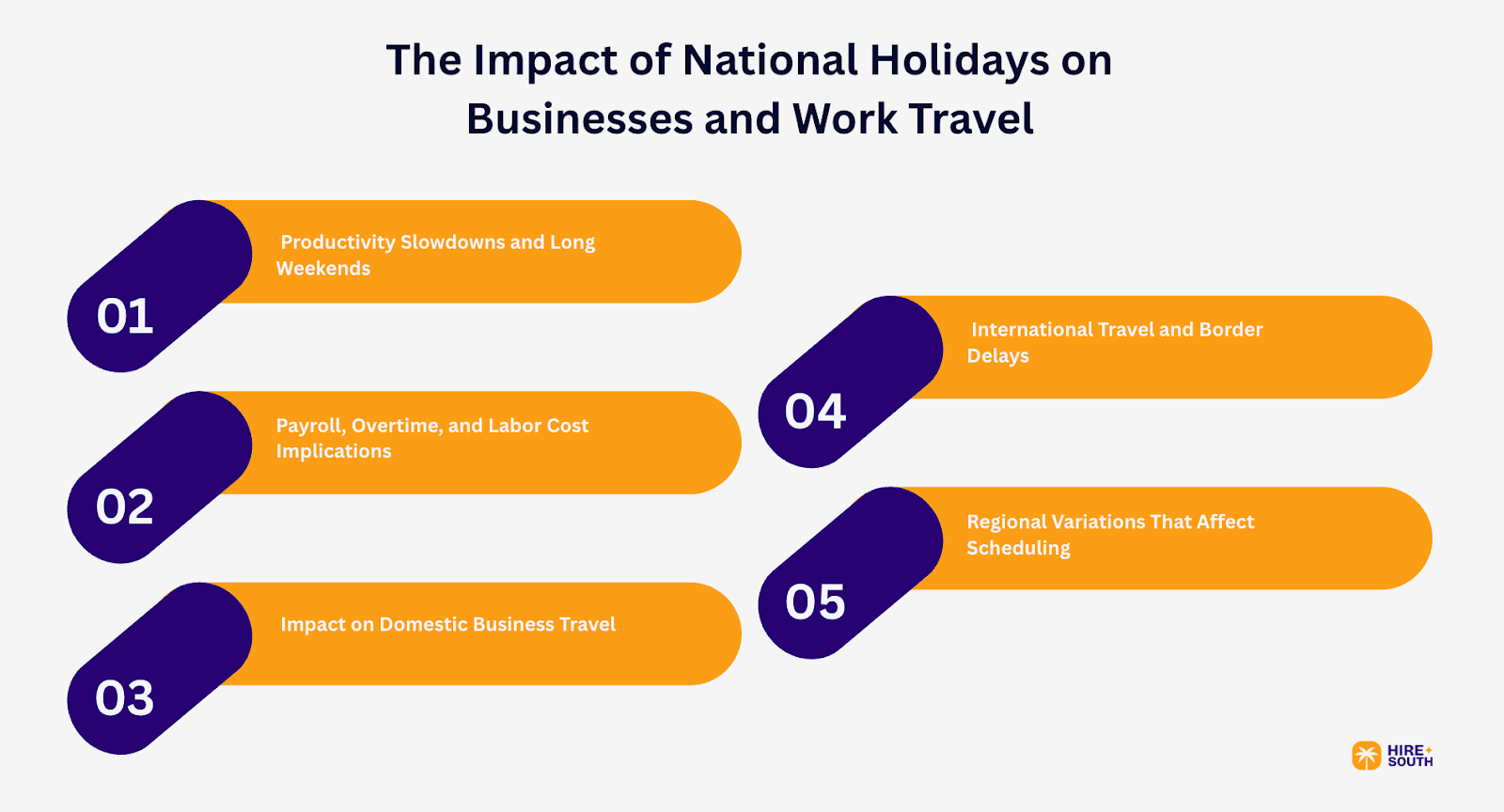
The Impact of National Holidays on Businesses and Work Travel
National public holidays in Chile are mandatory non-working days for most sectors. This means offices, government institutions, and many service providers either close completely or operate with reduced staff.
According to the OECD, Chile observes an average of 16 public holidays per year, which is higher than countries like the United States and Canada. For businesses, this translates into regular pauses in operations that must be reflected in delivery timelines, client expectations, and internal planning.
1. Productivity Slowdowns and Long Weekends
Holidays that fall on Mondays or Fridays often create long weekends, locally known as “fines de semana largos.” These periods tend to reduce overall business activity even beyond the official holiday itself.
Data from Banco Central de Chile has shown that short-term economic activity often dips around extended holiday periods, particularly in September during Fiestas Patrias. For planning purposes, you should expect slower response times and lower availability during these windows.
2. Payroll, Overtime, and Labor Cost Implications
Under Chilean labor law, employees required to work on national holidays are generally entitled to premium compensation or compensatory rest, depending on the sector.
The Dirección del Trabajo confirms that failure to comply with holiday pay rules can result in fines, especially in industries such as retail, logistics, and hospitality. This makes accurate holiday tracking essential for payroll accuracy and cost control.
3. Impact on Domestic Business Travel
National holidays significantly affect domestic travel availability. According to SERNATUR, domestic travel increases sharply during long weekends, leading to higher airfares and limited hotel availability in major cities and tourist regions.
For business travel, this often means higher costs, fewer flight options, and increased risk of delays. Scheduling meetings or site visits around national holidays can reduce disruption and expenses.
4. International Travel and Border Delays
Public holidays also impact international travel. Border crossings, customs offices, and immigration services often operate with reduced staffing on national holidays.
Data from Chile’s Ministry of the Interior shows that outbound and inbound travel spikes around major holidays like Independence Day and Easter. If travel is unavoidable, buffer time becomes critical for itineraries involving border controls.
5. Regional Variations That Affect Scheduling
While national holidays apply across Chile, their operational impact can vary by region. Tourist-heavy regions often experience more pronounced slowdowns, while industrial zones may maintain partial operations.
Understanding these regional dynamics helps you anticipate where delays are most likely and plan meetings, deliveries, and travel with greater precision.
Ready to Start Nearshoring in Chile?
Chile’s holiday calendar is set by law, updated annually through official government channels, and enforced nationwide, which means even small planning errors can lead to compliance issues, payroll mistakes, or avoidable downtime. Understanding how national, religious, and regional holidays interact is not optional for companies operating in or with Chile.
At Hire South, we work daily with businesses that need clarity around local labor rules, working calendars, and availability when building or managing teams in Chile and the rest of the Latin American region. Our experience supporting distributed teams across Latin America allows us to help you plan accurately, stay compliant, and operate with fewer surprises, even around complex holiday periods. Contact us to schedule a FREE consultation and learn about the changes around the LATAM landscape!