


Latin America has quickly become one of the most competitive regions for remote talent, especially for US companies looking to scale fast without sacrificing quality. And the shift isn’t slowing down. According to McKinsey, 58 percent of Americans now have the option to work remotely at least part of the week, a trend that’s pushed US employers to look beyond their borders for reliable, skilled professionals.
In this article, you’ll get a clear look at the best remote jobs in LATAM, the roles US companies hire for most, and why the region consistently ranks as a top destination for distributed teams. You’ll see which positions are growing fastest, where to find remote-ready talent, and what makes LATAM professionals stand out in a global market.
If you’re exploring talent options in the region, evaluating remote hiring strategies, or simply staying ahead of workforce trends, this guide provides a comprehensive overview without unnecessary details.
Why US Companies Recruit Heavily From LATAM
US companies turn to Latin America because the region addresses several hiring challenges simultaneously. You get real-time collaboration, strong technical talent, and predictable labor costs without the friction that comes with hiring across distant time zones. For many teams, that combination is hard to beat.
Time Zone Alignment Supports Real-Time Workflows:
LATAM’s geographic proximity is one of the biggest drivers behind US hiring demand. You can run daily standups, client calls, and cross-functional projects without forcing teams into early-morning or late-night schedules. Countries like Mexico, Colombia, Argentina, and Brazil sit within one to three hours of US time zones, giving you overlap that distributed teams in Asia or Eastern Europe rarely offer.
This alignment also reduces communication delays. According to Gartner, organizations with high real-time collaboration see up to 25 percent faster project cycle times, largely because teams can troubleshoot issues as they happen.
Deep Talent Pools in High-Demand Fields:
Latin America has invested heavily in technical and professional education, and it shows. LinkedIn’s data reveals a double-digit annual increase in software engineering and digital skills across major LATAM markets. Many countries graduate thousands of engineers, analysts, and designers each year, giving you access to specialized talent without long hiring cycles.
Beyond tech roles, remote-ready professionals in operations, finance, design, and customer support continue to grow. This diversity lets US companies fill multiple gaps across their org chart, not just engineering.
Cost Efficiency Without Sacrificing Skills:
Hiring from LATAM helps teams maintain quality while managing budget constraints. Salary expectations in the region are often 30 to 50 percent lower than US averages, depending on the role and seniority level. The savings add up, especially for companies scaling large remote teams or expanding product lines.
Lower costs don’t imply lower capability. Many LATAM professionals come with multilingual backgrounds, international certifications, and experience working with US-based teams. The combination creates a strong value-to-skill ratio that appeals to growth-stage and enterprise teams alike.
Cultural Compatibility and Strong English Proficiency:
Cultural alignment is another reason US companies recruit heavily from LATAM. Work styles in the region tend to be collaborative, service-driven, and responsive, traits that fit well with US corporate expectations.
English proficiency is also on the rise. According to the EF English Proficiency Index, Argentina, Costa Rica, and Chile rank among the highest in Latin America, and several other markets continue to improve year over year. This makes onboarding smoother and reduces the risk of miscommunication across time zones.
Reduced Compliance Friction Compared to Other Regions:
Many LATAM countries have simplified contractor and remote-friendly regulations, making it easier for US companies to hire legally and operate confidently. You avoid the complex entity setups or multilayered compliance steps common in Europe or Asia.
The result is faster onboarding and fewer administrative barriers, which matters when you need to fill roles quickly or ramp up project capacity.
How LATAM Professionals Can Stand Out to US Employers
US employers look for more than technical skills when hiring remotely from Latin America. They want professionals who communicate clearly, work independently, and understand how US teams operate. When you focus on these areas, you increase your chances of landing high-quality remote roles and progressing faster once hired.
Showcase Remote-Friendly Communication Skills.
Effective communication remains one of the biggest differentiators in remote hiring. US employers value clear written updates, structured thinking, and proactive follow-through. A study by Grammarly Business found that teams with strong communication practices see a 20 percent increase in productivity due to fewer misunderstandings and less rework.
Highlight your communication approach in your resume and portfolio. Use concise bullet points, include measurable outcomes, and show how you collaborate in distributed environments. Demonstrating clarity helps employers trust your ability to operate without constant supervision.
Build a Strong Digital Presence.
A polished online presence can set you apart quickly. US hiring managers often review LinkedIn profiles before scheduling interviews, and LinkedIn reports that candidates with complete profiles are 40 times more likely to receive opportunities through the platform.
Make sure your profile shows recent work, relevant skills, and achievements with real business impact. Add a summary that reflects your expertise and the type of work you’re targeting. Samples, case studies, or links to completed projects help employers evaluate your skill level without guesswork.
Strengthen English Fluency for Professional Contexts.
Even moderate improvements in English proficiency can make a meaningful difference. EF’s English Proficiency Index shows consistent year-over-year growth across Latin America, but competition remains high for US-facing roles.
You don’t need perfect fluency, but you do need consistent clarity. Practice industry-specific vocabulary, prepare short explanations of your past projects, and get comfortable answering behavioral questions. Stronger fluency reduces friction in daily interactions and improves your interview performance.
Highlight Experience Working With US Teams.
If you’ve worked with US clients or teams before, make that experience clear and specific. Mention the scope of work, time zone coordination, tools used, and measurable outcomes. These details prove you can adapt to expectations around speed, transparency, and direct communication.
If you haven’t had US exposure yet, emphasize any international collaboration or cross-cultural teamwork. Employers want to see that you function well in multicultural environments and that you’re comfortable adapting to different communication styles.
Use Certifications to Validate Skills.
Certifications help employers verify your knowledge quickly, especially in competitive fields. The demand for credentialed talent continues to grow. For example, CompTIA reports steady year-over-year increases in certifications for cloud, security, and analytics, areas where many US companies hire heavily.
Choose certifications that align with your role. For engineering, cloud, and DevOps certifications stand out. For business or operations roles, project management credentials can boost your profile. For design and content roles, platform- or tool-specific training signals readiness for real-world workflows.
Demonstrate Reliable Remote Work Practices.
US employers expect reliability, not micromanagement. Simple habits make a significant difference. Meeting deadlines consistently, using project management tools properly, and flagging blockers early all build trust.
You can highlight these habits in your portfolio or resume by referencing workflow tools, documenting processes you follow, or sharing examples of remote problem-solving. This helps employers picture you fitting seamlessly into an existing distributed team.
The Best Remote Jobs in Latin America for US Companies
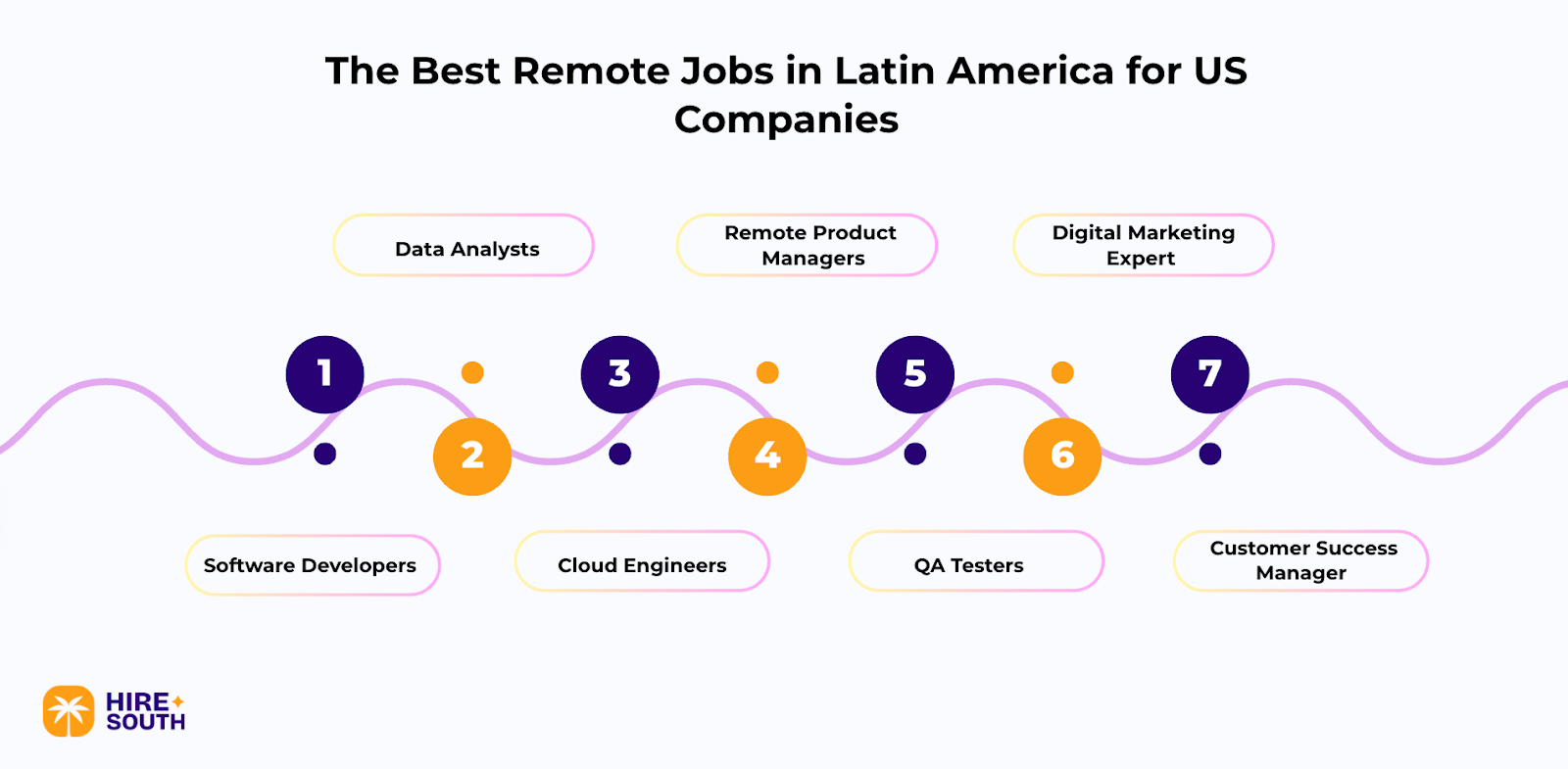
US companies consistently hire for roles that blend technical expertise, analytical skill, and operational reliability. These positions stand out because they support fast-moving teams, align well with LATAM’s talent strengths, and integrate smoothly into distributed workflows.
1. Software Developers and Full-Stack Engineers Remain in High Demand
Engineering roles top the list across the region. You’ll find heavy demand for full-stack, backend, and mobile developers, especially in JavaScript, Python, Java, and React ecosystems. The World Bank reports steady growth in STEM graduates across major LATAM countries, a trend that keeps talent pipelines strong and competitive.
US companies value LATAM developers for their problem-solving ability and familiarity with modern frameworks. Remote engineering teams benefit from time zone overlap, which supports real-time code reviews, sprint planning, and rapid production fixes.
2. Data Analysts and Data Engineers Supporting Data-Driven Teams
Data roles have expanded sharply as US companies scale analytics programs. LinkedIn’s Workforce Report highlights a multi-year rise in demand for analytics, data engineering, and machine learning skills across the Americas.
Data analysts, BI specialists, and engineers stand out because they help teams make decisions quickly and interpret large datasets with accuracy. Familiarity with SQL, Python, cloud warehouses, and visualization tools (like Power BI or Tableau) makes candidates more competitive for US-facing roles.
3. DevOps and Cloud Engineers Driving System Reliability
Cloud adoption continues to grow, and that increase fuels heavy demand for DevOps roles. AWS, Azure, and Google Cloud expertise consistently rank among the most requested skill sets. According to Gartner, global cloud spending increased more than 20 percent year over year, and companies need specialists who can support automation, CI/CD pipelines, and infrastructure scalability.
DevOps engineers from LATAM are often experienced in distributed team environments, which helps maintain uptime, monitor production systems, and troubleshoot issues without timezone delays.
4. Remote Product Managers and Product Owners Supporting Agile Delivery
Product roles remain valuable because they bridge communication between engineering, business, and customer-facing teams. Professionals who understand agile workflows, user research, and roadmapping can help US companies launch features faster and reduce friction between departments.
US employers often look for PMs with strong English communication skills and a clear track record of delivering outcomes rather than just managing tasks. Familiarity with metrics, product discovery, and prioritization frameworks strengthens a candidate’s profile significantly.
5. QA Testers and Automation Engineers Enhancing Software Quality
Quality assurance roles offer consistent opportunities throughout LATAM. Manual testers, QA analysts, and automation engineers help US companies release stable products and reduce regression issues.
Automation testing continues to rise as a core need. Tools like Selenium, Cypress, and Playwright show up frequently in US job descriptions. Automation specialists who understand CI/CD workflows and write maintainable test scripts tend to stand out in hiring pipelines.
6. Creative and Digital Marketing Roles With Remote Flexibility
Marketing and creative roles remain strong options because they translate well into asynchronous work. Digital marketers, PPC specialists, SEO analysts, and content strategists help US teams manage campaigns across different time zones.
The demand is supported by global marketing spend, which increased 10.4 percent in 2023, according to The CMO Survey. LATAM professionals often bring multilingual capabilities and regional market insight, which helps US brands expand into global audiences.
7. Customer Success and Account Management Roles for Service-Oriented Teams
US companies growing their customer experience functions frequently hire remote LATAM talent. Customer success managers, onboarding specialists, and account coordinators support retention and build long-term client relationships.
These roles require strong communication skills and a proactive, customer-first mindset. Many employers also seek candidates familiar with CRMs and SaaS workflows, which streamlines onboarding and internal coordination.
Conclusion
Remote work in Latin America keeps accelerating as US companies look for reliable talent, predictable collaboration, and skills that match fast-moving teams. The region’s growth isn’t slowing down either. World Bank data shows steady expansion in digital talent pipelines across multiple LATAM markets, which means stronger opportunities and more specialized roles year after year.
At Hire South, we help companies tap into this momentum by connecting them with vetted LATAM professionals who are ready for US-based remote roles. Our team evaluates technical ability, English proficiency, and remote-work readiness so you can scale confidently and reduce hiring friction. If you’re building a distributed team and want access to high-performing talent across the region, we make that process simpler, faster, and more predictable. Contact us to help you hire your next talent now!